Smart Money Hoards $40 Billion in Cash, Retail Bets $2.6 Trillion on Calls: The Critical Moment of the US Stock Market's AI Narrative

marsbitPublicado a 2026-05-09Actualizado a 2026-05-09

Resumen

Title: Smart Money Hoards $40 Billion in Cash, Retail Traders Bet $2.6 Trillion on Call Options: The Tipping Point for the AI Narrative in U.S. Stocks The U.S. stock market is experiencing a striking divergence. While the S&P 500 hits new highs, the financial sector is down 6% year-to-date, underperforming more than during the 2008 and COVID crises. In contrast, a record $2.6 trillion in S&P 500 call options traded in a single day, and the Philadelphia Semiconductor Index RSI is at its highest since 1999. This reflects a clear split: "smart money" is retreating while retail traders chase gains. Key data points highlight this critical juncture in the AI-driven rally: 1. SoftBank had to cut its $10 billion loan target against its OpenAI stake to $6 billion, as lenders questioned the valuation of the private AI giant, signaling primary market skepticism. 2. The explosive $2.6 trillion daily options volume, with 60% being calls, is described by a Goldman Sachs partner as a "semi-irrational chase," drawing parallels to the 1999 tech bubble. 3. The financial sector's severe underperformance relative to the S&P 500 is a classic technical warning signal, indicating potential underlying economic stress. 4. Apollo Global Management, despite strong earnings, is building a $40 billion cash buffer in its insurance business, preparing for what its CEO calls a 30-35% probability of an exogenous shock from geopolitics, inflation, and AI's economic disruption. 5. Consumer behavior mirr...

Author: Deep Tide TechFlow

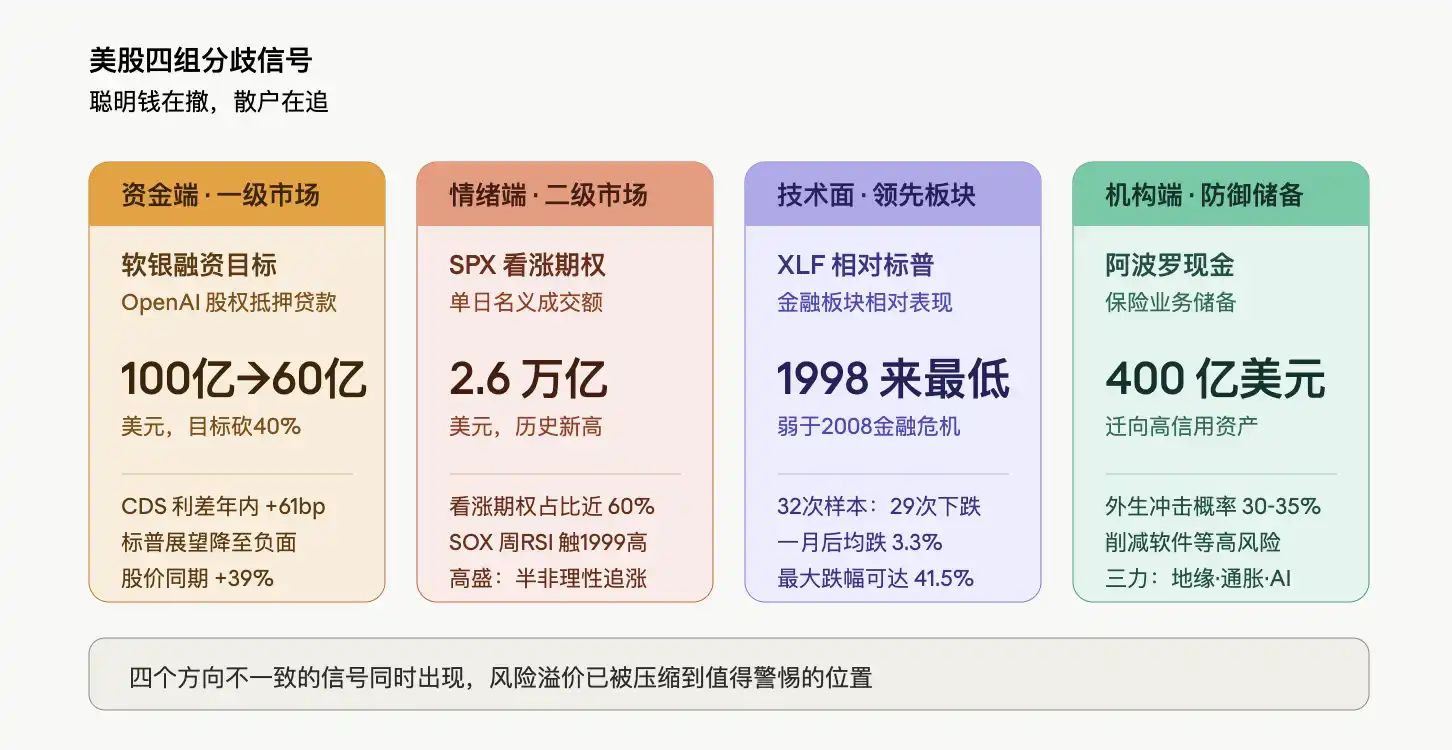
The US stock market is staging an exceptionally unusual divergence: while the S&P 500 repeatedly hits new highs, the financial sector has fallen 6% year-to-date, underperforming the broader market more severely than during the 2008 financial crisis and the Covid shock; meanwhile, the single-day notional trading volume of S&P 500 call options has exceeded $2.6 trillion, a record high, and the RSI for the Philadelphia Semiconductor Index has risen to its highest level since 1999. In the primary market, SoftBank's financing plan, using OpenAI equity as collateral, was forced to cut its target size from $100 billion to $60 billion; on the institutional side, Apollo has hoarded roughly $40 billion in cash within its insurance business. Smart money is pulling back, retail is piling in.

The narrative around AI computing power scarcity continues to drive the accelerated rise of the US tech sector, but the capital flow, sentiment, technicals, and institutional behavior are sending conflicting signals. This divergence itself is more worthy of scrutiny than any single data point.
Lenders Skeptical of OpenAI Valuation, SoftBank Cuts Financing Target by 40%

According to Bloomberg citing sources familiar with the matter, SoftBank has reduced the target size of its margin loan, collateralized by OpenAI equity, from $100 billion to a minimum of $60 billion, a 40% cut. The core resistance lies in valuation, with some investors being courted to participate harboring doubts about how to reasonably value this non-public company, OpenAI. Potential lenders involved in the discussions include private credit institutions, financial institutions, and hedge funds, with related negotiations starting as early as mid-March.

OpenAI's own fundamentals are also under pressure. The company failed to meet its monthly sales targets multiple times in early 2026, with rival Anthropic steadily eroding its share in programming and enterprise markets, and the internal goal of reaching 1 billion weekly active users for ChatGPT by the end of last year was also missed. OpenAI CFO Sarah Friar refuted this, stating the company is meeting its goals and seeing product demand "rise vertically."

SoftBank's own financial leverage is also at historically high levels. The group recently committed an additional $30 billion to OpenAI, having already invested over $30 billion cumulatively; the $40 billion loan completed this March set a record for its US dollar loan size, with part of the funds used to support the latest follow-on investment in OpenAI.

Capital market judgment on SoftBank has shown significant divergence. SoftBank's stock has risen 39% year-to-date, significantly outperforming the 12.3% gain of Japan's benchmark Topix index; however, its credit default swap spreads have widened by about 61 basis points this year. In March, S&P Global Ratings downgraded SoftBank's credit outlook from "stable" to "negative," citing that the investment in OpenAI could harm the company's liquidity and asset credit quality.

The pricing divergence for top AI assets in the primary market is manifesting in the most direct way: lenders are willing to lend 40% less than SoftBank wants to borrow.

Options Market Hits $2.6 Trillion in a Single Day, Goldman Sachs Partner Calls It "Semi-Irrational"

The secondary market presents another picture. On Thursday, the notional trading volume of S&P 500 index (SPX) call options broke through $2.6 trillion, setting a historical record, with nearly 60% of all SPX options that day being calls. Rich Privorotsky, head of Goldman Sachs's One-Delta trading desk, characterized the current US stock market as being in a "spot-up, vol-up chase mode."

The weekly RSI for the Philadelphia Semiconductor Index (SOX) has risen to its highest level since 1999. A Goldman Sachs partner stated bluntly: "It feels like we are in a semi-irrational chase mode." Privorotsky cited 1999 as a more fitting historical analogy, when numerous telecom equipment suppliers had overflowing order books, providing the "physical bottleneck narrative" supporting that rally, highly similar to the current logic around computing power scarcity and AI infrastructure deployment.

QQQ implied volatility has spiked sharply with the rally, with its spread over SPX volatility widening to over 6 volatility points. Goldman's volatility trading desk described this day as "one of the craziest trading days in the past few weeks." Notably, the number of S&P 500 constituent stocks experiencing single-day moves exceeding 3 standard deviations reached 35, the highest level since February 3rd this year.

Bank of America's global equity derivatives research team also pointed out that the S&P 500's latest record-breaking rally is reminiscent of the late 1920s and the 1990s internet bubble, but market pricing for "tail options" remains below the level implied by realized volatility. In layman's terms, the market is chasing the rally but unwilling to pay for downside risk.

Goldman Sachs warned that the dynamics of "spot-up, vol-up" have limited the room for systematic strategies to add further positions; Commodity Trading Advisors (CTAs) are already essentially back to full long positions, and as realized volatility in the upward direction rises, the marginal incremental demand from volatility control strategies is also waning. In other words, programmatic buying from the institutional side is nearing its limit, with subsequent upward momentum relying more on retail and sentiment-driven funds.

XLF Hits Weakest Relative to S&P 500 Since 1998, Financial Stocks Sound Alarm

If the options market is an extreme reading of sentiment, then the relative performance of the financial sector is a warning signal from the technical front.

The US financial sector has fallen about 6% year-to-date, while the S&P 500 index has risen 7% over the same period and closed at a record high 14 times in the past 17 trading days.

Related data was analyzed in The Crack Beneath the S&P's New High: Financial Sector Down 6% Year-to-Date, $2 Trillion Private Credit Undercurrent Spreading.

The financial sector is seen as a leading indicator due to its core role as a provider of economic liquidity. Concerns in the private credit market are believed to be a major reason for the pressure on the financial sector. Melissa Brown, Global Head of Investment Decision Research at SimCorp, noted that the financial system is highly interconnected, and related risks "have the potential to spread more widely than currently anticipated." He suggested investors might consider gradually "trimming chip stocks" rather than continuing to chase the rally, and certainly not injecting new funds into the market.

Apollo Hoards $40 Billion in Cash, Rowan Estimates 35% Probability of Exogenous Shock

Defensive moves have begun on the institutional side. Marc Rowan, CEO of Apollo Global Management, stated while announcing quarterly results that he estimates the probability of an exogenous shock occurring at 30% to 35%, far above the usual level.

Rowan attributed this risk to the convergence of three forces: a full-scale reset in geopolitics, inflationary pressures driven by trade tariffs and immigration policies, and the profound reshaping of the economic structure by AI. He characterized the current AI wave as "without question the biggest tech cycle" of his career and specifically highlighted the fragility of government finances—compared to corporations and consumers, government balance sheets are already under pressure.

Apollo has taken a series of defensive measures: shifting its fixed-income portfolio towards higher credit quality, reducing exposure to high-risk sectors like software, and hoarding about $40 billion in cash within its insurance business. "This means we are investing with an eye to protecting capital, making sure we can go through the cycle, and if there is an adjustment, we frankly expect it to happen."

Rowan saved his sharpest criticism for industry rivals. He warned that not all insurance companies are running their businesses as they should, with some relying on what he called "outrageous" practices, including Cayman Islands offshore structures, complex mortgage arrangements, and aggressive credit assumptions, making some balance sheets appear stronger than they actually are. "We are concerned about contagion," he said.

It's worth noting that Apollo's performance this quarter was stellar, with assets under management surpassing $1 trillion and fee-related earnings hitting a record high. Choosing its most significant defense at the peak of its own operational performance is, in itself, a judgment.

Consumer End's Tale of Two Cities, Confirming Macro Divergence

Consumer data provides micro-level evidence for the above macro judgment. Whirlpool (WHR) plunged 16% after hours on Thursday, with management describing the current environment as a "sharp deterioration in macroeconomic conditions" and announcing "decisive actions" like price increases and accelerated cost-cutting to restore profitability. The chill in the housing and major appliance sectors forms a stark contrast with the heat in the semiconductor sector.

In contrast, DoorDash stated the second quarter is "off to a good start," demand "remains quite strong," and its stock rose about 10%.

This divergence reflects the underlying logic of current consumer behavior: large expenditures (like renovation, appliances) feel like a recession, while small, immediate consumption (like food delivery) remains almost unaffected. Consumers haven't disappeared; they've just become highly selective, aligning perfectly with the corporate conclusion: AI infrastructure investment is accelerating, while traditional durable goods consumption is contracting.

Place these four sets of signals on the same chart: lenders unwilling to pay $100 billion for OpenAI, the options market betting $2.6 trillion on a single-day rally, the financial sector at its weakest relative level since 1998, and Apollo hoarding $40 billion in cash. This does not constitute a judgment of "imminent crash." Scott Brown himself also emphasized that similar warning signals sometimes persist for a long time before being digested by the market, or may not even materialize. But when the primary market, secondary market, leading sector, and top institutions simultaneously give conflicting readings, it at least means that the risk premium corresponding to current price levels has been compressed to a level worth vigilance.


Preguntas relacionadas

QWhat is the core reason for the 40% reduction in SoftBank's margin loan target, secured by OpenAI equity?

AThe core reason is valuation concerns. Some potential lenders are skeptical about how to determine a reasonable valuation for OpenAI as a private company, leading to reduced willingness to fund the full $100 billion target.

QAccording to the Goldman Sachs partner, what historical period does the current market rally closely resemble, and why?

AThe Goldman Sachs partner compares the current market to the 1999 period. The parallel is drawn because both eras are fueled by a narrative of physical bottlenecks — telecom equipment capacity back then and AI compute/scarcity today — providing a tangible, 'real' story to support the frenzy.

QWhat is the significance of the underperformance of the US financial sector (XLF) relative to the S&P 500, as highlighted in the article?

AThe financial sector's significant underperformance (down 6% vs. S&P 500 up 7%) is a leading indicator and a technical warning signal. As the primary provider of economic liquidity, its weakness, partly due to concerns in the private credit market, suggests underlying stress that contradicts the broader market's record highs.

QWhat defensive action has Apollo Global Management taken in its insurance business, and what probability does its CEO assign to an exogenous shock?

AApollo has accumulated approximately $40 billion in cash reserves within its insurance business as a defensive measure. CEO Marc Rowan estimates the probability of an exogenous shock occurring at 30-35%, which is significantly higher than the typical level.

QHow does the divergence in consumer spending between Whirlpool and DoorDash illustrate the current macroeconomic split?

AThe divergence shows that consumers are becoming highly selective. Large-ticket, durable goods spending (like Whirlpool appliances) is feeling recessionary pressures, while smaller, immediate consumption (like DoorDash delivery) remains strong. This mirrors the business split where AI infrastructure investment booms while traditional capital goods spending contracts.

Lecturas Relacionadas

Kraken Changed Its Vote at the Last Minute, Solana's Inflation Policy Narrowsly Passes by 0.33 Percent

Kraken’s last-minute vote reversal secured the passage of SGP-0002, a pivotal Solana governance proposal to accelerate the network’s annual inflation reduction from 15% to 30%. The final vote tally was 67.001%, narrowly exceeding the required 66.667% supermajority by just 0.334 percentage points. This change will bring Solana’s terminal inflation rate of 1.5% forward to around 2029, reducing future SOL issuance over six years by approximately 18.9 million tokens (about 2.6% of current supply). The vote, the first major test of Solana’s new on-chain governance system, saw intense drama. The Kraken 2 validator, controlling about 8.9 million staked SOL, switched from support to opposition hours before the deadline, pushing the "yes" vote below the passing threshold. A flurry of lobbying, including direct outreach by Helius CEO Mert Mumtaz, ensued. Kraken ultimately flipped back to supporting the proposal, and JitoSOL holders used the "staker override" mechanism to bypass opposing validators and vote directly with their stake. While SGP-0002 passed, a companion proposal (SGP-0003) to restructure transaction fees failed, indicating community willingness to adjust token supply but hesitance to change fee economics. The approved proposal now moves to a technical implementation phase, requiring client teams to code and activate the change. The event highlighted both the power of large validators and the resilience of Solana’s governance mechanisms, marking a significant, albeit messy, step in decentralized monetary policy management.

marsbitHace 1 min(s)

Kraken Changed Its Vote at the Last Minute, Solana's Inflation Policy Narrowsly Passes by 0.33 Percent

marsbitHace 1 min(s)

Trading Volume Surges 10 Times in a Month, Who's Driving UNI's Soaring Price?

The article discusses the recent surge in the price of UNI, the governance token of Uniswap, which reached a high above $5.4 on August 31, marking a three-month increase of over 100%. The resurgence is attributed primarily to two key developments. First, Uniswap was designated as the primary Automated Market Maker (AMM) on the newly launched Robinhood Chain. Data shows Uniswap generated $4.29 million in fees in 24 hours on this chain and facilitated a tenfold increase in stock token trading volume over a month, reaching approximately $130 million daily. Second, a fundamental change in UNI's tokenomics, approved in December 2025, activated a "fee switch" mechanism. A portion of protocol fees is now directed to a "TokenJar" contract. Arbitrage bots can destroy an equivalent value of UNI tokens to claim these fees, creating a perpetual buy-and-burn pressure. This mechanism has led to the burning of over 110 million UNI tokens (worth $630 million), with recent daily burns exceeding $400,000 in value, nearly half contributed by activity on Robinhood Chain. The symbiotic relationship is highlighted: Uniswap gains a substantial new source of on-chain revenue to fuel its token deflation, while Robinhood Chain leverages Uniswap's deep liquidity and decentralized infrastructure for its stock token offerings. This integration represents a deeper convergence of traditional and decentralized finance.

marsbitHace 15 min(s)

Trading Volume Surges 10 Times in a Month, Who's Driving UNI's Soaring Price?

marsbitHace 15 min(s)

Major Reshuffle in Foreign Trade Cities! Shenzhen Surpasses Shanghai, Suzhou Surpasses Beijing

A major reshuffle has occurred in China's foreign trade city rankings for the first seven months of 2026. Shenzhen has consolidated its position as the top city, significantly widening its lead over Shanghai. Notably, Shenzhen's import value surpassed Shanghai's for the first time historically. Suzhou overtook Beijing to become the third-ranked city, while Wuxi entered the top ten, replacing Qingdao which dropped out. Xi'an emerged as the biggest dark horse, with its foreign trade soaring by 100.4%. Nationally, import growth (22%) significantly outpaced export growth (14%), becoming the primary driver of overall trade expansion. This surge in imports, particularly of intermediate goods, signals a recovery in domestic demand and strengthens the foundation for future exports. Key cities leading the charge are those with strong foundations in semiconductors and AI hardware. Xi'an's explosive growth is powered by major memory chip manufacturers like Samsung and Micron. Suzhou's rise is driven by electronics and AI computing hardware exports. Shenzhen, Hefei, and Wuxi also benefited from their robust integrated circuit and electronics manufacturing industries. The overall trend shows manufacturing and export-oriented cities advancing rapidly in the rankings. However, 19 of the top 30 cities grew slower than the national average, indicating an uneven recovery.

marsbitHace 30 min(s)

Major Reshuffle in Foreign Trade Cities! Shenzhen Surpasses Shanghai, Suzhou Surpasses Beijing

marsbitHace 30 min(s)

Marvell: Can't Compare to NVIDIA, Can't Meet Expectations, Overvaluation Gets Squeezed First?

Marvell Technology (MRVL.O) reported its Q2 FY2027 earnings (ending July 2026) after market close on August 27. Key points include: The company raised its full-year revenue outlook for FY2027 to $12 billion (from $11.5B) and for FY2028 to $18 billion (from $16.5B). However, these upward revisions were only slightly above market expectations and significantly trailed NVIDIA's recent explosive guidance. The Data Center segment, accounting for 79% of revenue, grew 19% quarter-over-quarter to $2.17 billion, primarily driven by connectivity products. For FY2028, management forecasts over 60% growth for this segment, again below NVIDIA's >70% outlook. A major disappointment for investors was the lack of an upward revision to the Custom ASIC business guidance, despite Marvell's recent partnership agreement with Google. The market had anticipated potential gains from Google's TPU orders, but the maintained guidance for "over 100% growth" in FY2028 (with no specific target for FY2027) led to concerns that the Google deal may be a less favorable "framework agreement" where Marvell holds a weaker negotiating position. Adjusted gross margin was flat at 58.3%. Q3 revenue guidance is $3.15 billion, slightly above consensus. Overall, the report was largely in line with expectations, but the subsequent stock decline is attributed to growth forecasts that failed to meet heightened market expectations (particularly versus NVIDIA) and lingering uncertainty around the tangible benefits of the Google ASIC partnership. High valuation faces near-term pressure, but expectations for >50% growth in the coming years and long-term ASIC opportunity may provide support.

marsbitHace 1 hora(s)

Marvell: Can't Compare to NVIDIA, Can't Meet Expectations, Overvaluation Gets Squeezed First?

marsbitHace 1 hora(s)

US Stock Market Trend (August 31st): Kashkari's Hawkish Remarks Weigh on Chip Stocks, US-Iran Weekend Strikes Boost Oil Prices

U.S. stock markets ended lower on Friday following hawkish remarks from Federal Reserve Chair Wash at the Jackson Hole symposium, which sharply increased the probability of a September rate hike from 35% to nearly 60%. Major indexes fell: the S&P 500 dropped 0.25%, the Nasdaq declined 0.52%, and the Dow was essentially flat. This shift in interest rate expectations pressured rate-sensitive assets, leading to significant declines in chip stocks. The Philadelphia Semiconductor Index fell 3.47%, with Nvidia dropping 4.57%, erasing about half its post-earnings gains. Geopolitical tensions also escalated over the weekend as the U.S. and Iran exchanged military strikes, raising concerns over the security of oil transit through the Strait of Hormuz. This pushed oil prices up over 2% in early Asian trading on Monday, reintroducing a geopolitical risk premium. In other energy news, former President Trump announced a landmark 25-year oil deal with Venezuela, aiming to significantly increase the country's oil production. However, this long-term supply boost was overshadowed in the short term by the Middle East conflict and the dominant market focus on interest rates. The core market narrative for the coming week revolves around the interplay between re-priced hawkish rate expectations and escalating geopolitical risks. Key areas to watch include the trajectory of Treasury yields, the evolution of U.S.-Iran tensions and its impact on oil prices, and whether the sell-off in high-valuation tech and semiconductor stocks stabilizes or continues under the pressure of higher rates.

marsbitHace 1 hora(s)

US Stock Market Trend (August 31st): Kashkari's Hawkish Remarks Weigh on Chip Stocks, US-Iran Weekend Strikes Boost Oil Prices

marsbitHace 1 hora(s)

Trading

Spot
活动图片