Small-Cap Index Hits New High Again: Will History Predict This Crypto Bull Market?

比推Publicado a 2026-01-23Actualizado a 2026-01-23

Resumen

Small-cap stock index Russell 2000 has reached a new all-time high in early 2026, sparking discussions about its historical correlation with Bitcoin bull markets. The index, which tracks 2,000 smaller U.S. companies, is seen as a gauge of risk appetite, as these firms are more sensitive to interest rate changes due to their reliance on bank financing. Historical data shows that previous breakouts in Russell 2000—in 2016 and 2020—coincided with major Bitcoin rallies. In 2016, post-halving supply constraints and improved risk appetite fueled a bull run. In 2020, massive monetary easing and institutional adoption drove Bitcoin’s surge. However, the current cycle differs. Bitcoin had already reached $100,000 by November 2024, and its post-halving gains—around 50% since April 2024—are modest compared to previous cycles (5x and 27x). Factors like institutional involvement through ETFs, reduced volatility, diminishing halving effects, and earlier price peaks may explain the slower momentum. While some analysts link Russell 2000’s performance to crypto market movements due to shared sensitivity to macro liquidity, the correlation remains speculative with only two historical instances. Notably, despite the index’s rise, small-cap ETFs saw significant outflows in 2025, and many Russell 2000 companies reported negative earnings—raising questions about the sustainability of the risk-on narrative. The article concludes that while Russell 2000’s breakout is an interesting macro indicat...

Author: Deep Tide TechFlow

Original Title: U.S. Small-Cap Stock Index Hits Record High, An Overlooked Crypto Cycle Signal?


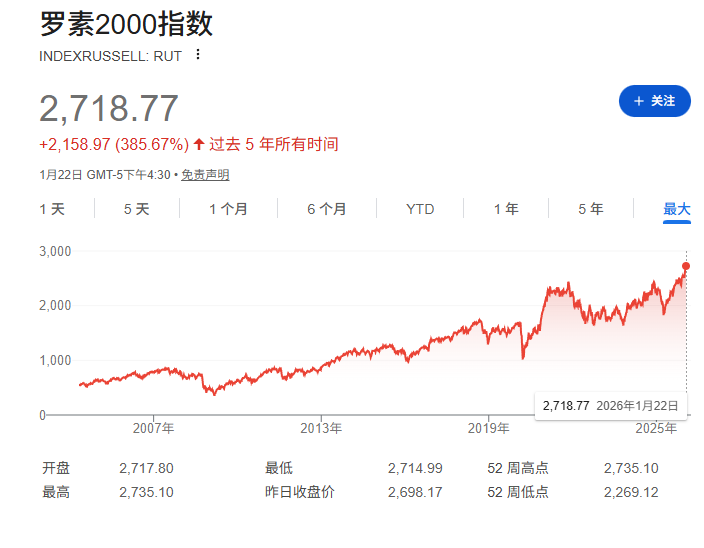
Three weeks into 2026, the Russell 2000 Index has risen 9%, breaking through 2700 points.

This U.S. small-cap stock index had been moving sideways for three years since its previous high at the end of 2021, only breaking through for the first time last November. It has now entered the "price discovery" phase, with no historical resistance levels to reference.

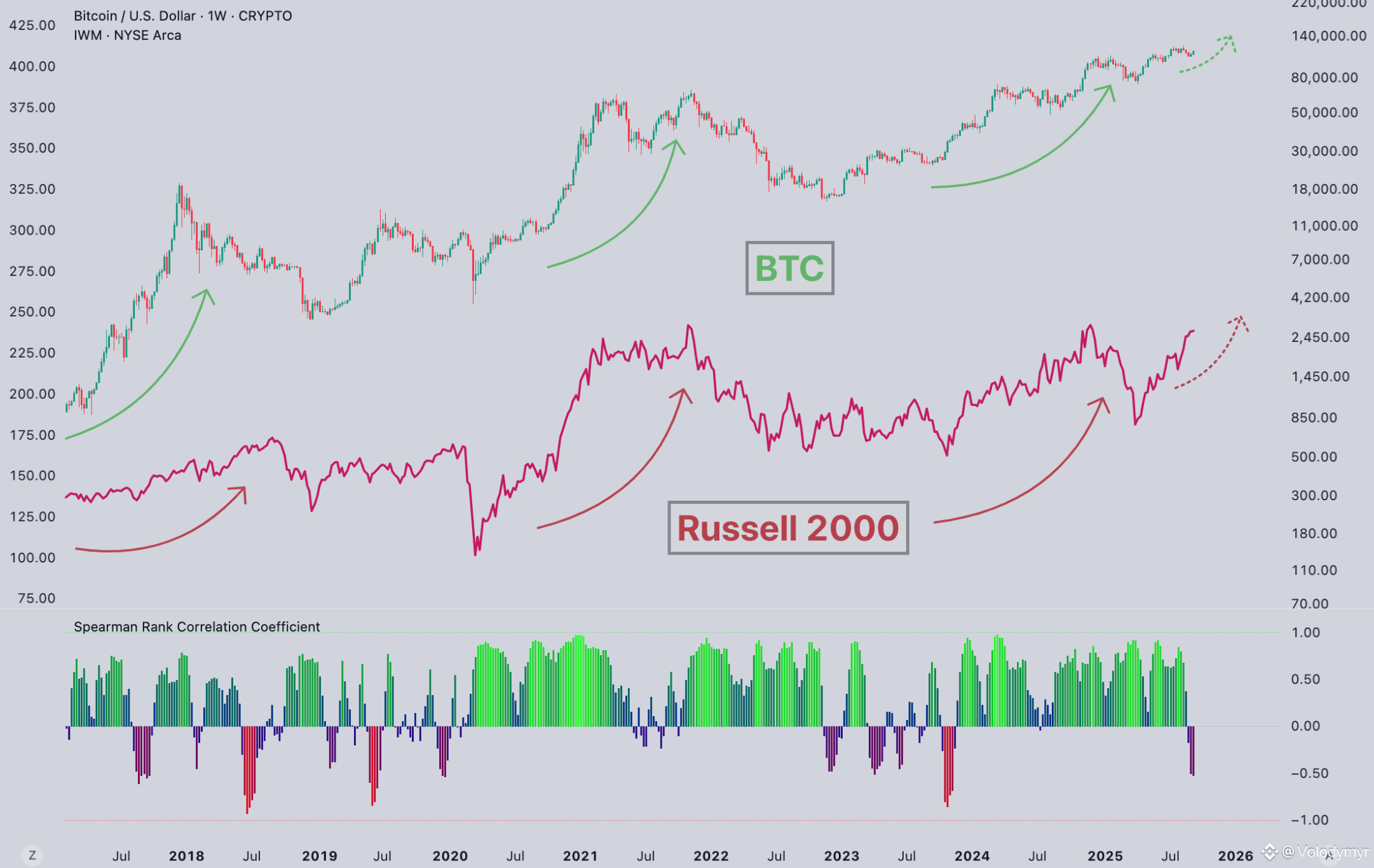
Recently, a view has been circulating: when the Russell 2000 broke out in 2016 and 2020, BTC also started a bull run, hitting both times. Now it has broken out again—will crypto follow?

Looking at the data, it does seem like a leading signal, at least historically validated.
The Russell 2000 tracks the 2,000 smallest companies by market cap in the U.S. stock market, with a median market cap of just over $1 billion. Compared to star stocks like Apple and Microsoft in the S&P 500, these small companies share a common trait: they rely mainly on bank loans for financing, not bond issuance.

When interest rates rise, their financing costs are the first to suffer; when rates fall, they are the first to benefit.

Therefore, traders like to use the Russell 2000 as a "risk appetite thermometer." A new high indicates that the market is willing to put money into higher-risk assets.

There is another layer of logic. Small-cap stocks are concentrated in the U.S. domestic market, unlike globally diversified companies like Apple and Microsoft. A rise in the Russell 2000, to some extent, reflects the domestic economic sentiment in the U.S.

2016 and 2020: Two Breakouts in the Small-Cap Index, Two BTC Takeoffs

First, the data.

In 2016, the Federal Reserve was nearing the end of its rate-hiking cycle, and Trump's election brought expectations of tax cuts, boosting risk appetite. BTC had just undergone a halving, with supply contraction meeting rising demand, leading to the 2017 bull run.

The 2020 breakout was even stronger. The pandemic caused a major crash, and the Fed went all out with money printing, pushing rates to the floor. Institutions entered the market on a large scale for the first time, with MicroStrategy and Tesla buying heavily, driving BTC from over $10,000 to $69,000.

The timing of the Russell 2000 breakout and the BTC bull market确实 aligns in both cases.

But there are only two historical samples.

Looking back to November 2024, the Russell 2000 first broke through its 2021 high. At the same time, BTC was already near $100,000.

From the April 2024 halving, BTC rose from $63,000 to the current $90,000, a gain of about 50%. Sounds good, but compared to the 5x and 27x gains in the same period of the previous two cycles, the difference is significant.
A few possible reasons.

First, institutional entry has dampened volatility. After the ETF approval in January 2024, giants like BlackRock and Fidelity entered the market, with ETFs alone absorbing hundreds of billions of dollars. Institutional money doesn't chase pumps and dumps like retail, smoothing out volatility. The upside is that crashes are less severe, but the downside is the lack of vertical rallies like in 2017.

Second, the marginal effect of halvings is diminishing. After the fourth halving, BTC's annual inflation rate dropped from 1.7% to 0.85%. Sounds like a halving, but 94% of BTC has already been mined. The dilution of new supply on the存量 is getting smaller, and the "supply shock" from halvings is weakening each time.

Third, BTC broke its previous high in March 2024, the first time it has done so before a halving. ETF expectations提前释放了一波 demand, so by the time the halving arrived, the利好 was already priced in.

Coincidence, or the Same Liquidity Logic?

The Russell 2000 and BTC—one is a U.S. small-cap stock index, the other a crypto leader—why would they move in sync?

My understanding is that they are sensitive to the same macro signals.

When the Fed signals easing, money moves out along the risk curve. First to government bonds, then to blue chips, then to small caps, and finally to high-beta assets like crypto.

A Russell 2000 breakout is like a green light in the middle of that chain.

A JPMorgan study last year noted that BTC has the highest correlation with small-cap tech stocks in the Russell 2000. The reason is that crypto projects rely on VC funding, and blockchain innovation is concentrated in small companies rather than large tech giants. Essentially, the people buying small-cap stocks and those buying crypto have similar risk appetites.

But I hesitate to call this a causal relationship. Two samples aren't enough statistically.

Moreover, in 2016 and 2020, BTC itself had its own halving cycle. The Russell 2000 might just have been another macro signal appearing concurrently, not necessarily leading.

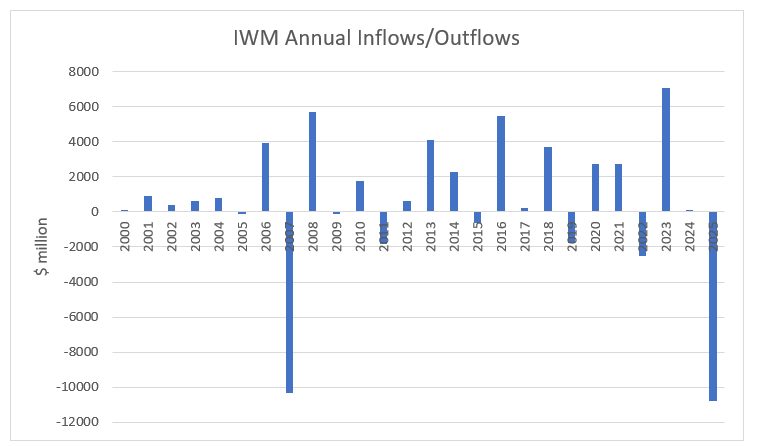
Additionally, an interesting phenomenon: although the Russell index is rising, money is flowing out.

In 2025, the Russell 2000 rose over 40%, but U.S. small-cap ETFs saw nearly $20 billion in net outflows for the year. This contrasts sharply with past bull markets—when the index rose, funds flowed in.
(Source: etf.com)

Another data point: about 40% of companies in the Russell 2000 reported negative earnings in Q3 2025, near a historical high. This proportion has more than doubled since 2007.

The index hits a new high, fundamentals are concerning, and money is still leaving.

How to explain this? One possibility is a few stocks driving the index; another is passive fund rebalancing. But either way, the "return of risk appetite" narrative takes a hit.

Lately, if you follow macro and finance content, you'll notice more voices on investment video blogs and crypto Twitter saying "the Russell 2000 breakout is a leading signal for BTC's rise."

The Russell 2000 breakout确实 was a signal present before the 2016 and 2020 crypto bull markets, and it's here again. It has value as an observation window, but my view is: don't use it as a trading signal.

Two samples can't establish causality, and this cycle has several variables different from before: ETFs changed the capital structure, volatility has been suppressed by institutions, and the halving effect is fading. The old script might not play out the same way.

The "resonance" between the Russell 2000 and BTC might only be answered once this cycle concludes.

Note:

Data sources: Yahoo Finance, TradingEconomics, JPMorgan Research, BeInCrypto. As of January 2026.


Twitter:https://twitter.com/BitpushNewsCN

Bitpush TG Discussion Group:https://t.me/BitPushCommunity

Bitpush TG Subscription: https://t.me/bitpush

Original link:https://www.bitpush.news/articles/7605542

Preguntas relacionadas

QWhat is the Russell 2000 index and why is it considered a 'risk appetite thermometer'?

AThe Russell 2000 index tracks the 2,000 smallest publicly traded companies in the U.S. stock market, with a median market capitalization of just over $1 billion. It is considered a 'risk appetite thermometer' because these small companies rely primarily on bank loans for financing, not bond issuance. When interest rates rise, their financing costs are the first to become unsustainable, and when rates fall, they are the first to benefit. Therefore, its new highs indicate that the market is willing to put money into higher-risk assets.

QAccording to the article, what historical correlation exists between the Russell 2000 index and Bitcoin's price?

AHistorically, there have been two instances where a breakout of the Russell 2000 index preceded a major Bitcoin bull run. The first was in 2016, which led into the 2017 bull market. The second was in 2020, which was followed by Bitcoin's price rising from over $10,000 to $69,000. The article notes, however, that this is only a correlation based on two data points and does not necessarily imply causation.

QWhat are the three reasons the article suggests for Bitcoin's more modest 50% gain post-halving in 2024 compared to previous cycles?

AThe three reasons are: 1) Institutional adoption through ETFs has dampened volatility, as large inflows from firms like BlackRock and Fidelity have a stabilizing effect that prevents the extreme price surges seen in retail-driven markets. 2) The marginal effect of the Bitcoin halving is diminishing; with 94% of BTC already mined, the supply shock from each halving is weaker. 3) Bitcoin's price reached a new all-time high in March 2024 *before* the halving, meaning much of the positive demand effect from the ETF approval was already priced in.

QDespite the Russell 2000 hitting new highs, what contradictory data points suggest the 'risk-on' narrative might be flawed?

AContradictory data includes: 1) U.S. small-cap ETFs saw net outflows of nearly $20 billion in 2025, even as the index rose over 40%, which is the opposite of typical bull market behavior where money flows into rising assets. 2) Approximately 40% of the companies in the Russell 2000 reported negative earnings in Q3 2025, a proportion that has more than doubled since 2007, indicating weak underlying fundamentals despite the index's performance.

QWhat is the article's final conclusion on using the Russell 2000 breakout as a trading signal for crypto?

AThe article concludes that while the Russell 2000 breakout is a valuable observational signal that has appeared before past crypto bull markets, it should not be used as a direct trading signal. The reasoning is that the correlation is based on only two historical samples, and the current cycle has key differences—such as the impact of ETFs, dampened volatility, and a weaker halving effect—that mean the 'old script' may not play out the same way.

Lecturas Relacionadas

Can a Hair Dryer Earn $34,000? Deciphering the Reflexivity Paradox in Prediction Markets

An individual manipulated a weather sensor at Paris Charles de Gaulle Airport with a portable heat source, causing a Polymarket weather market to settle at 22°C and earning $34,000. This incident highlights a fundamental issue in prediction markets: when a market aims to reflect reality, it also incentivizes participants to influence that reality. Prediction markets operate on two layers: platform rules (what outcome counts as a win) and data sources (what actually happened). While most focus on rules, the real vulnerability lies in the data source. If reality is recorded through a specific source, influencing that source directly affects market settlement. The article categorizes markets by their vulnerability: 1. **Single-point physical data sources** (e.g., weather stations): Easily manipulated through physical interference. 2. **Insider information markets** (e.g., MrBeast video details): Insiders like team members use non-public information to trade. Kalshi fined a剪辑师 $20,000 for insider trading. 3. **Actor-manipulated markets** (e.g., Andrew Tate’s tweet counts): The subject of the market can control the outcome. Evidence suggests Tate’sociated accounts coordinated to profit. 4. **Individual-action markets** (e.g., WNBA disruptions): A single person can execute an event to profit from their pre-placed bets. Kalshi and Polymarket handle these issues differently. Kalshi enforces strict KYC, publicly penalizes insider trading, and reports to regulators. Polymarket, with its anonymous wallet-based system, has historically been more permissive, arguing that insider information improves market accuracy. However, it cooperated with authorities in the "Van Dyke case," where a user traded on classified government information. The core paradox is reflexivity: prediction markets are designed to discover truth, but their financial incentives can distort reality. The more valuable a prediction becomes, the more likely participants are to influence the event itself. The market ceases to be a mirror of reality and instead shapes it.

marsbitHace 15 min(s)

Can a Hair Dryer Earn $34,000? Deciphering the Reflexivity Paradox in Prediction Markets

marsbitHace 15 min(s)

First Day Review of "Musk's WeChat" XChat: Even Worse Than Expected

Elon Musk's much-anticipated "WeChat-like" app, XChat, has officially launched after multiple delays. The initial review reveals a product that falls short of expectations, offering an experience largely similar to X Platform's (formerly Twitter) direct messages, despite being marketed as an encrypted communication tool. Key observations from the first-day test include: 1. The app's promoted "end-to-end encryption" and its claimed relation to Bitcoin's architecture were criticized by experts as a superficial attempt to capitalize on crypto buzz, with no real technical connection. 2. Musk's vision of an ad-free "secure communication system" is technically met, but only because the app is currently extremely basic, featuring only a single chat interface. 3. A promised anti-screenshot feature appears inconsistent; it works in X Platform group chats but fails within the XChat app itself, where screenshots still capture avatars. 4. The app supports 45 languages and has a 16+ age rating, indicating a broader tolerance for content compared to WeChat's 13+ rating. 5. A puzzling login process requires users to verify the email associated with their X account. 6. The touted encryption" feels minimal in practice, with its presence only indicated by a simple "Encrypted - Yes" label on messages. 7. Disappearing message timers for groups can be set from 5 minutes to 4 weeks, with the timer starting upon being read by a user. 8. Group invite links are shared with X Platform groups. 9. Group size limits are planned to be increased, aiming for 1000 members, a move that has drawn user criticism. 10. The app offers 8 different colored icons, and its chat bubbles are notably similar to WeChat's. Message deletion options mimic Telegram's. Crucially, many pre-announced features like importing X contacts, integrating Grok AI, X Money payments, and Cashtags are not yet available. The initial release is seen as a bare-bones and underwhelming first step.

Odaily星球日报Hace 1 hora(s)

First Day Review of "Musk's WeChat" XChat: Even Worse Than Expected

Odaily星球日报Hace 1 hora(s)

Trading

Spot
Futuros
活动图片





