SK Hynix's Most Profitable Quarter Ever: Why Did It Still "Miss Expectations"?

Odaily星球日报Publicado a 2026-07-29Actualizado a 2026-07-29

Resumen

SK H力士 reported record-breaking financial results for Q2 2026. Revenue reached 79.32 trillion KRW (up 257% YoY), while operating profit surged to 60.54 trillion KRW (up 557% YoY). Despite this, the figures fell slightly short of market expectations, causing initial volatility in its stock price. Key factors behind the "miss" include a high proportion of HBM sales tied to long-term supply agreements, which limited profit elasticity during a period of rapid price increases for standard DRAM and NAND memory. The company's outlook remains optimistic. Management forecasts continued strong demand growth for DRAM and NAND in 2026, with no observed slowdown in AI-related investments. Progress on HBM4 shipments and next-generation product development remains on schedule. Furthermore, SK H力士 plans to maintain high capital expenditures, indicating confidence in future AI-driven storage demand. The market reaction highlights a broader debate: investors are less focused on past profits and more on how to price future growth. Bulls emphasize the ongoing AI infrastructure expansion, while bears express concerns about valuation and the sustainability of capital spending. The company's performance and strategy will continue to be a key focus in the semiconductor sector.

Original | Odaily Planet Daily (@OdailyChina)

Author | Azuma (@azuma_eth)

On July 29, Beijing time, SK Hynix announced its financial results for the second quarter of 2026.

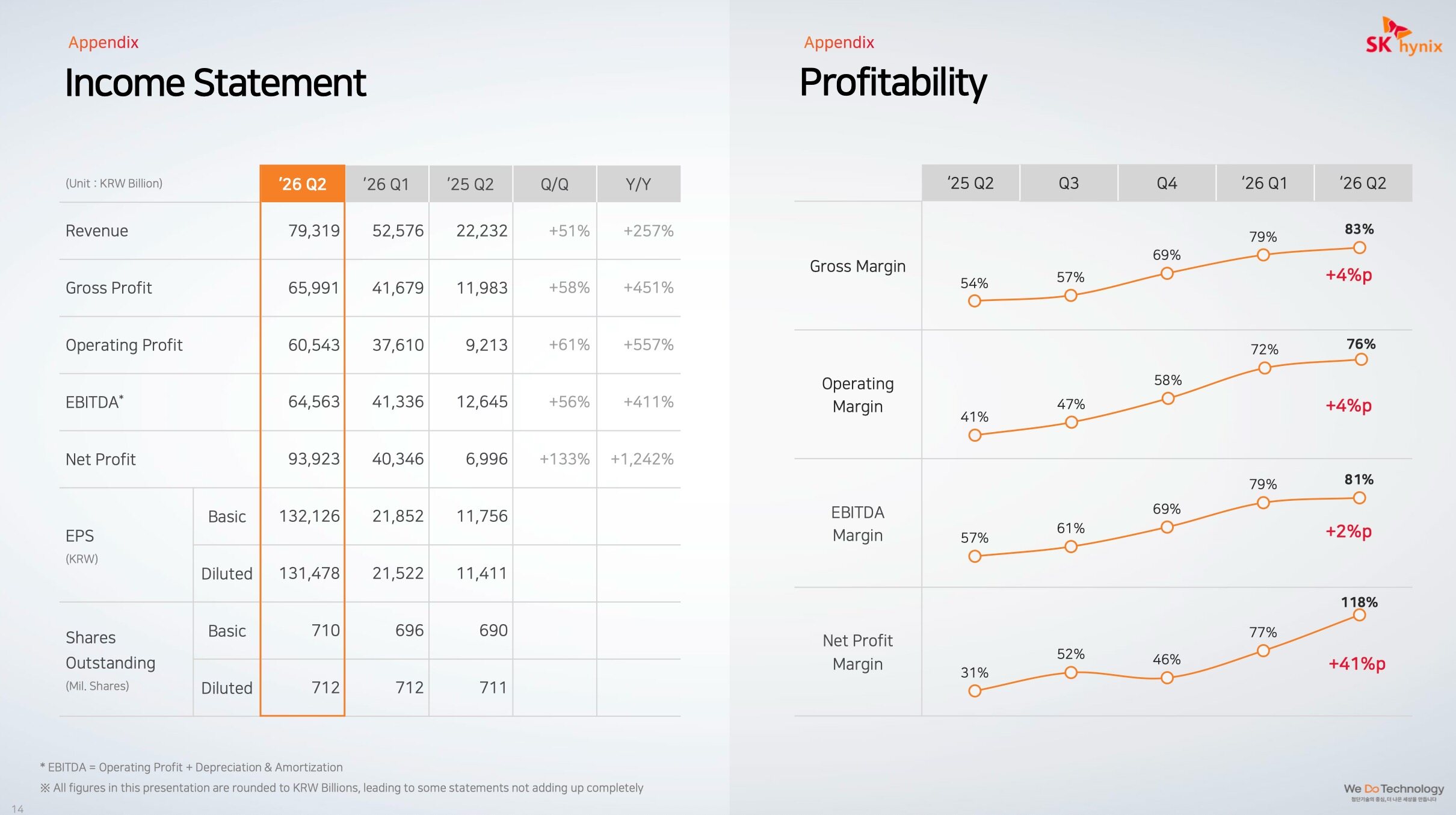
The financial report data shows that SK Hynix achieved revenue of 79.32 trillion won in the second quarter, a year-on-year increase of 257% and a quarter-on-quarter increase of 51%; operating profit was 60.54 trillion won, a year-on-year increase of 557% and a quarter-on-quarter increase of 61%. The operating profit margin further rose to 76%, reaching a historical high; if the one-time investment income of 62.166 trillion won from the sale of part of its equity in Kioxia is included, the company's net profit could reach 93.92 trillion won.
In any industry, this would be considered a report card shocking enough to stun the market.

However, the initial reaction from the capital market was completely opposite. Due to both revenue (actual 79.32 trillion won, market expectation 84 trillion won) and operating profit (actual 60.54 trillion won, market expectation 64 trillion won) slightly falling short of previous market expectations, coupled with SK Hynix's stock price having already corrected over 40% cumulatively in the previous month, under intertwined pessimistic sentiment, SK Hynix's US-listed ADR price fell by about 9% in after-hours trading following the earnings release (it had already plunged nearly 9% at yesterday's US market close). However, as investors gradually digested the details of the report, the stock price quickly recovered all its losses and even turned positive.

At the same time, after the Korean stock market opened this morning, SK Hynix's stock price first opened higher, rising by up to 4%, but then gradually weakened. As of 10:00, it had fallen again by over 9%.

A record-breaking financial report: why was it first sold off frantically, then rapidly recovered its losses, and then suddenly turned downward again? The answer perhaps lies in the fact that what the market truly cares about is far more than just how much money SK Hynix made in the second quarter, but how to reprice the future growth space — and obviously, bulls and bears have not yet reached a consensus on this point.

The Most Profitable Quarter Ever: Why Still Below Expectations?

Looking solely at the numbers, SK Hynix remains in one of its most profitable phases.

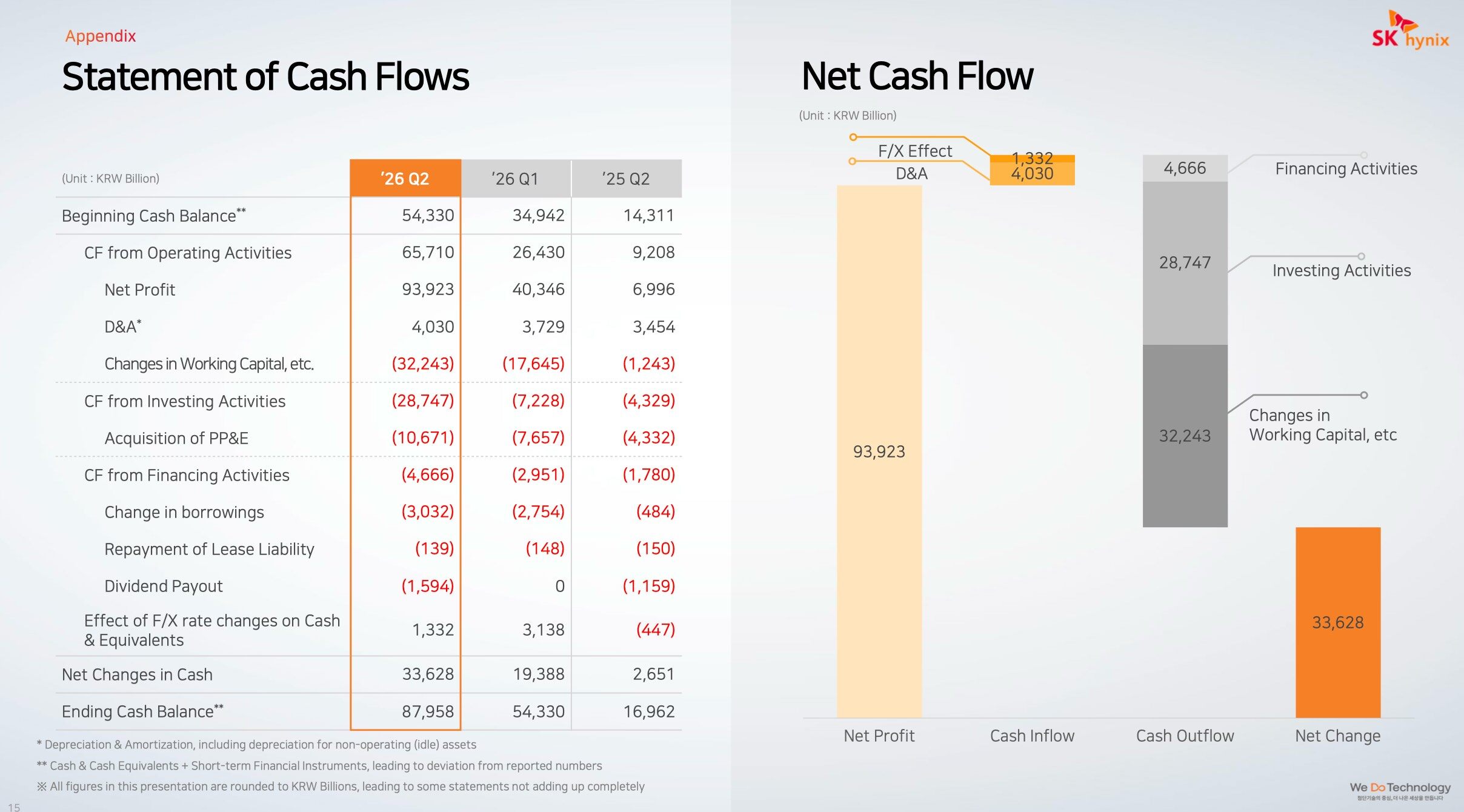
In the second quarter, the company's gross profit margin reached 83%, and its operating profit margin reached 76%. This means that for every 100 won of products sold, about 76 won is converted into operating profit. This level of profitability even exceeds that of the vast majority of global semiconductor manufacturers. At the same time, the company's cash and short-term financial assets continued to grow rapidly to 87.96 trillion won, and its net cash position further expanded, providing ample ammunition for subsequent capacity expansion.
But the problem is, the market had already set its expectations much higher. Previously, market consensus expected SK Hynix's second-quarter revenue to be around 84 trillion won and operating profit around 64 trillion won. The final actual figures were about 5% and 6% lower than expectations, respectively.

For a company, such a deviation is not significant. However, for SK Hynix, which has been labeled the "biggest beneficiary of AI" and whose valuation is built on high growth expectations, any data falling short of expectations will be amplified by the market.

Upon closer inspection of the financial report, this "miss" is actually not due to a deterioration in market demand, but rather stems more from changes in the profit structure.

First, a counterintuitive point is that the continuous increase in the proportion of HBM products has actually weakened profit elasticity. Over the past few quarters, an important driver for the rapid expansion of profits across the memory industry has been the continuous rise in spot prices for traditional DRAM and NAND. However, because SK Hynix itself has a much higher proportion of HBM revenue than its peers, and HBM is more often priced under long-term supply agreements (LTAs), it cannot fully enjoy all the benefits from the rapid rise in spot prices like ordinary DRAM.

Furthermore, SK Hynix disclosed that the average selling price (ASP) of ordinary DRAM in the second quarter increased by approximately 30% quarter-on-quarter. Although growth was maintained, it was significantly lower than the first quarter; NAND ASP increased by 50%-55% quarter-on-quarter, also slowing down compared to the first quarter.

In other words, more AI products were sold, but the pace of price increases for traditional products slowed down; long-term orders locked in future revenue but also limited short-term profit elasticity. This is also why record-breaking profits still did not meet the numbers the market had previously "fantasized" about.

Is the Memory Super Cycle Still On? How the Earnings Report Answers

If the operating data answers how much money SK Hynix made in the second quarter, then the information provided by management in the financial report and subsequent conference call answers another question the market cares more about — Has the AI memory super cycle already begun to cool down?

From the current perspective, the answer SK Hynix provides remains optimistic.
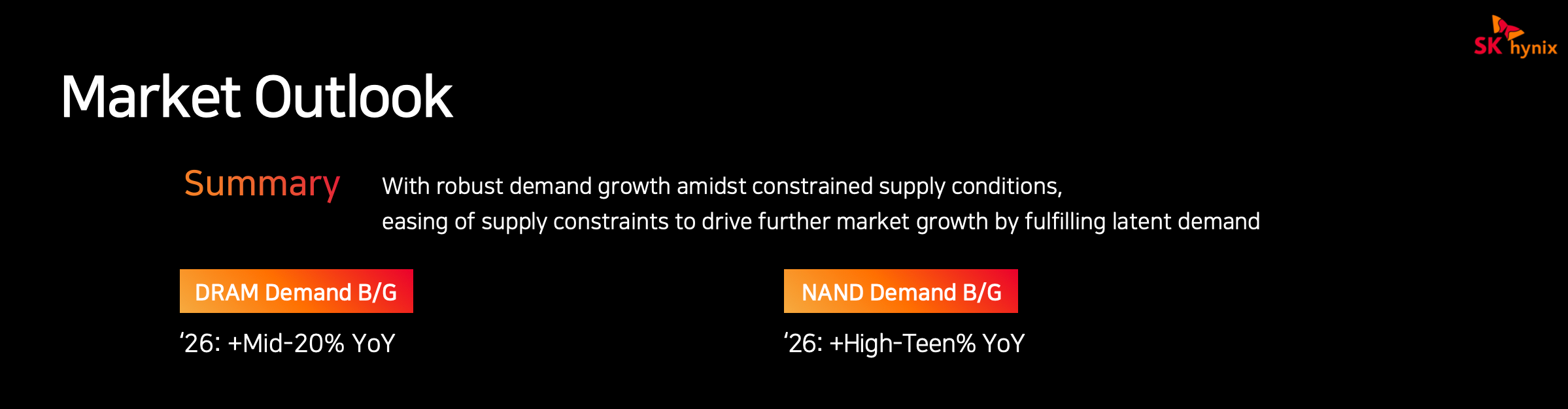
First, regarding the demand outlook, the company did not release any clear signals of caution as the market had feared. SK Hynix expects that global DRAM demand in 2026 will still grow year-on-year in the mid-20% range (Mid-20%), and NAND demand will grow year-on-year in the high-teen percentage range (High-Teen%). Management also stated during the post-earnings conference call that they have not yet observed any signs of a slowdown in AI investment and expect AI infrastructure investment to maintain steady growth even after 2027.
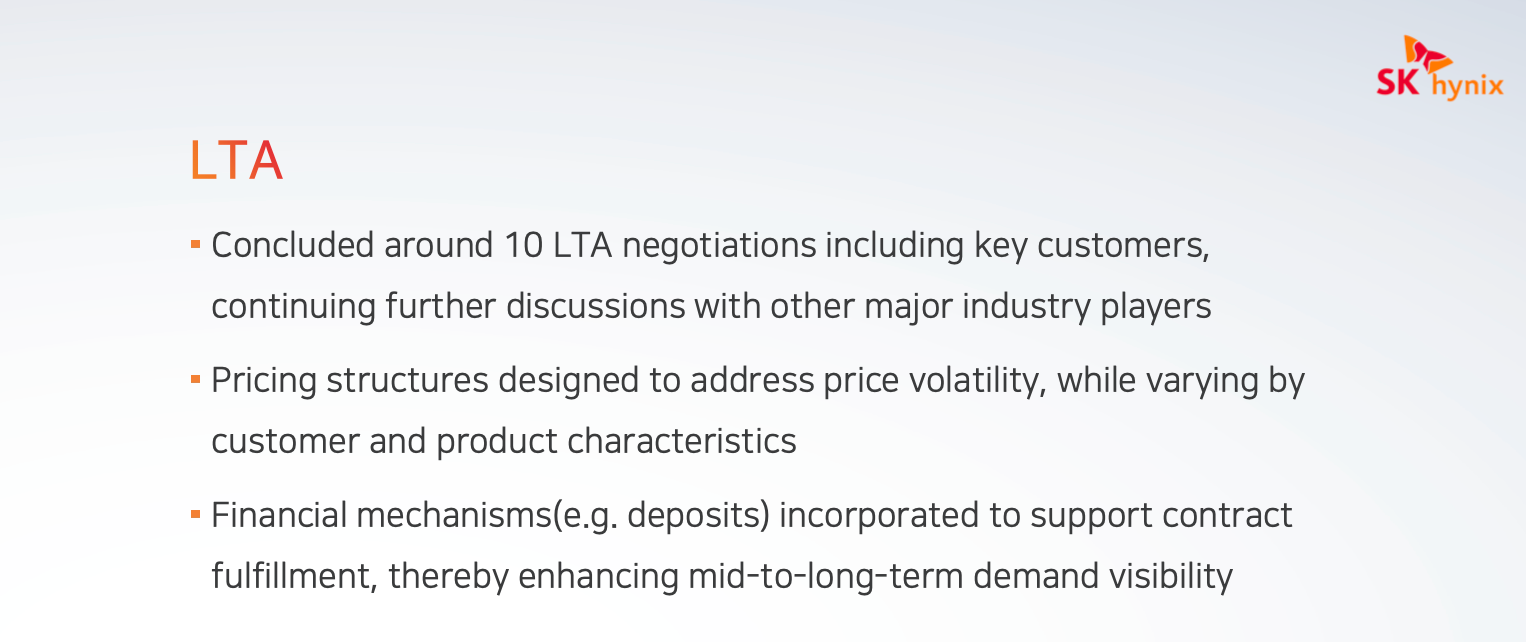
Secondly, another key piece of information worth noting is the further advancement of long-term supply agreements (LTAs). SK Hynix disclosed that the company has currently completed long-term supply agreement negotiations with about 10 customers and is still in continuous discussions with other major industry customers. The new generation of long-term agreements will adopt pricing mechanisms that can cope with price fluctuations and ensure contract performance through corresponding financial mechanisms, thereby enhancing the stability and predictability of future demand.

For the memory industry, this change is significant. In the past, products like DRAM and NAND relied more on spot market pricing, with severe price fluctuations causing the entire industry to remain stuck with the label of a "cyclical stock." However, as the proportion of HBM products increases in the AI era, more and more large cloud providers are beginning to lock in supply capacity for several years in advance. Supply-demand relationships are also gradually evolving from short-term games to longer-term, more stable cooperative partnerships. Although long-term agreements, like this quarter, somewhat compress profit elasticity during phases of rapid spot price increases, what is gained in return is higher revenue certainty for the coming years.
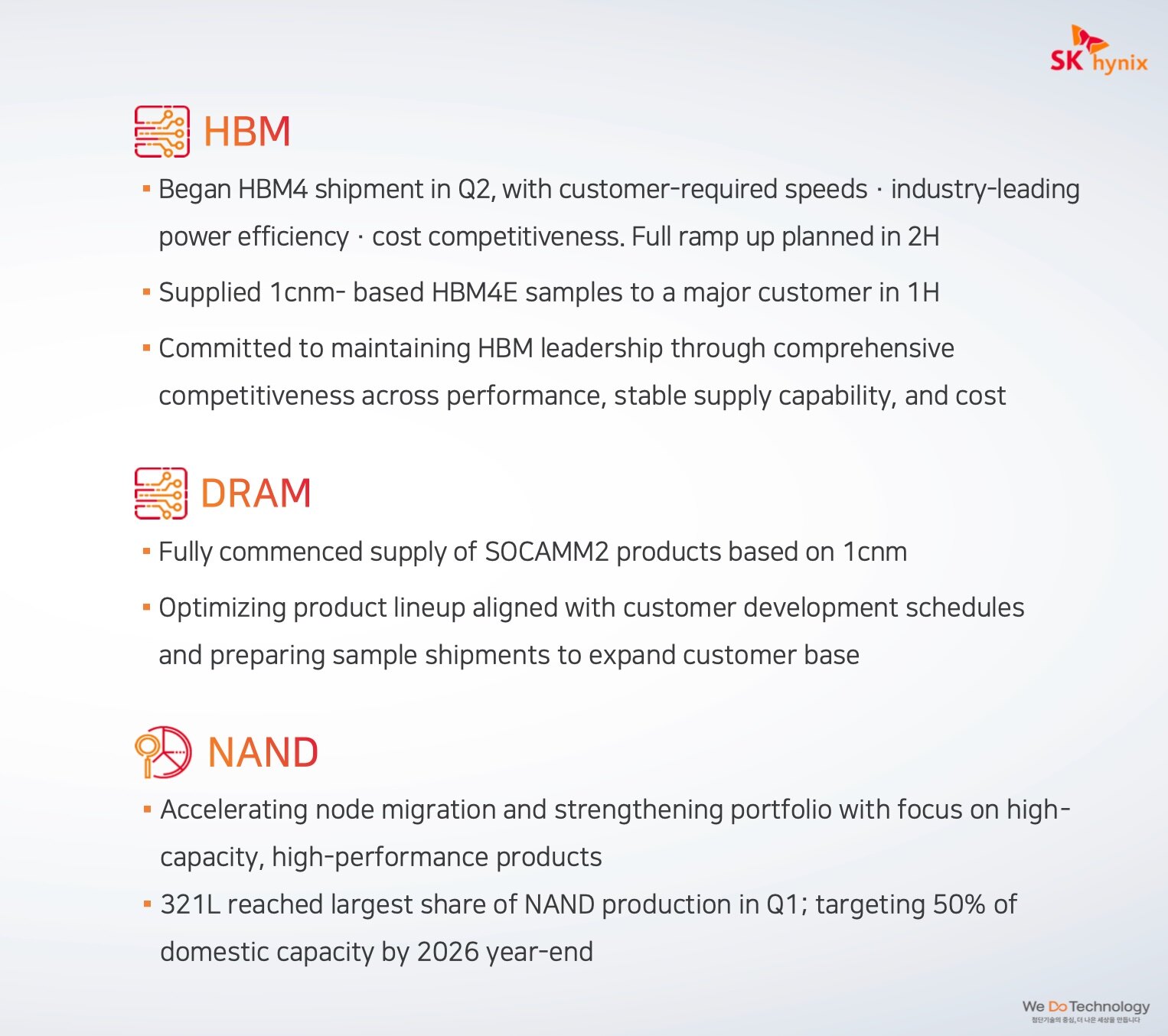
Thirdly, SK Hynix's progress on next-generation products has not encountered any surprises. The financial report shows that SK Hynix began shipping HBM4 products in the second quarter and plans to fully ramp up volume in the second half of the year; the next-generation HBM4E has also completed sampling to major customers in the first half of the year. Additionally, SOCAMM2 products based on the 1cnm process have officially begun shipping.

This means SK Hynix's product cadence for the next-generation AI GPU platforms remains leading. Considering that HBM4 will be a key companion memory for next-generation AI platforms like NVIDIA's Rubin, its smooth ramp-up also indicates that the company currently firmly holds a leading position in the high-end AI memory market.
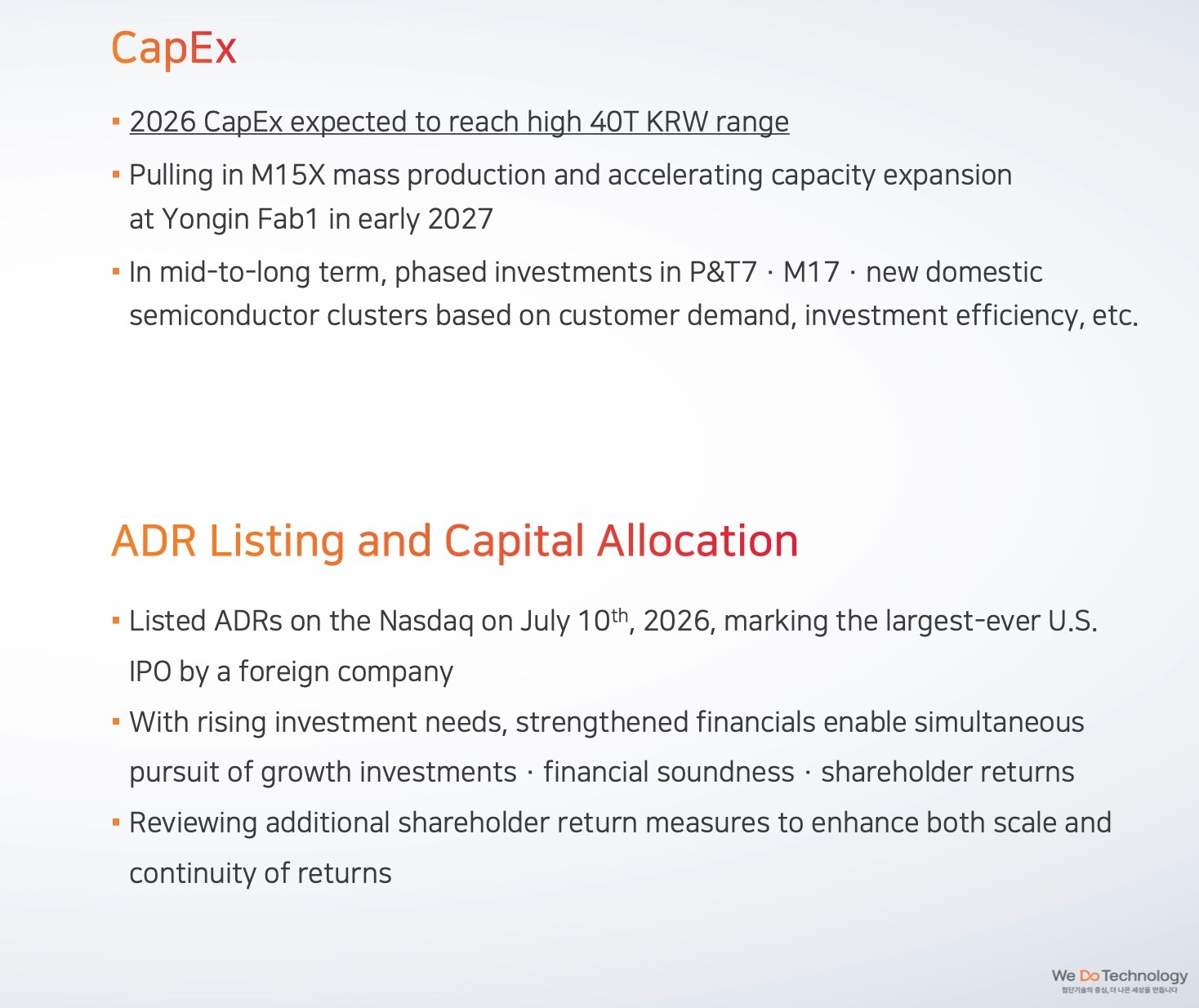
Finally, in terms of capital expenditure (CapEx), which most accurately reflects management's true judgment, SK Hynix not only maintained its expectation for 2026 capital expenditure to be in the high range of over 40 trillion won, but also plans to advance the mass production of the M15X fab ahead of schedule, accelerate the construction of Phase 1 of the Yongin Fab, and continue to advance medium- to long-term projects such as P&T7, M17, and new semiconductor clusters in South Korea.

For a company that has experienced multiple memory cycles, such an aggressive capacity expansion plan is, in itself, a statement — management still believes that AI memory demand in the coming years is sufficient to absorb these new capacities.

The Focal Point of Bulls vs. Bears

Today's SK Hynix has become a core battleground for bulls and bears in the AI memory cycle.

For bulls, the record profits, continuously expanding HBM demand, and the AI infrastructure investment cycle still support the company's long-term growth thesis. For bears, the earnings miss, valuation pressure, and market concerns about the sustainability of AI capital expenditures are also amplifying short-term adjustment pressures. Bulls are betting that AI infrastructure expansion will continue, while bears worry that the market has already priced in future growth.

Heavy is the head that wears the crown. SK Hynix enjoys the valuation of an industry leader and must inevitably bear the pressure of a leader — when the market already believes your story, excellent performance is no longer enough; only continuously surpassing higher expectations can drive valuations further upward.


Preguntas relacionadas

QWhy did SK Hynix's record-breaking Q2 2026 financial results still miss market expectations?

ADespite achieving record revenue and operating profit, the results fell slightly short of market expectations (revenue of 79.32 trillion KRW vs. an expected 84 trillion KRW; operating profit of 60.54 trillion KRW vs. an expected 64 trillion KRW). This miss was primarily due to two factors: 1) A high proportion of HBM revenue, which is priced under long-term agreements (LTAs), limiting short-term profit elasticity compared to standard DRAM, which benefits more from spot price surges. 2) Slower price increases for standard DRAM and NAND products in Q2 compared to Q1.

QAccording to the article, how did SK Hynix's stock price react to the Q2 2026 earnings report?

AThe stock reaction was volatile and showed a divergence between short-term trading and longer-term sentiment. Initially, SK Hynix's US ADR fell about 9% in after-hours trading due to the earnings miss and recent share price declines. However, it quickly recovered all losses and turned positive as investors digested the report details. The following morning in the Korean market, the stock opened higher (up 4%) but then weakened again, falling over 9% by 10:00 AM local time.

QWhat key forward-looking information did SK Hynix management provide about AI demand and the storage super-cycle?

AManagement remained optimistic. They forecast global DRAM demand to grow in the mid-20% range and NAND demand to grow in the high-teen percentage range for 2026. They stated they have not observed any signs of an AI investment slowdown and expect AI infrastructure investment to remain robust even beyond 2027. Furthermore, they maintained aggressive capital expenditure plans (over 40 trillion KRW for 2026) and are advancing multiple fab projects, indicating strong confidence in future AI storage demand.

QWhat is the significance of Long-Term Supply Agreements (LTAs) for SK Hynix's business model, as discussed in the article?

ALTAs represent a strategic shift for SK Hynix and the storage industry. While they can limit profit upside during periods of rapid spot price increases (as seen in Q2), they provide greater future revenue stability and predictability. SK Hynix has completed LTA negotiations with about 10 clients and is discussing with others. These agreements, often with major cloud providers, help transition the business from a cyclical model reliant on volatile spot markets to one with more stable, long-term partnerships, potentially reducing the severity of future industry downturns.

QWhat was the status of SK Hynix's next-generation product roadmap as of Q2 2026?

ASK Hynix's next-generation product rollout remained on schedule and competitive. The company began shipments of HBM4 in Q2, with plans for full-scale volume production in the second half of the year. It had already provided samples of the subsequent HBM4E to major customers in the first half. Additionally, it commenced supply of SOCAMM2 products based on the 1cnm process. This pace keeps SK Hynix in a leading position for supplying high-end memory for next-generation AI platforms like NVIDIA's Rubin.

Lecturas Relacionadas

Low Investment Isn't Apple's Immunity Pass

While Meta and Google face investor scrutiny over ballooning AI capital expenditures, Apple's minimal AI investment has paradoxically become a strength. Its market cap recently reclaimed the global top spot, surpassing $5 trillion. The irony is deep: Apple's own AI efforts have lagged, with "Apple Intelligence" delayed and core talent lost, forcing reliance on partners like Google Gemini and Alibaba's Qianwen. Its Q3 FY2026 (Q2 CY) earnings initially seemed stellar. Revenue hit $109.4B (up 16% YoY), with iPhone and Mac sales, growing 22% and 29% respectively, driving most of the growth. However, the stock fell over 8% post-earnings. The primary concern was a weaker Q4 revenue growth forecast of 9-11%, below expectations, due to looming supply chain constraints. Apple is feeling the indirect cost of the AI boom. Soaring memory and chip prices, fueled by massive data center investments from Microsoft, Amazon, and others, are forcing Apple to raise Mac and iPad prices significantly. The upcoming iPhone launch is also expected to see substantial price hikes. Despite avoiding heavy AI infrastructure spending—its capital expenditures are actually down 28%—Apple cannot escape the industry-wide supply and cost pressures. While Apple's operating cash flow remains robust, its substantial R&D spending (up 32% YoY) has yet to yield major AI breakthroughs. As Tim Cook prepares to step down as CEO, Apple faces a challenging transition: balancing its premium hardware success against the strategic and cost pressures of the AI era it has so far cautiously navigated.

marsbitHace 13 min(s)

Low Investment Isn't Apple's Immunity Pass

marsbitHace 13 min(s)

PA Graphics Explanation | One Chart to Understand the Major Web3 Events in August 2026

**PANews Crypto Calendar: Key Web3 Events in August 2026** PANews introduces its revamped crypto calendar, featuring comprehensive coverage, flexible filtering, and easy export options. The market in August will be shaped by multiple key events across macroeconomics, regulation, tokenomics, and project developments: * **Macro & Policy:** Key US economic data releases (July Non-Farm Payrolls, CPI), the Federal Reserve meeting minutes, and the Jackson Hole Economic Symposium will be in focus. On the regulatory front, the US Senate plans to release a new draft of the *CLARITY Act*, while the EU's expanded crypto ban against Belarus comes into effect. * **Token Unlocks:** Significant token unlocks are scheduled for assets including ENA, AVAX, CONX, ZRO, and KAITO, which may influence market volatility. * **Project Updates & Shutdowns:** Several services, including Exchange Art, Ctrl Wallet, Zapper, NFTfi, and Summer.fi, are set to cease operations or undergo major adjustments. Users are advised to manage their assets accordingly. * **Corporate Activity:** Q2 earnings reports from companies like SpaceX, Circle, and Nvidia are due. Unitree Robotics will initiate its IPO subscription on the STAR Market, and Moonshot AI plans to begin a Pre-IPO financing round. * **Industry Events:** Major conferences such as Bitcoin Asia 2026 and the 2026 Digital Expo will take place. The overarching market narrative for August will revolve around macroeconomic expectations, regulatory developments, token unlock schedules, and ongoing industry consolidation.

marsbitHace 24 min(s)

PA Graphics Explanation | One Chart to Understand the Major Web3 Events in August 2026

marsbitHace 24 min(s)

Wall Street's Most Famous 'Cassandra' Now Has His Sights Set on Nvidia

Michael Burry, the famed "Big Short" investor, has once again captured Wall Street's attention with a series of short positions against major tech and semiconductor stocks, most notably Nvidia. In late June and July, through his "Cassandra Unchained" newsletter, Burry disclosed short bets against Nvidia, Tesla, Applied Materials, Caterpillar, the SOXX semiconductor ETF, and later, Micron Technology. His core thesis revolves around potential distortions in the AI infrastructure boom, specifically questioning whether extended depreciation schedules (e.g., 6 years vs. a realistic 2-3 years for AI chips) by cloud giants like Microsoft and Google artificially inflate profits. He also raises concerns about possible "off-balance-sheet circular financing," where chip demand might be propped up by vendor-backed funding to clients. Nvidia's stock experienced volatility following these disclosures, briefly dipping but largely holding near Burry's reported entry points, leaving his positions roughly flat or slightly underwater as of late July. This move is part of a pattern for Burry, whose track record since his legendary 2008 bet is mixed. He has faced notable losses, such as on Tesla in 2021, while scoring on broader market turns like the 2020 pandemic crash. His methodology focuses intensely on free cash flow and scrutinizing original financial documents to spot overvaluation and structural risks, but it often struggles with timing the market. The article contrasts Burry's stance with other prominent investors. Steve Eisman, another "Big Short" figure, is not shorting Nvidia, citing strong fundamentals but expressing nervousness about sustainability. Jim Chanos agrees with the broad "accounting mismatch" concern—comparing it to the dot-com bubble—but targets financial leverage in private equity firms rather than the chip stocks themselves. While Nvidia's short interest remains relatively low at 1.3-1.4% of float, the massive stock size means absolute short losses have been significant, exceeding $5 billion earlier this year. The piece concludes that for ordinary investors, the key takeaway is not replicating specific short bets but learning from the critical frameworks these investors use: questioning rosy accounting, identifying structural vulnerabilities, and maintaining skepticism during market euphoria, even if pinpointing the exact catalyst for a downturn remains elusive.

marsbitHace 48 min(s)

Wall Street's Most Famous 'Cassandra' Now Has His Sights Set on Nvidia

marsbitHace 48 min(s)

Weekly Selection丨Epic Stock Market Volatility, Changxin Tech's IPO Reshapes Storage Landscape, Saylor Aims to Re-Anchor STRC Around September 8th

PANews Weekly Digest: Market Turmoil, Tech Breakthroughs, and Crypto Developments. The week saw significant volatility across global markets. South Korea's KOSPI index experienced extreme turbulence, including multiple trading halts, largely driven by sharp declines in AI hardware stocks like SK Hynix. In contrast, China's Changxin Xinqiao (CXC) achieved a landmark IPO with a market cap surpassing 4 trillion yuan, marking a major success for the domestic DRAM industry after a decade of losses. In the crypto and Web3 space, several key narratives emerged. AI is driving demand for new infrastructure, with projects like AI agent wallets and programmable payments gaining traction, attracting interest from firms like Coinbase. The Bitcoin mining sector is pivoting, with companies like MARA focusing on energy management as electricity becomes a core AI-era asset. Meanwhile, the RWA (Real World Assets) sector faces a "utilization puzzle," with hundreds of billions in on-chain assets remaining dormant. Notable market movements included a historic single-day surge of over 17% for the KOSPI index and a significant migration of $16.5 billion in staked ETH within the Lido ecosystem. Michael Saylor announced a target to re-peg the STRC stablecoin around September 8th. Other highlights include discussions on Ethereum's ambitious 2030 roadmap for scaling and privacy, analysis showing high protocol revenues not always translating to token price gains, and warnings from Citi about potential extreme commodity price shocks by late 2026.

marsbitHace 54 min(s)

Weekly Selection丨Epic Stock Market Volatility, Changxin Tech's IPO Reshapes Storage Landscape, Saylor Aims to Re-Anchor STRC Around September 8th

marsbitHace 54 min(s)

When the Market Begins to Question AI Capex: A Full Analysis of Q2 Earnings Reports from Five Tech Giants

In late July 2026, five major US tech giants—Alphabet, Intel, Microsoft, Meta, and Apple—released their Q2 earnings reports. While all companies exceeded revenue and profit expectations, driven by strong AI-related business growth, investor reactions diverged sharply due to concerns over escalating AI capital expenditures (capex) and their impact on free cash flow. Alphabet reported strong revenue growth and a surging cloud business, but its stock fell after announcing a doubled year-on-year capex and negative quarterly free cash flow for the first time. Intel posted its strongest revenue growth in over 15 years, but its stock experienced volatile trading after significantly raising its full-year capex guidance. Microsoft saw its stock surge after beating estimates and, crucially, lowering its capex forecast while projecting positive free cash flow. Meta faced the most severe sell-off as its profits declined despite revenue beats, with free cash flow plunging over 90% and its capex guidance raised. Apple reported record June-quarter results, but its stock plummeted after providing Q4 revenue guidance that fell short of expectations, citing supply chain constraints and forex headwinds. The overall takeaway is that the market's focus has shifted from validating AI demand to scrutinizing the timeline for returns on massive AI investments. Companies demonstrating a clearer path to managing capex and preserving free cash flow, like Microsoft, were rewarded, while those signaling continued aggressive spending faced investor skepticism.

Odaily星球日报Hace 1 hora(s)

When the Market Begins to Question AI Capex: A Full Analysis of Q2 Earnings Reports from Five Tech Giants

Odaily星球日报Hace 1 hora(s)

Trading

Spot
活动图片