
Silicon Valley AI Landscape Shifts: Karpathy Jumps Ship, Musk Steps In, Son Left Holding the Fort

marsbitPublicado a 2026-05-21Actualizado a 2026-05-21

Resumen

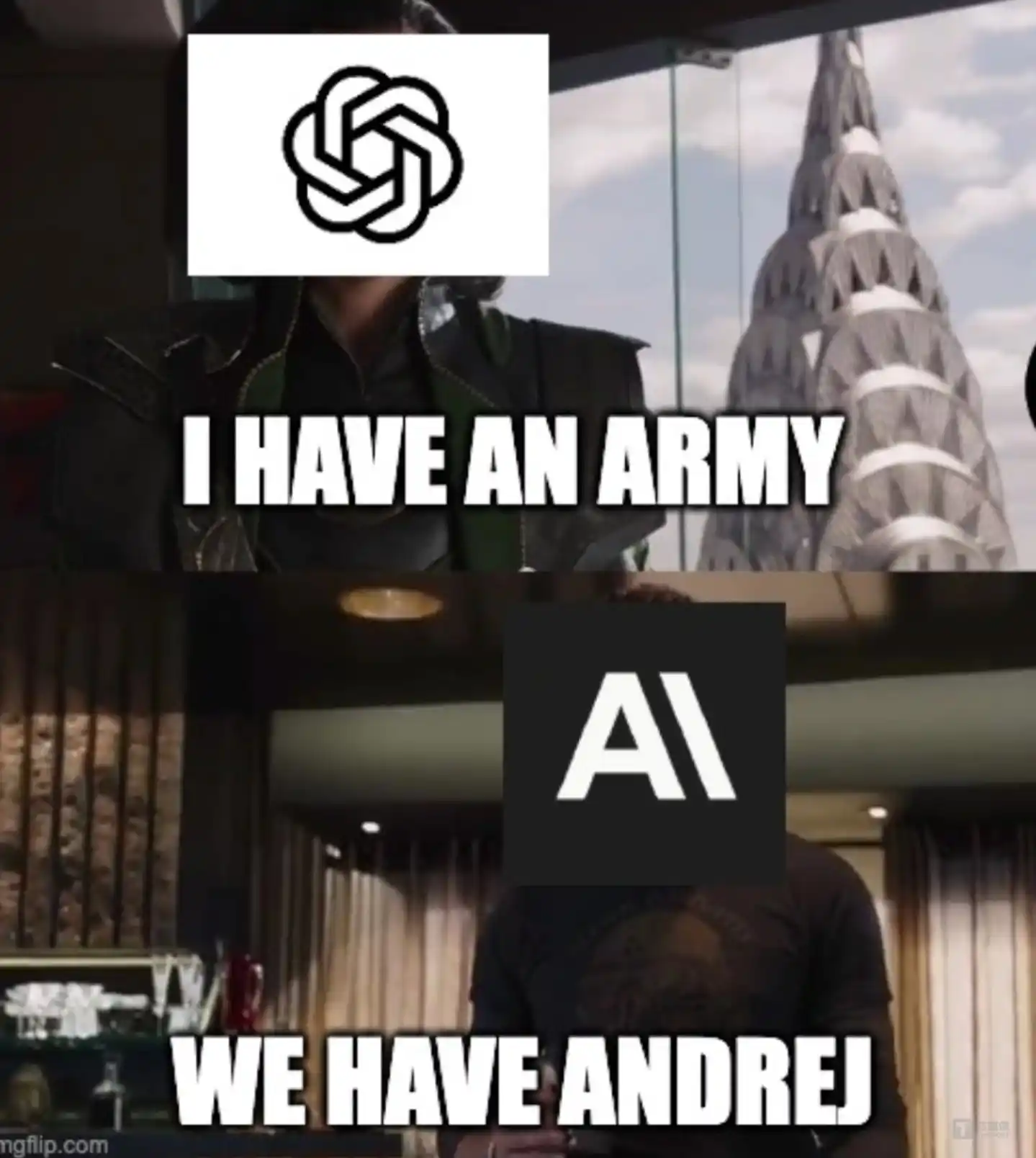
Silicon Valley's AI landscape is shifting as key talent moves and financial pressures mount. Andrej Karpathy, a prominent AI researcher and former OpenAI co-founder, has announced he is joining competitor Anthropic full-time. His departure highlights a talent drain at OpenAI, where most of the original founders have now left. Karpathy, known for his engineering work at Tesla, is expected to help Anthropic develop more efficient model training methods using its Claude AI, challenging OpenAI's current compute-intensive approach. The move coincides with diverging financial paths for the two AI giants. Anthropic is reportedly on track to post its first quarterly profit with $10.9B in sales, while OpenAI, despite a massive $852B valuation and a recent $122B funding round led by SoftBank's Masayoshi Son, faces significant compute costs and potential heavy losses as it pushes for a rapid IPO. Son has invested over $60B in OpenAI, a concentrated bet that has drawn internal criticism over its risk, reminiscent of SoftBank's past losses on WeWork. Elon Musk, an OpenAI co-founder turned rival, is also influencing the dynamic. After losing a lawsuit against OpenAI, Musk's SpaceX leased its massive "Colossus 1" computing center, equipped with over 220,000 Nvidia GPUs, to Anthropic in a deal worth $40-45B. This provides Anthropic with crucial computational resources while pressuring OpenAI. The developments signal a consolidation where only well-capitalized players can compete in founda...

Two pieces of news spread through Silicon Valley almost simultaneously.

One: Anthropic is expected to achieve $10.9 billion in sales this quarter, reaching quarterly profitability for the first time.

Another: OpenAI is accelerating its IPO process, planning to confidentially file its prospectus in the coming weeks at the earliest, with a potential listing in the fall, and a valuation that could reach a trillion dollars.

Upon the news, SoftBank Group's stock price soared nearly 20% intraday, with its market value rising approximately 240 billion RMB in a single day.

One has just touched the profitability line, while the other, still in the red, is rushing to go public. Looking back at the personnel change two days ago, the logic becomes clear—

On May 19th, former OpenAI co-founder Andrej Karpathy announced on X: he is joining Anthropic full-time.

This is no ordinary job change.

Today's OpenAI is already the largest AI company by volume in the capital markets.

It just completed a $122 billion financing round at an $852 billion valuation.

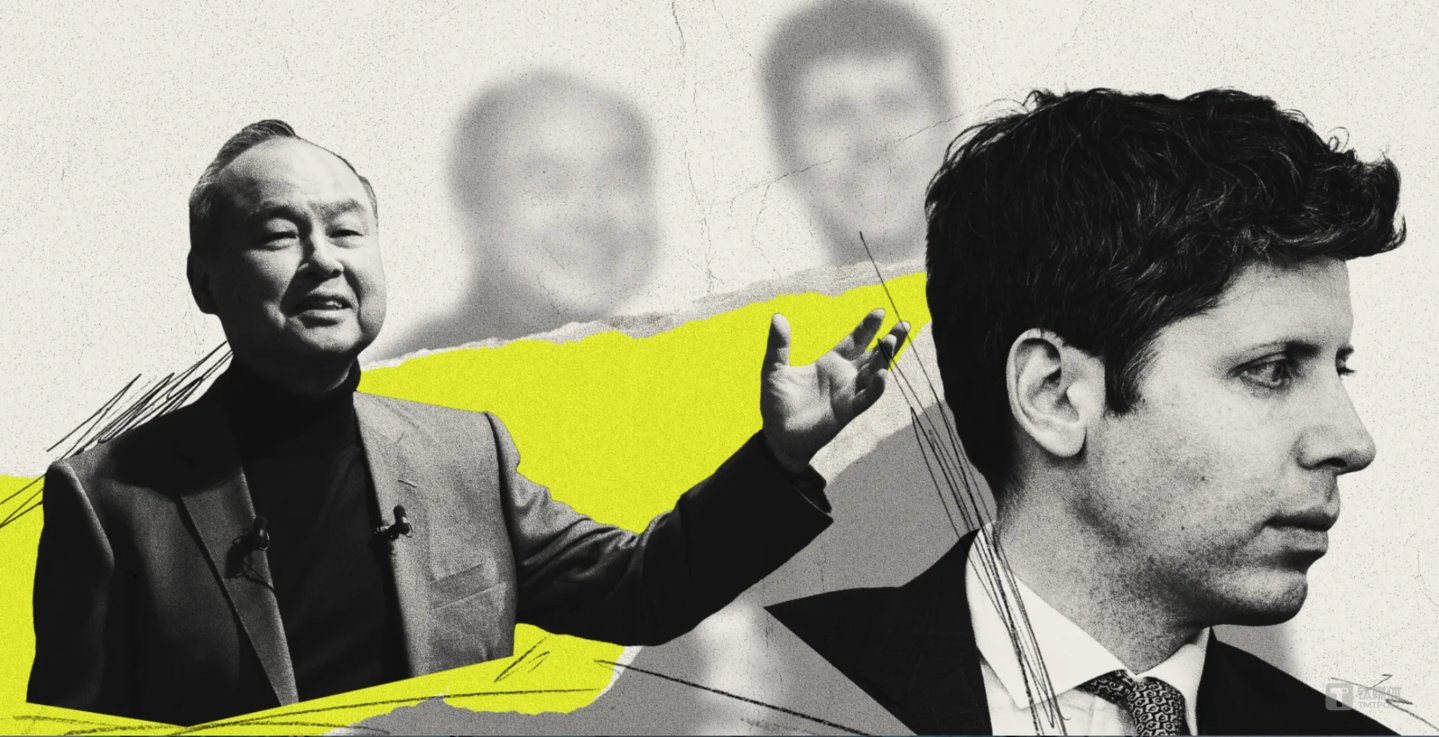
Japan's SoftBank's Masayoshi Son, ignoring internal executive opposition, concentrated over $60 billion to bet on OpenAI.

But inside the company, something else is happening:

Of the 11 co-founders who signed the startup agreement in that humble office back in the day, only two remain—CEO Sam Altman and President Greg Brockman.

Capital is piling up, but core founders are dwindling.

The reasons behind this go beyond a simple explanation of "philosophical differences"; it's more like the result of a clash over strategy, competition for computing power, and a game of giants.

Who is Karpathy? Why Did He Choose Anthropic?

To understand this, one must first grasp Karpathy's position in the AI industry.

In the eyes of top investors, he is not just a technical manager but more like a key figure who can directly influence R&D pace—whichever company he joins, that company's model iteration speed changes.

The 39-year-old Karpathy does have a standout resume.

While pursuing his PhD at Stanford under Fei-Fei Li, he helped create Stanford's first deep learning course.

But what truly made him famous was his five years at Tesla.

He left OpenAI to join Tesla in 2017, and briefly returned to OpenAI in 2023.

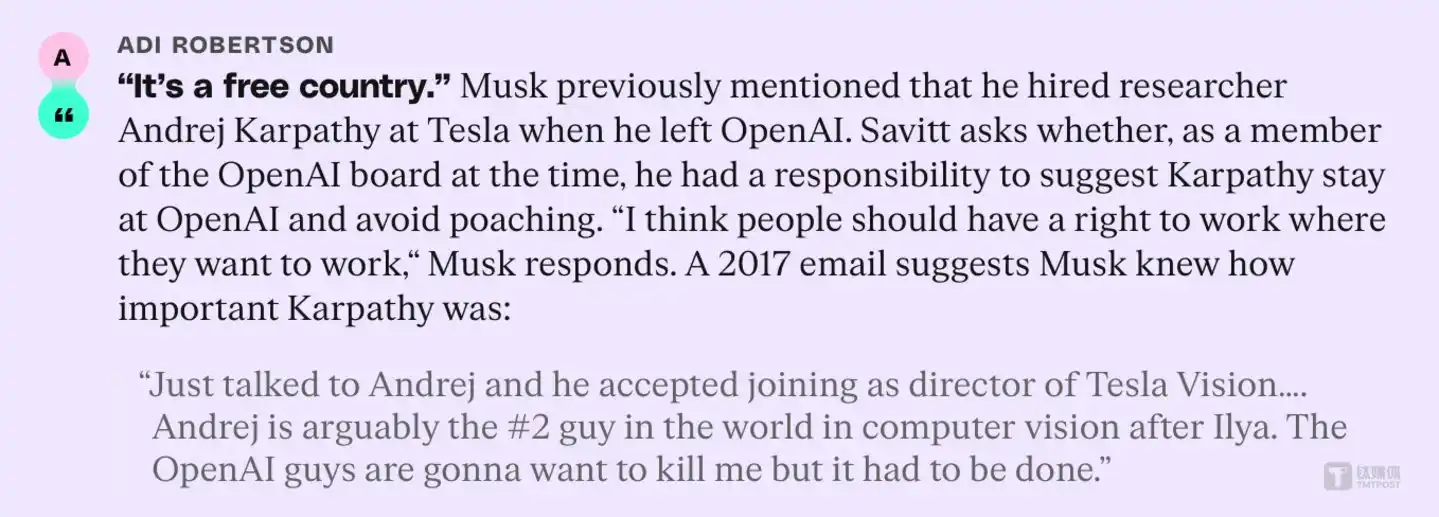
In 2017, Musk, then an OpenAI board member, bypassed OpenAI management and directly recruited Karpathy to Tesla, responsible for AI and autonomous driving vision. Court evidence shows this move displeased OpenAI at the time.
At Tesla, Karpathy did far more than write papers.

He built the autonomous driving engineering system from scratch, including assembling a data labeling team and deploying neural networks onto Tesla's self-designed chips.

The tech circle's trendy concept of "Vibe Coding" in recent years was also popularized by him.

So, what will he do at Anthropic now?

The answer: Join the pre-training team to use Claude to accelerate the pre-training of the next-generation model.
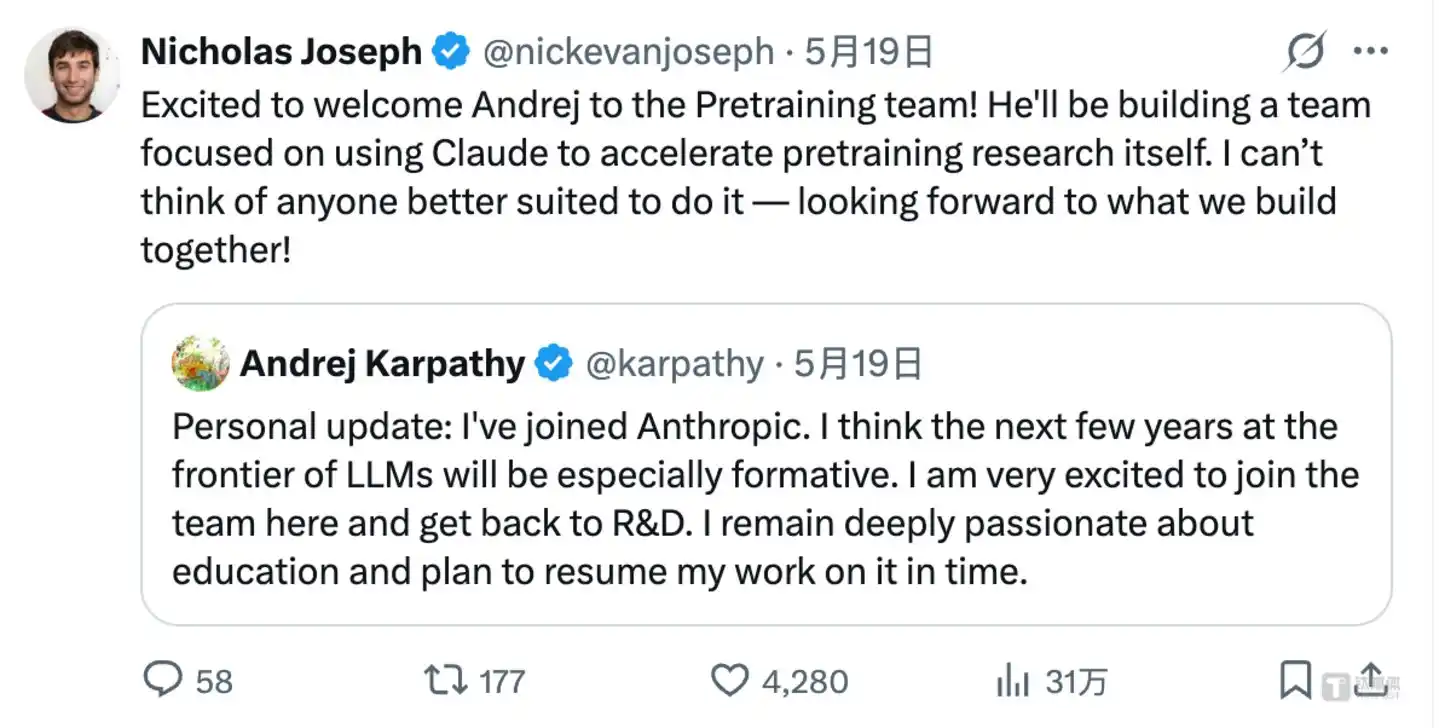
Simply put, OpenAI currently trains large models mainly by brute-forcing computing power—massive amounts of NVIDIA GPUs running simultaneously, competing on who can afford more electricity and hardware costs.

What Karpathy aims to do at Anthropic is to have Claude help accelerate the training process itself.

If this path succeeds, the training cost of large models will drop significantly.

Karpathy's choice actually signals something: from the perspective of those actually doing engineering work, the path of simply burning money on computing power is nearing its end; using models to assist training is a more realistic direction.

Compute Consumption and the "WeWork Shadow"

The successive departure of core talent is often related to the company's operational direction.

Today's OpenAI has transformed from an early non-profit research institution into a company bearing revenue pressure.

As of February 2026, OpenAI's annualized revenue exceeded $25 billion.

But compute costs are growing even faster.

According to a 2024 Reuters report citing insider predictions, OpenAI might face up to $14 billion in losses in 2026, with positive cash flow not expected until 2029. This prediction has not been updated or confirmed.

Compute power is a heavy asset with rapid depreciation. To control losses, OpenAI began cutting unprofitable projects.

The Sora video project was shut down in March this year because it reportedly burned about $1 million per day in server costs, with user growth falling short of expectations.

The OpenAI for Science division, established in 2025, also saw its team split and merged into other product lines.

These adjustments, on one hand, are to comply with the requirements for transitioning to a "Public Benefit Corporation (PBC)" in 2025, and on the other hand, are preparations for the IPO. But for the scientists who joined driven by technological ideals, the company's priorities have changed.

And it is at this moment that Son chose to double down.

Over the past year, SoftBank has channeled over $60 billion into OpenAI through various means.

There is significant internal controversy at SoftBank about this.

Several executives privately believe concentrating this much capital on a single private company is excessively risky.

To raise funds, SoftBank sold off some assets, including NVIDIA shares. Simultaneously, the Vision Fund cut about 20% of its staff, tilting resources towards the AI track.

What SoftBank executives fear is a repeat of the WeWork debacle.

Back then, Son was enamored with WeWork's business story, ultimately losing tens of billions. According to Bloomberg, some insiders used the term "starstruck" to describe Son's attitude towards Altman this time—eerily similar to his attitude towards WeWork's founder back in the day.

After investing $60 billion, SoftBank did not secure a substantive board seat at OpenAI. But Son had already missed the last internet wave; he is unwilling to miss AI again. In his view, these losses are the price to pay for a ticket to "base intelligence."

And when the news of OpenAI's IPO came out, SoftBank's market value rose by 240 billion RMB in a single day—at least for now, this bet hasn't lost.
Musk's Compute Play

The one best at causing trouble in this game is still Musk.

He is one of OpenAI's earliest co-founders and now its most direct competitor.

In May this year, Musk lost his lawsuit against OpenAI for deviating from its original purpose, on grounds of the statute of limitations.

But the trial disclosed much information: the one who originally wanted to turn OpenAI into a for-profit company was none other than Musk himself.

He had calculated the math—Mars colonization needs about $80 billion, and controlling an AGI company was his way to raise funds.

Failing to gain control, he chose to exit, stop funding, and simultaneously poached Karpathy.

Although he lost the lawsuit, Musk soon took action on the compute front.

In early May, Musk announced the merger of xAI into SpaceX. Subsequently, SpaceX leased its Colossus 1 computing center in Memphis, Tennessee—equipped with over 220,000 NVIDIA GPUs—to Anthropic as a whole. SpaceX's IPO prospectus shows the total value of this lease is between $40 and $45 billion.
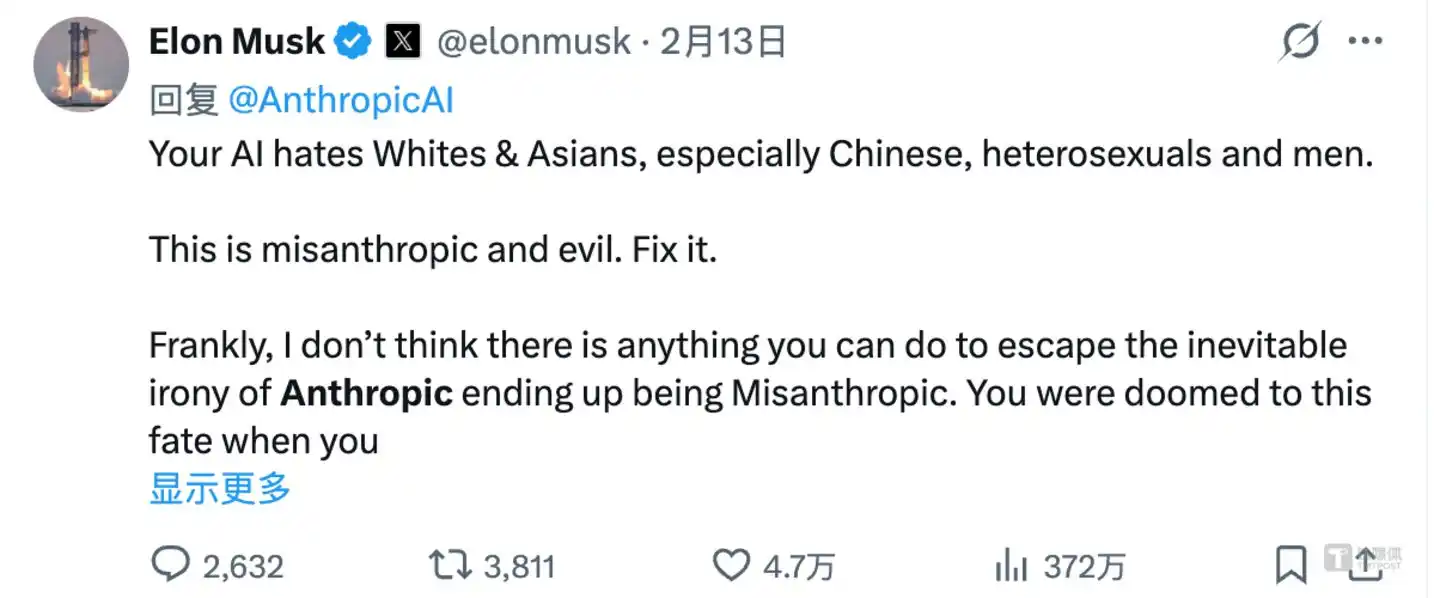

Just months ago, Musk publicly called Anthropic "misanthropic and evil" on X.

But before business interests, positions can be adjusted at any time.

Musk pinpointed OpenAI's weak spot—compute power.

Leasing the computing center to Anthropic, on one hand, generates hefty rent, and on the other hand, indirectly strengthens the power of OpenAI's competitor, putting pressure on OpenAI.

Anthropic's Fearsome Comeback

With ample compute power, Anthropic's performance is indeed accelerating.

In April 2026, Anthropic announced its annualized revenue exceeded $30 billion, surpassing OpenAI (approximately $25 billion) in scale for the first time.

By May 21st, the Wall Street Journal further disclosed: Anthropic is expected to achieve $10.9 billion in sales in the second quarter, reaching quarterly profitability for the first time.

For reference, it took Salesforce over twenty years to reach a comparable revenue scale. Anthropic, from its founding in 2021 to now, took less than five years.
More crucial is cost control.

Anthropic's product line is relatively focused, mainly on enterprise-level code generation and AI agents, without venturing into C-end video generation and other fields. Its model training costs are estimated to be only about one-fourth of OpenAI's.

Higher revenue, lower expenditure—that's Anthropic's current advantage.

For someone like Karpathy, who has long focused on engineering implementation, this difference is persuasive.

From Karpathy's choice to the compute-power game among giants, this round of competition sends a signal: the threshold for large-scale model foundational training is already very high, making it difficult for ordinary entrepreneurs to find opportunities in the general model domain. More pragmatic paths are either to focus on specific B-end scenarios like Anthropic does—such as using AI to solve workflow problems with clear willingness to pay, like code generation; or to find niche opportunities in directions like AI-assisted training, synthetic data, etc. Compute costs determine who can survive this round; that's the most fundamental calculation.

(This article was first published on TMTPost APP, author | Silicon Valley Tech_news, editor | Linshen)

Lecturas Relacionadas

Will the Next Crypto Bull Run Start with On-Chain Trading of SpaceX?

This article presents a scenario-based forecast for the crypto industry from 2026 to 2029, arguing that the next major cycle will be driven not by technological narratives but by legal access to real-world assets. The author predicts that by mid-2026, pre-IPO perpetual contracts for top private companies like SpaceX, OpenAI, and Anthropic on platforms like Hyperliquid will become the primary gateway for accessing quality assets, as most crypto-native tokens fail to capture real value. The much-hyped AI x Crypto intersection largely fails except for prediction markets, which thrive on betting on AI model supremacy. By 2027, public blockchain foundations are forced to choose between catering to retail speculation or building compliant infrastructure for institutions, with many opting for the latter. Growth in stablecoins and tokenized private credit/equity hits a "triple ceiling" due to regulatory and political uncertainty rather than market demand. The pivotal shift is forecast for 2028. A major liquidation event in pre-IPO perpetuals exposes the structural flaw of synthetic markets lacking a real underlying asset anchor. In response, regulatory changes finally allow the public solicitation of private securities resales to verified accredited investors. This creates a legitimate secondary market for real company equity, which then becomes the core asset class of the new bull market, relegating synthetic perps to a niche role. By 2029, the industry becomes "boring" but foundational. Tokens without claims on real cash flows or assets cease trading. Stablecoin growth is steady but politically capped. Crypto infrastructure fades from view as it gets absorbed into traditional finance backends. The article's central thesis is that the key bottleneck for crypto's next phase is legal and regulatory channels for real asset ownership, not technology.

marsbitHace 34 min(s)

Will the Next Crypto Bull Run Start with On-Chain Trading of SpaceX?

marsbitHace 34 min(s)

The Value Distribution of Stablecoins

**Summary: The Value Distribution of Stablecoins** The article argues that stablecoins are evolving from mere trading tools into broader channels for dollar access. It divides the stablecoin ecosystem into four layers to analyze how value is distributed: 1. **Issuance Layer:** Mints stablecoins, holds reserve assets, and captures the spread between reserve yield and user costs (e.g., Tether, Circle). This layer currently earns the largest profit margin. 2. **Infrastructure Layer:** Connects stablecoins to the traditional financial system, handling fiat on/off-ramps, banking integration, compliance (KYC/AML), and asset management (e.g., Bridge, BVNK). This is the "unglamorous" but critical work, building the essential bridges between crypto and real-world finance. 3. **Acquiring/Distribution Layer:** Integrates stablecoins into merchant systems, manages payment flows, and provides enterprise financial software (e.g., Stripe, Coinbase). They act as the access point for businesses. 4. **Application Layer:** The end-users and businesses that ultimately use stablecoins for payments, settlements, or as a store of value. They benefit from convenience but have little pricing power. The core thesis is that while the issuance layer currently dominates profits, the often-overlooked **infrastructure layer holds significant long-term potential**. The real challenge and barrier to mass adoption is not the on-chain transfer of stablecoins (which is simple), but the complex "last mile" integration into existing business workflows, banking systems, and regulatory frameworks across different countries. Companies in this layer are currently in a "land grab" phase, investing heavily to build networks, secure bank partnerships, and establish compliance pathways. While their position is currently pressured by the profitable issuers above and distribution platforms below, the article suggests that if stablecoins become a default financial rail for businesses, the infrastructure providers who have done the hard work of integration will ultimately gain strong pricing power and become entrenched, essential players.

marsbitHace 7 hora(s)

The Value Distribution of Stablecoins

marsbitHace 7 hora(s)

The Value Distribution of Stablecoins

The Value Distribution of Stablecoins The article argues that stablecoins are evolving from a mere trading tool into a broad "dollar channel." It analyzes the industry's value chain through four layers: 1. **Issuance Layer (e.g., Tether, Circle):** The top layer that mints stablecoins, holds reserve assets, and captures the thickest interest rate spread. 2. **Infrastructure Layer (e.g., Bridge, BVNK):** Connects stablecoins to the traditional financial system, handling critical but complex "dirty work" like fiat on/off-ramps, banking integration, compliance (KYC/AML), and cross-border settlement. 3. **Acquiring/Distribution Layer (e.g., Stripe, Coinbase):** Embeds stablecoins into merchant systems, manages payment flows, and integrates with enterprise software. 4. **Application Layer:** End-users and businesses that ultimately use stablecoins for payments, settlement, or storing value. The author posits that while the issuance layer currently captures the most profit, the most overlooked and potentially critical layer is infrastructure. The core challenge for stablecoin adoption isn't the on-chain transfer (which is simple), but bridging the gap between blockchain and the real-world financial system. This involves solving practical problems for businesses: fiat conversion, reconciliation, tax handling, and user onboarding. Infrastructure companies are currently in a difficult "land-grab" phase—building networks, securing banking relationships, and achieving compliance country-by-country. They face pressure from both the profitable issuance layer above and distribution platforms below. However, the author suggests this layer is building a crucial moat. Once stablecoins become a default business rail, the infrastructure players who have done the hard work of integration may gain significant, durable value and pricing power.

链捕手Hace 7 hora(s)

The Value Distribution of Stablecoins

链捕手Hace 7 hora(s)

Trading

Spot
Futuros

Artículos destacados

Cómo comprar ONE

¡Bienvenido a HTX.com! Hemos hecho que comprar Harmony (ONE) sea simple y conveniente. Sigue nuestra guía paso a paso para iniciar tu viaje de criptos.Paso 1: crea tu cuenta HTXUtiliza tu correo electrónico o número de teléfono para registrarte y obtener una cuenta gratuita en HTX. Experimenta un proceso de registro sin complicaciones y desbloquea todas las funciones.Obtener mi cuentaPaso 2: ve a Comprar cripto y elige tu método de pagoTarjeta de crédito/débito: usa tu Visa o Mastercard para comprar Harmony (ONE) al instante.Saldo: utiliza fondos del saldo de tu cuenta HTX para tradear sin problemas.Terceros: hemos agregado métodos de pago populares como Google Pay y Apple Pay para mejorar la comodidad.P2P: tradear directamente con otros usuarios en HTX.Over-the-Counter (OTC): ofrecemos servicios personalizados y tipos de cambio competitivos para los traders.Paso 3: guarda tu Harmony (ONE)Después de comprar tu Harmony (ONE), guárdalo en tu cuenta HTX. Alternativamente, puedes enviarlo a otro lugar mediante transferencia blockchain o utilizarlo para tradear otras criptomonedas.Paso 4: tradear Harmony (ONE)Tradear fácilmente con Harmony (ONE) en HTX's mercado spot. Simplemente accede a tu cuenta, selecciona tu par de trading, ejecuta tus trades y monitorea en tiempo real. Ofrecemos una experiencia fácil de usar tanto para principiantes como para traders experimentados.

290 Vistas totalesPublicado en 2024.12.12Actualizado en 2026.06.02

Cómo comprar ONE

Discusiones

Bienvenido a la comunidad de HTX. Aquí puedes mantenerte informado sobre los últimos desarrollos de la plataforma y acceder a análisis profesionales del mercado. A continuación se presentan las opiniones de los usuarios sobre el precio de ONE (ONE).

活动图片



