Shielded Labs Warns Zcash Must Act Now To Win Long-Term Investors

bitcoinistPublicado a 2026-03-04Actualizado a 2026-03-04

Shielded Labs is urging the Zcash community to move quickly on long-term sustainability changes, arguing that the network has a near-term opening to attract patient capital and should not wait for that window to close. The pitch is not just technical. In Shielded Labs’ telling, protocol-level clarity around future security and emissions could itself become an investment signal for ZEC.

The argument surfaced in a Zcash Community Forum discussion around the proposed Network Sustainability Mechanism, or NSM, where Shielded Labs pushed back on the idea that the work lacks short-term relevance.

“We believe there’s an opportunity right now to attract long-term investors. In conversations we’ve had over the past year, investors respond positively to the fact that we’re thinking about and actively addressing long-term sustainability. Broad consensus from the community and coinholders for implementing the NSM in the next network upgrade would send a clear signal that we have a credible path forward,” the group wrote.

Zcash Could Miss Its Moment Without Fast Action

That framing matters because the current debate is not simply about whether Zcash should strengthen its future security budget, but how. In a separate governance post, Shielded Labs said recent polling showed a split between support for the overall direction of the NSM and resistance to one of its more sensitive design choices, issuance smoothing.

According to the group, “There were two separate questions: one related to the NSM and issuance smoothing, and another focused on burning 60 percent of transaction fees to support network sustainability.” It added that the issuance-smoothing question won “broad support from panels but not from coinholders,” while the fee-burning component drew broad support from both panels and coinholders.

On that basis, Shielded Labs said it sees “clear support” for the elements that remove ZEC from circulation, including ZIP 233 and ZIP 235, and intends to push those parts toward the next network upgrade.

Shielded Labs also acknowledged that resistance from coinholders is not irrational. “For some coinholders, the existing emissions schedule is viewed as a defining part of Zcash’s monetary identity, similar in principle to the 21 million supply cap. That is a rational position,” the post said, adding that the team remains open to alternative designs that preserve the halving schedule while still improving sustainability.

Still, the core message from the newer forum exchange was unmistakably urgent. Shielded Labs argued that upcoming network developments could make the timing more consequential than it appears today.

“Tachyon could increase aggregate fees in the near term by allowing a much higher rate of transactions, which makes the timing especially important. NEAR Intents integrations and additional Maya DEX activity could also increase fee demand. If several of these developments gain traction at the same time, aggregate network usage could rise meaningfully. In that scenario, it would be better to already have the NSM in place rather than trying to introduce it later.”

The broader strategic claim is that Zcash can differentiate itself by confronting a question many proof-of-work networks still treat as a future problem. Shielded Labs explicitly tied the issue to the wider debate over Bitcoin’s long-term security budget, arguing that a mechanism “explicitly defined at the protocol level” could matter for how users and investors evaluate network durability.

Whether that case is enough to win over skeptical coinholders remains unresolved, but the direction of travel is clearer: Shielded Labs wants Zcash to present sustainability not as an abstract research topic, but as part of the asset’s investment thesis now.

At press time, ZEC traded at $216.59.
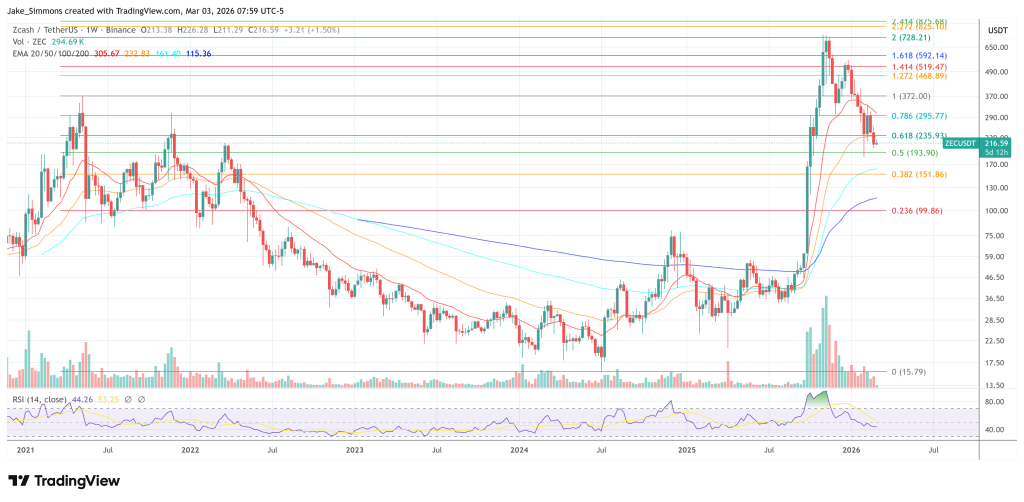
ZEC trades below the 0.618 Fib, 1-week chart | Source: ZECUSDT on TradingView.com

Lecturas Relacionadas

The AI Agent Era Accelerates Its Arrival: Questflow Defines a New Paradigm of Financial Intelligence with On-Chain AI Brokerage

The AI Agent era is accelerating, with the CB Insights AI 100 list highlighting global investment confidence. The focus has shifted from whether AI works to its speed of deployment and ability to manage complex workflows, with autonomous AI Agents driving this transformation. At the forefront is Questflow, a Singapore-based startup redefining financial intelligence through its on-chain AI brokerage. Unlike tools that merely provide data dashboards, Questflow deploys AI Agents that proactively scan markets, form judgments, and execute trades via a conversational interface—operating 24/7 without requiring manual confirmation for each decision. This embodies the new AI paradigm of agents capable of executing multi-step workflows autonomously. Questflow's mission is to democratize institutional-grade trading intelligence. Historically reserved for the ultra-wealthy, this capability is now accessible starting from just $1 through Questflow's "AI Clone + Copy Trade" model. The platform charges only a 1% execution fee, aligning its incentives directly with users and eliminating traditional management or performance fees. The timing is opportune, aligning with key trends identified by CB Insights: the scalable deployment of AI Agents, accelerated AI adoption in financial services, and the maturation of on-chain infrastructure. With robust liquidity on platforms like Hyperliquid and Polymarket, alongside advancements in AI reasoning and non-custodial wallet security, Questflow is positioned to merge the roles of broker, fund, and exchange into a single, accessible platform for millions.

链捕手Hace 1 hora(s)

The AI Agent Era Accelerates Its Arrival: Questflow Defines a New Paradigm of Financial Intelligence with On-Chain AI Brokerage

链捕手Hace 1 hora(s)

Why Pricing Social Interactions is Doomed to Fail?

Titled "Why Putting a Price on Social Interaction Is Doomed to Fail," this article critiques attempts to monetize social networks directly through SocialFi models, arguing their inevitable failure stems from a fundamental misunderstanding of media dynamics. Using Marshall McLuhan's theory of "hot" and "cold" media, the author posits that social networks are inherently "cold" media. Their value isn't contained in individual posts but is co-created through user participation, interpretation, and fragmented, ongoing interaction (e.g., replies, shares). This ambiguity and need for user involvement are core to their function. The article asserts that SocialFi projects like Friend.tech failed because introducing real-time, tradable financial pricing (a definitive "hot" signal) into this "cold" environment doesn't add a layer—it replaces the medium's essence. The unambiguous price signal overshadows and nullifies the nuanced, participatory social signal. Users become traders, not participants, and when speculative profits vanish, the underlying social ecosystem—never genuinely cultivated—collapses entirely. This principle extends beyond crypto. The author argues platforms like Twitter have gradually "heated up" through metrics (likes, retweets counts, algorithmically defined value), shifting users from participants to performers and eroding organic engagement. The solution isn't to abandon capital but to manage its entry point. Successful models like Substack, Patreon, or Bandcamp allow capital to "condense" at specific, isolated nodes (e.g., subscriptions, one-time payments) without permeating and "heating" every social interaction. They preserve the core "cold," participatory medium while enabling monetization at designated boundaries. The NFT boom and bust serves as a stark parallel: the ancient "cold" medium of collecting (valued for story, community, gradual accumulation) was rapidly destroyed by platforms that introduced real-time floor prices, rarity scores, and trading dashboards, transforming collectors into speculators and vaporizing cultural value when prices fell. The core lesson: "Liquidity equals heat." Injecting high liquidity and definitive pricing into a "cold" participatory medium doesn't optimize it; it fundamentally alters and destroys its value-creating mechanism. The future lies not in pricing every social gesture but in finding precise, non-invasive points for capital to condense without overheating the entire ecosystem.

marsbitHace 1 hora(s)

Why Pricing Social Interactions is Doomed to Fail?

marsbitHace 1 hora(s)

Trading

Spot
Futuros
活动图片





