Shiba Inu At A Crossroads: Here’s How Top Traders Are Leaning On The Meme Coin

bitcoinistPublicado a 2026-03-05Actualizado a 2026-03-05

Resumen

Shiba Inu is at a pivotal point, with top traders maintaining a net-long bias but showing signs of fading conviction. Derivatives data from Binance indicates a Long/Short Ratio (Positions) of 1.13, with 52.97% long positions versus 47.03% short. However, this ratio has been gradually declining, reflecting a cautious reduction in bullish exposure. Similarly, the Long/Short Ratio (Accounts) has decreased from above 1.30 to 1.09, signaling a steady cooling in sentiment. Buying activity is met with responsive selling, creating balanced volume dynamic and preventing either side from dominating. This suggests a market in a compression phase, lacking a clear catalyst, with traders prioritizing risk management over aggressive bets. While bulls still hold a structural edge, the narrowing bias and balanced activity indicate growing uncertainty. Shiba Inu remains at a crossroads, with professional traders positioned carefully rather than confidently, awaiting a decisive move.

Shiba Inu is approaching a pivotal moment, and the latest derivatives data suggests that while top traders still lean bullish on the meme coin, their conviction is steadily fading. Rather than signaling a strong directional move, current positioning reflects a market that is active but cautious.

Shiba Inu Positioning Reflects Controlled Optimism

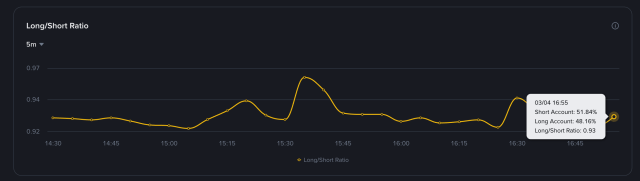
On the 5-minute timeframe, data from Binance shows that the Top Trader Long/Short Ratio (Positions) recently stood at 1.13, with 52.97% of positions long and 47.03% short. This confirms that leading traders maintain a net-long bias. However, the margin remains relatively narrow. Earlier in the session, the ratio was closer to 1.18 before gradually trending lower, indicating that bullish exposure has been scaled back over time.

The broader Long/Short Ratio (Accounts) reinforces this pattern. The metric was near 1.09 at the same timestamp, reflecting 52.12% long accounts compared to 47.88% short. More importantly, this ratio has declined from levels above 1.30 earlier in the observed window among Shiba Inu traders. The downward slope is not dramatic, but it is consistent. That consistency signals a steady cooling in sentiment.
Source: Binance

In strongly trending markets, long/short ratios typically expand as traders crowd into the prevailing direction. Here, the opposite is happening. The imbalance between longs and shorts is compressing. Traders are not abandoning their bullish outlook entirely, but they are scaling back exposure. This suggests risk management is taking priority over aggressive positioning.

Such behavior often appears when the market lacks a clear catalyst. Participants remain involved, yet they hesitate to commit heavily without stronger confirmation from price action.

Balanced Volume Underscores A Market At Decision Point

Taker buy and sell volume data adds another layer of context. Buying activity has produced visible spikes, but these are frequently met with responsive selling. This balanced interaction prevents either side from establishing dominance. Instead of momentum building in one direction, liquidity remains evenly distributed.

Crucially, both positioning ratios for Shiba Inu remain above 1.0. Bulls still hold a structural edge. However, the gradual decline toward parity indicates that confidence is thinning. This is not a bearish reversal signal, but it does reflect growing uncertainty.

Markets often move from expansion to compression before a breakout. The current environment around Shiba Inu resembles that compression phase. Exposure is active but measured. Traders are participating, yet leverage concentration appears controlled.

Taken together, the data presents a coherent narrative. Shiba Inu is not experiencing aggressive accumulation, nor is it under heavy short-term pressure. Instead, it is trading in a state of restrained optimism. The narrowing long bias and balanced volume suggest a market preparing for its next decisive move.

Until a clear imbalance emerges, either through renewed long expansion or a shift below parity, this meme coin remains at a crossroads, with professional traders positioned carefully rather than confidently.

SHIB price begins to recover again | Source: SHIBUSDT on Tradingview.com

Preguntas relacionadas

QWhat does the current Top Trader Long/Short Ratio (Positions) for Shiba Inu indicate about market sentiment?

AThe current ratio of 1.13, with 52.97% long positions and 47.03% short, indicates that top traders maintain a net-long bias, but the narrow margin and its decline from earlier levels of 1.18 show that bullish conviction is steadily fading, reflecting a cautious and controlled optimism.

QHow has the Long/Short Ratio (Accounts) for Shiba Inu changed, and what does this trend signify?

AThe Long/Short Ratio (Accounts) has declined from levels above 1.30 earlier in the observed window to near 1.09, indicating a consistent and steady decline in bullish sentiment among traders, signaling a cooling off rather than a dramatic reversal.

QWhat does the behavior of the long/short ratios in a strongly trending market typically look like compared to the current Shiba Inu market?

AIn a strongly trending market, long/short ratios typically expand as traders crowd into the prevailing direction. In contrast, Shiba Inu's ratios are compressing, indicating that traders are scaling back exposure and prioritizing risk management over aggressive positioning due to a lack of a clear catalyst.

QWhat does the taker buy and sell volume data reveal about the current state of the Shiba Inu market?

AThe taker buy and sell volume data shows that buying activity produces visible spikes, but these are frequently met with responsive selling. This balanced interaction prevents either side from establishing dominance, resulting in evenly distributed liquidity and a market at a decision point.

QHow is the current Shiba Inu market environment characterized based on the overall data presented?

AThe data characterizes the Shiba Inu market as being in a state of restrained optimism and compression. It is not experiencing aggressive accumulation or heavy selling pressure, but is instead active yet measured, with traders carefully positioned and preparing for the next decisive move, leaving the meme coin at a crossroads.

Lecturas Relacionadas

The Value Distribution of Stablecoins

**Summary: The Value Distribution of Stablecoins** The article argues that stablecoins are evolving from mere trading tools into broader channels for dollar access. It divides the stablecoin ecosystem into four layers to analyze how value is distributed: 1. **Issuance Layer:** Mints stablecoins, holds reserve assets, and captures the spread between reserve yield and user costs (e.g., Tether, Circle). This layer currently earns the largest profit margin. 2. **Infrastructure Layer:** Connects stablecoins to the traditional financial system, handling fiat on/off-ramps, banking integration, compliance (KYC/AML), and asset management (e.g., Bridge, BVNK). This is the "unglamorous" but critical work, building the essential bridges between crypto and real-world finance. 3. **Acquiring/Distribution Layer:** Integrates stablecoins into merchant systems, manages payment flows, and provides enterprise financial software (e.g., Stripe, Coinbase). They act as the access point for businesses. 4. **Application Layer:** The end-users and businesses that ultimately use stablecoins for payments, settlements, or as a store of value. They benefit from convenience but have little pricing power. The core thesis is that while the issuance layer currently dominates profits, the often-overlooked **infrastructure layer holds significant long-term potential**. The real challenge and barrier to mass adoption is not the on-chain transfer of stablecoins (which is simple), but the complex "last mile" integration into existing business workflows, banking systems, and regulatory frameworks across different countries. Companies in this layer are currently in a "land grab" phase, investing heavily to build networks, secure bank partnerships, and establish compliance pathways. While their position is currently pressured by the profitable issuers above and distribution platforms below, the article suggests that if stablecoins become a default financial rail for businesses, the infrastructure providers who have done the hard work of integration will ultimately gain strong pricing power and become entrenched, essential players.

marsbitHace 32 min(s)

The Value Distribution of Stablecoins

marsbitHace 32 min(s)

The Value Distribution of Stablecoins

The Value Distribution of Stablecoins The article argues that stablecoins are evolving from a mere trading tool into a broad "dollar channel." It analyzes the industry's value chain through four layers: 1. **Issuance Layer (e.g., Tether, Circle):** The top layer that mints stablecoins, holds reserve assets, and captures the thickest interest rate spread. 2. **Infrastructure Layer (e.g., Bridge, BVNK):** Connects stablecoins to the traditional financial system, handling critical but complex "dirty work" like fiat on/off-ramps, banking integration, compliance (KYC/AML), and cross-border settlement. 3. **Acquiring/Distribution Layer (e.g., Stripe, Coinbase):** Embeds stablecoins into merchant systems, manages payment flows, and integrates with enterprise software. 4. **Application Layer:** End-users and businesses that ultimately use stablecoins for payments, settlement, or storing value. The author posits that while the issuance layer currently captures the most profit, the most overlooked and potentially critical layer is infrastructure. The core challenge for stablecoin adoption isn't the on-chain transfer (which is simple), but bridging the gap between blockchain and the real-world financial system. This involves solving practical problems for businesses: fiat conversion, reconciliation, tax handling, and user onboarding. Infrastructure companies are currently in a difficult "land-grab" phase—building networks, securing banking relationships, and achieving compliance country-by-country. They face pressure from both the profitable issuance layer above and distribution platforms below. However, the author suggests this layer is building a crucial moat. Once stablecoins become a default business rail, the infrastructure players who have done the hard work of integration may gain significant, durable value and pricing power.

链捕手Hace 36 min(s)

The Value Distribution of Stablecoins

链捕手Hace 36 min(s)

How to Do Research Well: Deliberately Practice the Real Skills That Matter

No one truly teaches you how to do research. You're often given a desk, a pre-selected problem, and vague instructions to "create something new." Consequently, many people reverse-engineer the job based on visible outputs—papers, posts, announcements—learning only how to *appear* like a researcher rather than how to *become* one. True research capability is built from stacking small, trainable skills, nearly all of which can be developed through deliberate practice. **Pick Your Own Problem:** Most researchers absorb problems from advisors or trends, lacking the underlying reasoning. Choosing a problem you genuinely care about, as John Schulman advises, leads to original work. Develop "taste" like a muscle: predict experiment outcomes, guess paper results from methods, and track which findings remain important over time. **Upgrade Your Inputs:** Relying on shared reading lists (arXiv hot lists, filtered group chats) leads to unoriginal conclusions. Undervalued old literature often holds crucial insights (e.g., MoE, LSTM, backpropagation). Richard Sutton's "The Bitter Lesson" or Claude Shannon's 1952 talk on creative thinking are more predictive than lengthy modern surveys. Breadth matters as much as depth: draw from neuroscience, mechanism design, hardware knowledge, and honest statistics. Read papers directly, especially appendices and limitations sections. **Write Everything Down:** As Paul Graham noted, writing exposes flaws in seemingly mature ideas. Writing is the cheapest defense against self-deception. Following Feynman's principle, Darwin programmatically wrote down facts contradicting his theory to combat memory bias. Maintain a detailed log of hypotheses, setups, predictions, results, and updated understandings. Reviewing past logs fosters essential humility.

marsbitHace 2 hora(s)

How to Do Research Well: Deliberately Practice the Real Skills That Matter

marsbitHace 2 hora(s)

Trading

Spot
Futuros

Artículos destacados

Qué es MEME 2.0

Memecoin 2.0: El Ascenso de $MEME 2.0 en el Mundo de las Criptomonedas Introducción En el panorama siempre cambiante de las criptomonedas, ha surgido un nuevo contendiente. Memecoin 2.0, simbolizada como $MEME 2.0, lleva el concepto de las monedas meme a un emocionante nuevo nivel. Como un subproducto del Memecoin original, este proyecto ha capturado la atención de la comunidad cripto al cambiar el enfoque de los incentivos financieros típicos a una experiencia comprometida y entretenida. Operando en la blockchain de Ethereum, Memecoin 2.0 redefine audazmente la participación de la comunidad en la esfera cripto. ¿Qué es Memecoin 2.0, $MEME 2.0? En su núcleo, Memecoin 2.0 es un proyecto de criptomoneda que prioriza el espíritu comunitario y la diversión asociada con la cultura meme. A diferencia de las criptomonedas convencionales, que se concentran en casos de uso prácticos y beneficios tangibles, Memecoin 2.0 se distingue al abrazar el lado más liviano de la moneda digital. El proyecto existe sin promesas de utilidad, un mapa estructurado o retornos financieros, enfocándose en cambio en fomentar una comunidad vibrante centrada en memes y en el disfrute compartido. Al hacerlo, aprovecha la creciente tendencia de la cultura meme en el espacio en línea, convirtiéndose en un jugador único en el mundo de los activos digitales. Creador de Memecoin 2.0, $MEME 2.0 A pesar de la extensa investigación sobre los orígenes de Memecoin 2.0, la identidad explícita de su creador sigue siendo desconocida. Esta anonimidad no es inusual en la comunidad cripto, donde muchos proyectos son liderados por individuos o grupos que prefieren permanecer en las sombras. La falta de información disponible públicamente sobre el creador podría verse como un movimiento estratégico, poniendo el foco en la participación comunitaria en lugar de la notoriedad individual dentro del espacio. Inversores de Memecoin 2.0, $MEME 2.0 La información sobre los inversores o el respaldo financiero de Memecoin 2.0 es escasa. Esta ausencia de detalles puede sugerir que el proyecto es autofinanciado o que su enfoque en la comunidad en lugar de las estructuras de inversión tradicionales ha atraído a un tipo diferente de apoyo. Dado que el mundo de las monedas meme generalmente involucra una participación más de base en lugar de inversión institucional, este enfoque está alineado con la ética de los proyectos impulsados por la comunidad. ¿Cómo Funciona Memecoin 2.0, $MEME 2.0? Memecoin 2.0 opera completamente en la blockchain de Ethereum, capitalizando sus robustas características de seguridad y escalabilidad. Al aprovechar las fortalezas de Ethereum, Memecoin 2.0 puede ofrecer un entorno seguro para las interacciones de los usuarios, asegurando que las transacciones sean tanto eficientes como rentables. Uno de los atributos únicos de Memecoin 2.0 radica en su estructura impulsada por la comunidad. El valor y la popularidad del token $MEME 2.0 derivan de la participación activa de sus usuarios, en vez de de una utilidad inherente. Este diseño refuerza el enfoque del proyecto en el aspecto de entretenimiento de las criptomonedas, lo que implica que la risa y la participación comunitaria son las verdaderas monedas que impulsan su éxito. Además, el proyecto encaja dentro del ecosistema más amplio de las monedas meme, donde el valor de cada moneda meme oscila basado en la cultura, tendencias y la participación de la comunidad, en lugar de principios económicos tradicionales. Cronología de Memecoin 2.0, $MEME 2.0 Para entender mejor la evolución y los hitos de Memecoin 2.0, aquí hay una cronología que destaca eventos significativos en su historia: 2024: Se reconoce la creación de Memecoin 2.0 como una ramificación del Memecoin original, estableciéndose dentro del contexto próspero de las monedas meme mientras opera en la blockchain de Ethereum. 13 de julio de 2024: Memecoin 2.0 se posiciona oficialmente como una moneda meme centrada en la comunidad en la red de Ethereum, enfatizando su enfoque centrado en el entretenimiento que invita a los usuarios a participar y crecer. Puntos Clave Sobre Memecoin 2.0, $MEME 2.0 Varios rasgos críticos definen a Memecoin 2.0: Enfoque Centrado en la Comunidad: La misión principal de Memecoin 2.0 es crear una experiencia comunitaria divertida y atractiva, capitalizando en el disfrute colectivo derivado de la cultura memética. Construido sobre Ethereum: Operar en la blockchain de Ethereum proporciona al proyecto una infraestructura esencial que garantiza seguridad y escalabilidad. Falta de Utilidad o Hoja de Ruta: En un notable desvío de las criptomonedas tradicionales, Memecoin 2.0 no promete características utilitarias ni retornos financieros, reafirmando su compromiso con la participación comunitaria y el compromiso social. Enfoque en la Cultura Memética: Al abrazar los aspectos humorísticos y culturales del fenómeno meme, Memecoin 2.0 proporciona una plataforma para que los usuarios interactúen con cripto tanto fuera de línea como en línea. Contexto Adicional: La Importancia de las Monedas Meme Las monedas meme han surgido como una clase distinta de criptomonedas, a menudo impulsadas por el humor y un enfoque desenfadado para el comercio. Estas monedas generalmente carecen de una utilidad significativa o hojas de ruta de desarrollo, atrayendo a los usuarios con la promesa de diversión, interacción comunitaria y relevancia cultural. En el panorama del ecosistema cripto más amplio, las monedas meme reviven la importancia de la participación comunitaria, revirtiendo enfoques únicamente motivados por el lucro. Proyectos como Memecoin 2.0 inauguran una era donde el entretenimiento puede armonizar con las aspiraciones financieras, convirtiendo la blockchain en un parque de diversiones para la creatividad y la interacción social. Conclusión Memecoin 2.0, o $MEME 2.0, encarna una nueva ola de criptomonedas que prioriza la participación comunitaria sobre estructuras financieras rígidas. Con un enfoque en el humor y la interacción social, capitaliza sobre la fascinación que rodea la cultura meme. Al operar en la blockchain de Ethereum, Memecoin 2.0 aprovecha las capacidades de la tecnología mientras se mantiene firme en su compromiso con el valor de entretenimiento de la moneda digital. A medida que el espacio alrededor de las criptomonedas continúa evolucionando, Memecoin 2.0 sirve como un testimonio de la noción de que el futuro de los activos digitales podría depender, en gran medida, de experiencias compartidas, risas y sólidas conexiones comunitarias. En el mundo impredecible de las criptomonedas, quizás la alegría pueda ser tan valiosa como la ganancia financiera tradicional.

96 Vistas totalesPublicado en 2024.04.04Actualizado en 2024.12.03

Qué es MEME 2.0

Cómo comprar MEME

¡Bienvenido a HTX.com! Hemos hecho que comprar Memeland (MEME) sea simple y conveniente. Sigue nuestra guía paso a paso para iniciar tu viaje de criptos.Paso 1: crea tu cuenta HTXUtiliza tu correo electrónico o número de teléfono para registrarte y obtener una cuenta gratuita en HTX. Experimenta un proceso de registro sin complicaciones y desbloquea todas las funciones.Obtener mi cuentaPaso 2: ve a Comprar cripto y elige tu método de pagoTarjeta de crédito/débito: usa tu Visa o Mastercard para comprar Memeland (MEME) al instante.Saldo: utiliza fondos del saldo de tu cuenta HTX para tradear sin problemas.Terceros: hemos agregado métodos de pago populares como Google Pay y Apple Pay para mejorar la comodidad.P2P: tradear directamente con otros usuarios en HTX.Over-the-Counter (OTC): ofrecemos servicios personalizados y tipos de cambio competitivos para los traders.Paso 3: guarda tu Memeland (MEME)Después de comprar tu Memeland (MEME), guárdalo en tu cuenta HTX. Alternativamente, puedes enviarlo a otro lugar mediante transferencia blockchain o utilizarlo para tradear otras criptomonedas.Paso 4: tradear Memeland (MEME)Tradear fácilmente con Memeland (MEME) en HTX's mercado spot. Simplemente accede a tu cuenta, selecciona tu par de trading, ejecuta tus trades y monitorea en tiempo real. Ofrecemos una experiencia fácil de usar tanto para principiantes como para traders experimentados.

217 Vistas totalesPublicado en 2024.12.12Actualizado en 2026.06.02

Cómo comprar MEME

Discusiones

Bienvenido a la comunidad de HTX. Aquí puedes mantenerte informado sobre los últimos desarrollos de la plataforma y acceder a análisis profesionales del mercado. A continuación se presentan las opiniones de los usuarios sobre el precio de MEME (MEME).

活动图片














