ShapeShift founder denies $260mln whale accumulation – Here’s what we know!

ambcryptoPublicado a 2026-03-23Actualizado a 2026-03-23

Recent on-chain data suggests that large investors are quietly building strong positions in Ethereum.

Over the past two weeks, a major whale, reportedly linked to Erik Voorhees, Founder of ShapeShift, has deployed nearly $260 million in USDT to accumulate more than 120,000 ETH.

This buying pattern points to a steady accumulation strategy rather than a one-time trade. For instance, in the latest transaction, the whale spent $4.29 million to purchase ETH at $2,134.
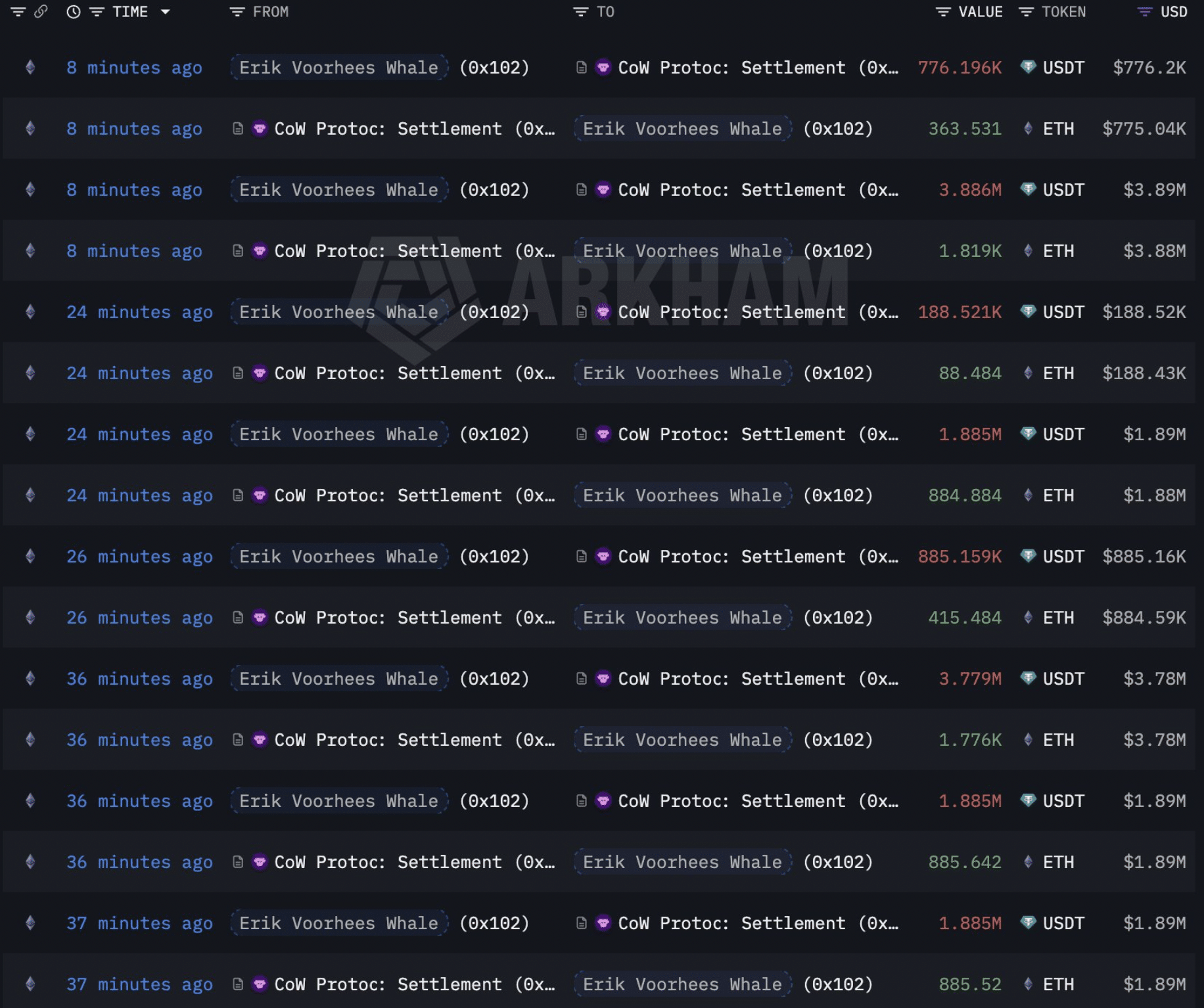
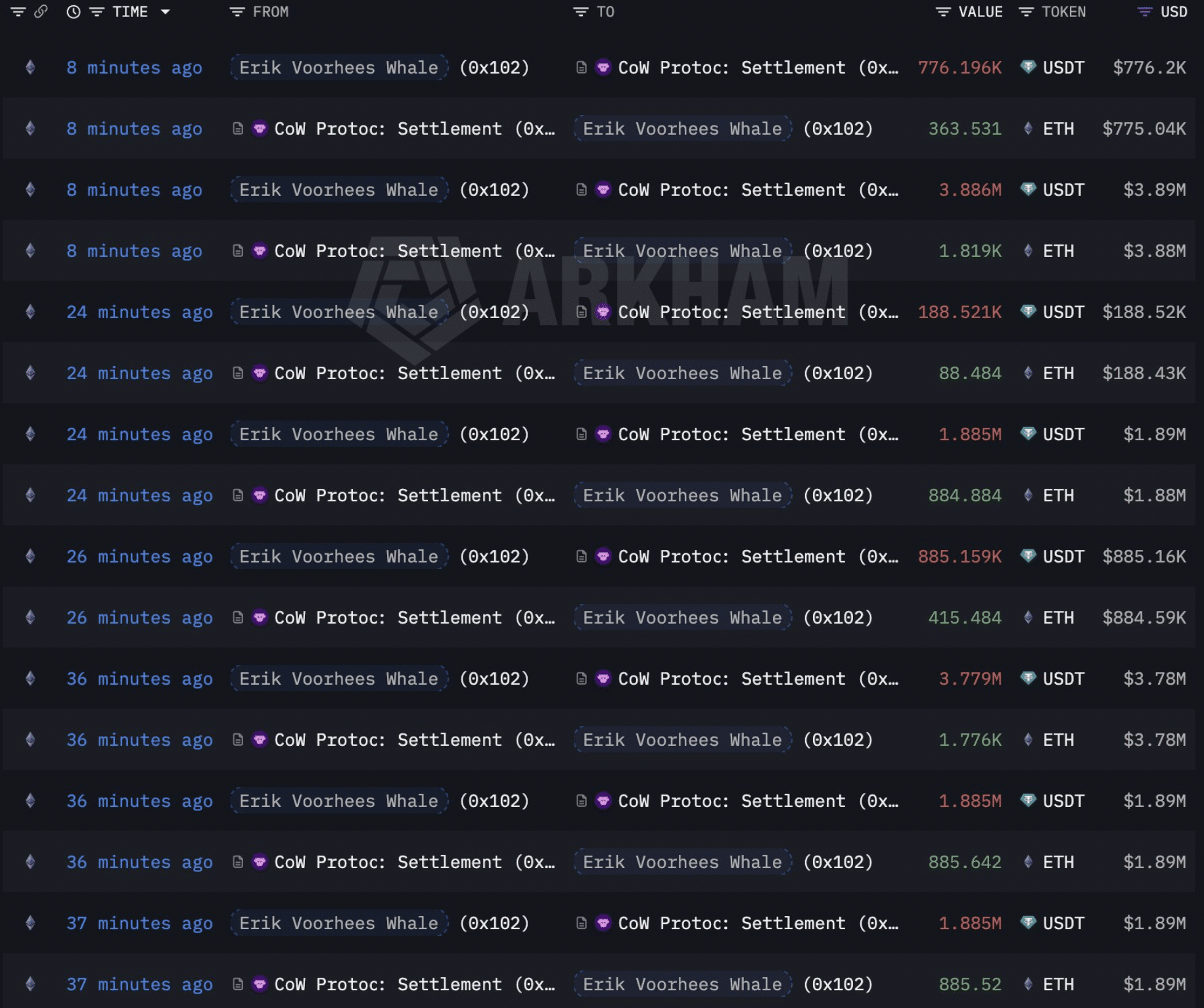
Source: Lookonchain/X

Overall, the average buying price stands at around $2,162, which now acts as a key support level for the market.

Such moves signal strong confidence that Ethereum may be nearing its bottom, with expectations of potential upside in the coming months.

Notably, this accumulation is happening even as ETH trades at $2,071.67, down over 3% in the last 24 hours. This paints a clear divergence between short-term price action and long-term investor sentiment.

Retail vs whale behavior

To understand this better, let’s analyse the Spot Retail Activity by CryptoQuant.

Historically, smaller investors tend to buy when prices are already high, driven by FOMO. This happened in past cycles like 2018, 2021, and even 2024.
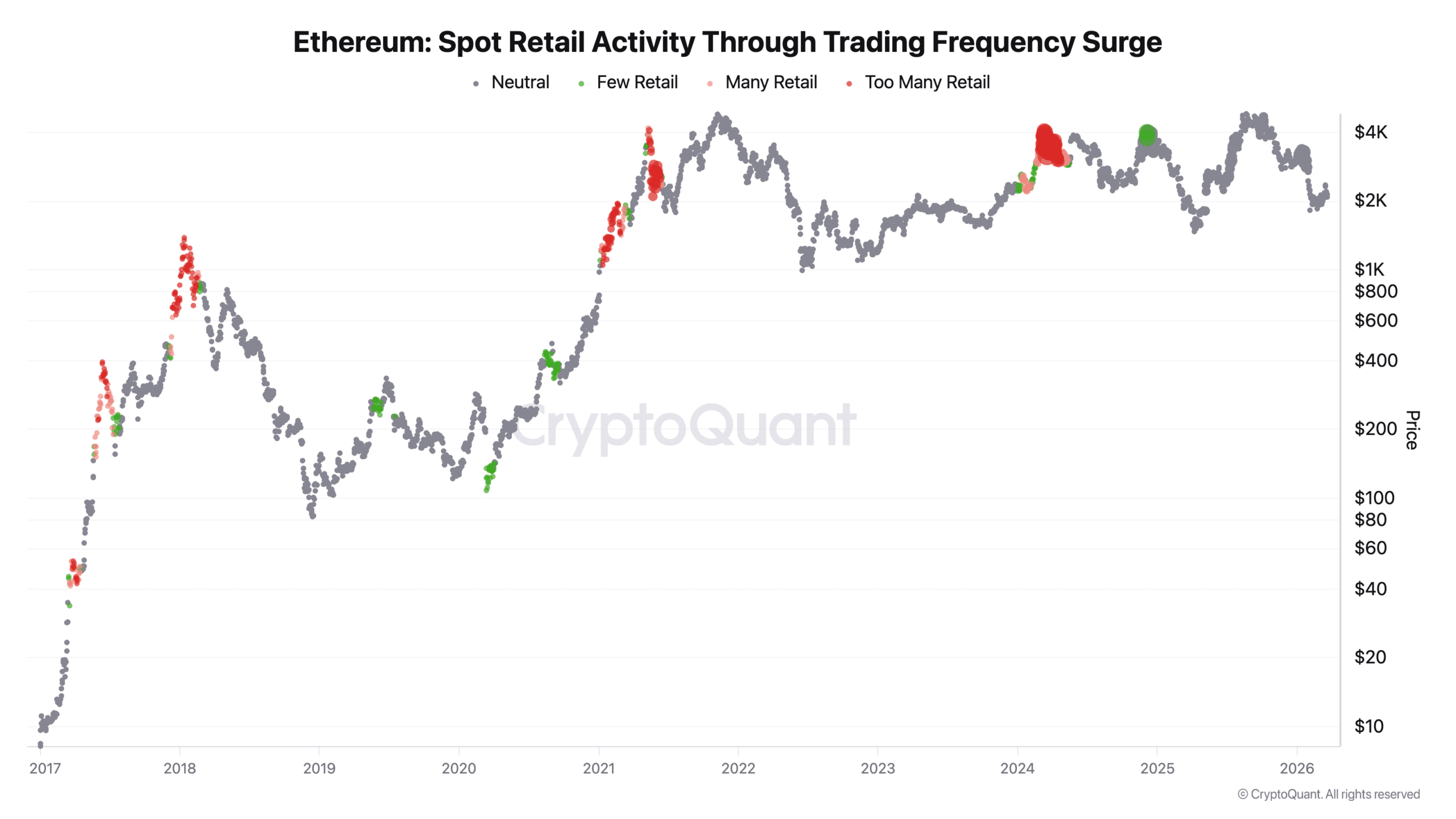
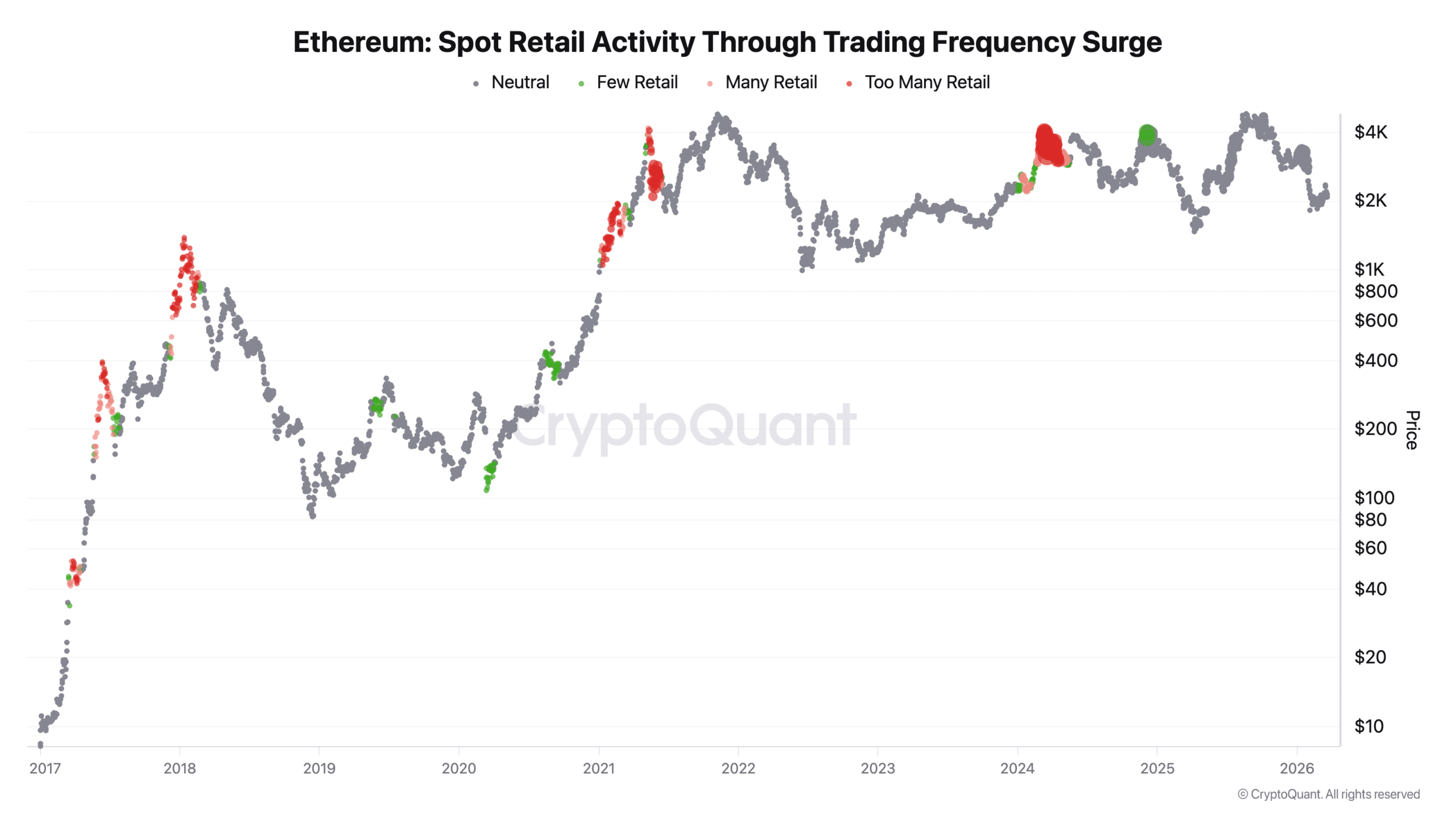
Source: CryptoQuant

Right now, retail activity is relatively low, which is actually a good sign. It means the market is in a quieter phase where large investors are accumulating, while the public is still on the sidelines.

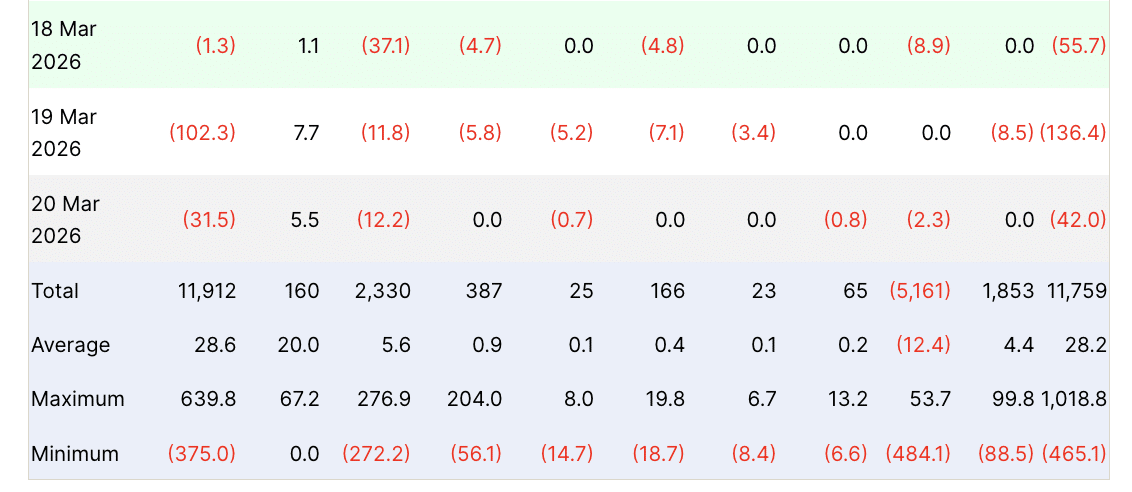
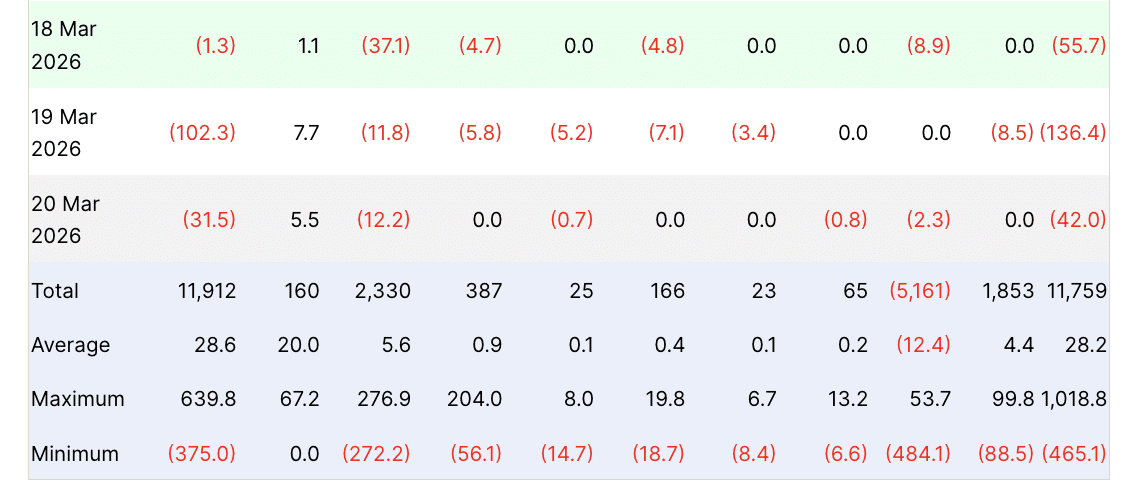
Interestingly, while this whale has been aggressively buying Ethereum [ETH], ETFs have been seeing money flow out, which may seem negative at first.
Source: Farside Investors

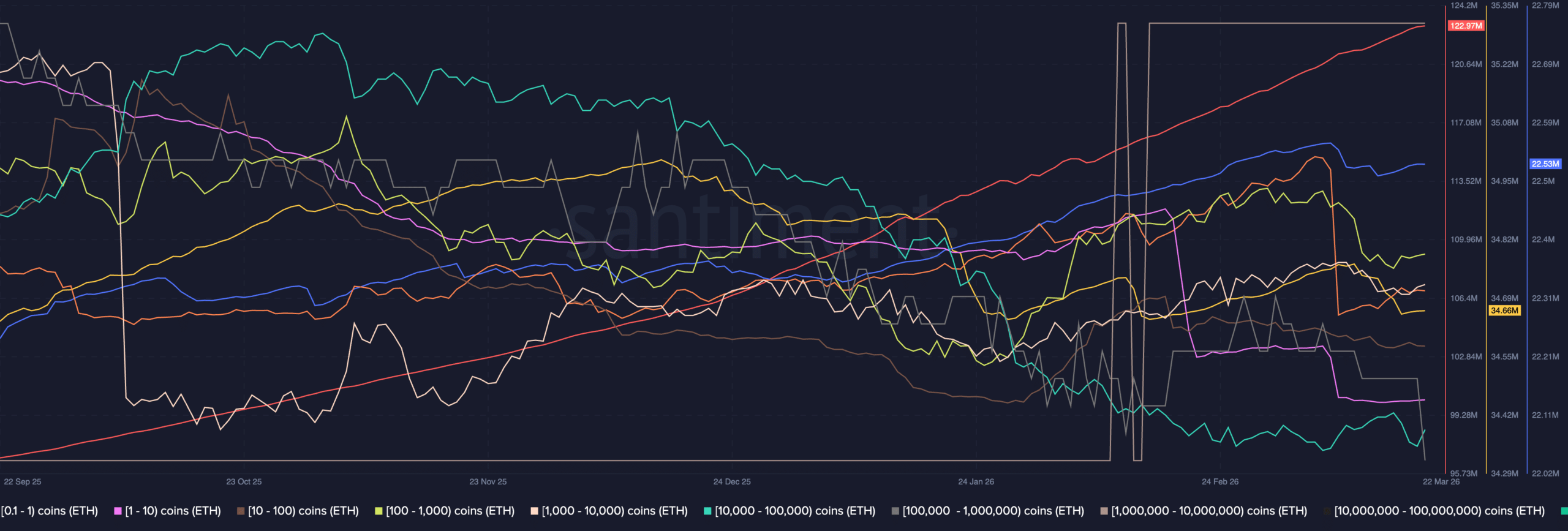
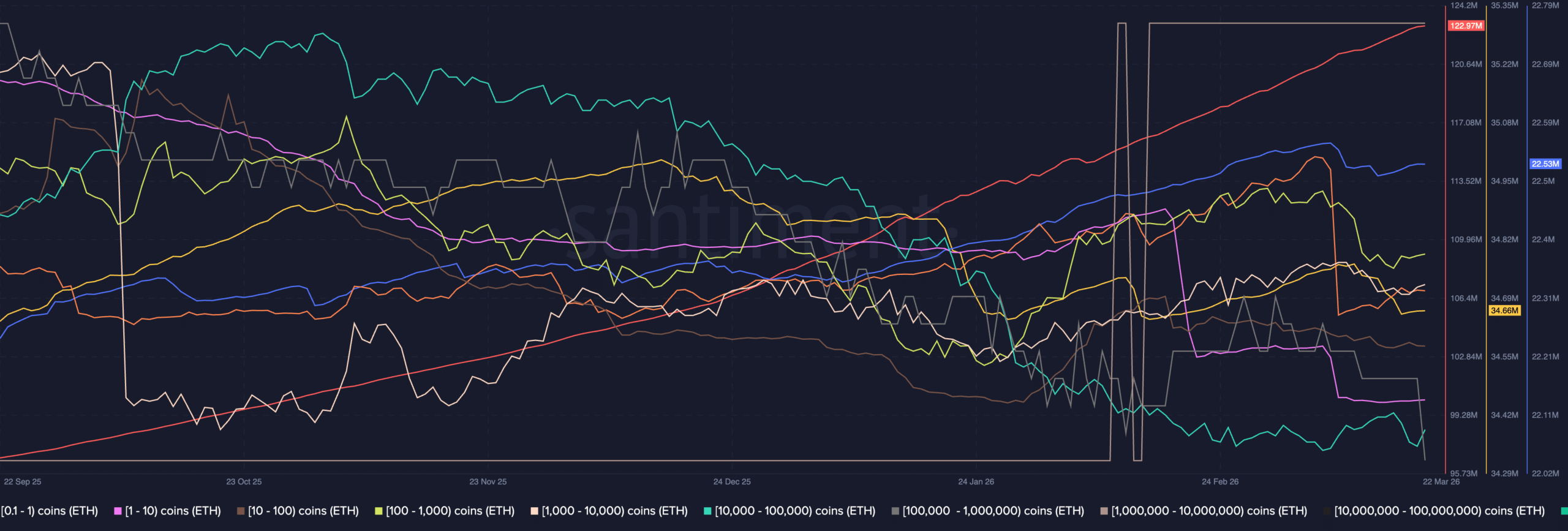
However, a closer look reveals that large whales are steadily increasing their holdings, while mid-sized investors seem to be selling or redistributing.

Meanwhile, retail investors remain inconsistent, often buying at higher levels and selling during dips.
Source: Santiment

Overall, this indicates that Ethereum is gradually moving from weaker hands to stronger, long-term holders, which is typically a bullish sign for the market.

Voorhees’ past whale move and a crazy plot twist

For those unaware, this whale activity began on the 16th of March and intensified on the 20th of March, when the Voorhees-linked whale made another major move.
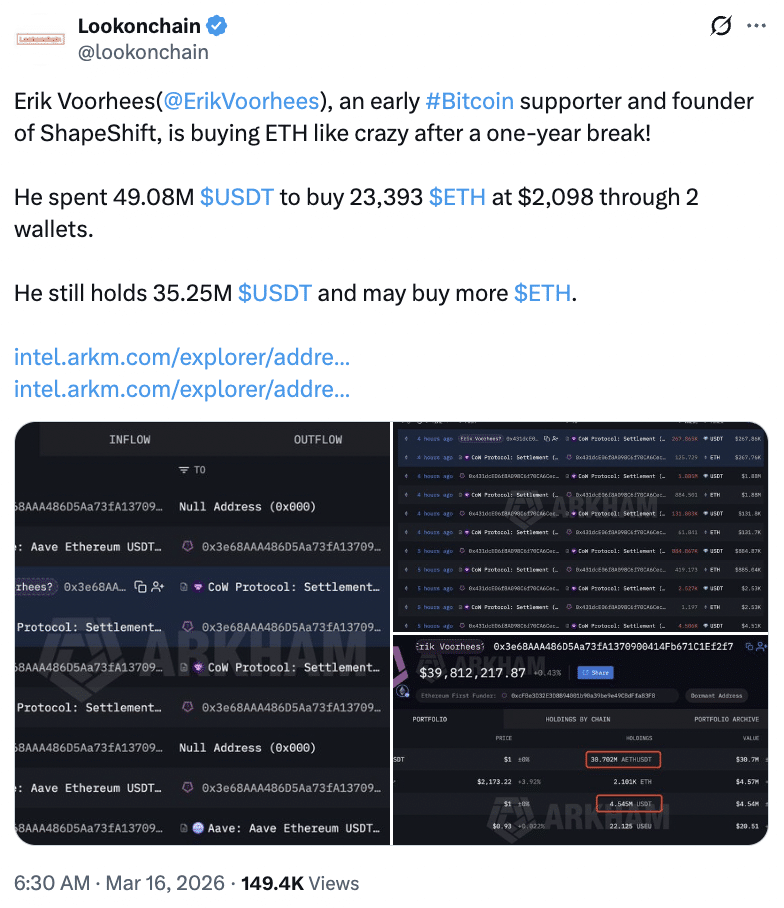
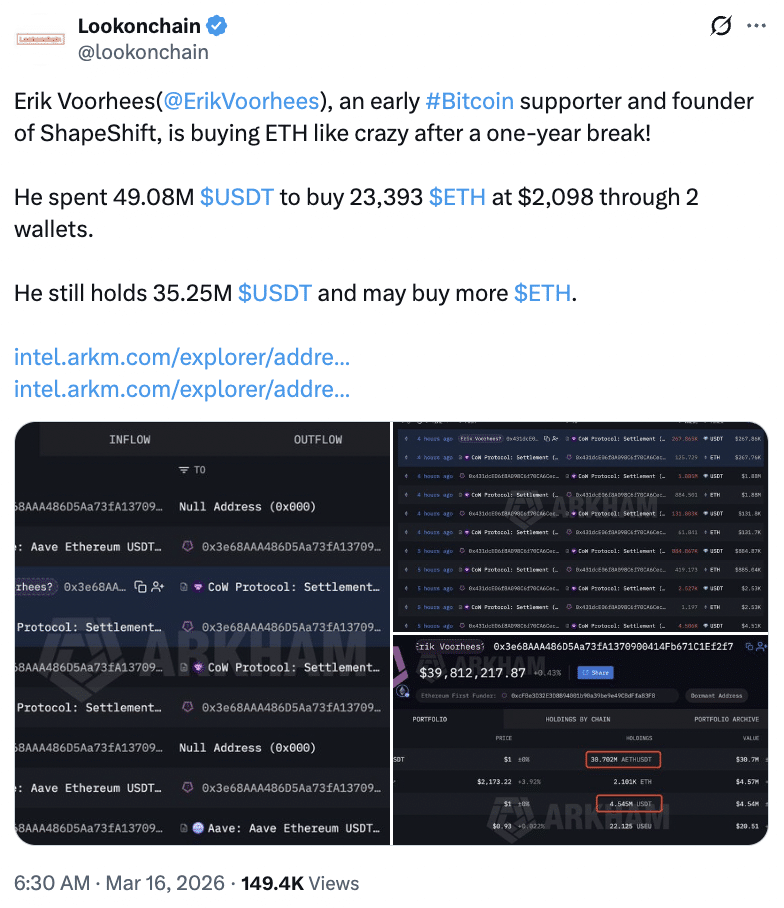
Source: Lookonchain/X

However, the narrative took a sharp turn when Voorhees publicly denied any involvement and said,

I did not buy any eth and those tracking sites are a scam.

Now, this throws darts at two opposite possibilities. In the first case, it could be a different investor with similar wallet activity, or simply a misidentification by tracking platforms.

However, another possibility is stealth accumulation, where large investors buy quietly to avoid moving the market.

Whatever the possibilities may be, such whale movements do impact how investors perceive and feel about the token’s future.


Final Summary

  • Price weakness is being used as an opportunity by large players, not a warning sign.
  • ETF outflows may look bearish, but on-chain data shows whales are steadily increasing holdings.

Preguntas relacionadas

QWhat recent on-chain activity is linked to a major whale, and how much ETH was accumulated?

ARecent on-chain data suggests a major whale, reportedly linked to Erik Voorhees, deployed nearly $260 million in USDT to accumulate more than 120,000 ETH over the past two weeks.

QWhat is the average buying price for the whale's ETH accumulation, and why is it significant?

AThe average buying price for the whale's accumulation stands at around $2,162, which now acts as a key support level for the market.

QHow does the current retail activity for Ethereum compare to the behavior of large whales, according to the article?

ARetail activity is currently low, which is a sign the market is in a quieter phase where large investors are accumulating, while retail investors tend to buy at higher prices and sell during dips.

QWhat was Erik Voorhees's public response to the reports linking him to the whale activity?

AErik Voorhees publicly denied any involvement, stating, 'I did not buy any eth and those tracking sites are a scam.'

QWhat is one possible explanation given in the article for the whale's activity if it is not Voorhees?

AOne possibility is that it could be a different investor with similar wallet activity, or simply a misidentification by tracking platforms. Another possibility is stealth accumulation, where large investors buy quietly to avoid moving the market.

Lecturas Relacionadas

From Payment to Deployment: Stripe Bets on the AI Agent Economy

From Payments to Deployment: Stripe Bets on the AI Agent Economy Stripe is redefining economic infrastructure for the AI era, shifting its focus from serving primarily human users and software companies to enabling machine agents as active economic participants. The core thesis is that AI agents are evolving from tools into independent buyers and builders on the internet, necessitating a complete overhaul of traditional payment, billing, and deployment models. To empower agents as **buyers**, Stripe, in collaboration with Tempo, developed the Machine Payments Protocol. This protocol allows businesses to programmatically accept payments from agents without human intervention, using machine-readable payment instructions. Furthermore, Stripe's consumer wallet, Link, is being adapted to let users securely authorize agents to spend on their behalf. To empower agents as **builders**, Stripe Projects aims to simplify the deployment process. It allows developers and their agents to register, manage, and integrate the services needed to deploy applications directly from the command line, making "vibe-deploying" as seamless as "vibe-coding." This agent-driven economy, where products have real, variable costs (like AI tokens), disrupts traditional SaaS models. **Token-based monetization** is becoming central, requiring usage-based billing that charges for actual resource consumption, as seen with companies like Lovable and ElevenLabs. However, this model introduces new challenges like **token theft**, where fraudsters exploit services and vanish before billing. Stripe Radar helps combat this by assessing new accounts and predicting abuse risks. A critical innovation to balance customer experience and financial risk is **streaming payments**. By combining Metronome (for real-time usage tracking) with Tempo (for low-cost, high-frequency stablecoin payments), Stripe enables AI companies to collect fees *as tokens are consumed*. This eliminates the trade-off between imposing hard usage caps and risking unpaid invoices. In summary, Stripe's vision for AI economic infrastructure now encompasses providing a commercial framework for agents, wallets for agents, deployment tools for agents, token-based billing, fraud prevention for token abuse, and streaming payment capabilities. As AI transforms both commerce and software creation, Stripe is building the foundational infrastructure to support it.

marsbitHace 26 min(s)

From Payment to Deployment: Stripe Bets on the AI Agent Economy

marsbitHace 26 min(s)

Trading

Spot
Futuros
活动图片





