Senator Cynthia Lummis urges CLARITY Act rush: ‘Let’s get it done, once and for all’

ambcryptoPublicado a 2026-03-23Actualizado a 2026-03-23

Resumen

After months of stalemate over stablecoin yield regulations, a breakthrough has been reached on the CLARITY Act. Following intense negotiations in March, the White House and Senators agreed on a compromise: passive rewards for simply holding stablecoins are prohibited, but activity-based rewards for using them in transactions are permitted. Senator Cynthia Lummis urged swift passage, warning that if the Senate Banking Committee doesn't approve the bill by April's end, progress could stall until 2027 due to the upcoming midterm elections. Market sentiment has improved, with prediction markets showing a 10% increase in the act's passage odds. This legislation aims to establish clear crypto regulations, positioning the U.S. as a global digital asset hub.

For months, the U.S. crypto space has been stuck on one key issue: yield. This refers to the rewards people earn on stablecoins.

The clash between traditional banks and crypto firms went beyond slowing progress and nearly blocked the Digital Asset Market CLARITY Act. At one point, it even risked pushing innovation outside the U.S.

Now, things are starting to move. After intense meetings between the White House and lawmakers this March, a breakthrough seems close.

Executives are confident about the CLARITY Act passage

Senator Cynthia Lummis said negotiations are done, suggesting a deal on stablecoin rewards is almost here, but the obstacles are not over yet.

With an important Senate review coming in April and midterm elections approaching in 2026, time is running out. If a deal isn’t reached by May, progress on clear crypto rules could be delayed for a long time.

Senator Lummis said,

President Trump pledged to make America the digital asset capital of the world. The CLARITY Act is how we make that happen. Let’s get it done, once and for all.

What changed?

For those unaware, things took a big turn on the 20th of March. Patrick Witt, the White House’s top crypto advisor, said that the Senate and the administration had reached an “agreement in principle.”

He called it a major step forward, as it finally breaks the long-standing deadlock. He also gave credit to Senators Thom Tillis and Angela Alsobrooks for helping both sides reach a compromise.

The deal finally found a middle path. As per the latest discussion, it will not allow passive rewards, meaning users won’t earn interest just for holding stablecoins, which was a concern for banks.

But it will allow activity-based rewards, where users can earn benefits by using stablecoins for payments or on platforms.

Crypto community is optimistic

Nic Puckrin, CEO of Coin Bureau, also stressed that time is running out. He said that if the CLARITY Act doesn’t pass the Senate Banking Committee by the end of April, it could be “dead” until 2027, as lawmakers will soon shift focus to the 2026 midterm elections.

Still, Puckrin is cautiously hopeful, as he said,

Yesterday, the stablecoin yield deal happened. Senators + the White House reached a compromise on the exact issue that’s been blocking this for months.

He added,

This isn’t done yet. But the path just opened. Watch April closely.

Polymarket odds rise

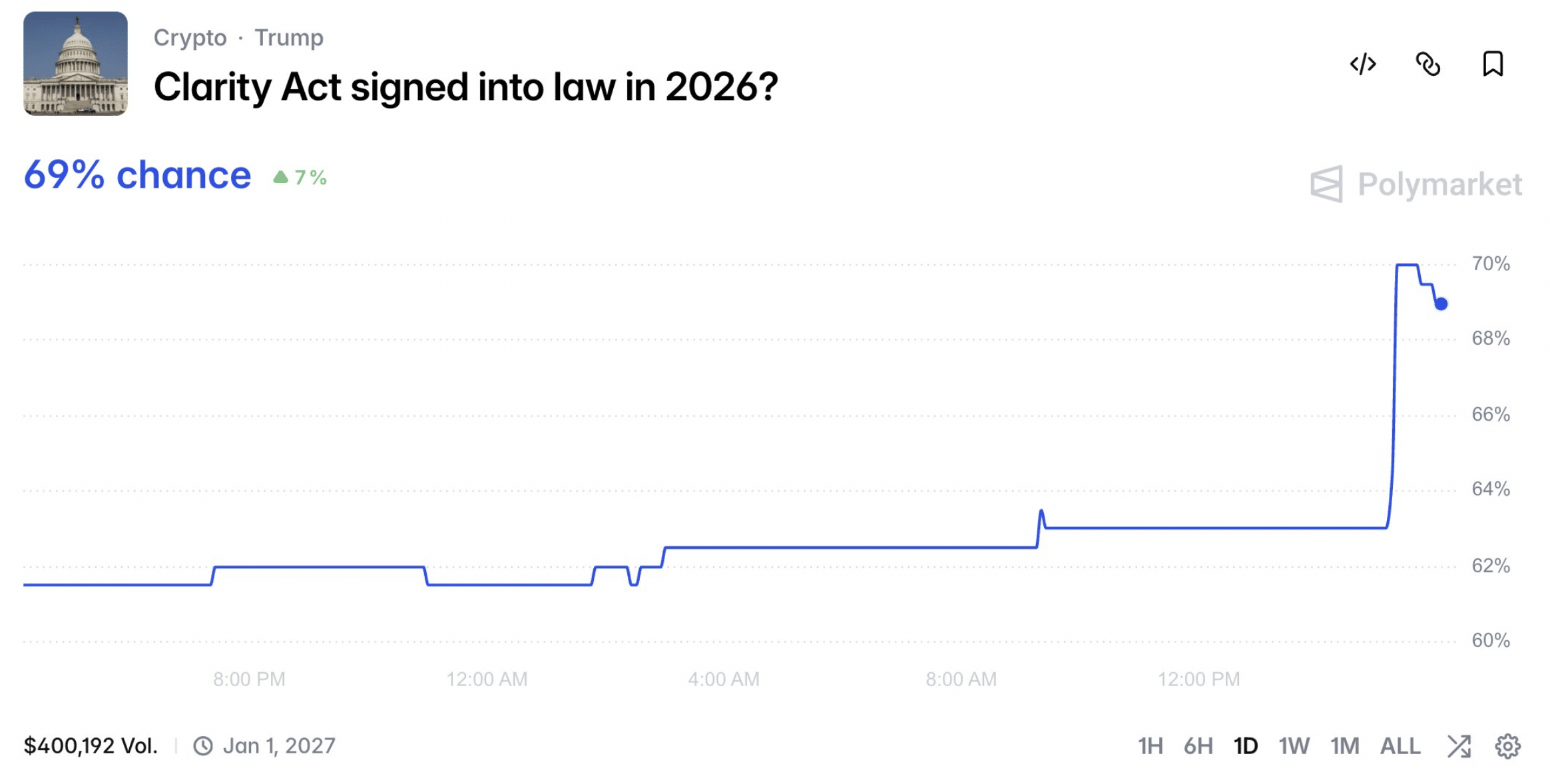
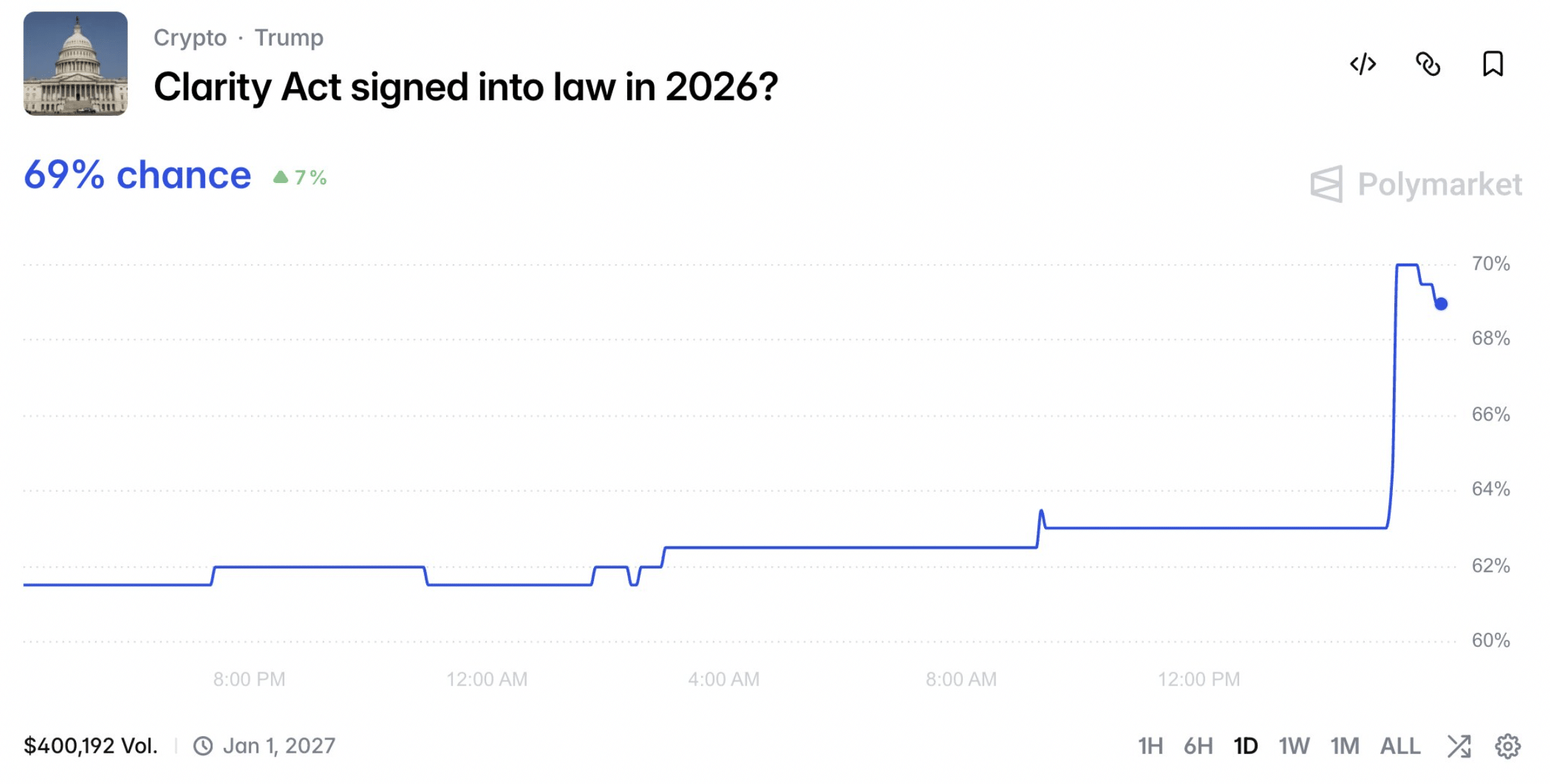
This shift is already visible in market sentiment. On Polymarket, the chances of the CLARITY Act becoming law in 2026 jumped from 60% to 70% in just one day after the update on the 20th of March.
Source: Polymarket

This shows that more people now believe the long delay in decision-making might finally end.

If this momentum continues and the bill passes between April and May, it could have a massive impact. It may bring in large amounts of investment and make the crypto market work more efficiently.

More importantly, it would replace unclear regulation and position the U.S. as a global crypto hub. Ergo, as expected, all eyes are on what comes next for the CLARITY Act.


Final Summary

  • The stablecoin yield compromise has broken a months-long deadlock, bringing the CLARITY Act closer to reality.
  • Political pressure from the upcoming 2026 midterms could delay progress if deadlines are missed.

Preguntas relacionadas

QWhat is the main issue that has been stalling progress in the U.S. crypto space according to the article?

AThe main issue has been the debate over yield, specifically the rewards people earn on stablecoins.

QWhat key compromise was reached between the Senate and the White House regarding stablecoin rewards?

AThe compromise allows for activity-based rewards, where users can earn benefits by using stablecoins for payments or on platforms, but it will not allow passive rewards (earning interest just for holding stablecoins).

QWhy is there a sense of urgency to pass the CLARITY Act by the end of April?

AIf the act doesn't pass the Senate Banking Committee by the end of April, progress could be delayed until 2027 because lawmakers will soon shift their focus to the 2026 midterm elections.

QHow did the market prediction platform Polymarket react to the news of the compromise?

AOn Polymarket, the prediction odds of the CLARITY Act becoming law in 2026 jumped from 60% to 70% in just one day after the announcement on March 20th.

QWhat did Senator Cynthia Lummis say is the purpose of the CLARITY Act?

ASenator Lummis stated that the CLARITY Act is how the U.S. will achieve President Trump's pledge to make America the digital asset capital of the world.

Lecturas Relacionadas

Can a Hair Dryer Earn $34,000? Deciphering the Reflexivity Paradox in Prediction Markets

An individual manipulated a weather sensor at Paris Charles de Gaulle Airport with a portable heat source, causing a Polymarket weather market to settle at 22°C and earning $34,000. This incident highlights a fundamental issue in prediction markets: when a market aims to reflect reality, it also incentivizes participants to influence that reality. Prediction markets operate on two layers: platform rules (what outcome counts as a win) and data sources (what actually happened). While most focus on rules, the real vulnerability lies in the data source. If reality is recorded through a specific source, influencing that source directly affects market settlement. The article categorizes markets by their vulnerability: 1. **Single-point physical data sources** (e.g., weather stations): Easily manipulated through physical interference. 2. **Insider information markets** (e.g., MrBeast video details): Insiders like team members use non-public information to trade. Kalshi fined a剪辑师 $20,000 for insider trading. 3. **Actor-manipulated markets** (e.g., Andrew Tate’s tweet counts): The subject of the market can control the outcome. Evidence suggests Tate’sociated accounts coordinated to profit. 4. **Individual-action markets** (e.g., WNBA disruptions): A single person can execute an event to profit from their pre-placed bets. Kalshi and Polymarket handle these issues differently. Kalshi enforces strict KYC, publicly penalizes insider trading, and reports to regulators. Polymarket, with its anonymous wallet-based system, has historically been more permissive, arguing that insider information improves market accuracy. However, it cooperated with authorities in the "Van Dyke case," where a user traded on classified government information. The core paradox is reflexivity: prediction markets are designed to discover truth, but their financial incentives can distort reality. The more valuable a prediction becomes, the more likely participants are to influence the event itself. The market ceases to be a mirror of reality and instead shapes it.

marsbitHace 46 min(s)

Can a Hair Dryer Earn $34,000? Deciphering the Reflexivity Paradox in Prediction Markets

marsbitHace 46 min(s)

First Day Review of "Musk's WeChat" XChat: Even Worse Than Expected

Elon Musk's much-anticipated "WeChat-like" app, XChat, has officially launched after multiple delays. The initial review reveals a product that falls short of expectations, offering an experience largely similar to X Platform's (formerly Twitter) direct messages, despite being marketed as an encrypted communication tool. Key observations from the first-day test include: 1. The app's promoted "end-to-end encryption" and its claimed relation to Bitcoin's architecture were criticized by experts as a superficial attempt to capitalize on crypto buzz, with no real technical connection. 2. Musk's vision of an ad-free "secure communication system" is technically met, but only because the app is currently extremely basic, featuring only a single chat interface. 3. A promised anti-screenshot feature appears inconsistent; it works in X Platform group chats but fails within the XChat app itself, where screenshots still capture avatars. 4. The app supports 45 languages and has a 16+ age rating, indicating a broader tolerance for content compared to WeChat's 13+ rating. 5. A puzzling login process requires users to verify the email associated with their X account. 6. The touted encryption" feels minimal in practice, with its presence only indicated by a simple "Encrypted - Yes" label on messages. 7. Disappearing message timers for groups can be set from 5 minutes to 4 weeks, with the timer starting upon being read by a user. 8. Group invite links are shared with X Platform groups. 9. Group size limits are planned to be increased, aiming for 1000 members, a move that has drawn user criticism. 10. The app offers 8 different colored icons, and its chat bubbles are notably similar to WeChat's. Message deletion options mimic Telegram's. Crucially, many pre-announced features like importing X contacts, integrating Grok AI, X Money payments, and Cashtags are not yet available. The initial release is seen as a bare-bones and underwhelming first step.

Odaily星球日报Hace 1 hora(s)

First Day Review of "Musk's WeChat" XChat: Even Worse Than Expected

Odaily星球日报Hace 1 hora(s)

Trading

Spot
Futuros

Artículos destacados

Cómo comprar ONE

¡Bienvenido a HTX.com! Hemos hecho que comprar Harmony (ONE) sea simple y conveniente. Sigue nuestra guía paso a paso para iniciar tu viaje de criptos.Paso 1: crea tu cuenta HTXUtiliza tu correo electrónico o número de teléfono para registrarte y obtener una cuenta gratuita en HTX. Experimenta un proceso de registro sin complicaciones y desbloquea todas las funciones.Obtener mi cuentaPaso 2: ve a Comprar cripto y elige tu método de pagoTarjeta de crédito/débito: usa tu Visa o Mastercard para comprar Harmony (ONE) al instante.Saldo: utiliza fondos del saldo de tu cuenta HTX para tradear sin problemas.Terceros: hemos agregado métodos de pago populares como Google Pay y Apple Pay para mejorar la comodidad.P2P: tradear directamente con otros usuarios en HTX.Over-the-Counter (OTC): ofrecemos servicios personalizados y tipos de cambio competitivos para los traders.Paso 3: guarda tu Harmony (ONE)Después de comprar tu Harmony (ONE), guárdalo en tu cuenta HTX. Alternativamente, puedes enviarlo a otro lugar mediante transferencia blockchain o utilizarlo para tradear otras criptomonedas.Paso 4: tradear Harmony (ONE)Tradear fácilmente con Harmony (ONE) en HTX's mercado spot. Simplemente accede a tu cuenta, selecciona tu par de trading, ejecuta tus trades y monitorea en tiempo real. Ofrecemos una experiencia fácil de usar tanto para principiantes como para traders experimentados.

225 Vistas totalesPublicado en 2024.12.12Actualizado en 2025.03.21

Cómo comprar ONE

Discusiones

Bienvenido a la comunidad de HTX. Aquí puedes mantenerte informado sobre los últimos desarrollos de la plataforma y acceder a análisis profesionales del mercado. A continuación se presentan las opiniones de los usuarios sobre el precio de ONE (ONE).

活动图片