Saylor Says ‘Don’t Sell Your Bitcoin’, as LiquidChain Unites Liquidity for Utility

bitcoinistPublicado a 2026-02-03Actualizado a 2026-02-03

Resumen

Michael Saylor advocates holding Bitcoin as long-term "economic energy," but this creates capital inefficiency. DeFi needs high-quality collateral, yet moving Bitcoin across chains is complex and risky. LiquidChain ($LIQUID) addresses this with a Layer 3 solution that unifies liquidity from Bitcoin, Ethereum, and Solana into a single execution layer. Its Cross-Chain VM allows developers to build applications that use assets from all three chains simultaneously, reducing friction and counterparty risk. The protocol also enables liquidity staking, letting users earn yield without selling their assets. $LIQUID tokens power the network and offer staking rewards, positioning LiquidChain as infrastructure for connected, multi-chain DeFi.

Michael Saylor says that Bitcoin isn’t currency for spending, it’s ‘economic energy’ meant to be preserved for 100 years.

The Strategy chairman’s thesis is simple: you don’t sell the winner to buy the losers. While this ‘Diamond Hand’ philosophy has shifted Bitcoin from speculative toy to treasury reserve asset, it creates a massive friction point: capital inefficiency.

While Saylor advocates for indefinite holding, the broader DeFi ecosystem is starving for high-quality collateral. Right now, traders face a binary choice: leave Bitcoin gathering dust in cold storage, or risk it in a maze of bridges, wrapped tokens, and centralized custodians just to chase yield on Ethereum. (Sound familiar?)

This fragmentation is the bottleneck of the current cycle. Liquidity is trapped in silos, making cross-chain moves slow, expensive, and technically risky.
We’re seeing a shift from ‘store of value’ to ‘productive assets.’ As institutional flows stabilize, the next frontier isn’t just owning crypto; it’s using it across ecosystems without selling the bag.

This demand is fueling Layer 3 (L3) infrastructure designed to smash these barriers. Enter LiquidChain ($LIQUID), a protocol engineering a fusion of Bitcoin, Ethereum, and Solana liquidity into a single execution environment.

Breaking Down The Silos With A Unified Liquidity Layer

The real risk in the DeFi landscape today isn’t price drops, it’s execution complexity. Moving value from Bitcoin to Solana usually involves multiple hops, slippage, and ‘wrapped’ assets that introduce sketchy counterparty risk. This fragmentation means billions in liquidity remain trapped on their native chains.

LiquidChain fixes this by deploying a Cross-Chain VM (Virtual Machine) that serves as a unified execution layer.
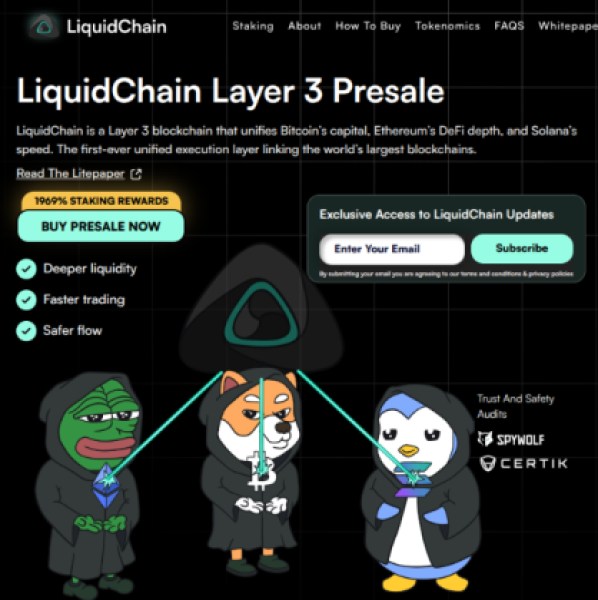
Instead of forcing users to bridge assets manually, LiquidChain’s ‘Deploy-Once Architecture’ allows developers to build applications that tap into $BTC, $ETH, and $SOL simultaneously. That’s critical for removing the friction that kills adoption.

In the LiquidChain model, you could theoretically pledge Bitcoin collateral to access Solana-speed execution or Ethereum-based DeFi protocols in a single step.
The protocol’s architecture focuses on verifiable settlement. By operating as Layer 3 infrastructure, it aggregates security from the underlying chains while offering a single interface.

If you’re a developer, this ends the headache of maintaining different codebases for different ecosystems. Instead of having to choose between Ethereum’s TVL (Total Value Locked) or Solana’s speed, LiquidChain offers a venue where they coexist.

EXPLORE UNIFIED LIQUIDITY WITH $LIQUID.

Unlocking Capital Efficiency Through Liquidity Staking

Saylor’s advice to ‘never sell’ is a solid strategy, but it doesn’t solve the cash flow problem. Investors holding large caps are often asset-rich but liquidity-poor. LiquidChain tackles this through its native utility model, which centers on Liquidity Staking.

The protocol is designed to use the $LIQUID token not just for governance, but as transaction fuel powering the network. By staking liquidity, you can earn rewards derived from the economic activity passing through the Layer 3 infrastructure. It matches the ‘productive crypto’ narrative perfectly, assets generate yield without you having to sell a dime.

You can buy your $LIQUID now for $0.0135 and don’t miss the staking opportunities currently sitting at 1966%.

Plus, the platform aims to include a grant system for developers, incentivizing dApps that use this cross-chain fluidity. This ecosystem approach suggests the future of DeFi isn’t about which chain ‘wins,’ but which infrastructure connects them.

By enabling single-step execution across the industry’s three largest liquidity pools, LiquidChain positions itself as the connective tissue for the next phase of market maturity. To paraphrase an adage, it appears in crypto, it’s no longer what you have but how its connected.’

JOIN THE LIQUIDCHAIN ECOSYSTEM.

Disclaimer: This article is for informational purposes only and does not constitute financial advice. Cryptocurrency investments, including presales and new protocols, carry high risks, including the potential for total loss. Always verify smart contract audits and conduct your own due diligence.


Preguntas relacionadas

QWhat is Michael Saylor's main thesis regarding Bitcoin, as mentioned in the article?

AMichael Saylor's main thesis is that Bitcoin isn't currency for spending, but 'economic energy' meant to be preserved for 100 years. He advocates for not selling the winner (Bitcoin) to buy the losers, promoting a 'Diamond Hand' philosophy of indefinite holding.

QWhat problem does the article identify with the current DeFi ecosystem in relation to Bitcoin?

AThe article identifies that the current DeFi ecosystem suffers from capital inefficiency and fragmentation. Liquidity is trapped in silos, making cross-chain moves slow, expensive, and technically risky. Traders face a binary choice: either leave Bitcoin idle in cold storage or risk it through complex bridges, wrapped tokens, and centralized custodians to chase yield.

QHow does LiquidChain aim to solve the problem of fragmented liquidity across different blockchains?

ALiquidChain aims to solve fragmentation by deploying a Cross-Chain VM (Virtual Machine) that serves as a unified execution layer. Its 'Deploy-Once Architecture' allows developers to build applications that can tap into Bitcoin ($BTC), Ethereum ($ETH), and Solana ($SOL) liquidity simultaneously, enabling single-step execution across these ecosystems.

QWhat is the role of the $LIQUID token within the LiquidChain ecosystem?

AThe $LIQUID token is used not just for governance but also as transaction fuel powering the network. Users can stake their liquidity to earn rewards derived from the economic activity on the Layer 3 infrastructure, allowing them to generate yield without having to sell their underlying assets.

QWhat specific benefit does LiquidChain's Liquidity Staking offer to investors who follow a 'never sell' strategy like Saylor's?

ALiquidity Staking offers a solution to the 'cash flow problem' for investors who are asset-rich but liquidity-poor due to holding large caps like Bitcoin. It allows them to earn yield on their assets by staking liquidity, generating rewards from network activity without having to sell any of their principal holdings.

Lecturas Relacionadas

Public Version of Mythos Officially Launched: Analyzing the Advantages and Limitations of AI Smart Contract Auditing

Publicly available Mythos, Anthropic's AI model, has officially launched, demonstrating both significant potential and limitations in smart contract security auditing. The article analyzes its capabilities through real-world cases. AI excels in identifying subtle, low-level vulnerabilities through pattern recognition and large-scale code screening. A key example is detecting a storage slot collision between a custom rewards mapping and a third-party library's ReentrancyGuard, a vulnerability easily missed in manual audits. In the recent Zcash incident, AI also rapidly discovered a critical soundness bug that had remained hidden for years. However, AI currently struggles with complex, interconnected scenarios. When tested on the Curve LlamaLend sDOLA exploit, which involved manipulating prices across multiple protocols (Curve pools, lending markets) to trigger liquidations, Fable 5 failed to identify the core cross-protocol attack vector. These scenarios require a deep understanding of DeFi economic models and multi-contract interactions. In conclusion, while AI tools like Mythos significantly boost efficiency in finding standardized, syntactic vulnerabilities, they cannot yet replace expert analysis for complex, business-logic, and cross-protocol attacks. An effective audit workflow combines AI's speed for initial screening with human expertise for in-depth, holistic analysis.

marsbitHace 2 min(s)

Public Version of Mythos Officially Launched: Analyzing the Advantages and Limitations of AI Smart Contract Auditing

marsbitHace 2 min(s)

Trade.xyz's Rebase Refusal Sparks Controversy, On-Chain Pre-IPO Market Faces Major Pricing Test

The debate surrounding Trade.xyz's refusal to adjust its SPCX (SpaceX pre-IPO) perpetual contract pricing amid updated share count revelations highlights a key challenge for on-chain pre-IPO markets. While several centralized exchanges (CEXs) paused and repriced their contracts after SpaceX's filing showed a ~10% increase in total shares, Trade.xyz maintained its market-driven pricing logic, which tracks expected per-share price sentiment rather than fundamental valuation metrics like market cap. This discrepancy triggered cross-platform arbitrage and caused leveraged long positions on Trade.xyz to suffer significant losses, as the platform's HIP-3 architecture lacks a native "Rebase" mechanism to neutrally adjust all user positions following such corporate actions. The incident underscores the difficulty for decentralized perpetual exchanges (Perp DEXs) to implement Rebase—a process CEXs handle by centrally pausing markets and adjusting ledger data. On-chain, this requires complex smart contract modifications, increasing gas costs, complexity, and potential attack surfaces. While some DEXs have managed similar adjustments, Trade.xyz's current design does not natively support it, though the team is reportedly exploring solutions for future events like stock splits. Ultimately, the controversy serves as a critical case study for the nascent on-chain pre-IPO sector, raising questions about price discovery reliability, transparent rule disclosure, and the readiness of DeFi infrastructures to handle traditional corporate actions as real-world assets (RWAs) gain traction.

marsbitHace 10 min(s)

Trade.xyz's Rebase Refusal Sparks Controversy, On-Chain Pre-IPO Market Faces Major Pricing Test

marsbitHace 10 min(s)

The 'Middle Eastern Prince' Swindles a Wealthy Woman: Renting Planes and Rolls-Royces, Scamming 120 Million Over Three Years

Two brothers who posed as "Middle Eastern princes" have been sentenced in the United States to 24 and 23 years in prison, respectively, and ordered to pay over $21.2 million in restitution and back taxes. Over three years, they fraudulently obtained approximately $21 million, primarily by promoting fictitious investment projects, including a non-existent cryptocurrency mining operation in a former General Electric industrial park in East Cleveland. The brothers, aged 42 and 33, created elaborate personas: one claimed to be a wealthy royal family heir and the city's "International Economic Advisor," while the other posed as a hedge fund manager with expertise from watching the TV show *Billions*. They bolstered their image by renting luxury cars and private jets and cultivating a relationship with a local mayor's chief of staff, who provided official-looking documents and government event access. A significant portion of the victims' funds, about $18 million, came from a single Chinese investor, a woman from Sichuan with experience in Bitcoin mining. The brothers also defrauded several women, including one former girlfriend. Their scheme unraveled when the primary investor discovered her $6 million worth of mining equipment had been sold off. The case highlights a trend of impostors using fabricated "Middle Eastern royal" identities to target wealthy individuals. Similar incidents include a "Dubai prince" who recently promoted a $500 million family office in Hong Kong and a Colombian man who impersonated a Saudi prince for decades in the US before being caught and sentenced in 2019.

marsbitHace 25 min(s)

The 'Middle Eastern Prince' Swindles a Wealthy Woman: Renting Planes and Rolls-Royces, Scamming 120 Million Over Three Years

marsbitHace 25 min(s)

a16z Partner: Being in the Flow of Capital Is the True Moat

A16z Partner: Standing in the Cash Flow is the True Moat Historically, many of the strongest companies built their moats by positioning themselves within "cash flows"—facilitating value creation and transfer in a network and taking a cut. The more value flows, the larger they grow. Crypto is the first modern technology natively built for this. With open ledgers, programmable settlement, and stablecoins enabling internet-speed global value transfer, it allows startups to inherit network effects from day one. Well-designed tokens align users, developers, and the protocol towards network growth, distributing value to contributors. This model isn't new (e.g., railroads, Visa, Google, AWS) but Crypto democratizes it. It lets entrepreneurs target areas with high inefficiency and profit extraction—like traditional finance's payments, custody, FX, and settlement—to compress costs, increase speed, and redistribute value by standing in the new flow. The opportunity extends beyond finance to emerging markets like GPU/compute, AI training data, energy, and space, where new, programmable infrastructure can be built without legacy constraints. Key questions for founders: Are you already in the cash flow? Does your revenue scale 10x with network activity? Where is profit extraction highest relative to value created in your market? The strategy is clear: compress the old cost structure, position yourself in the new value stream, and let the network compound.

marsbitHace 52 min(s)

a16z Partner: Being in the Flow of Capital Is the True Moat

marsbitHace 52 min(s)

Trading

Spot
Futuros

Artículos destacados

Cómo comprar T

¡Bienvenido a HTX.com! Hemos hecho que comprar Threshold Network Token (T) sea simple y conveniente. Sigue nuestra guía paso a paso para iniciar tu viaje de criptos.Paso 1: crea tu cuenta HTXUtiliza tu correo electrónico o número de teléfono para registrarte y obtener una cuenta gratuita en HTX. Experimenta un proceso de registro sin complicaciones y desbloquea todas las funciones.Obtener mi cuentaPaso 2: ve a Comprar cripto y elige tu método de pagoTarjeta de crédito/débito: usa tu Visa o Mastercard para comprar Threshold Network Token (T) al instante.Saldo: utiliza fondos del saldo de tu cuenta HTX para tradear sin problemas.Terceros: hemos agregado métodos de pago populares como Google Pay y Apple Pay para mejorar la comodidad.P2P: tradear directamente con otros usuarios en HTX.Over-the-Counter (OTC): ofrecemos servicios personalizados y tipos de cambio competitivos para los traders.Paso 3: guarda tu Threshold Network Token (T)Después de comprar tu Threshold Network Token (T), guárdalo en tu cuenta HTX. Alternativamente, puedes enviarlo a otro lugar mediante transferencia blockchain o utilizarlo para tradear otras criptomonedas.Paso 4: tradear Threshold Network Token (T)Tradear fácilmente con Threshold Network Token (T) en HTX's mercado spot. Simplemente accede a tu cuenta, selecciona tu par de trading, ejecuta tus trades y monitorea en tiempo real. Ofrecemos una experiencia fácil de usar tanto para principiantes como para traders experimentados.

606 Vistas totalesPublicado en 2024.12.10Actualizado en 2026.06.02

Cómo comprar T

Discusiones

Bienvenido a la comunidad de HTX. Aquí puedes mantenerte informado sobre los últimos desarrollos de la plataforma y acceder a análisis profesionales del mercado. A continuación se presentan las opiniones de los usuarios sobre el precio de T (T).

活动图片












