While AI inference demand continues to fuel storage needs, SanDisk has presented an extremely aggressive long-term financial outlook.
On Thursday, Eastern Time, the 13th, at its 2026 Investor Day, SanDisk unveiled its long-term financial model, outlining a series of financial targets to be achieved during the fiscal years 2028 to 2030. These include maintaining mid-to-high double-digit revenue growth throughout this period. SanDisk also clarified market concerns about bit growth, stating that the bit volume available for sale will be adjusted based on profitability optimization needs. Simultaneously, the company committed to returning 100% of its excess cash to shareholders after completing necessary business investments.
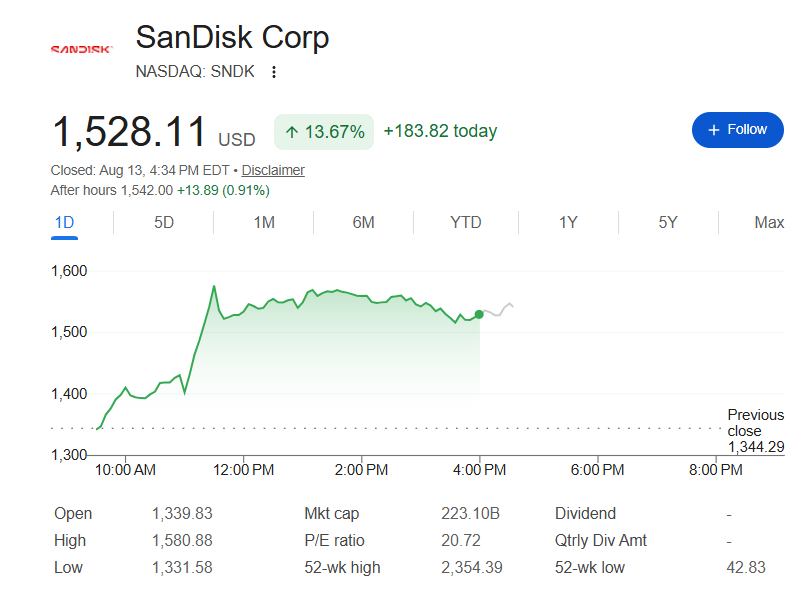
Following the announcement, the market quickly cast its vote with the stock price. SanDisk (SNDK) saw its intraday gain expand to as much as 17.6% on Thursday; the storage sector also strengthened. At the close, SanDisk rose nearly 14%, while SK Hynix and Western Digital gained over 7%, Seagate Technology rose nearly 5%, and Micron Technology increased by more than 4%.
FY2028-30 Targets: 80% Gross Margin, 75% Operating Margin
The highlight of the Investor Day was undoubtedly SanDisk's long-term financial model.
The company anticipates that revenue will maintain mid-to-high double-digit growth from FY2028 to FY2030, with growth rates matching bit shipment increases. Meanwhile, on a non-GAAP basis, the gross margin is expected to remain around 80%, and the operating margin is projected to be approximately 75%.
Special attention must be paid here to the concept of the fiscal year. SanDisk's fiscal year does not align with the calendar year. The company's fiscal year ends on the Friday closest to June 30th, typically spanning 52 weeks. Fiscal Year 2026, the previous fiscal year, ended on July 3, 2026. Early July 2026 already marks the beginning of FY2027. Therefore, the FY2028-30 period announced refers to the future three-fiscal-year span starting around July 2027, not the calendar years 2028 to 2030.
Under this financial model, SanDisk expects operating expenses to account for about 5% of revenue, with other income and expenses not having a material impact. Even after accounting for taxes, capital expenditures, and working capital required to support business growth, the company still anticipates an adjusted free cash flow margin of approximately 50%.
For the historically highly cyclical NAND storage industry, these targets are particularly aggressive. SanDisk is essentially conveying a clear judgment to the market: AI-driven storage demand growth has the potential to keep the company's revenue growth and profitability well above the average levels of traditional storage cycles for years to come.
Not Blindly Chasing "Bit Volume": SanDisk to Flexibly Adjust Sellable Output Based on Profitability
Another crucial signal released by SanDisk is that the company does not intend to simply use expanding bit shipments as its growth target. Instead, it will proactively adjust the volume of bits available for sale based on profitability.
The market had previously focused on SanDisk's FY2027 bit growth guidance: the company projected mid-to-high double-digit growth for input bit volume, while the growth for output bits available for sale might be lower. During the Investor Day, management further clarified that this does not indicate a lack of capacity to increase output.
According to Lynx Equity Strategies analyst KC Rajkumar's interpretation of management's comments, SanDisk CEO David Goeckeler clearly stated that the long-term target for input bit growth is mid-to-high double digits, but the volume of bits available for sale will be flexibly adjusted based on the need to optimize profitability. In some periods, the actual growth in output bits could even exceed mid-to-high double digits.
This signifies that SanDisk places greater emphasis on "how much money each bit can make" rather than purely pursuing "how many bits to sell."
Especially during NAND technology node transitions, the company will selectively reduce wafer output to prevent excessive market supply caused by the rapid increase in bit density brought by new technologies.
Rajkumar pointed out that each NAND technology node transition at SanDisk brings an average bit growth of about 54%. Therefore, if the company fully released the new capacity from technology upgrades, it could easily recreate a situation of oversupply. By proactively reducing wafer output during node transitions, SanDisk can control the volume of bits entering the market, thereby better maintaining pricing, profit margins, and capital efficiency.
This logic also explains why SanDisk dares to set a long-term gross margin target of around 80%: the bit density improvements brought by technological progress may not all translate into supply growth; the company can actively "step on the brakes," converting part of the technological dividend into profitability.
More "Earned Money" Returned to Shareholders: 100% of Excess Cash for Buybacks or Dividends
In addition to revenue and margin targets, SanDisk also made a very clear capital return commitment.
SanDisk Chief Financial Officer (CFO) Luis Visoso stated that after completing the investments needed to support business growth, the company expects to return 100% of its excess cash to shareholders.
This means SanDisk's future capital allocation framework will revolve around three main pillars: first, investing in business and technology to support growth; second, maintaining strong free cash flow generation capability; and finally, returning as much remaining cash as possible to shareholders.
An adjusted free cash flow margin of about 50% implies that if the long-term financial model materializes, SanDisk's future cash-generating ability will be very strong, which is also a key reason the market is willing to assign it a higher valuation.
Eight Major Customers Signed Long-Term Agreements, Covering Approximately Two-Thirds of FY2028 Bit Shipments
A significant reason for SanDisk's strong confidence in the aforementioned long-term financial model is the company's shift in the traditional NAND industry's business model.
The company disclosed that it has already signed New Business Model (NBM) agreements with eight customers. These agreements include committed purchase volumes, binding contractual frameworks, minimum financial guarantees, and structured pricing mechanisms. They can enhance the alignment between customer demand and the company's capacity planning and reduce the impact of cyclical fluctuations typical in the traditional storage industry.
More importantly, the scale covered by these agreements is already substantial: the currently signed NBM agreements cover approximately 50% of FY2027 bit shipments and about two-thirds of FY2028 bit shipments.
SanDisk believes this model can lead to more predictable revenue, higher cash flow visibility, and more sustained profit growth.
In other words, SanDisk is not only betting on the storage demand growth driven by AI but also attempting to partially transform the strong cyclical nature of the traditional NAND business into more stable, predictable revenue and cash flow through long-term agreements.
AI Inference Drives a Larger Storage Market; Enterprise SSD TAM Expected to Reach 1.2 ZB by 2030
Another major support for SanDisk's high growth outlook over the next three years is the new demands placed on storage infrastructure as AI expands from training to inference.
SanDisk estimates that the flash memory market could grow from a historical annual revenue base of around $60 billion to over $300 billion in 2026 and approach $500 billion in 2027.
The company stated that AI inference workloads are driving rapid growth in Token usage, and KV Cache is reshaping the memory hierarchy in data centers. As AI inference scales, AI data centers are expected to become more reliant on storage. SanDisk projects that the Total Addressable Market (TAM) for enterprise data center flash will reach 1.2 zettabytes (ZB) by 2030.
On the technical front, SanDisk is advancing its two-dimensional scaling strategy based on CMOS Direct Bond Array (CBA) to enable more flexible development of customized products for different market needs while improving capital efficiency.
The company's latest BiCS9 QLC technology is the first example of this strategy. This technology combines the BiCS8 array with a CMOS wafer based on BiCS10. Simultaneously, the new BiCS10 QLC node achieves a 60% bit density improvement compared to BiCS8.
HBF Bets on AI Inference; Storage Sector Rallies Collectively
SanDisk is also developing a new High Bandwidth Flash (HBF) technology targeting AI inference. The company stated that HBF is becoming a key technical solution for addressing storage demands in the era of AI inference, and a related industry ecosystem is forming.
From the market's perspective, this means SanDisk's AI storage narrative is no longer limited to "AI data centers need more SSDs" but extends further to the demands of AI inference architecture itself for higher performance, lower power consumption, and higher storage density.
This expectation also quickly spread throughout the storage sector. SanDisk's own gains were more pronounced: after announcing the long-term financial targets, its stock price surged nearly 18% intraday. Year-to-date, SanDisk's stock price has already accumulated a gain of over 530%.
However, SanDisk also emphasized that the aforementioned long-term financial targets are forward-looking statements based on a series of estimates and assumptions. Actual results may still be affected by factors such as demand, average selling prices, competition, technological iteration, supply chain, and storage industry cycles.