Facing an Immense Fortune, Applied Materials (AMAT) Actually Hesitated?

marsbitPublicado a 2026-08-14Actualizado a 2026-08-14

Resumen

Applied Materials (AMAT) reported strong Q3 FY2026 (ending July 2026) results, with revenue of $9.12 billion, up 25% year-over-year and slightly above expectations. Growth was driven by AI infrastructure expansion, boosting demand for advanced logic, DRAM, and advanced packaging equipment. Gross margin reached 50.3%, meeting forecasts. However, despite solid performance and Q4 revenue guidance of $9.75-$10.75 billion (above consensus), the stock fell in after-hours trading. This was primarily due to management's conservative outlook. While major foundries like TSMC and memory chipmakers have significantly raised their 2026 capital expenditure forecasts (pointing to ~40% industry growth), AMAT did not explicitly upgrade its prior full-year semiconductor systems business growth guidance of "more than 30%." Management indicated business strength is continuing and growth would exceed the prior "over 30%" target but refrained from providing a new quantitative figure (e.g., 40%). Analysts note that even assuming 40% growth for the calendar year, the implied sequential growth rates would show a sharp deceleration in the coming quarters. The lack of a more aggressive guidance uplift, despite robust industry CapEx trends, disappointed the market. The article concludes that while the short-term guidance conservatism affects sentiment, the underlying AI-driven semiconductor cycle uptrend remains intact. Continued increases in customer capital expenditure could still drive future earn...

Applied Materials (AMAT.O) released its Q3 FY2026 (ending July 2026) earnings after the U.S. market close on August 14, 2026, Beijing time. Key points are as follows:

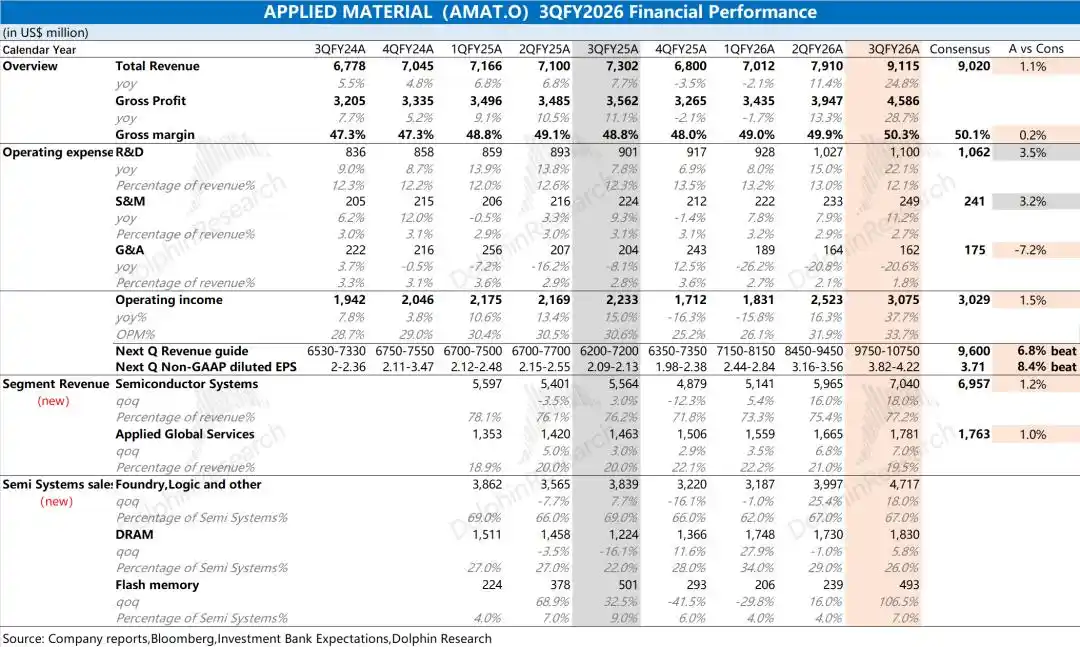
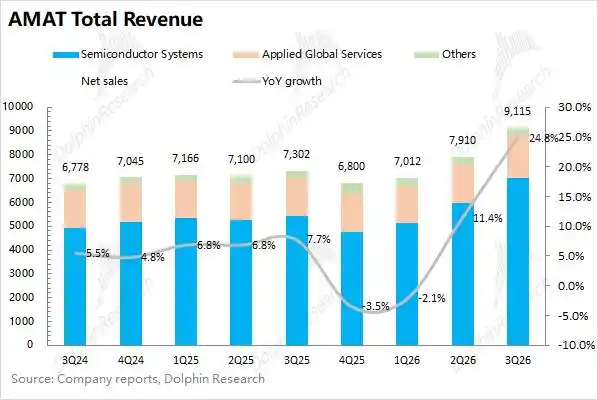
1. Key Data:Applied Materials (AMAT) reported revenue of $9.12 billion this quarter, a 25% year-over-year increase, slightly better than market expectations ($9.02 billion). The growth was primarily driven by the expansion of AI computing infrastructure, which increased demand for advanced logic, DRAM, and advanced packaging equipment.

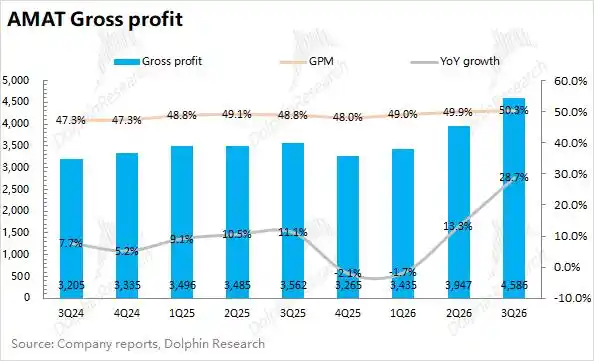
The company's gross margin for this quarter was 50.3%, a sequential increase of 0.4 percentage points, meeting market expectations (50.1%). Against the backdrop of downstream capital expenditure expansion, the company's gross margin showed an upward trend. Regarding the relatively slow rate of improvement, the company explained it has also increased cost investments in the semiconductor equipment and services segments.
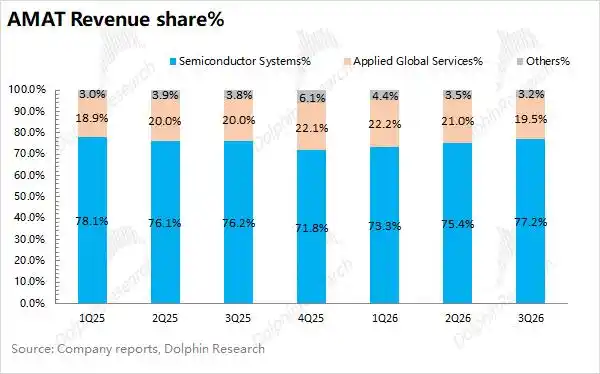
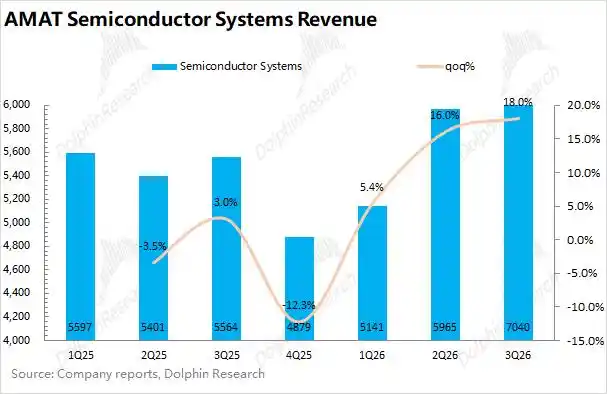
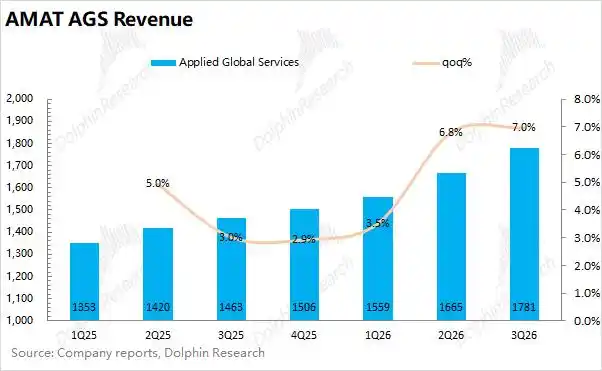
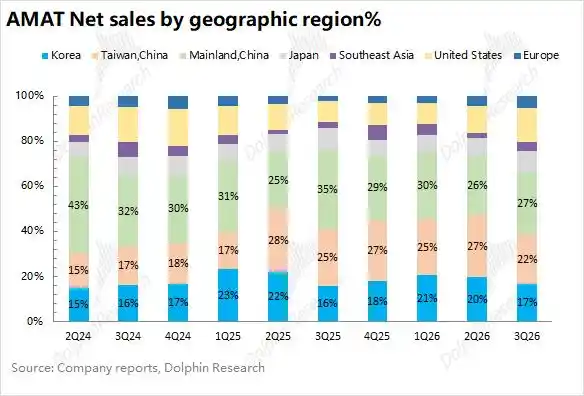
2. Specific Business Situation: Applied Materials' (AMAT) business is mainly divided into Semiconductor Systems (equipment) and Applied Global Services (services). Semiconductor Systems is the company's largest revenue source, accounting for over 70%.

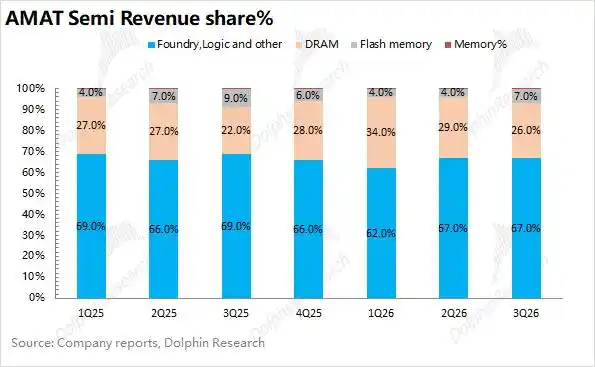
Within Semiconductor Systems: 1) Logic-related business revenue this quarter was $4.72 billion, an 18% sequential increase, mainly driven by demand for advanced nodes; 2) DRAM business revenue this quarter was $1.83 billion, a 6% sequential increase, impacted by the mismatch between customer expansion schedules and delivery cycles (limited cleanroom space).
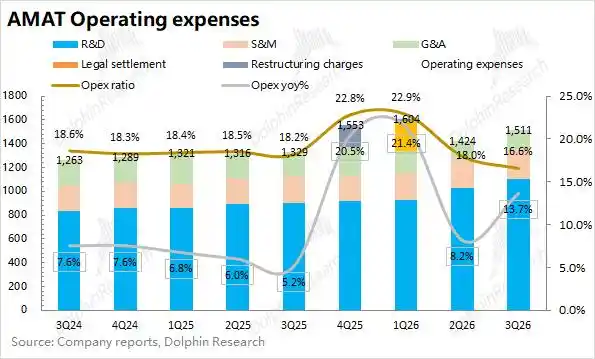
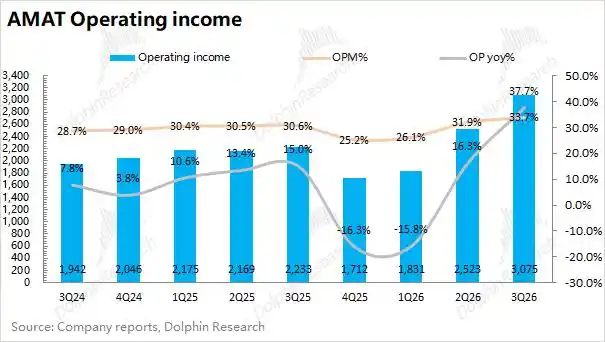
3. Operating Expenses:The company's operating expenses increased to approximately $1.51 billion, up 14% year-over-year. In terms of core operating expenses, R&D expenses this quarter increased to $1.1 billion, while SG&A expenses remained stable.

The company announced a 4% workforce reduction at the end of October 2025. With the improving business performance, the company has significantly expanded its hiring of semiconductor engineers and service personnel. The number of employees grew by 7% sequentially this quarter.

4. Next Quarter Guidance:Applied Materials (AMAT) expects Q4 FY2026 revenue to be between $9.75 billion and $10.75 billion, better than market expectations ($9.6 billion). The midpoint of the range implies a 12.5% sequential growth. The company expects next quarter's Non-GAAP EPS to be between $3.82 and $4.22, also better than market expectations ($3.71).
Dolphin Research Overall View: Good earnings failed to support conservative guidance.

Applied Materials' (AMAT) earnings report figures were good, with both revenue and gross margin meeting market expectations. The company's growth was mainly driven by the expansion of AI infrastructure, boosting demand for advanced logic, DRAM, and advanced packaging equipment.

The company's guidance for the next quarter was also better than market expectations. However, the company's stock price plunged after hours, primarily influenced by management's commentary during the earnings call. The company had previously guided that its "Semiconductor Systems business is expected to grow over 30% in calendar year 2026." Yet, following this earnings report, it did not explicitly raise this guidance.

Management mentioned that demand continued to strengthen this quarter and that business growth would also exceed the "over 30%" emphasized last quarter. The company also stressed expectations for increased market share within the year, but refrained from giving a quantitative figure, even something like "40%." This reflects a lack of confidence in the company's own order visibility.

Considering the capital expenditures of major core fabs (growing over 40% for the full year), Applied Materials' guidance is noticeably weak. Especially given that several major fabs have recently raised their full-year capital expenditure forecasts again, the market was anticipating a significant upward revision from the company.

On the other hand, due to the two-month offset between Applied Materials' fiscal year and the calendar year, even if calendar year 2026 growth were assumed to be 40%, it would imply a significant sequential deceleration for the Semiconductor Systems business (18% this quarter -> 12% next quarter -> 6% the quarter after). Notably, Q1 FY27 (ending January 2027) has 14 weeks, meaning that the implied "+6%" growth, when adjusted to a comparable 13-week basis, would be close to zero sequential growth. This obviously does not satisfy the market.

Beyond this quarter's performance, the market is also focused on the following developments:

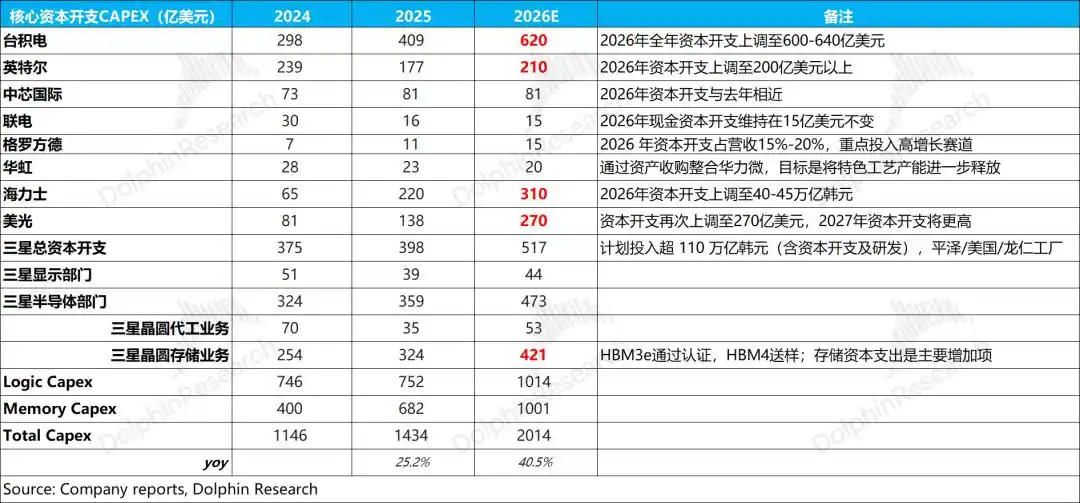
a) Foundry Capital Expenditure: Driven by AI demand, several core foundries have again raised their capital expenditure outlooks, which has been the main driver pushing up the semiconductor equipment sector and company stock prices.

Specifically: 1) TSMC raised its 2026 capital expenditure guidance to $60-64 billion, with the annual increment reaching around $20 billion; 2) Micron increased its 2026 capital expenditure again to $27 billion; 3) Samsung and SK Hynix have also explicitly increased capital expenditures.

Considering the capital expenditure outlooks from these companies, the growth rate of global core fab capital expenditures in 2026 will increase to around 40%. The main increments come from TSMC's advanced nodes and memory manufacturers' capacity expansions. However, the company did not explicitly raise its "full-year growth over 30%" guidance for the Semiconductor Systems business post-earnings, which is hard for the market to accept.
b) Memory Demand and Order Visibility:

Judging from the capital expenditure outlooks of major fabs, memory manufacturers have a relatively stronger desire to expand capital expenditures. Since DRAM and HBM manufacturing rely more on processes like deposition, CMP, and advanced packaging, Applied Materials (AMAT) will benefit from this round of capital expenditure driven by memory manufacturers.

Because Applied Materials' (AMAT) revenue focus comes from the logic sector, with memory accounting for only 20-30% of total revenue, memory's pulling effect on the company is not as pronounced as for Lam Research (where memory revenue accounts for nearly half). Notably, Applied Materials has the broadest coverage across various segments in the DRAM/HBM field (deposition/CMP/metrology/packaging), which should bring more stable performance.

The company's management maintained during the call that its "largest customer provides rolling forecasts for up to 8 quarters," with the incremental information being "some customer dialogues extend to 2030." The latter is still in the discussion phase, with the relatively certain visibility remaining at the 8-quarter timeframe.

Indeed, Applied Materials (AMAT), ASML, and Lam Research all belong to the upstream equipment segment of the semiconductor industry, forming a basket of stocks influenced by the semiconductor cycle/fab capital expenditures. Applied Materials' current valuation multiples are also similar to those of peers like ASML and Lam Research.

Investing in semiconductor equipment companies primarily focuses on the certainty of semiconductor capacity expansion and high growth over the next 2-3 years. As long as the momentum of AI Capex/the semiconductor cycle remains strong, subsequent upward revisions to capital expenditures are still expected to drive the earnings and valuations of upstream semiconductor equipment-related companies higher.

Previously, semiconductor demand was concentrated in advanced nodes and the memory sector. Looking at SMIC's gross margin yesterday, the mature node segment has also entered an upturn cycle, with price increases becoming common especially in the 8-inch area. Starting from AI demand, the "tight supply-demand situation" has already spilled over to more semiconductor segments. If companies subsequently increase investments in traditional semiconductor areas as well, it could further boost demand for semiconductor equipment and related sectors.

Overall, driven by the continuous increase in AI Capex and the recovery in traditional semiconductors, the trend of this semiconductor cycle has not changed. Major manufacturers are still likely to continue strengthening their capital expenditure efforts, which is the foundation for accelerated growth for the company and the semiconductor equipment industry.

Regarding the company's management not explicitly raising the full-year outlook for the Semiconductor Systems business this time (still "over 30%"), it will impact market confidence in the short term. As long as the semiconductor cycle's upward trend remains unchanged, short-term pullbacks will likely not be too deep. Subsequent increases in downstream customer expansion demand and investments are still expected to drive the company's earnings and valuations higher.

Below is Dolphin Research's detailed data on Applied Materials' (AMAT) earnings:
This article is from the WeChat public account "Dolphin Investment Research" (ID: haituntouyan), author: Dolphin Research


Preguntas relacionadas

QWhy did Applied Materials (AMAT) stock drop in after-hours trading despite beating earnings estimates?

AThe stock dropped primarily due to management's commentary during the earnings call. The company did not explicitly raise its full-year guidance for its Semiconductor Systems business growth beyond "more than 30%," which the market interpreted as overly conservative. This was disappointing given that major wafer foundries like TSMC and Micron had recently increased their capital expenditure outlooks significantly.

QWhat was the primary driver of Applied Materials' revenue growth in Q3 FY2026?

AThe revenue growth was primarily driven by the expansion of AI computing infrastructure, which increased demand for equipment related to advanced logic, DRAM, and advanced packaging.

QHow does Applied Materials' Q4 FY2026 revenue guidance compare to market expectations?

AApplied Materials' Q4 FY2026 revenue guidance of $9.75 to $10.75 billion was better than the market expectation of $9.6 billion. The midpoint of the guidance implies a sequential growth of 12.5%.

QAccording to the article, why is the company's semiconductor equipment growth guidance considered weak compared to industry trends?

AThe guidance is considered weak because major wafer fabrication companies have recently raised their full-year capital expenditure growth outlooks to around 40%. In contrast, Applied Materials maintained its prior guidance of "more than 30%" growth for its semiconductor equipment business without providing a more aggressive quantitative update, which fell short of market expectations for a significant upward revision.

QWhat is the main factor supporting the long-term growth outlook for semiconductor equipment companies like Applied Materials, according to the analyst's view in the article?

AThe main supporting factor is the ongoing uptrend in the semiconductor cycle, fueled by continuous increases in AI-related capital expenditures (AI Capex) and a recovery in traditional semiconductor segments. As long as this trend persists, major manufacturers are expected to continue increasing their capital spending, which forms the foundation for accelerated growth for Applied Materials and the broader semiconductor equipment industry.

Lecturas Relacionadas

Selling Block Space Is No Longer Profitable, Arbitrum and MegaETH Venture into Applications

Selling block space is no longer a sustainable core business for blockchains, as it is easily commoditized and generates insufficient revenue to support their valuations, especially when compared to the high fees generated by applications built on them. This report, following up on the "Verticalization" thesis, examines how chains like Arbitrum, Polygon, MegaETH, and Sophon are adapting. It categorizes their strategies into two main paths: **Ecosystem Expansion** and **Product Expansion**. **Ecosystem Expansion** involves chains extending their reach by offering their technology stack to others. Examples include Arbitrum, which earns revenue from chains like Robinhood's L2 built on Arbitrum Stack, and Polygon, which is positioning itself as a payment chain for fintech. However, this model faces challenges, as seen with Optimism's revenue drop after Base left its Superchain, and often fails to translate chain success into sustained token value due to ongoing emissions. **Product Expansion** sees chains vertically integrating by building their own applications to capture more value internally. MegaETH shifted focus to developing first-party consumer apps and launched a native stablecoin, USDm, to capture yield. Similarly, Sophon pivoted from being an independent chain to becoming an application builder on Base. The goal is to directly own the lucrative application fee streams that typically don't flow back to the underlying chain. The conclusion is that with hundreds of chains offering similar block space, differentiation through liquidity alone is not enough. To justify high valuations and ensure sustainability, chains are moving beyond their foundational role. They are evolving into broader ecosystems or application builders themselves, actively working to internalize the value generated within their networks. This represents a pragmatic shift towards utility, where chains are becoming more than just infrastructure providers in a highly competitive landscape.

marsbitHace 15 min(s)

Selling Block Space Is No Longer Profitable, Arbitrum and MegaETH Venture into Applications

marsbitHace 15 min(s)

A Glimpse into Crypto Miners in Q2: Rushing into AI Data Centers – Are They Profiting?

Mining companies presented mixed Q2 results as they navigate the shift towards AI data centers alongside their core Bitcoin mining operations. While mining output increased for some, declining Bitcoin prices and rising network difficulty pressured revenues. For instance, MARA mined more Bitcoin year-over-year but saw a 27% revenue drop and a significant net loss, partly due to unrealized losses on Bitcoin holdings. The standout trend is the growing contribution of AI/high-performance computing (HPC) hosting revenue. Core Scientific now derives over 80% of its revenue from high-density hosting, while TeraWulf generates about 71% from HPC leasing. However, the transition is at varying stages. Companies like Riot Platforms and Cipher Digital are in earlier phases, with AI-related revenue still a smaller portion of their total income. The article cautions against conflating massive, long-term AI hosting contracts (often valued in billions) with current quarterly revenue, as income recognition depends on capacity delivery and lease commencement. Financially, net losses were common but driven by different factors: some by Bitcoin price revaluations or warrant fair value changes, others by operational costs exceeding revenue. The sector is diverging into three paths: pure-play miners focusing on efficiency, companies successfully transitioning to AI hosting, and those in a challenging transitional phase where legacy mining income is declining before new AI revenue scales up. The key to future performance lies in reliable power access, timely data center delivery, and converting long-term contracts into consistent quarterly income.

marsbitHace 18 min(s)

A Glimpse into Crypto Miners in Q2: Rushing into AI Data Centers – Are They Profiting?

marsbitHace 18 min(s)

DeepSeek's "Self-Evolution" Blueprint, Revealed

DeepSeek, in collaboration with Peking University, has unveiled a new research paper titled "A Programming Paradigm for Spatiotemporal Composability," which outlines the core architecture behind its "Harness" agent platform. The paper introduces **Cordis**, a foundational "Lego-like baseboard" that enables a highly modular and composable system where **everything is a plugin and everything can be reassembled**. The core innovation addresses two major challenges for self-evolving AI agents: **temporal composability** (the ability to dynamically load, unload, and update plugins at runtime without restarting the entire process) and **spatial composability** (managing complex, dynamic dependencies between components). Cordis solves these using two key theoretical concepts adapted for dynamic environments: **revertible effects** (which allow state changes to be cleanly rolled back) and **reactive coeffects** (which enable automatic, declarative dependency resolution). This design is not merely theoretical. It has been validated over four years in the **Koishi** chatbot framework, which is built on Cordis and hosts over 4,000 community plugins. The framework demonstrates live plugin management—enabling, disabling, or updating plugins without disrupting others—and robust handling of dependencies across a decentralized ecosystem. The paper represents DeepSeek's vision for a foundational infrastructure that supports true **self-evolution** in AI agents, allowing them to dynamically modify their own capabilities and tools at runtime. The authors are Yifan Shi (Peking University/DeepSeek, creator of Koishi), Wei Zhang (Peking University), and Tianyi Cui (DeepSeek Harness team lead).

marsbitHace 20 min(s)

DeepSeek's "Self-Evolution" Blueprint, Revealed

marsbitHace 20 min(s)

On-Chain Finance Finally Posts a Profitable Ledger: Figure's Quarterly Revenue Doubles, Net Profit Hits $87 Million

Blockchain finance firm Figure Technology Solutions reported a strong second-quarter earnings report, potentially serving as the first major proof of profitability for the sector. The company’s GAAP net revenue reached $226 million, up 113% year-over-year, while net profit surged 192% to $87.4 million, yielding a net profit margin of 38.8%. Its quarterly consumer loan origination volume hit $4.3 billion, marking 132% growth. Figure's business focuses on streamlining the U.S. Home Equity Line of Credit (HELOC) market by shifting the entire loan lifecycle—from origination to securitization—onto its proprietary Provenance blockchain. This backend infrastructure significantly reduces processing time and costs while remaining invisible to end borrowers, who simply benefit from faster, cheaper loans. A key growth driver is the Figure Connect platform, a blockchain-based marketplace connecting loan originators and institutional investors. It accounted for 65% ($2.8 billion) of the quarter's volume, demonstrating strong network effects with 489 partner firms. The company is building an integrated on-chain finance ecosystem that includes its SEC-approved yield-generating stablecoin, YLDS. Notably, Figure has achieved this scale and profitability without relying on token sales or speculative crypto economics, instead choosing a traditional IPO path. Its success suggests blockchain's most practical application in finance may be as an efficient, invisible infrastructure layer that solves specific real-world inefficiencies rather than attempting to overhaul the entire system.

marsbitHace 21 min(s)

On-Chain Finance Finally Posts a Profitable Ledger: Figure's Quarterly Revenue Doubles, Net Profit Hits $87 Million

marsbitHace 21 min(s)

Trading

Spot
活动图片