Sailor from Strategy Company Claims ChatGPT Facilitated a $15 Billion Financial Breakthrough

cryptonews.ruPublicado a 2026-08-06Actualizado a 2026-08-06

Resumen

Strategy executive chairman Sailor, in an interview on "The Diary of a CEO" podcast, stated that AI contributed to a $15 billion financial breakthrough for the company. Facing limitations with traditional convertible bond financing for Bitcoin purchases, Strategy used ChatGPT to design a novel financial security called STRK, a preferred share structure combining debt and equity instruments. Sailor claimed this AI-proposed solution, which initially faced resistance from lawyers and bankers, unlocked billions in investor capital. He positioned Bitcoin as "digital capital" and AI as "digital intelligence," arguing they are transformative technologies. Bitcoin enables global asset transfers without intermediaries, while AI boosts productivity by solving complex problems. Sailor advised entrepreneurs to leverage AI for unprecedented innovations rather than compete with it directly. The discussion covered Bitcoin's advantages over traditional finance (TradFi) for preserving value, criticizing fiat inflation and the long-term returns of residential real estate. Sailor also predicted AI will rapidly automate intellectual professions like accounting and legal work, shifting human roles towards managing AI. He emphasized learning emerging technologies over mature industries. Sailor views both Bitcoin and AI as early-stage technologies. He believes their combination will define the next generation of finance, creating entirely new products and business models.

In a conversation with Stephen Bartlett on the "The Diary of a CEO" podcast, the Executive Chairman of Strategy described AI as a tool for solving problems that the traditional financial system has never encountered. He began the discussion with a simple statement: "Bitcoin is digital capital. AI is digital intelligence." He emphasized that together, these technologies are transforming the face of business, markets, labor, and long-term prosperity.

Sailor Claims AI Solved a Problem That Humans Could Not

Sailor's main point concerned Strategy's and Digital Asset Treasury's (DAT) efforts to continue raising capital after exhausting more traditional financing options. According to him, the company had already become one of the world's largest issuers of convertible bonds to finance additional bitcoin purchases. Ultimately, this approach reached its practical limits.

Instead of abandoning its strategy, the company, according to Sailor, turned to the generative AI model ChatGPT to explore a completely new type of financial security. The result was STRK—a preferred equity structure designed to combine debt and equity instruments while enabling additional bitcoin purchases. Sailor noted that no such instrument had existed before.

"Last year, we made $15 billion using AI," Sailor explained to Bartlett. The founder of Strategy added:

"AI gave us a solution to a problem that no one in the history of the world had ever faced before."

He explained that lawyers and investment bankers initially resisted the idea because they had never encountered such a structure before. Instead, AI proposed alternative approaches that ultimately helped the company create a product capable of attracting billions of dollars from investors.

Bitcoin and AI Are Central to His Thesis

Throughout the interview, Sailor repeatedly linked bitcoin and artificial intelligence. He characterized bitcoin as the world's first form of digital capital and called AI the next major leap in digital intelligence.
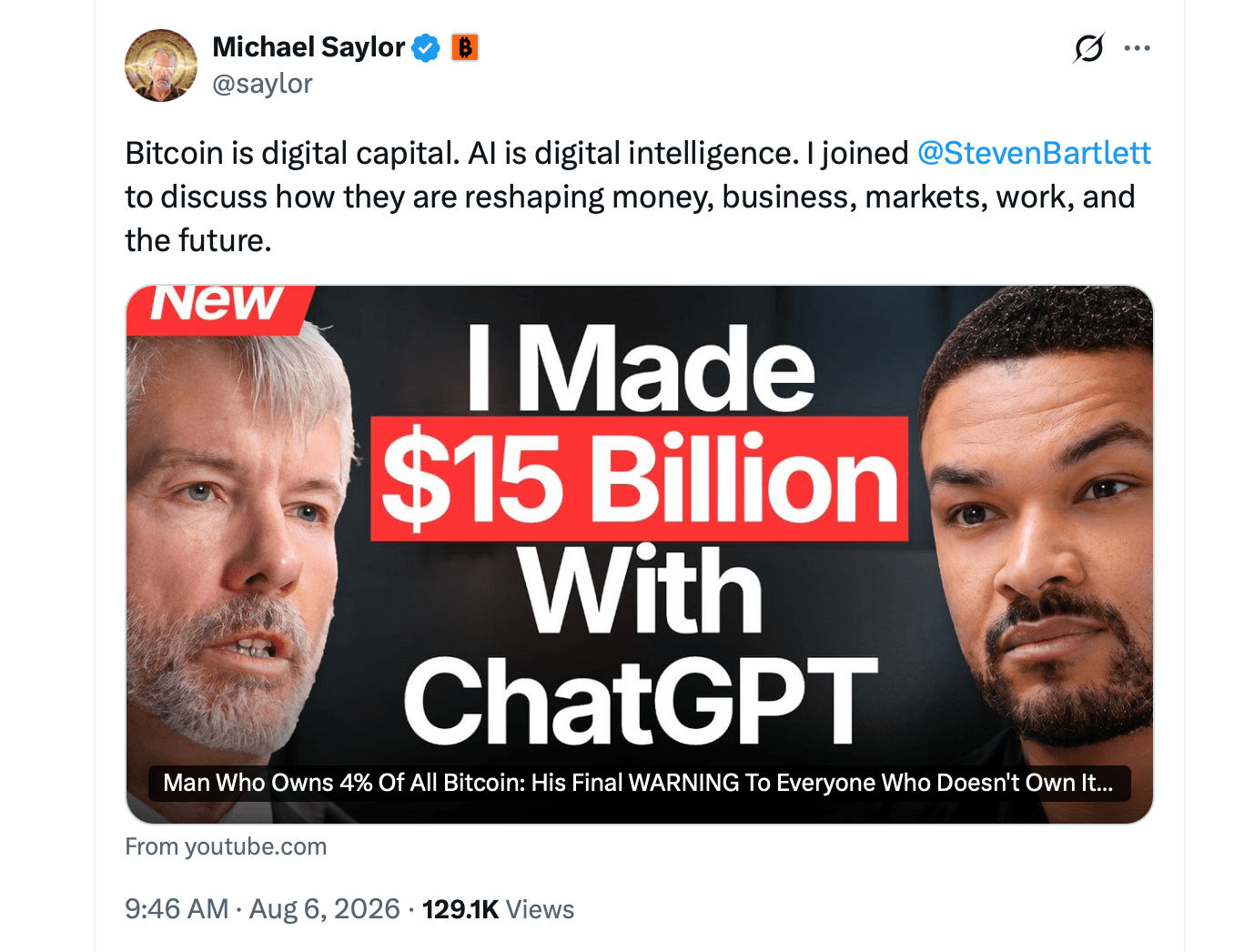
Image Source: X

According to Sailor, both technologies solve different problems. Bitcoin allows individuals and companies to own assets that can be transferred worldwide without involving numerous financial intermediaries, while AI significantly boosts labor productivity by helping people solve increasingly complex tasks.

He argued that entrepreneurs should stop directly competing with AI and instead use it to create products and services that previously seemed impossible.

Sailor told the host of "The Diary of a CEO" podcast:

"Don't try to work harder than robots. You need to ask AI to do something no one has done before."

Why He Still Prefers Bitcoin to Traditional Financial System (TradFi) Assets

The conversation also revisited one of Sailor's long-standing areas of focus: preserving purchasing power.

He argued that inflation steadily erodes the value of fiat currencies over long periods, citing historical examples that, in his view, demonstrate the loss of purchasing power of the U.S. dollar over several generations. He contrasted this with the world's scarcest assets, such as stocks, commercial real estate, gold, and bitcoin, which he characterized as more reliable long-term stores of value than holding cash.

Sailor also questioned traditional recommendations regarding homeownership. While acknowledging that residential real estate can appreciate in price, he argued that ongoing property taxes, insurance, and maintenance costs reduce long-term returns in many jurisdictions. According to him, commercial real estate often yields better returns because these costs can often be offset by rental income.

For Sailor, bitcoin has another advantage. Unlike physical assets, he explained, bitcoin can be transferred across borders in seconds without needing approval from numerous banks or governments, making it particularly valuable during periods of economic or political uncertainty.

AI Will Change Professions Faster Than Many Expect

A significant portion of the discussion shifted from investing to the broader economic impact of artificial intelligence.

Sailor predicted that AI will automate many forms of intellectual labor, including accounting, legal research, and document preparation. He emphasized that this does not mean people will stop creating value. On the contrary, future professions will increasingly focus on managing AI rather than performing repetitive work on their own.

He urged young people to study technologies that are still ascending the "S-curve" of innovation, rather than industries that have largely already reached maturity. According to him, the ability to work with AI is likely to be more valuable than mastering tasks that software will soon perform automatically.

He also refuted the idea that AI will eliminate the need for money. Responding to comments by Elon Musk about a future of material abundance, Sailor stated that while technology may make everyday goods cheaper, scarce assets will still exist, ensuring that wealth and capital remain important.

What's Next

Sailor characterized both bitcoin and artificial intelligence as technologies still in the early stages of adoption. He believes that companies combining digital capital with digital intelligence will create entirely new financial products and business models in the coming years.

Whether these predictions come true remains to be seen. What is already clear is that Strategy continues to expand and alter its bitcoin-focused corporate strategy, while Sailor increasingly presents AI as a tool capable of accelerating the company's next growth phase. The interview suggests he views the combination of bitcoin and AI not as separate trends, but as two technologies likely to define the next generation of finance and entrepreneurship.

end-content

Preguntas relacionadas

QWhat specific financial problem did ChatGPT help Strategy and DAT solve, and what was the outcome?

AChatGPT helped them explore and create a new type of financial security after exhausting traditional convertible bond options for funding Bitcoin purchases. The result was STRK, a preferred share structure that combined debt and equity instruments. This innovation generated $15 billion in capital for the company.

QHow does Michael Saylor characterize the relationship between Bitcoin and AI in his interview?

AHe characterizes Bitcoin as the world's first form of digital capital and AI as the next major leap in digital intelligence. He argues they are complementary forces: Bitcoin enables ownership and borderless transfer of assets, while AI enhances human productivity to solve more complex problems.

QAccording to Saylor, why does he prefer Bitcoin over traditional assets and fiat currency?

AHe argues that fiat currencies lose purchasing power due to inflation over long periods. He views Bitcoin as a superior long-term store of value compared to cash, citing its scarcity and the advantage of being transferable across borders in seconds without needing approvals from multiple banks or governments.

QWhat is Saylor's view on the future of jobs and professions in relation to AI?

AHe predicts AI will automate many intellectual tasks (like accounting, legal research). Future professions will focus more on managing and working alongside AI rather than performing repetitive work manually. He advises people to learn technologies on the rise, like AI, rather than skills in mature industries ripe for automation.

QWhat is the core piece of advice Saylor gives to entrepreneurs regarding AI?

AHis core advice is: 'Don't try to work harder than the robots. You need to ask AI to do something that nobody's done before.' He urges entrepreneurs not to compete directly with AI but to leverage it to create previously impossible products and services.

Lecturas Relacionadas

Company Managing $2.8 Billion in Bitcoin Makes Optimistic Statement About BTC!

Dylan LeClair, CFO of MetaPlanet, commented on the recent sharp sell-offs in crypto markets and growing criticism towards Bitcoin-holding companies. He compared the current pessimism to the 2022 crash, suggesting price corrections and liquidations have set the stage for Bitcoin's next growth phase. LeClair acknowledged that the recent BTC price drop created negative perceptions of corporate balance sheet holdings but called this a cyclical phenomenon. He referenced similar criticism faced by MicroStrategy in 2021/22, noting that while such companies can underperform BTC during downturns due to leveraged structures, the long-term trend reverses. He argued that for Bitcoin to reach a multi-trillion-dollar asset class, integration with traditional capital markets is essential, and retail "cold storage" alone is insufficient. Addressing criticism from some Bitcoin purists, LeClair defended the use of equities and debt instruments as necessary bridges to attract institutional capital with varying risk tolerances. LeClair suggested the market may have bottomed, citing institutional funds rotating from Bitcoin-related assets into AI stocks at the end of Q2, creating artificial selling pressure. He downplayed exaggerated fears like quantum computing threats, predicting that once sellers are exhausted, Bitcoin will surge sharply without significant news catalysts.

cryptonews.ruHace 2 hora(s)

Company Managing $2.8 Billion in Bitcoin Makes Optimistic Statement About BTC!

cryptonews.ruHace 2 hora(s)

Capital is Moving from Cryptocurrency Speculation to Tokenized RWA Assets

In 2026, tokenized real-world assets (RWA) became one of the fastest-growing areas in crypto. Investors, weary of market volatility, are shifting capital from speculative crypto trading towards assets offering stable yield. These include tokenized government bonds (e.g., T-bills), private credit, real estate income, commodities, and money market funds. Data shows a clear preference for transparent, regulated products. Deposits into RWA protocols more than tripled year-on-year, reaching $7.4 billion in Q2, while spot trading activity surged 220%. The total on-chain value of tokenized RWAs exceeded $30 billion in 2026, more than doubling from the previous year, and approached $38 billion by August. RWA acts as a bridge between traditional finance and blockchain, not a replacement. It allows banks and asset managers to launch regulated products on public blockchains, while DeFi users gain access to previously unavailable real-world assets. Blockchain provides 24/7 settlements, transparency, programmability, and lower fees, while traditional finance contributes capital, regulation, and proven products. Tokenized private credit remains the largest RWA category (over $7 billion on-chain), benefiting from blockchain's cost reduction and transparency. Treasury bills are the fastest-growing institutional segment, driven by higher interest rates. Tokenized commodities, especially gold, are expanding, combining asset safety with blockchain trading ease. Real estate, though smaller, is also growing steadily. Tokenization is increasingly viewed as core financial infrastructure.

cryptonews.ruHace 2 hora(s)

Capital is Moving from Cryptocurrency Speculation to Tokenized RWA Assets

cryptonews.ruHace 2 hora(s)

Lone Bitcoin Miner Defies All Odds, Hits $200,000 Jackpot with Block Reward

A solo Bitcoin miner, contrary to all predictions, won a $200,000 jackpot as a block reward. The payment went to an address linked to CKPool, a solo-mining service. This was the 317th solo block found by the pool. The reward consisted of the 3.125 BTC fixed subsidy and about 0.032 BTC in transaction fees from 4,243 transactions. CKPool operator Dr -ck (Con Kolivas) confirmed the win, noting the miner's hashrate was "extremely volatile, presumably rented," peaking at 100 PH/s. This represented about 0.011% of Bitcoin's total network hashrate. At that level, a miner could statistically expect to find a block roughly every 64 days, far more likely than for a typical small home setup. Solo mining differs from pool mining, where rewards are shared based on contributed work. In solo mining, a miner gets nothing unless they personally find a block, but then receives the entire reward. CKPool charges a ~2% fee on blocks found. Dr -ck noted the hashrate pattern suggested rented computing power, a practice making solo wins more accessible. He also highlighted this was the first mainnet block mined after integrating Stratum V2 code into ckpool, though the block itself was found using the older Stratum V1 protocol. Against a backdrop of mining concentration in large industrial pools, such solo finds remain rare but demonstrate that anyone with sufficient hashrate can claim a full reward without corporate or government permission. The block subsidy will remain 3.125 BTC until the next halving around April 2028. The miner's identity remains unknown, as is typical. Bitcoin's mining difficulty is due for an adjustment, and network hashrate has declined from late 2025 peaks, partly due to competition for power and hardware from AI data centers.

cryptonews.ruHace 2 hora(s)

Lone Bitcoin Miner Defies All Odds, Hits $200,000 Jackpot with Block Reward

cryptonews.ruHace 2 hora(s)

Blackrock Leads with $305 Million Inflow into Bitcoin and Ether ETFs

Money continued to flow rapidly into the largest cryptocurrency ETFs. Bitcoin and Ethereum ETFs collectively attracted over $305 million in inflows, with BlackRock again leading the charge, marking the third consecutive session of strong institutional demand. The broader market picture was mixed. Hyperliquid ($HYPE) ETFs finally saw renewed buying interest, while XRP ($XRP) ETFs faced outflows, and Solana-based products remained stagnant. In a strong session, Bitcoin ETFs recorded a net inflow of $244.42 million across five funds. BlackRock's IBIT dominated with $196.83 million, followed by ARK 21Shares' ARKB at $37.63 million and Fidelity's FBTC at $11.28 million. Vaneck's HODL was the sole fund to see an outflow (-$14.67 million), barely impacting the category's overall positive trend. Total trading volume reached $1.58 billion. Ethereum ETFs also continued their positive run, attracting $60.86 million. BlackRock's ETHA led with $50.34 million. The staking-oriented ETHB and Fidelity's FETH followed. No Ethereum ETF saw outflows. Among smaller tokens, Hyperliquid ETFs saw a minor but notable inflow of ~$966,690, potentially signaling easing selling pressure. Conversely, XRP ETFs experienced a $3.58 million outflow. Solana ETFs saw no net activity. The session solidified Bitcoin and Ethereum as the focal point for institutional capital, with BlackRock as the dominant source of demand, while activity in altcoin ETFs remained volatile.

cryptonews.ruHace 2 hora(s)

Blackrock Leads with $305 Million Inflow into Bitcoin and Ether ETFs

cryptonews.ruHace 2 hora(s)

Trading

Spot
活动图片