Robert Kiyosaki Forecasts Gold Price to Reach $10,000 and Silver to $200 as US National Debt Nears $40 Trillion

cryptonews.ruPublicado a 2026-08-17Actualizado a 2026-08-17

Resumen

Robert Kiyosaki, author of "Rich Dad Poor Dad," warned about the approaching $40 trillion U.S. national debt in a mid-August post on X. He urged followers to consider their response, reiterating his long-standing criticism of holding cash as a losing strategy. Citing insights from associates like Jim Rickards, Kiyosaki shared ambitious price forecasts for precious metals: gold reaching $10,000 per ounce and silver hitting $200 per ounce, potentially by late 2026. He specifically highlighted silver as his preferred choice for August 2026, despite its current price being only about a third of that target. Kiyosaki did not provide specific calculations for these predictions. The article notes that for gold to reach $10,000, its price would need to more than double from recent levels. Silver's path to $200 would require a significant surge, though a sustained market deficit and investment demand are providing underlying support. Kiyosaki views price dips in these metals as buying opportunities, positioning them as hedges against currency devaluation and inflation risks tied to expansive government debt and fiscal policy.

Robert Kiyosaki, author of "Rich Dad Poor Dad," called on his followers in an August 15 post on X to consider how to respond to the growing federal debt, while also sharing ambitious forecasts for precious metals. His remarks came as investors analyzed inflation, fiscal policy, and the question of whether deficit assets can preserve purchasing power more effectively than cash.

Kiyosaki stated:

"U.S. DEBT SOON $40 TRILLION!! Question: What are you doing about it?"

According to data from the U.S. Treasury's "Debt to the Penny," the total outstanding public debt as of August 13 was approximately $39.93 trillion. This amount included about $32.20 trillion held by the public and $7.73 trillion in intragovernmental holdings, bringing the total about $65.18 billion short of the $40 trillion mark.

The well-known author added:

"My friends who are much smarter than me, like Jim Rickards, predict that silver will soon reach $200 per ounce and gold $10,000 per ounce. Of these two... I believe silver will be the best choice by August 2026."

Kiyosaki provided no chart or calculation to support either of these forecasts. Rickards' forecast of a $10,000 gold price assumed it would reach that level by the end of 2026, relying on central bank demand, constrained supply, and broader institutional investor buying.

Silver Becomes Kiyosaki's Preferred Choice for August

Kiyosaki named silver as his preferred choice of the two metals for August, even though the metal's price is currently significantly below the stated target. On August 15, silver was trading around $65.33 per ounce, roughly one-third of the $200 mark and below the $121 level reached on January 29. His forecast is a continuation of a stance voiced in December when he predicted silver could reach $200 by 2026, linking price increases to currency debasement and inflation risks.

The well-known author maintains his precious metals forecast despite sharp price fluctuations, viewing declines as opportunities to increase his positions. In July, he backed an optimistic outlook for gold and silver after both metals saw sharp corrections, while acknowledging that any sustained rally could be preceded by further volatility.

Gold price dynamics continue to depend on several opposing factors, including interest rates, currency fluctuations, geopolitical risks, and investor demand. The "Gold Demand Trends" report for Q2, published by the World Gold Council on July 30, outlined conditions that could support the metal, while noting that stronger economic growth, higher yields, or a stronger dollar could restrain its performance.

Debt Warning Reinforces Kiyosaki's Long-Standing Criticism of Cash

The growing federal debt remains central to Kiyosaki's criticism of public finances and traditional savings. In June, he questioned how high taxation coexists with growing debt, linking federal spending to his preference for gold, silver, and Bitcoin over assets directly tied to state-issued currency.

Inflation erodes the purchasing power of money and savings when prices rise faster than cash returns, although an increase in federal debt does not automatically lead to proportional consumer inflation. The overall price level reflects many factors, including monetary conditions, consumer demand, supply disruptions, wage growth, and expectations about future prices.

Kiyosaki emphasized:

"Those who save cash are the BIGGEST LOSERS!!!!"

Market Data Shows What's Needed for Forecasts to Materialize

To reach Rickards' $10,000 target, the gold price would need to more than double from current levels. On August 14, the metal's price was around $4,365 per ounce. In Q2, the average gold price was $4,506.29 per ounce, 37% higher than a year earlier, while central banks purchased 288.9 metric tons, and gold exchange-traded funds saw an outflow of 44.8 metric tons.

Silver faces a different supply-demand situation: investment demand is strengthening while industrial consumption declines. The Silver Institute's "World Silver Survey 2026," published on April 15, forecasts demand for coins and net bars to increase by 18% this year to 257.6 million ounces from 217.7 million ounces in 2025. Industrial demand is projected to decline by another 3%, with photovoltaic consumption dropping 19% to 151.0 million ounces.

Global silver supply in 2026 is expected to contract by 2%, with mine production remaining roughly flat after reaching 846.6 million ounces last year. The market deficit is still expected to be 46.3 million ounces, marking the sixth consecutive annual deficit. These conditions may provide price support but do not guarantee silver reaching $200.


Preguntas relacionadas

QWhat is Robert Kiyosaki's specific price prediction for gold and silver, and what is the main context he provides for this forecast?

ARobert Kiyosaki predicts the price of gold will reach $10,000 per ounce and silver will reach $200 per ounce. He makes this forecast in the context of the approaching $40 trillion U.S. federal debt, suggesting investors should consider tangible assets as a response.

QWhy does Robert Kiyosaki state that silver is his preferred choice for August 2026, and what is the current market price of silver compared to his target?

AKiyosaki states silver is his preferred choice for August 2026, citing insights from analysts like Jim Rickards. As of August 15, silver was trading at approximately $65.33 per ounce, which is about one-third of his $200 target and below the $121 level seen in late January.

QWhat is the total outstanding U.S. public debt as of August 13, according to the article's reference to the 'Debt to the Penny' data?

AAccording to the U.S. Treasury's 'Debt to the Penny' data cited in the article, the total outstanding public debt as of August 13 was approximately $39.93 trillion. This consisted of about $32.20 trillion held by the public and $7.73 trillion in intragovernmental holdings.

QAccording to the article, what key market conditions does the World Gold Council's Q2 report identify that could support or hinder gold's price performance?

AThe World Gold Council's Q2 'Gold Demand Trends' report identifies that factors like central bank demand, geopolitical risks, and investor interest could support gold. However, stronger economic growth, rising yields, or a stronger U.S. dollar could hinder its price performance.

QWhat are the supply and demand dynamics for silver in 2026, as forecasted by the Silver Institute's 'World Silver Survey 2026'?

AThe Silver Institute's 'World Silver Survey 2026' forecasts that in 2026, investment demand for coins and bars will rise 18% to 257.6 million ounces, while industrial demand is projected to fall another 3%. Global silver supply is expected to decline by 2%, leading to a sixth consecutive annual market deficit of 46.3 million ounces.

Lecturas Relacionadas

Yield Leverage and Liquidity Leverage: The STONKBROKER Mechanism is Very Suitable for the RWA Scenario

The article argues that the STONKBROKER mechanism is highly suitable for Real-World Asset (RWA) tokenization scenarios due to its two key leverages: **Profit Leverage** and **Liquidity Leverage**. **Profit Leverage:** Traditional RWA models simply tie tokens to real-world asset yields. STONKBROKER's model is more engaging by allowing NFT holders to earn not only the underlying real-world cash flows but also additional yields generated from the on-chain system's own operations and transaction activity (like fees and slippage). This creates a dual income stream. **Liquidity Leverage:** Standard RWA asset bundles often suffer from poor liquidity. STONKBROKER's mechanism, which allows fixed-ratio swapping between NFTs and a platform's fungible token (and vice versa), solves this. It provides real-time market pricing and flexible exit options for each "RWA asset" NFT by unifying NFT liquidity with ERC-20 token liquidity via an AMM pool. This enhances capital efficiency and attracts more trading activity. The article further speculates on applying this model to broader RWAs (e.g., real estate, bonds). The core idea is to create a more dynamic, liquid, and profitable ecosystem where ordinary users can participate, combining real-world yields with the speculative and transactional energy of a crypto-native system. The author mentions being inspired by the launch of a project called @TheCardWall, which tokenizes high-grade physical trading cards.

marsbitHace 13 min(s)

Yield Leverage and Liquidity Leverage: The STONKBROKER Mechanism is Very Suitable for the RWA Scenario

marsbitHace 13 min(s)

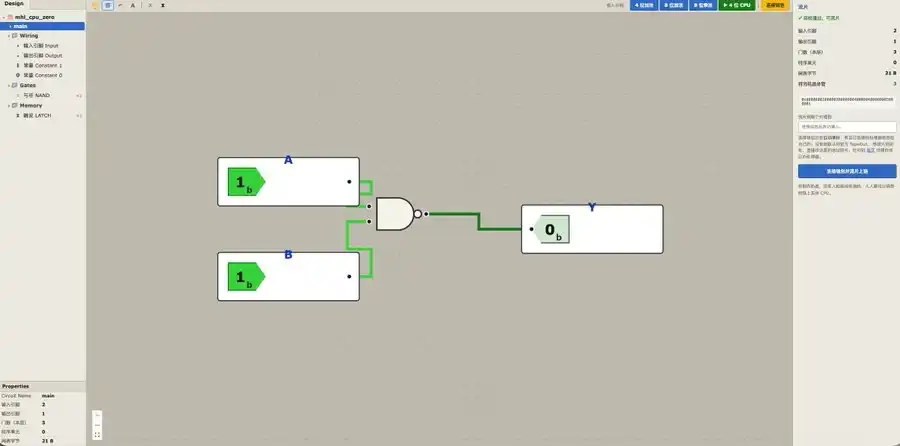
Deciphering TapeOut: A Child Built a CPU On-Chain

**Title: Understanding TapeOut: A Kid Built a CPU On-Chain** **Summary:** The article explores a remarkable experiment where a young developer named Blonskr has used blockchain technology to build a functional, on-chain CPU. Named "Behemoth," this CPU is based on the 1971 Intel 4004 processor specification. It runs on the BNB Chain, uses block production as its clock (running at a glacial 2.22 Hz), and is perhaps the slowest CPU in existence, yet it represents a novel and intriguing concept in the on-chain space. The core concept is the TapeOut protocol, named after the final "tape out" stage in semiconductor manufacturing. It treats the blockchain as a silicon wafer, with tokens representing fundamental logic components. The protocol's atomic unit is an ERC-1155 token representing a single NAND gate, the fundamental building block of digital logic. Users can visually design circuits on a "canvas," connecting these logic tokens. Once a design is finalized, the underlying tokens are burned, and an ERC-721 NFT representing the permanent, immutable circuit is minted. Blonskr used 2,300 such tokenized NAND gates to construct the Behemoth CPU. Key features of this and any TapeOut circuit include **permanent operation** (running as long as the chain exists), **free, permissionless evaluation** (anyone can query it without gas), and **safe composability** (circuits cannot call external contracts or modify state, making them inherently safe to use). This enables a new form of open, collaborative hardware design, where anyone can build upon and integrate components created by others. While highly niche, TapeOut reimagines the foundations of computation using blockchain's properties of permanence and openness. It pushes the boundaries of what can be built on-chain, potentially enabling future applications like custom mining circuits or decentralized, specialized processors. The experiment demonstrates an exciting combination of extreme technical vision and creative curiosity.

marsbitHace 47 min(s)

Deciphering TapeOut: A Child Built a CPU On-Chain

marsbitHace 47 min(s)

Novig Sues Wisconsin as Sports Prediction Market Dispute Heats Up

Novig, a sports event prediction market operator, has filed a lawsuit against Wisconsin's attorney general. The legal dispute centers on whether prediction markets fall under federal derivatives regulations or state gambling laws. The lawsuit, filed in a U.S. district court, seeks a declaratory judgment after Novig began offering event contracts to Wisconsin residents. This case is part of a broader conflict. In April, Wisconsin sued other prediction market platforms like Kalshi and Polymarket, alleging their sports-related contracts violate state gambling laws. Novig argues its contracts are "swaps" regulated exclusively by the federal Commodity Futures Trading Commission (CFTC), under the Commodity Exchange Act. Wisconsin contends they are sports betting. Federal courts have issued conflicting rulings on similar cases, creating legal uncertainty. The outcome is significant as prediction markets are a fast-growing sector, with trading volume reaching $9.5 billion on a single day in August. These markets are also increasingly intertwined with cryptocurrency infrastructure. Simultaneously, Novig is pursuing a nationwide legal strategy, having filed similar lawsuits in four other states. The company also recently secured a marketing partnership with the New York Mets, marking the first such deal with an MLB team. The Wisconsin case's resolution will influence whether prediction markets can operate as national financial products or remain constrained by individual state laws.

cryptonews.ruHace 54 min(s)

Novig Sues Wisconsin as Sports Prediction Market Dispute Heats Up

cryptonews.ruHace 54 min(s)

Держатели XRP могут торговать опционами на платформе Derive, используя FXRP в качестве залога

XRP holders can now trade options on the Derive platform using FXRP as collateral, as announced by Flare on August 12. This integration allows users to open positions from self-custody wallets while the underlying XRP backing the FXRP remains on the XRP Ledger. According to DeFi analyst Will Procheska, this provides XRP's dedicated holder base with a permissionless options market for generating yield or hedging. Derive's platform combines protocol-level settlements with an order book managed by Derive Trading Co., enabling users to retain asset control while professional market-makers provide liquidity. XRP options on Derive are cash-settled in USDC, so profits or obligations adjust the trader's USDC balance without transferring XRP or FXRP. The platform's portfolio margin system assesses overall account risk but may still trigger liquidations if margin levels fall below requirements. The launch expands Flare's XRPFi ecosystem. FXRP, introduced via the FAssets system in September 2025, creates an on-chain representation of XRP for use in smart contracts. It has since been integrated into spot trading and, more recently, permissionless lending markets on Morpho. This addition of options on Derive offers XRP holders hedging and premium-earning capabilities comparable to other major assets. While regulated XRP options debuted on CME Group in October 2025, Derive provides a decentralized alternative with USDC settlement and direct wallet access. The platform also supports perpetual futures, offering further trading strategies. Flare and Derive are exploring automated "strategy vaults" to simplify yield-generating options approaches for users.

cryptonews.ruHace 54 min(s)

Держатели XRP могут торговать опционами на платформе Derive, используя FXRP в качестве залога

cryptonews.ruHace 54 min(s)

Trading

Spot
活动图片