Ripple Updates XRP ‘Fast Facts’ As ETF And Institutional Momentum Grows

bitcoinistPublicado a 2026-01-08Actualizado a 2026-01-08

Resumen

RippleX has updated its "FAST FACTS" about XRP, positioning it as infrastructure for real-world utility rather than a speculative asset. The update highlights XRP's role in settlement, liquidity, and moving value across financial systems, with a fixed supply of 100 billion. XRPL is emphasized as a decentralized blockchain with over 116 validators and 6.4 million wallets, settling over $1 trillion in value. The thread also notes XRP's growing role in real-world assets (RWA) and stablecoins, listing key issuers and partnerships. Additionally, it mentions the emergence of institutional treasuries, like Evernorth's $1B commitment, and multiple spot ETFs, signaling regulated, mainstream adoption. XRP traded at $2.20 at the time of writing.

RippleX, the developer-focused arm of Ripple,used a Jan. 6 X thread to refresh a set of “FAST FACTS” about XRP, framing the asset less as a speculative ticker and more as market infrastructure, arriving as spot ETF momentum and early institutional treasury narratives begin to form around the token.

“XRP is a digital asset of choice for real-world utility – from stablecoin settlement to real-world assets, to institutional payments,” RippleX wrote. “With new momentum around XRP ETFs and institutional treasuries forming, here are some updated FAST FACTS about XRP.”

What Is XRP?

The thread’s opening points stick to the positioning Ripple has leaned on for years: XRP as a liquidity and settlement rail between financial systems rather than an app-layer bet.

RippleX described it as “a functional digital asset designed for settlement and liquidity, focusing on moving value between financial systems,” adding that, “acting as a neutral bridge, it helps move value between payments, stablecoins, tokenized financial assets, and collateral across the global economy.”

RippleX also reiterated supply constraints and control narratives that frequently resurface in institutional due diligence. “XRP was created at the launch of XRPL in 2012 and its supply is permanently capped at 100B – no additional XRP can ever be minted and no single entity (including Ripple) controls or can change the total supply,” the post said.

Other “fast facts” were more about market posture than mechanics, including the claim that XRP is “one of the few digital assets with clear regulatory standing in the US” and that it remains a top-three asset by market capitalization.

RippleX devoted several entries to XRPL’s decentralization metrics and operational history, emphasizing that the ledger runs independently of Ripple the company.

“XRPL is a public, decentralized blockchain with 116+ independent validators and 910+ public nodes – it operates independent of Ripple as an entity,” RippleX wrote. “XRP plays a core role on the network as its native settlement and liquidity asset.”

On consensus and execution, RippleX said XRPL uses “Proof-of-Association (PoA),” describing a model with “no mining, no staking, no block rewards,” and “transaction finality in 3–5 seconds.” It also pointed to network-scale usage stats since inception: “4B+ transactions,” “100M+ ledgers,” “6.4M+ wallets,” and “$1T+ in value” settled.

Real-World Assets And Stablecoins

A notable portion of the thread focused on RWAs and stablecoins,two categories where issuers and liquidity relationships matter more than raw TPS.

RippleX said XRPL is “now one of the top 10 blockchains for RWA activity,” listing issuers and initiatives “such as Ondo Finance, OpenEden, Archax/abrdn, Guggenheim Treasury Services, Mercado Bitcoin, VERT, and the Dubai Land Department” as building or launching assets on XRPL.

On stablecoins, RippleX cited a “growing stablecoin ecosystem” including “RLUSD, USDC, XSGD, AUDD, BBRL/USBD, and EURCV,” adding that “XRP often serves as a liquidity pair,” facilitating exchange between stablecoins and other assets on the network.

RippleX’s final “fast facts” aimed directly at regulated access and institutional balance sheets. It claimed XRP “now has its first institutional treasury” via Evernorth, which “has secured more than $1B in commitments,” describing this as a shift “from a traded asset to a regulated, balance-sheet asset for institutions.”

It also said XRP is “now supported by multiple spot ETFs,” naming Bitwise (XRP), Canary Capital (XRPC), Franklin Templeton (XRPZ), and Grayscale (GXRP) as issuers—positioning ETFs as a bridge into “regulated, mainstream investment products.”

Finally, RippleX pointed to wrapped XRP as an interoperability lever, saying it extends XRP’s utility to the “XRPL EVM Sidechain” and to ecosystems including “Ethereum, Solana, Optimism, and HyperEVM.”

At press time, XRP traded at $2.20.
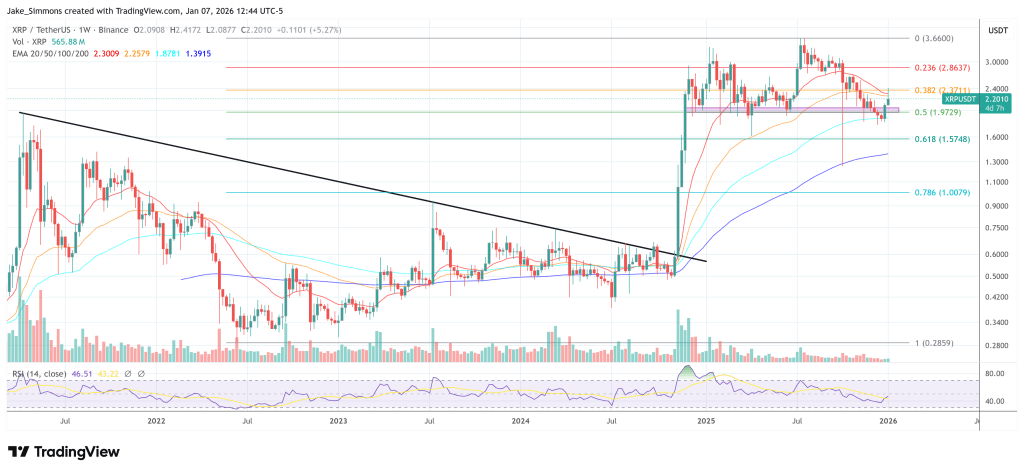
XRP faces the 0.382 Fib, 1-week chart | Source: XRPUSDT on TradingView.com

Preguntas relacionadas

QWhat is the main purpose of RippleX's updated 'FAST FACTS' about XRP?

ATo frame XRP less as a speculative asset and more as market infrastructure, highlighting its real-world utility and institutional adoption as ETF and treasury momentum grows.

QHow does RippleX describe the role of XRP in the financial ecosystem?

ARippleX describes XRP as a functional digital asset designed for settlement and liquidity, acting as a neutral bridge to move value between payments, stablecoins, tokenized financial assets, and collateral across the global economy.

QWhat are some key technical features of the XRP Ledger (XRPL) mentioned in the article?

AXRPL is a public, decentralized blockchain with over 116 independent validators and 910+ public nodes, using Proof-of-Association consensus with no mining or staking, and achieving transaction finality in 3-5 seconds.

QWhich real-world asset (RWA) and stablecoin initiatives are building on XRPL according to the article?

ARWA initiatives include Ondo Finance, OpenEden, Archax/abrdn, Guggenheim Treasury Services, Mercado Bitcoin, VERT, and the Dubai Land Department. Stablecoins include RLUSD, USDC, XSGD, AUDD, BBRL/USBD, and EURCV.

QHow is XRP gaining institutional adoption through regulated products?

AXRP now has its first institutional treasury via Evernorth with over $1B in commitments, and is supported by multiple spot ETFs from issuers like Bitwise, Canary Capital, Franklin Templeton, and Grayscale, positioning it as a regulated, balance-sheet asset.

Lecturas Relacionadas

The Verdict in Choi Tae-won's Divorce Case: Revealing the Inheritance Undercurrent Behind SK Hynix's Trillion-Won Empire

SK Group Chairman Chey Tae-won's high-profile divorce case, involving a record 1.38 trillion won settlement, has drawn attention to the succession plans for Korea's second-largest conglomerate, especially its crown jewel, SK hynix. Unlike traditional chaebol scripts centered on the eldest son, Chey's three children from his marriage to former President Roh Tae-woo's daughter, Roh Soh-yeong, are carving distinct, non-traditional paths. Eldest daughter Chey Yun-jung (b. 1989) is seen as the most evident successor. With a scientific and consulting background, she holds executive roles at SK bioscience and SK Inc.'s growth support department, focusing on future strategy and biopharma. Her marriage is to an AI infrastructure entrepreneur, not a traditional business alliance. Second daughter Chey Min-jung (b. 1991) took a unique route, voluntarily serving as a South Korean naval officer, including an anti-piracy deployment. She later worked on policy and strategy for SK hynix in Washington D.C. before co-founding an AI-driven healthcare startup. She married a former U.S. Marine Corps officer, connecting her to U.S. defense and policy circles—networks crucial for a global semiconductor giant. The only son, Chey In-geun (b. 1995), who studied physics like his father, worked briefly at SK E&S before joining McKinsey. Despite fitting the traditional "heir" profile as the eldest son, he remains silent and holds no public position or shares in SK, suggesting the old succession playbook is obsolete. As SK hynix's valuation soars, becoming a geopolitical asset in the AI era, the heirs' legitimacy is no longer automatic. They must prove themselves in fields like AI biotech, global policy, and strategic consulting. Their marriages also reflect new elite networks in tech and defense, not old political alliances. Their inheritance is the complex challenge of navigating a globalized, tech-driven world, not just a corporate throne.

marsbitHace 11 hora(s)

The Verdict in Choi Tae-won's Divorce Case: Revealing the Inheritance Undercurrent Behind SK Hynix's Trillion-Won Empire

marsbitHace 11 hora(s)

From OpenSea to OpenRouter: Is Alex Atallah Repeating His 'Exit at the Peak' Playbook?

From OpenSea to OpenRouter: Is Alex Atallah Repeating His "Exit at the Peak" Playbook? According to the Wall Street Journal, payments giant Stripe is in talks to acquire the AI model aggregation platform OpenRouter in a potential deal valuing the company near $100 billion. This would mark founder Alex Atallah's second creation of a company reaching a $100 billion valuation, following his co-founding of NFT marketplace OpenSea. OpenRouter, founded just over three years ago, has grown rapidly by acting as a unified gateway for developers to access over 400 AI models. It currently has about 10 million users and processes over 200 trillion tokens monthly. While the platform's annualized revenue is around $50 million, its valuation has skyrocketed from $1.3 billion in March 2026. The potential acquisition by Stripe, a company OpenRouter's founder once likened it to, represents a major expansion into AI infrastructure for the payments leader. This move echoes Atallah's previous timing with OpenSea, where he departed before the NFT market's significant downturn. For OpenRouter, selling now may be strategic. Despite its scale, its business model—charging a 5-5.5% fee on AI inference calls—faces pressure from competition, open-source models, and potential price wars among model providers, limiting its profitability narrative for an IPO. A key asset for potential acquirers like Stripe is OpenRouter's vast repository of real-world AI usage data, which offers unique insights into model performance and developer preferences that are difficult to replicate. Whether this potential deal signifies a new valuation benchmark for AI infrastructure or another market peak signal remains to be seen.

链捕手Hace 11 hora(s)

From OpenSea to OpenRouter: Is Alex Atallah Repeating His 'Exit at the Peak' Playbook?

链捕手Hace 11 hora(s)

Trading

Spot
活动图片





