Ripple, Stellar Show Up In New Epstein Files, Ex-CTO Schwartz Reacts

bitcoinistPublicado a 2026-02-03Actualizado a 2026-02-03

Resumen

Newly released Jeffrey Epstein documents include a 2014 email from Blockstream co-founder Austin Hill that mentions Ripple and Stellar. In the email, Hill reportedly complained to Epstein and others about investors supporting competing projects, framing backers of Ripple or Stellar as "enemies/opponents" to his Bitcoin-centric ecosystem. Former Ripple CTO David Schwartz publicly responded, stating he knows of no direct connections between Epstein and either Ripple, XRP, or Stellar. He emphasized there is no evidence that anyone from these projects met with Epstein or his close associates. Schwartz criticized the "enemy/opponent" mindset as harmful to the entire crypto space and dismissed the notion of deeper involvement as speculative conspiracy. He also addressed a question about Ripple's for-profit structure versus Stellar's non-profit, revealing he had opposed the non-profit model early on, believing it seemed dishonest and borderline illegal. At the time of reporting, XRP was trading at $1.64.

Ripple and Stellar were pulled into a fresh round of social-media speculation this weekend after newly surfaced emails from the Epstein document release appeared to reference the two projects in a 2014 investor dispute. Former Ripple CTO David Schwartz pushed back publicly, saying he knows of no direct links between Epstein and either network, and framed the episode as another example of tribal politics bleeding into crypto.

Schwartz Reacts After Epstein Docs Mention Ripple, Stellar

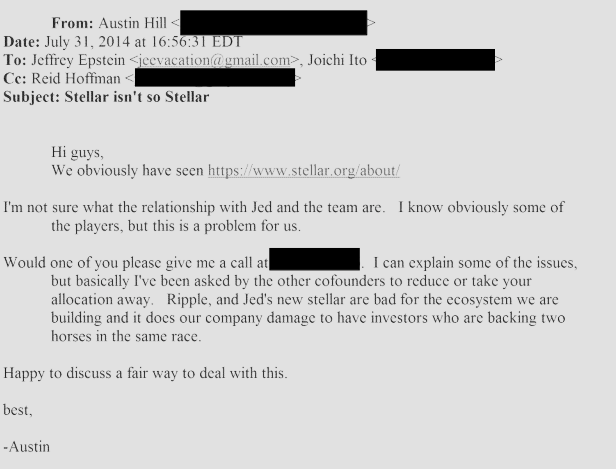
The spark came from a screenshot circulating on X that shows an email chain in which Austin Hill (co-founder of Blockstream) complained to a group of high-profile recipients, including Epstein, about investors allocating capital across competing projects. According to Schwartz, the document “is an email from Austin Hill to Jeffrey Epstein explaining that Hill felt that support for Ripple or Stellar made someone an enemy/opponent,” adding that Hill likely shared similar views “to many other people.”

As the image spread, some posts characterized the mere inclusion of Ripple and Stellar in the email as evidence of deeper involvement. Schwartz responded with a message that tried to separate inflammatory framing from what the document actually shows.

“I don’t know of any connections between Jeffrey Epstein and Ripple, XRP, or Stellar. [I don’t know of] any evidence anyone at Ripple or Stellar ever met with Epstein or anyone closely connected to him,” he wrote. “There are some indirect ties between Epstein and people connected to Bitcoin in various ways, but that’s probably true of most very wealthy people.”
Source: X @JoelKatz

Schwartz’s first post on the thread captured the mood of the day, both suspicion and a reluctance to feed it. “I hate to be a conspiracy theorist, but I wouldn’t be at all surprised if this is just the tip of a giant iceberg,” he wrote while linking to the DOJ-hosted file. He later argued the more corrosive issue was the “enemy/opponent” mindset, writing that “we really are all in this together and this kind of attitude hurts everyone in the space.”

In the underlying 2014 email described in the source material, Hill is portrayed as objecting to backers funding multiple “horses” at once, treating support for Ripple or Stellar as hostile to the bitcoin-centric “ecosystem” he was building at Blockstream. Reports summarizing the chain say it was sent to Joichi Ito, Epstein, and Reid Hoffman, and included language that investors in both camps were “backing two horses in the same race.”

The resurfaced email also revived an older fault line in how early projects structured themselves. In response to a user asking about Ripple versus Stellar’s nonprofit posture, Schwartz said the idea was debated early on and that he opposed it.

“We discussed it in the early days. I was strongly against it because it seemed dishonest and borderline illegal to have a non-profit whose success was so tied to the gains of private parties,” he wrote. “It felt, at least to me, like Walmart creating a non-profit to help educate people about how much money they could save by shopping at Walmart.”

At press time, XRP traded at $1.64.
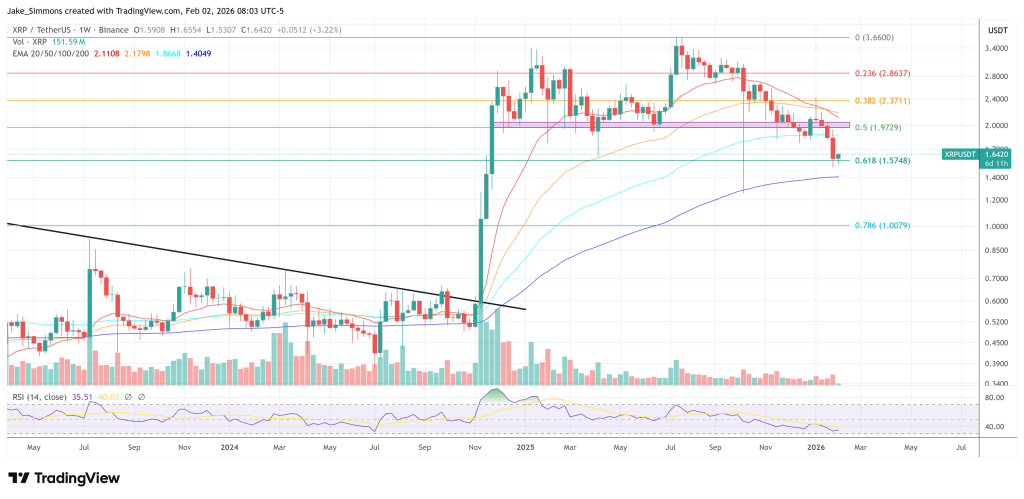
XRP holds above the 0.618 Fib, 1-week chart | Source: XRPUSDT on TradingView.com

Preguntas relacionadas

QWhat sparked the recent social-media speculation involving Ripple and Stellar?

AThe speculation was ignited by a screenshot of a 2014 email chain from the Epstein document release, in which Blockstream co-founder Austin Hill complained to Jeffrey Epstein and others about investors allocating capital across competing projects like Ripple and Stellar.

QHow did former Ripple CTO David Schwartz respond to the allegations of connections between Epstein and Ripple/Stellar?

ADavid Schwartz publicly stated that he knows of no direct connections between Jeffrey Epstein and Ripple, XRP, or Stellar, and that he was unaware of any evidence that anyone at Ripple or Stellar had ever met with Epstein or anyone closely connected to him.

QWhat was the main complaint in Austin Hill's 2014 email as described in the article?

AIn the email, Austin Hill objected to investors funding multiple competing projects simultaneously, characterizing support for Ripple or Stellar as being hostile to the bitcoin-centric 'ecosystem' he was building at Blockstream, and referred to it as 'backing two horses in the same race.'

QWhat did David Schwartz identify as the more corrosive issue in the crypto space, beyond the Epstein speculation?

ASchwartz argued that the more corrosive issue was the 'enemy/opponent' mindset, stating that 'we really are all in this together and this kind of attitude hurts everyone in the space.'

QWhat was David Schwartz's stated position on Ripple adopting a non-profit structure in its early days?

ASchwartz said he was strongly opposed to the idea of Ripple becoming a non-profit because he felt it seemed dishonest and borderline illegal to have a non-profit whose success was so tied to the gains of private parties, comparing it to 'Walmart creating a non-profit to help educate people about how much money they could save by shopping at Walmart.'

Lecturas Relacionadas

Gensyn AI: Don't Let AI Repeat the Mistakes of the Internet

In recent months, the rapid growth of the AI industry has attracted significant talent from the crypto sector. A persistent question among researchers intersecting both fields is whether blockchain can become a foundational part of AI infrastructure. While many previous AI and Crypto projects focused on application layers (like AI Agents, on-chain reasoning, data markets, and compute rentals), few achieved viable commercial models. Gensyn differentiates itself by targeting the most critical and expensive layer of AI: model training. Gensyn aims to organize globally distributed GPU resources into an open AI training network. Developers can submit training tasks, nodes provide computational power, and the network verifies results while distributing incentives. The core issue addressed is not decentralization for its own sake, but the increasing centralization of compute power among tech giants. In the era of large models, access to GPUs (like the H100) has become a decisive bottleneck, dictating the pace of AI development. Major AI companies are heavily dependent on large cloud providers for compute resources. Gensyn's approach is significant for several reasons: 1) It operates at the core infrastructure layer (model training), the most resource-intensive and technically demanding part of the AI value chain. 2) It proposes a more open, collaborative model for compute, potentially increasing resource utilization by dynamically pooling idle GPUs, similar to early cloud computing logic. 3) Its technical moat lies in solving complex challenges like verifying training results, ensuring node honesty, and maintaining reliability in a distributed environment—making it more of a deep-tech infrastructure company. 4) It targets a validated, high-growth market with genuine demand, rather than pursuing blockchain integration without purpose. Ultimately, the boundaries between Crypto and AI are blurring. AI requires global resource coordination, incentive mechanisms, and collaborative systems—areas where crypto-native solutions excel. Gensyn represents a step toward making advanced training capabilities more accessible and collaborative, moving beyond a niche controlled by a few giants. If successful, it could evolve into a fundamental piece of AI infrastructure, where the most enduring value in the AI era is often created.

marsbitHace 10 hora(s)

Gensyn AI: Don't Let AI Repeat the Mistakes of the Internet

marsbitHace 10 hora(s)

Why is China's AI Developing So Fast? The Answer Lies Inside the Labs

A US researcher's visit to China's top AI labs reveals distinct cultural and organizational factors driving China's rapid AI development. While talent, data, and compute are similar to the West, Chinese labs excel through a pragmatic, execution-focused culture: less emphasis on individual stardom and conceptual debate, and more on teamwork, engineering optimization, and mastering the full tech stack. A key advantage is the integration of young students and researchers who approach model-building with fresh perspectives and low ego, prioritizing collective progress over personal credit. This contrasts with the US culture of self-promotion and "star scientist" narratives. Chinese labs also exhibit a strong "build, don't buy" mentality, preferring to develop core capabilities—like data pipelines and environments—in-house rather than relying on external services. The ecosystem feels more collaborative than tribal, with mutual respect among labs. While government support exists, its scale is unclear, and technical decisions appear driven by labs, not state mandates. Chinese companies across sectors, from platforms to consumer tech, are building their own foundational models to control their tech destiny, reflecting a broader cultural drive for technological sovereignty. Demand for AI is emerging, with spending patterns potentially mirroring cloud infrastructure more than traditional SaaS. Despite challenges like a less mature data industry and GPU shortages, Chinese labs are propelled by vast talent, rapid iteration, and deep integration with the open-source community. The competition is evolving beyond a pure model race into a contest of organizational execution, developer ecosystems, and industrial pragmatism.

marsbitHace 12 hora(s)

Why is China's AI Developing So Fast? The Answer Lies Inside the Labs

marsbitHace 12 hora(s)

3 Years, 5 Times: The Rebirth of a Century-Old Glass Factory

Corning, a 175-year-old glass company, is experiencing a dramatic revival as a key player in AI infrastructure, driven by surging demand for high-performance optical fiber in data centers. AI data centers require vastly more fiber than traditional ones—5 to 10 times as much per rack—to handle high-speed data transmission between GPUs. This structural demand shift, coupled with supply constraints from the lengthy expansion cycle for fiber preforms, has created a significant supply-demand gap. Nvidia has invested in Corning, along with Lumentum and Coherent, in a $4.5 billion total commitment to secure the optical supply chain for AI. Corning's competitive edge lies in its expertise in producing ultra-low-loss, high-density, and bend-resistant specialty fiber, which is critical for 800G+ and future 1.6T data rates. Its deep involvement in co-packaged optics (CPO) with partners like Nvidia further solidifies its position. While not the largest fiber manufacturer globally, Corning's revenue from enterprise/data center clients now exceeds 40% of its optical communications sales, and it has secured multi-year supply agreements with major hyperscalers including Meta and Nvidia. Financially, Corning's optical communications revenue has surged, doubling from $1.3 billion in 2023 to over $3 billion in 2025. Its stock price has risen nearly 6-fold since late 2023. Key future catalysts include the rollout of Nvidia's CPO products and the scale of undisclosed customer agreements. However, risks include high current valuations and potential disruption from next-generation technologies like hollow-core fiber. The company's long-term bet on light over electricity, maintained even through the telecom bubble crash, is now being validated by the AI boom.

marsbitHace 12 hora(s)

3 Years, 5 Times: The Rebirth of a Century-Old Glass Factory

marsbitHace 12 hora(s)

Trading

Spot
Futuros
活动图片


