Ripple, Stellar Show Up In New Epstein Files, Ex-CTO Schwartz Reacts

bitcoinistPublicado a 2026-02-03Actualizado a 2026-02-03

Resumen

Newly released Jeffrey Epstein documents include a 2014 email from Blockstream co-founder Austin Hill that mentions Ripple and Stellar. In the email, Hill reportedly complained to Epstein and others about investors supporting competing projects, framing backers of Ripple or Stellar as "enemies/opponents" to his Bitcoin-centric ecosystem. Former Ripple CTO David Schwartz publicly responded, stating he knows of no direct connections between Epstein and either Ripple, XRP, or Stellar. He emphasized there is no evidence that anyone from these projects met with Epstein or his close associates. Schwartz criticized the "enemy/opponent" mindset as harmful to the entire crypto space and dismissed the notion of deeper involvement as speculative conspiracy. He also addressed a question about Ripple's for-profit structure versus Stellar's non-profit, revealing he had opposed the non-profit model early on, believing it seemed dishonest and borderline illegal. At the time of reporting, XRP was trading at $1.64.

Ripple and Stellar were pulled into a fresh round of social-media speculation this weekend after newly surfaced emails from the Epstein document release appeared to reference the two projects in a 2014 investor dispute. Former Ripple CTO David Schwartz pushed back publicly, saying he knows of no direct links between Epstein and either network, and framed the episode as another example of tribal politics bleeding into crypto.

Schwartz Reacts After Epstein Docs Mention Ripple, Stellar

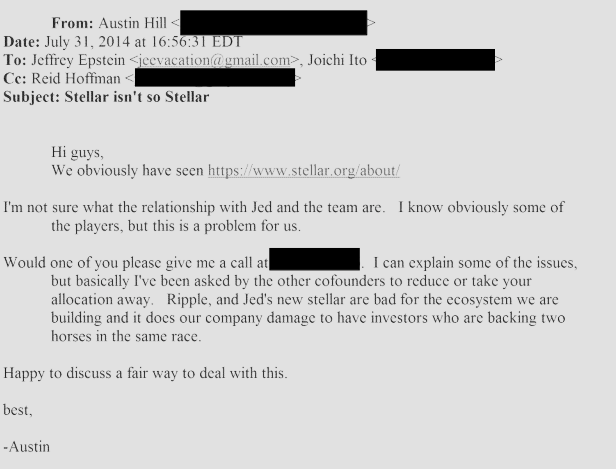
The spark came from a screenshot circulating on X that shows an email chain in which Austin Hill (co-founder of Blockstream) complained to a group of high-profile recipients, including Epstein, about investors allocating capital across competing projects. According to Schwartz, the document “is an email from Austin Hill to Jeffrey Epstein explaining that Hill felt that support for Ripple or Stellar made someone an enemy/opponent,” adding that Hill likely shared similar views “to many other people.”

As the image spread, some posts characterized the mere inclusion of Ripple and Stellar in the email as evidence of deeper involvement. Schwartz responded with a message that tried to separate inflammatory framing from what the document actually shows.

“I don’t know of any connections between Jeffrey Epstein and Ripple, XRP, or Stellar. [I don’t know of] any evidence anyone at Ripple or Stellar ever met with Epstein or anyone closely connected to him,” he wrote. “There are some indirect ties between Epstein and people connected to Bitcoin in various ways, but that’s probably true of most very wealthy people.”
Source: X @JoelKatz

Schwartz’s first post on the thread captured the mood of the day, both suspicion and a reluctance to feed it. “I hate to be a conspiracy theorist, but I wouldn’t be at all surprised if this is just the tip of a giant iceberg,” he wrote while linking to the DOJ-hosted file. He later argued the more corrosive issue was the “enemy/opponent” mindset, writing that “we really are all in this together and this kind of attitude hurts everyone in the space.”

In the underlying 2014 email described in the source material, Hill is portrayed as objecting to backers funding multiple “horses” at once, treating support for Ripple or Stellar as hostile to the bitcoin-centric “ecosystem” he was building at Blockstream. Reports summarizing the chain say it was sent to Joichi Ito, Epstein, and Reid Hoffman, and included language that investors in both camps were “backing two horses in the same race.”

The resurfaced email also revived an older fault line in how early projects structured themselves. In response to a user asking about Ripple versus Stellar’s nonprofit posture, Schwartz said the idea was debated early on and that he opposed it.

“We discussed it in the early days. I was strongly against it because it seemed dishonest and borderline illegal to have a non-profit whose success was so tied to the gains of private parties,” he wrote. “It felt, at least to me, like Walmart creating a non-profit to help educate people about how much money they could save by shopping at Walmart.”

At press time, XRP traded at $1.64.
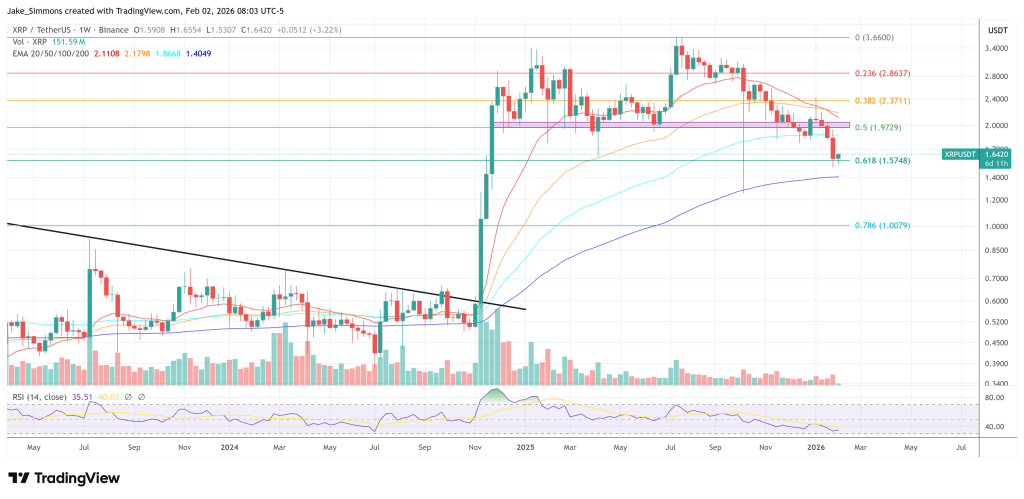
XRP holds above the 0.618 Fib, 1-week chart | Source: XRPUSDT on TradingView.com

Preguntas relacionadas

QWhat sparked the recent social-media speculation involving Ripple and Stellar?

AThe speculation was ignited by a screenshot of a 2014 email chain from the Epstein document release, in which Blockstream co-founder Austin Hill complained to Jeffrey Epstein and others about investors allocating capital across competing projects like Ripple and Stellar.

QHow did former Ripple CTO David Schwartz respond to the allegations of connections between Epstein and Ripple/Stellar?

ADavid Schwartz publicly stated that he knows of no direct connections between Jeffrey Epstein and Ripple, XRP, or Stellar, and that he was unaware of any evidence that anyone at Ripple or Stellar had ever met with Epstein or anyone closely connected to him.

QWhat was the main complaint in Austin Hill's 2014 email as described in the article?

AIn the email, Austin Hill objected to investors funding multiple competing projects simultaneously, characterizing support for Ripple or Stellar as being hostile to the bitcoin-centric 'ecosystem' he was building at Blockstream, and referred to it as 'backing two horses in the same race.'

QWhat did David Schwartz identify as the more corrosive issue in the crypto space, beyond the Epstein speculation?

ASchwartz argued that the more corrosive issue was the 'enemy/opponent' mindset, stating that 'we really are all in this together and this kind of attitude hurts everyone in the space.'

QWhat was David Schwartz's stated position on Ripple adopting a non-profit structure in its early days?

ASchwartz said he was strongly opposed to the idea of Ripple becoming a non-profit because he felt it seemed dishonest and borderline illegal to have a non-profit whose success was so tied to the gains of private parties, comparing it to 'Walmart creating a non-profit to help educate people about how much money they could save by shopping at Walmart.'

Lecturas Relacionadas

VCs on 2025 Crypto Investments: 84% of 118 Tokens Break Issue Price, Only One Type of Company is Quietly Making Money

Crypto investor Ching Tseng categorizes the market into four quadrants based on two axes: crypto-native vs. traditional finance (TradFi)-oriented, and having traction vs. no traction. In 2025, 84.7% of 118 tracked token launches fell below their issuance price, with a median fully diluted valuation drop of 71%. Crypto-native projects without traction are experiencing massive capital destruction, often relying on speculative narratives without sustainable revenue or user retention. Crypto-native teams with traction, often built in prior cycles, generate real revenue but face structural challenges with their tokens lacking direct value capture mechanisms. While some have implemented successful buyback programs, the core issue remains finding growth beyond crypto volatility. TradFi-oriented startups without traction face long, costly enterprise sales cycles but benefit from a robust M&A environment, with crypto acquisitions reaching a record $8.6 billion in 2025. The current winners are TradFi-oriented companies with traction, particularly in the Real World Asset (RWA) tokenization space, which grew from $5.5B to $18.6B in 2025. They are winning through enterprise sales, building alliances, and improving unit economics on established compliance stacks. Their main risk is being bypassed by large incumbent institutions building their own infrastructure. The overarching theme is market maturation, where narrative alone is insufficient for long-term success.

marsbitHace 40 min(s)

VCs on 2025 Crypto Investments: 84% of 118 Tokens Break Issue Price, Only One Type of Company is Quietly Making Money

marsbitHace 40 min(s)

Trading

Spot
Futuros
活动图片