Ripple Outlines Next Steps After Critical XRP Ledger Batch Amendment Bug

bitcoinistPublicado a 2026-03-04Actualizado a 2026-03-04

Resumen

Ripple is implementing stricter security measures for the XRP Ledger amendment process after a critical bug was discovered in the proposed Batch amendment (XLS-56). The flaw, identified by Cantina AI, was caught before activation, preventing any mainnet impact. RippleX Head of Engineering J. Ayo Akinyele acknowledged the amendment "progressed further than it should have" and emphasized the need for higher review standards. While the network's safeguards worked as a final defense, Ripple is taking steps to make them a primary one. Proposed changes include mandatory multiple independent audits for high-risk features, an expanded bug bounty program, and formal adversarial testing. The company is also incorporating AI-assisted code review and aims to make formal verification standard for critical ledger components.

Ripple says it is tightening the XRP Ledger amendment process after a critical flaw was found in the proposed Batch amendment (XLS-56), an incident that exposed gaps in review even as the network’s last-resort safeguards prevented any mainnet impact.

In a post on X, RippleX Head of Engineering J. Ayo Akinyele said the bug was identified last week by Cantina AI, reported responsibly, and quickly validated as critical. The issue never became exploitable on mainnet because the amendment had not yet been activated, and a hotfix was issued to disable both Batch and the related fix amendment while a broader remediation is reviewed.

Ripple Responds To The Critical Bug

Akinyele did not try to soften the significance of the lapse. “The Batch amendment progressed further than it should have,” he wrote. “As active participants in the amendment lifecycle, we share responsibility for ensuring that review, signaling, and activation safeguards meet the highest standard. In this case, we must do better.”

At the same time, Ripple is framing the episode as a failure of early-stage review rather than of the XRPL governance model itself. Akinyele said “the amendment process functioned as designed,” noting that activation gating prevented harm to mainnet and the bug bounty disclosure route worked as intended. But he added a sharper warning: “Those safeguards matter, but they should serve as a final line of defense, not the primary one.”

That distinction runs through the rest of Ripple’s response. Rather than suggesting tighter centralized control, Akinyele argued that amendment security on XRPL must remain distributed across core contributors, validators, the XRPL Foundation and outside researchers. “No single entity controls activation. No single entity owns risk in isolation,” he wrote, describing that structure as both a consequence of decentralization and a strength, provided it is matched by layered defenses and better coordination.

Ripple’s proposed fixes are broad. Akinyele said future releases that introduce features carrying “theoretical risk of disruption” will go through multiple independent audits with reputable security firms in coordination with the XRPL Foundation. The idea is straightforward: different teams catch different classes of issues, and redundancy reduces blind spots when code touches consensus-critical behavior.

The company also plans to expand the bug bounty program and formalize adversarial testing campaigns before activation. Akinyele pointed to initiatives such as the Lending attackathon and a UBRI-sponsored hackathon as models for that approach, arguing that incentivizing white-hat attackers before launch is far cheaper than reacting after the fact. He added that lessons from the Batch incident have already affected other roadmap items, saying Ripple “deliberately held lending back” to allow for more review, testing and scrutiny before moving toward activation.

Part of that next phase will rely more heavily on AI. Akinyele said Ripple is incorporating AI-assisted code review, automated invariant discovery, agentic fuzzing and simulated attack scenarios into its software development lifecycle. “AI does not replace expert C++ engineers, but rather augments them,” he wrote, especially when “subtle logic interactions at critical points can create outsized risk.”

Longer term, Ripple says it wants formal verification to become standard for high-risk ledger components. That includes modeling amendment behavior before activation, proving safety properties for critical components and integrating formal methods from XLS specification through implementation and testing. The broader aim, Akinyele said, is end-to-end assurance that amendment code is not only functionally correct but aligned with defined security and safety properties.

At press time, XRP traded at $1.3698.
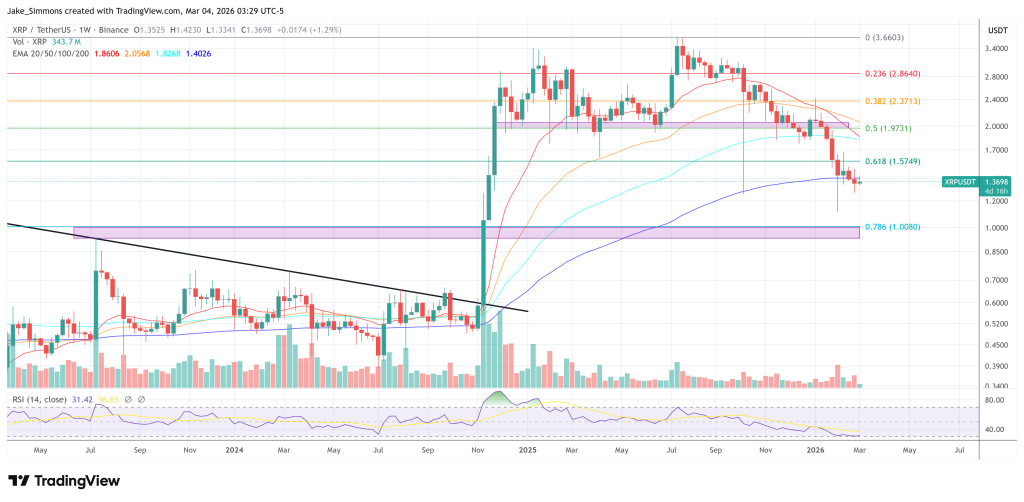
XRP falls below the 200-week EMA agan, 1-week chart | Source: XRPUSDT on TradingView.com

Preguntas relacionadas

QWhat was the critical flaw discovered in the XRP Ledger and how was it identified?

AA critical flaw was found in the proposed Batch amendment (XLS-56). It was identified by Cantina AI, who reported it responsibly, and it was quickly validated as critical.

QAccording to RippleX Head of Engineering, what was the primary failure that allowed the Batch amendment to progress too far?

AJ. Ayo Akinyele stated that the primary failure was in the early-stage review process, not the XRPL governance model itself. He said, 'The Batch amendment progressed further than it should have,' and that the review, signaling, and activation safeguards did not meet the highest standard.

QWhat specific new measures is Ripple implementing to prevent similar incidents in the future?

ARipple is implementing multiple independent audits for high-risk features, expanding the bug bounty program, formalizing adversarial testing campaigns, incorporating AI-assisted code review and automated testing into its development lifecycle, and aiming to make formal verification standard for high-risk ledger components.

QHow did the XRP Ledger's existing safeguards prevent the bug from causing harm on the mainnet?

AThe network's activation gating safeguards prevented any harm because the flawed amendment had not yet been activated on the mainnet. A hotfix was then issued to disable the amendment while a broader remediation was reviewed.

QWhat is Ripple's long-term goal regarding the security of amendment code on the XRP Ledger?

ARipple's long-term goal is to achieve end-to-end assurance that amendment code is not only functionally correct but also aligned with defined security and safety properties. This involves using formal verification to model behavior, prove safety properties for critical components, and integrate formal methods from specification through implementation and testing.

Lecturas Relacionadas

You Bet on the News, the Pros Read the Rules: The True Cognitive Gap in Losing Money on Polymarket

The article explains that the key to profiting on Polymarket, a prediction market platform, lies not just predicting real-world events correctly, but in meticulously understanding the specific rules that govern how each market will be resolved. It illustrates this with examples, such as a market on Venezuela's 2026 leader, where the official rules defining "officially holds" the office overruled the intuitive answer of who was in practical control. Other examples include debates over the definition of a "token" or what constitutes an "agreement." The core argument is that a "reality vs. rules" gap creates pricing discrepancies that savvy traders ("车头" or "whales") exploit. The platform has a formal dispute resolution process managed by UMA token holders to settle ambiguous outcomes. This process involves proposal submission, a challenge window, a discussion period, and a final vote. However, the article highlights a critical flaw in this system compared to a traditional court: the lack of separation between the arbiters (UMA voters) and the interested parties (traders with financial stakes in the outcome). This conflict of interest undermines the discussion phase, leads to herd mentality, and results in opaque final decisions without explanatory rulings. Consequently, the system lacks a body of precedent, making it difficult for users to learn from past disputes. The ultimate takeaway is that success on Polymarket requires a lawyer-like scrutiny of the rules to identify and capitalize on the cognitive gap between how events appear and how they are contractually defined for settlement.

marsbitHace 24 min(s)

You Bet on the News, the Pros Read the Rules: The True Cognitive Gap in Losing Money on Polymarket

marsbitHace 24 min(s)

Will the Fed Still Cut Interest Rates? Tonight's Data Is Crucial

The core debate surrounding the Federal Reserve's potential interest rate cuts is intensifying amid geopolitical conflict and rebounding inflation. The key question is whether high energy prices will cause persistent inflation or weaken consumer demand enough to force the Fed to cut rates. Citigroup presents a bullish case for cuts, arguing that oil supply disruptions from the Strait of Hormuz are temporary and will not lead to lasting inflationary pressure. They point to receding bond yields and oil prices as evidence the market is pricing in a short-lived shock. Citi's data also shows tightening financial conditions, a stabilizing labor market, and healthy tax returns, supporting their view that the path to lower rates remains open. Conversely, Deutsche Bank offers a starkly contrasting, more hawkish outlook. They argue the Fed's current policy is already neutral and expect rates to remain unchanged indefinitely. Their view is based on stalled disinflation progress and a shift toward more hawkish rhetoric from key Fed officials like Waller, who cited risks from prolonged Middle East conflict and tariffs. Other officials, including Williams and Hammack, signaled rates would likely stay on hold for a "considerable time." The market pricing has shifted dramatically, now forecasting zero cuts in 2026. The imminent release of the March retail sales "control group" data is highlighted as a critical test. This metric, which excludes gas station sales, will reveal if high gasoline prices are eroding consumer spending in other areas. A weak reading could support the case for imminent rate cuts, while a strong one would bolster the argument for the Fed to hold steady. This data is pivotal for determining the near-term policy path.

marsbitHace 44 min(s)

Will the Fed Still Cut Interest Rates? Tonight's Data Is Crucial

marsbitHace 44 min(s)

Trading

Spot
Futuros

Artículos destacados

Qué es XRP 2.0

XRP 2.0: Una Nueva Frontera en el Panorama de las Criptomonedas Introducción a XRP 2.0 En el siempre cambiante ámbito de las criptomonedas, nuevos proyectos surgen continuamente, compitiendo por atención y adopción. Una de estas iniciativas prometedoras es XRP 2.0, un nuevo proyecto de criptomoneda diseñado para aprovechar la tecnología blockchain avanzada y metodologías de encriptación robustas. Aunque el nombre establece paralelismos con el XRP de Ripple, es crucial señalar que XRP 2.0 opera de manera independiente, enfocándose en mejorar la seguridad de las transacciones, la privacidad y la escalabilidad. A medida que el panorama financiero digital abraza cada vez más soluciones descentralizadas, XRP 2.0 busca contribuir de manera significativa a web3 y a la expansión general de los proyectos de criptomonedas. ¿Qué es XRP 2.0? En esencia, XRP 2.0 es un proyecto de criptomoneda que busca crear un ecosistema de moneda digital seguro y descentralizado. Su tecnología fundamental integra principios avanzados de blockchain con técnicas de encriptación de vanguardia. El objetivo principal de XRP 2.0 es establecerse como una plataforma confiable y eficiente que permita la ejecución rápida de transacciones mientras prioriza la protección de la privacidad de sus usuarios. El proyecto se promociona como una solución a muchas limitaciones enfrentadas por las criptomonedas existentes, proponiendo un sistema que puede manejar un mayor volumen de transacciones con mejor velocidad y privacidad. Esta versatilidad posiciona a XRP 2.0 como un competidor significativo en un mercado plagado de diversas monedas digitales. ¿Quién es el Creador de XRP 2.0? La identidad del creador detrás de XRP 2.0 ha sido señalada como 'Wilbur.' Sin embargo, los detalles completos sobre Wilbur o su entidad asociada siguen siendo elusivos. La anonimidad de muchos creadores de criptomonedas no es un fenómeno poco común en la industria, a menudo diseñado para mantener un grado de privacidad y seguridad. ¿Quiénes son los Inversores de XRP 2.0? Hasta ahora, la información específica relacionada con las fundaciones o organizaciones de inversión que apoyan a XRP 2.0 no está disponible públicamente. En el sector de las criptomonedas, el respaldo de inversores respetables puede influir significativamente en la credibilidad y el éxito de un proyecto, sin embargo, la transparencia sobre los patrocinadores financieros de XRP 2.0 no se ha establecido. ¿Cómo Funciona XRP 2.0? XRP 2.0 se destaca al emplear una combinación de tecnología blockchain y algoritmos de encriptación avanzados que aseguran transacciones seguras y descentralizadas. Su estructura innovadora incluye características únicas diseñadas para fomentar el compromiso del usuario y ampliar las funcionalidades más allá de las transacciones convencionales de criptomonedas. Entre estas características, XRP 2.0 incorpora capacidades impulsadas por IA, como funcionalidades de texto a imagen y de texto a voz. Estas adiciones están diseñadas para mejorar la experiencia interactiva de los usuarios, promoviendo una mayor aplicabilidad en diversos sectores. Al unir avances tecnológicos con un diseño centrado en el usuario, XRP 2.0 busca captar la atención de una amplia gama de individuos y empresas que buscan integrar soluciones de criptomonedas en sus marcos operativos. Cronología de XRP 2.0 Entender XRP 2.0 requiere examinar los hitos que han definido su viaje hasta ahora: 23 de julio de 2023: Se presenta XRP 2.0 como un nuevo proyecto de criptomonedas, con el objetivo de revolucionar las capacidades de transacciones seguras y descentralizadas en el ámbito de blockchain. 8 de septiembre de 2023: Se lanza otro proyecto, XRP20, marcando la aparición de un token ERC-20 en la blockchain de Ethereum que no guarda relación con XRP 2.0. 13 de noviembre de 2023: El Libro Mayor de XRP experimenta una actualización significativa con el lanzamiento de la versión 2.0.0 del software del servidor rippled. Es esencial señalar que este desarrollo está desconectado del proyecto de criptomonedas XRP 2.0. Puntos Clave sobre XRP 2.0 Para destilar la esencia de XRP 2.0, surgen varios factores críticos: Características Únicas: La inclusión de características como texto a imagen y texto a voz impulsadas por IA diversifica aún más las aplicaciones potenciales de XRP 2.0. Tecnología Blockchain: El marco utiliza mecanismos avanzados de blockchain y protocolos de encriptación, asegurando un entorno seguro y descentralizado para las transacciones. Escalabilidad y Privacidad: XRP 2.0 prioriza la protección mejorada de la privacidad en los procesos de transacción y la escalabilidad necesaria para acomodar una base de usuarios creciente. No Afiliación con Ripple: Es importante destacar que, a pesar de su nombre, XRP 2.0 no tiene ninguna lealtad ni colaboración con el XRP de Ripple, diferenciando su marco operativo y objetivos dentro del ecosistema de criptomonedas. Conclusión XRP 2.0 representa una ambiciosa aventura en la esfera de las criptomonedas, buscando ofrecer una combinación de seguridad, privacidad y eficiencia en las transacciones digitales. Al integrar tecnologías sofisticadas y características amigables para el usuario, el proyecto se propone ampliar los horizontes de lo que la criptomoneda puede lograr en la economía digital de hoy. Si bien la anonimidad de su creador y la falta de inversores revelados pueden generar cuestionamientos para algunos, el enfoque de XRP 2.0 en funcionalidades avanzadas y descentralización realza su atractivo en un mercado de criptomonedas cada vez más abarrotado. A medida que el paisaje de las criptomonedas sigue evolucionando, XRP 2.0 podría emerger como un jugador crucial en la expansión de soluciones blockchain seguras y escalables.

174 Vistas totalesPublicado en 2024.04.05Actualizado en 2024.12.03

Qué es XRP 2.0

Cómo comprar XRP

¡Bienvenido a HTX.com! Hemos hecho que comprar XRP (XRP) sea simple y conveniente. Sigue nuestra guía paso a paso para iniciar tu viaje de criptos.Paso 1: crea tu cuenta HTXUtiliza tu correo electrónico o número de teléfono para registrarte y obtener una cuenta gratuita en HTX. Experimenta un proceso de registro sin complicaciones y desbloquea todas las funciones.Obtener mi cuentaPaso 2: ve a Comprar cripto y elige tu método de pagoTarjeta de crédito/débito: usa tu Visa o Mastercard para comprar XRP (XRP) al instante.Saldo: utiliza fondos del saldo de tu cuenta HTX para tradear sin problemas.Terceros: hemos agregado métodos de pago populares como Google Pay y Apple Pay para mejorar la comodidad.P2P: tradear directamente con otros usuarios en HTX.Over-the-Counter (OTC): ofrecemos servicios personalizados y tipos de cambio competitivos para los traders.Paso 3: guarda tu XRP (XRP)Después de comprar tu XRP (XRP), guárdalo en tu cuenta HTX. Alternativamente, puedes enviarlo a otro lugar mediante transferencia blockchain o utilizarlo para tradear otras criptomonedas.Paso 4: tradear XRP (XRP)Tradear fácilmente con XRP (XRP) en HTX's mercado spot. Simplemente accede a tu cuenta, selecciona tu par de trading, ejecuta tus trades y monitorea en tiempo real. Ofrecemos una experiencia fácil de usar tanto para principiantes como para traders experimentados.

1.3k Vistas totalesPublicado en 2024.12.10Actualizado en 2025.03.21

Cómo comprar XRP

Discusiones

Bienvenido a la comunidad de HTX. Aquí puedes mantenerte informado sobre los últimos desarrollos de la plataforma y acceder a análisis profesionales del mercado. A continuación se presentan las opiniones de los usuarios sobre el precio de XRP (XRP).

活动图片