Ripple Makes New AI Bet As XRP Ledger Targets Agentic Payments

bitcoinistPublicado a 2026-02-26Actualizado a 2026-02-26

Resumen

Ripple has invested in AI infrastructure startup t54 as part of a $5 million seed round, signaling a strategic move into autonomous payments and agent-driven financial systems. The investment aims to integrate the XRP Ledger as a key network for machine-to-machine commerce. t54 is developing a trust layer for the "agentic economy," focusing on verifiable agent identity (KYA), real-time risk assessment, and programmable accountability. The platform spans identity verification, risk management, credit, and settlement, with support for multiple blockchains including XRPL, Solana, and Base. Ripple executives emphasized the need for evolved financial infrastructure as AI agents become active economic participants. Survey data cited by t54 indicates growing consumer willingness to delegate financial tasks to AI, contingent on robust security. At the time of reporting, XRP was trading at $1.4397.

Ripple has backed AI infrastructure startup t54 in a $5 million seed round, a move that ties the company more closely to the emerging market for autonomous payments and agent-driven financial activity. The investment also puts the XRP Ledger in the frame as one of the networks being positioned for machine-to-machine commerce.

Ripple And The XRP Ledger Enter The Agentic Payments Race

t54 announced on February 25 that its seed round was led by Anagram, PL Capital, and Franklin Templeton, with strategic participation from Ripple, alongside Virtuals Ventures, Blockchain Coinvestors, and ABCDE. The company describes itself as a “trust layer for the agentic economy,” focused on a problem that is starting to attract more attention as AI systems move from recommendation to execution: how to verify an agent’s identity, evaluate its risk, and assign accountability when something goes wrong.

That framing was echoed by Ripple President Monica Long, who wrote on X that “as autonomous agents begin managing and transacting with real capital, trust infrastructure becomes a foundational piece of the equation.” She added that Ripple was “proud to be at the forefront of AI innovation,” calling out t54 as a team “building the trust layer for the agentic economy.”

The company’s pitch is that existing financial rails were built around humans, not software agents acting on delegated authority. In the press release, founder Chandler Fang laid that out directly:

“We are building trust infrastructure for the agentic economy. Financial systems were designed around human identity and human decision-making. As agents become autonomous participants, we need agent-native financial primitives—verifiable agent identity (KYA), real-time risk assessment, and programmable accountability—built for how agents operate.”

That thesis is not just about identity in the abstract. t54 says its platform is built across four pillars: identity and verification, risk and fraud, credit, and a broader operating platform that combines controls with settlement. The idea is to give institutions a way to bind agents to verified developers or human operators, monitor their behavior in real time, and decide when they should be allowed to transact, borrow, or execute payment flows.

The company is also making a direct bet on crypto rails as part of that stack. Among the products it listed is an “XRPL x402 Facilitator,” described as infrastructure that lets AI agents pay for services using XRP and RLUSD. It also highlighted an open-source secure layer on x402 and said its ecosystem spans XRPL, Solana, Base, and Virtuals, suggesting it is not building for a single chain, even if Ripple’s involvement gives XRPL special relevance.

That matters because Ripple’s interest here goes beyond venture exposure. Markus Infanger, SVP at RippleX, framed the opportunity as a shift in the nature of economic actors themselves:

“Autonomous systems are becoming participants in economic activity, not just tools. The financial infrastructure that supports them must evolve accordingly. We support t54’s efforts to build the identity and risk capabilities that will be foundational as AI agents operate across payments, treasury, and capital markets.”

Tony Pecore, Franklin Templeton SVP and director of digital asset management, said:

“As institutions embrace tokenization and autonomous systems, the infrastructure layer must evolve to match. t54 is building the trust and verification framework that institutional finance will require as AI agents become participants in financial markets.”

t54 also backed its market argument with survey data. It cited a recent YouGov study showing 42% of US consumers would allow an AI agent to make purchases on their behalf if it secured the lowest price.

At the same time, research from Keyfactor found 86% of cybersecurity professionals believe autonomous systems and AI agents should have unique, dynamic digital identities. Together, those figures capture the tension t54 is trying to monetize: growing willingness to delegate financial actions to software, but only with tighter controls.

For Ripple and XRPL, the bet is clear. If autonomous agents do become active users of payment rails, then Ripple wants XRP Ledger infrastructure to be part of that next layer.

At press time, XRP traded at $1.4397.
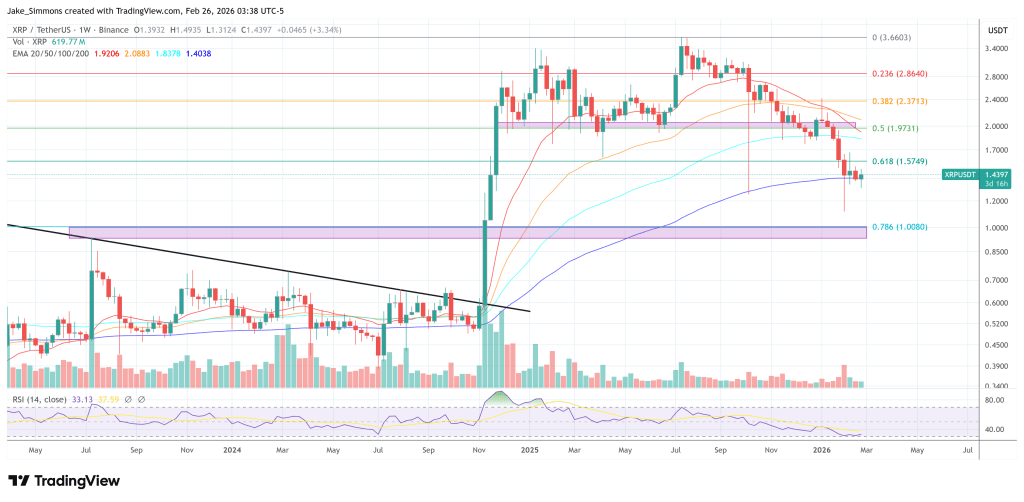
XRP rises back above the 200-week EMA, 1-week chart | Source: XRPUSDT on TradingView.com

Preguntas relacionadas

QWhat is the main focus of t54, the AI infrastructure startup that Ripple invested in?

At54 is building a trust layer for the agentic economy, focusing on providing verifiable agent identity (KYA), real-time risk assessment, and programmable accountability for autonomous AI agents operating in financial systems.

QWhich financial networks is t54's platform being built to support?

At54's ecosystem spans multiple networks, including XRP Ledger (XRPL), Solana, Base, and Virtuals, indicating it is not building for a single blockchain.

QAccording to Ripple President Monica Long, why is trust infrastructure becoming crucial?

AMonica Long stated that as autonomous agents begin managing and transacting with real capital, trust infrastructure becomes a foundational piece of the equation to ensure security and accountability.

QWhat key statistic from a YouGov study did t54 cite to support its market argument?

At54 cited a YouGov study showing 42% of US consumers would allow an AI agent to make purchases on their behalf if it secured the lowest price.

QHow did Markus Infanger from RippleX describe the shift in economic activity?

AMarkus Infanger described it as autonomous systems becoming participants in economic activity, not just tools, necessitating an evolution in the financial infrastructure that supports them.

Lecturas Relacionadas

What Happens to Ethereum Developer Tools After the Grants Run Out?

On February 27th, the Ethereum Foundation (EF) announced Project Odin, a structured sustainability support program designed for a select group of strategic, previously grant-funded teams. Unlike a standard grant, Odin offers a long-term advisory mechanism focused on helping these teams establish credible, sustainable paths within a two-year framework, thereby reducing long-term dependence on single funding sources. The program addresses a critical post-grant challenge: how essential public goods, especially major developer tools, can achieve financial sustainability beyond initial funding. While grants from EF and programs like Gitcoin or RetroPGF remain vital for startups and research, they often fall short for mature, widely-used infrastructure. Tools like compilers, languages, and network stacks are deeply embedded but struggle with monetization, trapped between being too foundational to lose and too public to generate natural revenue. Project Odin provides teams with a dedicated Strategic Advisor to guide them through a three-phase process: 1) analyzing current funding and realistic options, 2) validating potential paths with stakeholders, and 3) executing plans, which may include crafting support contracts, service agreements, or other recurring revenue models. The first pilot participant is Vyper, a critical smart contract language for the EVM, highlighting the need for sustainable models for core infrastructure. The initiative reframes the public goods conversation from "who should be funded" to "how do already-proven teams avoid perpetual funding crises?" It encourages ecosystem participants—protocols and projects that depend on these tools—to view sustainable support not just as charity, but as essential risk management for their own operational supply chains.

marsbitHace 20 min(s)

What Happens to Ethereum Developer Tools After the Grants Run Out?

marsbitHace 20 min(s)

MARA Reports Q1 Revenue Below Expectations, Net Loss of $1.3 Billion, Stock Plunges After Hours

Bitcoin mining firm MARA Holdings reported disappointing Q1 2024 results, causing its stock to erase all daily gains and fall 3.44% in after-hours trading. Revenue dropped 18% year-over-year to $174.6 million, missing Wall Street estimates of $192.7 million. The company posted a net loss of $1.3 billion, a significant increase from a $533.4 million loss a year ago, primarily driven by unrealized losses on its holdings of 38,689 Bitcoin, which depreciated in value during the quarter. MARA also sold over 15,100 BTC in late March to repurchase debt at a discount. The broader mining environment remains challenging due to a 35% decline in Bitcoin's price from its all-time high and a nearly 30% increase in mining difficulty over the past year. MARA's market cap ranking among U.S. miners has slipped to seventh. Critically, the company announced a strategic pivot away from Bitcoin mining expansion. It stated it has no plans to purchase new mining equipment and is fully transitioning toward AI data centers. Its strategy involves retrofitting existing mining sites for AI and high-performance computing (HPC) and leveraging its recent $1.5 billion acquisition of Long Ridge Energy & Power, a gas-fired power plant and data center. This infrastructure could eventually support 600 MW of AI compute capacity, allowing MARA to redeploy up to 90% of its non-custodial mining power for AI and IT workloads.

marsbitHace 20 min(s)

MARA Reports Q1 Revenue Below Expectations, Net Loss of $1.3 Billion, Stock Plunges After Hours

marsbitHace 20 min(s)

The AI Investment Landscape Is Being Reshaped: Beyond the 'Magnificent Seven', What Opportunities Lie in the Semiconductor Supply Chain?

AI Investment Map is Reshaping: Opportunities Beyond the 'Magnificent Seven' Since ChatGPT ignited the AI wave, investment initially focused on the "Magnificent Seven" tech giants dominating cloud infrastructure. However, the rise of DeepSeek and debates on AI capital expenditure effectiveness are shifting this dynamic. Investors now recognize opportunities deeper in the supply chain—the companies providing the essential "picks and shovels." Early concerns about an AI investment "arms race" and potential low returns were partly alleviated by strong Q1 earnings from cloud providers, validating robust compute demand. This has highlighted a more certain investment thesis: regardless of which AI applications ultimately win, massive capital expenditure will first fuel demand for semiconductors and related components. This "pick-and-shovel" logic has driven semiconductor ETFs to record highs. Key beneficiaries include: * **Memory Chipmakers (e.g., SK Hynix, Samsung, Micron)**: High Bandwidth Memory (HBM) is a critical bottleneck for AI training. * **Photonics Companies**: Crucial for high-speed data transfer within AI data centers. * **The Broader "AI-11" Semiconductor Ecosystem**: This encompasses foundries & lithography (TSMC, ASML), logic & custom chips (AMD, Broadcom, Intel, Marvell), and enterprise storage (SanDisk, Western Digital). Every dollar of AI infrastructure spending flows through this chain. While the "Magnificent Seven" remain dominant in market size, their earnings growth premium over the rest of the S&P 500 ("S&P 493") is narrowing. Market attention and marginal investment are shifting towards the expanding semiconductor supply chain. The investment narrative is evolving from "betting on the ultimate AI winner" to "investing in the certainty of the infrastructure build-out." Understanding this shift from the demand side to the supply side is key to identifying future AI investment opportunities.

marsbitHace 49 min(s)

The AI Investment Landscape Is Being Reshaped: Beyond the 'Magnificent Seven', What Opportunities Lie in the Semiconductor Supply Chain?

marsbitHace 49 min(s)

Trading

Spot
Futuros

Artículos destacados

Qué es XRP 2.0

XRP 2.0: Una Nueva Frontera en el Panorama de las Criptomonedas Introducción a XRP 2.0 En el siempre cambiante ámbito de las criptomonedas, nuevos proyectos surgen continuamente, compitiendo por atención y adopción. Una de estas iniciativas prometedoras es XRP 2.0, un nuevo proyecto de criptomoneda diseñado para aprovechar la tecnología blockchain avanzada y metodologías de encriptación robustas. Aunque el nombre establece paralelismos con el XRP de Ripple, es crucial señalar que XRP 2.0 opera de manera independiente, enfocándose en mejorar la seguridad de las transacciones, la privacidad y la escalabilidad. A medida que el panorama financiero digital abraza cada vez más soluciones descentralizadas, XRP 2.0 busca contribuir de manera significativa a web3 y a la expansión general de los proyectos de criptomonedas. ¿Qué es XRP 2.0? En esencia, XRP 2.0 es un proyecto de criptomoneda que busca crear un ecosistema de moneda digital seguro y descentralizado. Su tecnología fundamental integra principios avanzados de blockchain con técnicas de encriptación de vanguardia. El objetivo principal de XRP 2.0 es establecerse como una plataforma confiable y eficiente que permita la ejecución rápida de transacciones mientras prioriza la protección de la privacidad de sus usuarios. El proyecto se promociona como una solución a muchas limitaciones enfrentadas por las criptomonedas existentes, proponiendo un sistema que puede manejar un mayor volumen de transacciones con mejor velocidad y privacidad. Esta versatilidad posiciona a XRP 2.0 como un competidor significativo en un mercado plagado de diversas monedas digitales. ¿Quién es el Creador de XRP 2.0? La identidad del creador detrás de XRP 2.0 ha sido señalada como 'Wilbur.' Sin embargo, los detalles completos sobre Wilbur o su entidad asociada siguen siendo elusivos. La anonimidad de muchos creadores de criptomonedas no es un fenómeno poco común en la industria, a menudo diseñado para mantener un grado de privacidad y seguridad. ¿Quiénes son los Inversores de XRP 2.0? Hasta ahora, la información específica relacionada con las fundaciones o organizaciones de inversión que apoyan a XRP 2.0 no está disponible públicamente. En el sector de las criptomonedas, el respaldo de inversores respetables puede influir significativamente en la credibilidad y el éxito de un proyecto, sin embargo, la transparencia sobre los patrocinadores financieros de XRP 2.0 no se ha establecido. ¿Cómo Funciona XRP 2.0? XRP 2.0 se destaca al emplear una combinación de tecnología blockchain y algoritmos de encriptación avanzados que aseguran transacciones seguras y descentralizadas. Su estructura innovadora incluye características únicas diseñadas para fomentar el compromiso del usuario y ampliar las funcionalidades más allá de las transacciones convencionales de criptomonedas. Entre estas características, XRP 2.0 incorpora capacidades impulsadas por IA, como funcionalidades de texto a imagen y de texto a voz. Estas adiciones están diseñadas para mejorar la experiencia interactiva de los usuarios, promoviendo una mayor aplicabilidad en diversos sectores. Al unir avances tecnológicos con un diseño centrado en el usuario, XRP 2.0 busca captar la atención de una amplia gama de individuos y empresas que buscan integrar soluciones de criptomonedas en sus marcos operativos. Cronología de XRP 2.0 Entender XRP 2.0 requiere examinar los hitos que han definido su viaje hasta ahora: 23 de julio de 2023: Se presenta XRP 2.0 como un nuevo proyecto de criptomonedas, con el objetivo de revolucionar las capacidades de transacciones seguras y descentralizadas en el ámbito de blockchain. 8 de septiembre de 2023: Se lanza otro proyecto, XRP20, marcando la aparición de un token ERC-20 en la blockchain de Ethereum que no guarda relación con XRP 2.0. 13 de noviembre de 2023: El Libro Mayor de XRP experimenta una actualización significativa con el lanzamiento de la versión 2.0.0 del software del servidor rippled. Es esencial señalar que este desarrollo está desconectado del proyecto de criptomonedas XRP 2.0. Puntos Clave sobre XRP 2.0 Para destilar la esencia de XRP 2.0, surgen varios factores críticos: Características Únicas: La inclusión de características como texto a imagen y texto a voz impulsadas por IA diversifica aún más las aplicaciones potenciales de XRP 2.0. Tecnología Blockchain: El marco utiliza mecanismos avanzados de blockchain y protocolos de encriptación, asegurando un entorno seguro y descentralizado para las transacciones. Escalabilidad y Privacidad: XRP 2.0 prioriza la protección mejorada de la privacidad en los procesos de transacción y la escalabilidad necesaria para acomodar una base de usuarios creciente. No Afiliación con Ripple: Es importante destacar que, a pesar de su nombre, XRP 2.0 no tiene ninguna lealtad ni colaboración con el XRP de Ripple, diferenciando su marco operativo y objetivos dentro del ecosistema de criptomonedas. Conclusión XRP 2.0 representa una ambiciosa aventura en la esfera de las criptomonedas, buscando ofrecer una combinación de seguridad, privacidad y eficiencia en las transacciones digitales. Al integrar tecnologías sofisticadas y características amigables para el usuario, el proyecto se propone ampliar los horizontes de lo que la criptomoneda puede lograr en la economía digital de hoy. Si bien la anonimidad de su creador y la falta de inversores revelados pueden generar cuestionamientos para algunos, el enfoque de XRP 2.0 en funcionalidades avanzadas y descentralización realza su atractivo en un mercado de criptomonedas cada vez más abarrotado. A medida que el paisaje de las criptomonedas sigue evolucionando, XRP 2.0 podría emerger como un jugador crucial en la expansión de soluciones blockchain seguras y escalables.

174 Vistas totalesPublicado en 2024.04.05Actualizado en 2024.12.03

Qué es XRP 2.0

Cómo comprar XRP

¡Bienvenido a HTX.com! Hemos hecho que comprar XRP (XRP) sea simple y conveniente. Sigue nuestra guía paso a paso para iniciar tu viaje de criptos.Paso 1: crea tu cuenta HTXUtiliza tu correo electrónico o número de teléfono para registrarte y obtener una cuenta gratuita en HTX. Experimenta un proceso de registro sin complicaciones y desbloquea todas las funciones.Obtener mi cuentaPaso 2: ve a Comprar cripto y elige tu método de pagoTarjeta de crédito/débito: usa tu Visa o Mastercard para comprar XRP (XRP) al instante.Saldo: utiliza fondos del saldo de tu cuenta HTX para tradear sin problemas.Terceros: hemos agregado métodos de pago populares como Google Pay y Apple Pay para mejorar la comodidad.P2P: tradear directamente con otros usuarios en HTX.Over-the-Counter (OTC): ofrecemos servicios personalizados y tipos de cambio competitivos para los traders.Paso 3: guarda tu XRP (XRP)Después de comprar tu XRP (XRP), guárdalo en tu cuenta HTX. Alternativamente, puedes enviarlo a otro lugar mediante transferencia blockchain o utilizarlo para tradear otras criptomonedas.Paso 4: tradear XRP (XRP)Tradear fácilmente con XRP (XRP) en HTX's mercado spot. Simplemente accede a tu cuenta, selecciona tu par de trading, ejecuta tus trades y monitorea en tiempo real. Ofrecemos una experiencia fácil de usar tanto para principiantes como para traders experimentados.

1.3k Vistas totalesPublicado en 2024.12.10Actualizado en 2025.03.21

Cómo comprar XRP

Discusiones

Bienvenido a la comunidad de HTX. Aquí puedes mantenerte informado sobre los últimos desarrollos de la plataforma y acceder a análisis profesionales del mercado. A continuación se presentan las opiniones de los usuarios sobre el precio de XRP (XRP).

活动图片














