Ripple Lands Major Korea Deal With Top Insurance Giant Kyobo

bitcoinistPublicado a 2026-04-16Actualizado a 2026-04-16

Resumen

Ripple has partnered with Kyobo Life Insurance, one of Korea's largest insurers, to develop the country's first tokenized government bond settlement workflow on blockchain. The collaboration will utilize Ripple Custody to hold, transfer, and settle transactions within a regulated framework, aiming to replace manual process with on-chain execution that could compress the standard two-day settlement cycle to near real-time. This initiative is positioned as infrastructure for a broader institutional stack. Both companies aim to assess the technical and regulatory feasibility, reduce counterparty risk, and explore stablecoin-based payment rails for 24/7 transactions. Ripple described this as a strategic entry into Korea's institutional financial market and a signal that proven digital asset infrastructure is ready for deployment.

Ripple has struck a new partnership with Kyobo Life Insurance to explore what it says would be Korea’s first tokenized government bond settlement workflow on blockchain, extending the company’s institutional push in Asia into the country’s insurance sector.

The partnership is built around Ripple Custody, which will be used to hold, transfer, and settle tokenized government bond transactions within a regulated institutional framework. The firm said the setup is designed to replace fragmented, manual settlement processes with on-chain execution, potentially compressing the standard two-day settlement cycle into near real-time.

Ripple Signs First Tier-1 Korean Insurer for Custody Push

Kyobo, one of Korea’s largest and most established life insurers, will work with Ripple to assess both the technical and regulatory feasibility of tokenized Treasury settlement within Korea’s financial system. The custody layer sits at the center of that effort. Ripple described Ripple Custody as a bank-grade, fully integrated platform built for regulated financial institutions, supporting the secure transfer, settlement, and management of digital assets.

Notably, the announcement positions custody not as a standalone product, but as the first layer of a broader institutional stack that could later expand into tokenization, payments, liquidity, and treasury management. In other words, the bond-settlement pilot is being presented as infrastructure, not a one-off proof of concept.

Ripple also tied the partnership to a larger modernization argument around government bond markets. By settling transactions simultaneously on-chain, the companies say institutions could reduce counterparty risk and improve capital efficiency. Ripple added that it will also support Kyobo in exploring stablecoin-based payment rails, with the goal of enabling 24/7 transaction capability inside a compliant framework.

Fiona Murray, Ripple’s managing director for Asia Pacific, cast the agreement as both a Korea market entry point and a signal to other institutions watching from the sidelines. “Korea’s institutional financial market is at an inflection point, and we are privileged to be entering it alongside Kyobo Life Insurance—one of Korea’s most respected financial institutions and the first major insurer in the country to take this step with us,” Murray said. “This partnership is a signal to the broader market that institutional-grade digital asset infrastructure is no longer a future aspiration; it is available, proven, and ready to deploy in Korea today.”

She went further, describing the move as part of a broader regional commitment rather than a narrowly scoped pilot. “Ripple’s commitment to Korea is long-term and strategic. We see this as the beginning of a broad and enduring partnership, not only with Kyobo, but with the Korean institutional financial market as a whole,” Murray said.

Kyobo framed the initiative less as a bet on crypto markets than as a test of whether conventional financial products can function more efficiently on blockchain rails. “Our partnership with Ripple is not simply about digital assets — it’s about validating how traditional financial instruments can operate securely and efficiently on blockchain,” said Jin Ho Park, senior executive vice president at Kyobo Life Insurance. “We are proud to collaborate with Ripple to advance Korea’s financial market infrastructure and bring next-generation solutions to our customers.”

At press time, XRP traded at $1.3543.
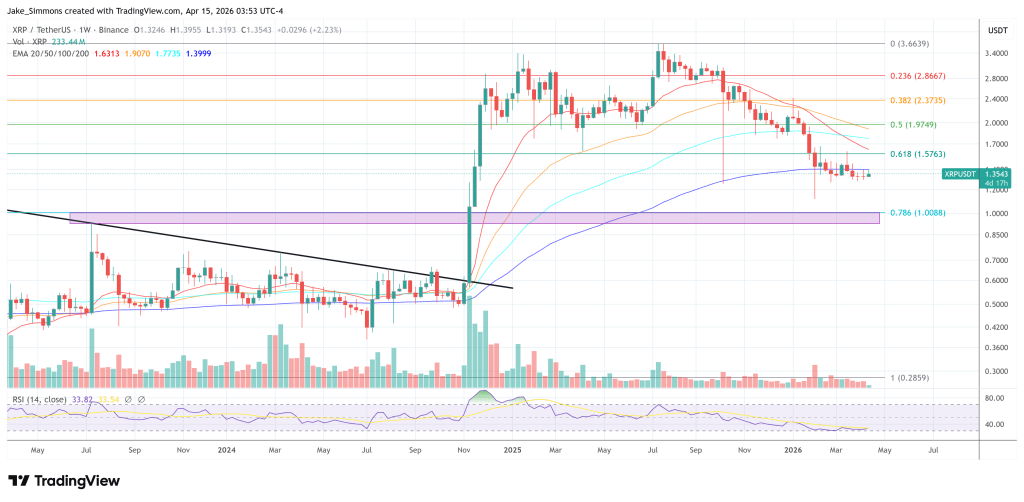
XRP must reclaim the 200-week EMA, 1-week chart | Source: XRPUSDT on TradingView.com

Preguntas relacionadas

QWhat is the main purpose of the partnership between Ripple and Kyobo Life Insurance?

AThe partnership aims to explore Korea's first tokenized government bond settlement workflow on blockchain, using Ripple Custody to hold, transfer, and settle these transactions within a regulated framework.

QHow does Ripple claim its technology will improve the settlement process for government bonds?

ARipple claims the on-chain execution will replace fragmented, manual settlement processes, potentially compressing the standard two-day settlement cycle into near real-time, reducing counterparty risk and improving capital efficiency.

QWhat additional payment rails will Ripple support Kyobo in exploring?

ARipple will support Kyobo in exploring stablecoin-based payment rails to enable 24/7 transaction capability inside a compliant framework.

QHow did Fiona Murray, Ripple's managing director for Asia Pacific, characterize the significance of this partnership?

AShe characterized it as both a market entry point into Korea and a signal to other institutions that institutional-grade digital asset infrastructure is available, proven, and ready to deploy in Korea today.

QAccording to Kyobo's executive, what is the broader goal of this initiative beyond digital assets?

AThe broader goal is to validate how traditional financial instruments, like government bonds, can operate more securely and efficiently on blockchain technology to advance Korea's financial market infrastructure.

Lecturas Relacionadas

Breaking: OpenAI Undergoes Major Reorganization, President Brockman Assumes Command

OpenAI has announced a major internal reorganization just months before its anticipated IPO. The company is merging its three flagship product lines—ChatGPT, Codex, and the API platform—into a single, unified product organization. The most significant leadership change involves co-founder and President Greg Brockman moving from a background technical role to take full, permanent control over all product strategy. This follows the indefinite medical leave of AGI Deployment CEO Fidji Simo. Additionally, ChatGPT's longtime lead, Nick Turley, has been reassigned to enterprise products, with former Instagram executive Ashley Alexander taking over consumer offerings. The consolidation, internally framed as a strategic move towards an "Agentic Future," aims to break down internal silos and create a cohesive "Super App." This planned desktop application would integrate ChatGPT's conversational abilities, Codex's coding power, and a rumored internal web browser named "Atlas" to autonomously perform complex user tasks. The reorganization occurs amid significant internal and external pressures. OpenAI has recently seen a wave of high-profile departures, including Sora co-lead Bill Peebles and other senior technical leaders, leading to concerns about a thinning executive bench. Externally, rival Anthropic recently secured funding at a staggering $900 billion valuation, surpassing OpenAI's own. Google's upcoming I/O developer conference also poses a competitive threat. Analysts suggest the dramatic restructure is a pre-IPO move to present a clearer, more focused narrative to Wall Street—streamlining operations and demonstrating decisive leadership under Brockman to counter internal turbulence and intense market competition.

marsbitHace 3 hora(s)

Breaking: OpenAI Undergoes Major Reorganization, President Brockman Assumes Command

marsbitHace 3 hora(s)

Two Survival Structures of Market Makers and Arbitrageurs

Market makers and arbitrageurs represent two distinct survival structures in high-frequency trading. Market makers primarily use limit orders (makers) to profit from the bid-ask spread, enjoying high capital efficiency (nominally 100%) but bearing inventory risk. This "inventory risk" arises from passive, fragmented, and discontinuous order fills in the limit order book (LOB). This risk, while a potential cost, can also contribute to excess profit if managed within control boundaries, allowing for mean reversion. Market makers essentially sell "time" (uncertainty over execution timing) to the market for price control and low fees. In contrast, cross-exchange arbitrageurs typically use market orders (takers) to exploit price differences or funding rates, resulting in lower nominal capital efficiency (requiring capital on both exchanges) and higher transaction costs. Their risk exposure stems from asymmetries in exchange rules (e.g., minimum order sizes), execution latency, and infrastructure risks (e.g., ADL, oracle drift). These exposures are active, exogenous gaps that primarily erode profits rather than contribute to them. Arbitrageurs essentially sell "space" (capital sunk across venues) for localized, immediate certainty. Both strategies engage in a trade-off between execution friction and residual risk. Optimal systems allow for temporary, controlled risk exposure rather than enforcing zero exposure at all costs. Their evolution converges towards hybrid models: arbitrageurs may use maker orders to reduce costs, while market makers may use taker orders or hedges for risk management. Ultimately, both use different forms of risk exposure—market makers exposing inventory, arbitrageurs immobilizing capital—to extract marginal, hard-won certainty from the market.

链捕手Hace 3 hora(s)

Two Survival Structures of Market Makers and Arbitrageurs

链捕手Hace 3 hora(s)

Who Will Define the Rules of the AI Era? Anthropic Discusses the 2028 US-China AI Landscape

This article, based on Anthropic's analysis, outlines the intensifying systemic competition between the U.S./allies and China for AI leadership by 2028. It argues that access to advanced computing power ("compute") is the critical bottleneck, where the U.S. currently holds a significant advantage through chip export controls and allied innovation. However, China's AI labs remain competitive by exploiting policy loopholes—via chip smuggling, overseas data center access, and "model distillation" attacks to copy U.S. model capabilities—keeping them close to the frontier. The piece presents two contrasting scenarios for 2028. In the first, decisive U.S. action to tighten compute controls and curb distillation locks in a 12-24 month AI capability lead, cementing democratic influence over global AI norms, security, and economic infrastructure. In the second, policy inaction allows China to achieve near-parity through continued access to U.S. technology, enabling Beijing to promote its AI stack globally and integrate advanced AI into its military and governance systems, altering the strategic balance. Anthropic contends that maintaining a decisive U.S. lead is essential for shaping safe AI development and governance. The core recommendation is for U.S. policymakers to urgently close compute and model access loopholes while promoting global adoption of the U.S. AI technology stack to secure a lasting strategic advantage.

marsbitHace 5 hora(s)

Who Will Define the Rules of the AI Era? Anthropic Discusses the 2028 US-China AI Landscape

marsbitHace 5 hora(s)

Trading

Spot
Futuros
活动图片





