Rhythm Interview with OpenMind: From x402 Payments to Building the 'Android for Robots'

marsbitPublicado a 2026-01-22Actualizado a 2026-01-22

Resumen

In a 2025 interview, OpenMind founder and Stanford professor Jan Liphardt discusses his vision for building the "brain" for humanoid robots, positioning it as a potential "Android for robots." Following a $20 million funding round, OpenMind has accelerated its product roadmap, launching a suite of offerings from an underlying operating system to a payment protocol. A core of OpenMind’s strategy is enabling the emerging "Machine Economy," where robots act as independent economic agents. A key development is its partnership with Circle and the implementation of the x402 protocol, allowing robots to autonomously conduct transactions using USDC stablecoins—exemplified by robots independently paying for charging at stations in San Francisco. Beyond payments, OpenMind is creating a modular operating system (OM1) and a dedicated app store where users can download skills and applications for their robots. The company aims to address critical challenges in robotics, including value exchange, identity authentication, data privacy, and collaborative governance through its FABRIC protocol and blockchain technology, envisioning a future of seamless human-robot collaboration.

In 2025, humanoid robots are transitioning from science fiction to reality. From Tesla's Optimus to Figure AI's Figure 01, the capabilities of general-purpose humanoid robots are rapidly expanding with the support of large language models. According to Goldman Sachs predictions, the humanoid robot market could reach $154 billion by 2035. A trillion-dollar market is attracting the world's top tech companies and brightest minds to dive in.

However, as robots' "limbs" become increasingly advanced, a more core question arises: how to build an intelligent, open, and secure enough "brain"? When thousands of robots enter homes, hospitals, and cities, how will they collaborate, exchange value, and seamlessly integrate with human society?

Stanford professor and OpenMind founder Jan Liphardt provides his answer. After securing $20 million in funding led by Pantera Capital in August 2025, OpenMind hit the fast-forward button, releasing a series of products from the underlying operating system to upper-layer payment protocols, gradually outlining the complete blueprint for its "robot brain."
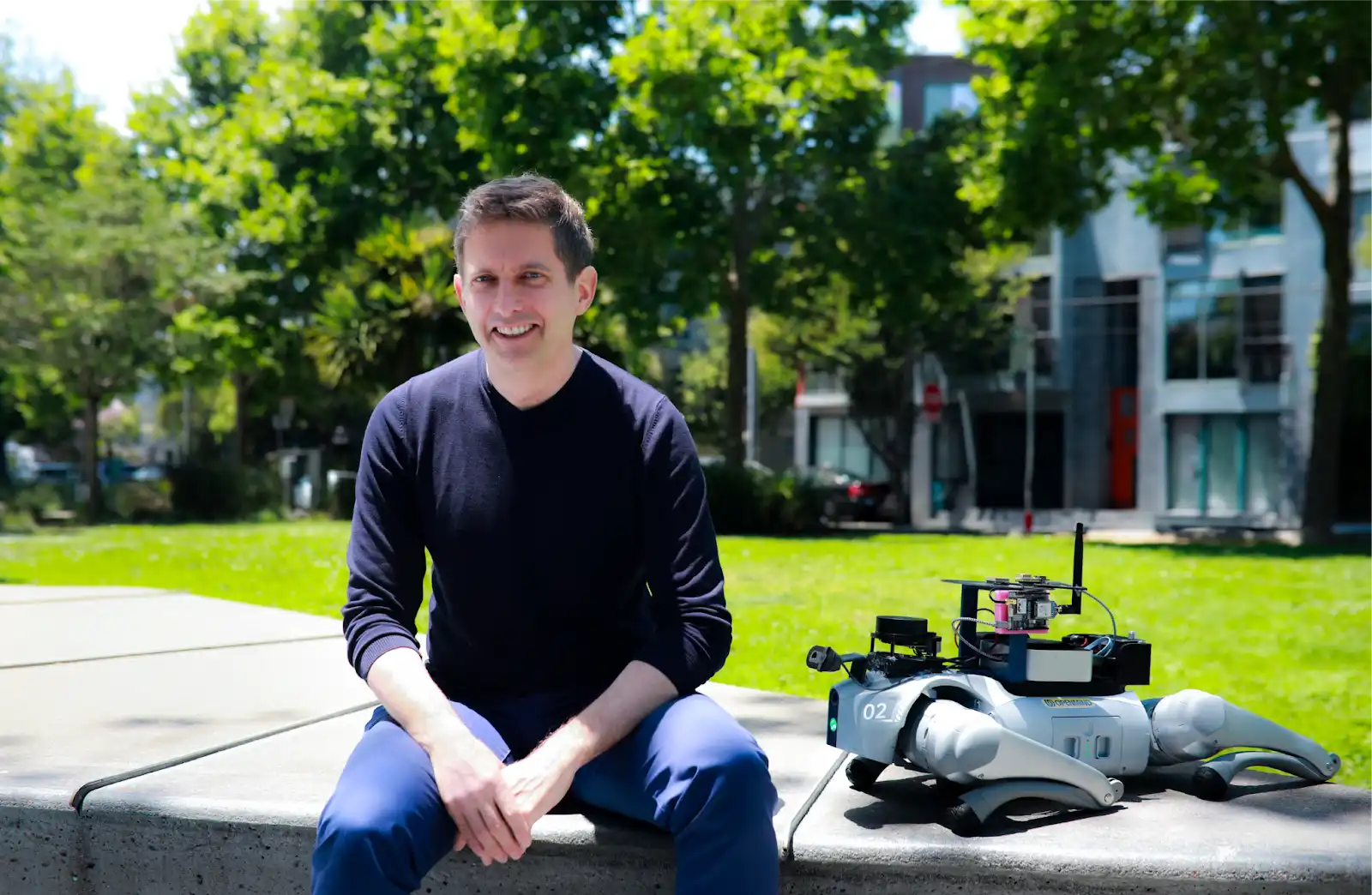
OpenMind's core business is providing SaaS-based cloud cognitive services to enterprises. But they keenly observed that as robots become independent economic participants, blockchain will play a crucial role in payment systems, identity authentication, data privacy, and collaborative governance.

Recently, OpenMind's collaboration with stablecoin issuer Circle and the deployment of robot charging stations on the streets of San Francisco are initial implementations of this vision. Robots can independently complete charging payments using USDC, which may mark the dawn of the "Machine Economy" era.

Simultaneously, OpenMind is building a dedicated app store for robots, allowing users to download applications and skills to their robots in one place, much like customizing phone apps on the Apple App Store or Google Play Store. The app was launched last week on the OpenMind App Store.

In this exclusive interview, we delved into the philosophy behind building the robot "brain," the design理念 of the modular operating system OM1, and how the FABRIC protocol and blockchain technology can构建 a future where machines and humans collaborate efficiently. He shared OpenMind's technical roadmap and offered profound insights on key issues such as developer ecosystems, remote operation, and data privacy.

Below is the interview content:

Establishing a "Bank Account" for Robots

In December 2025, OpenMind and stablecoin issuer Circle jointly announced the launch of a robot autonomous payment system based on the x402 protocol. As robots' capabilities improve, they will no longer be mere tools for executing tasks but will start to act as autonomous economic entities. They will need to purchase computing power, data, skills, and even hire other robots or humans to complete complex tasks.

To achieve this, a financial system designed specifically for machines, requiring no human intervention, becomes indispensable. The traditional banking system is clearly not prepared for this, and cryptocurrency and blockchain technology, with their native digital and decentralized characteristics, have become the most natural choice.


Preguntas relacionadas

QWhat is the core business of OpenMind as mentioned in the article?

AOpenMind's core business is providing SaaS-based cloud cognitive services for enterprises.

QWhich company led the $20 million funding round for OpenMind in August 2025?

APantera Capital led the $20 million funding round for OpenMind in August 2025.

QWhat specific payment protocol did OpenMind collaborate with Circle to implement for robots?

AOpenMind collaborated with Circle to implement a robot autonomous payment system based on the x402 protocol.

QWhat is the name of the modular operating system that OpenMind is developing for robots?

AOpenMind is developing a modular operating system called OM1 for robots.

QWhat recent development did OpenMind announce for customizing robot capabilities, similar to smartphone app stores?

AOpenMind announced a dedicated app store for robots, allowing users to download applications and skills to their robots, similar to smartphone app stores.

Lecturas Relacionadas

In-Depth Report on the On-Chain Lending Market: When Off-Chain Credit Meets On-Chain Liquidation

The on-chain lending market has evolved from a peripheral DeFi niche into core financial infrastructure. As of early 2026, total value locked (TVL) in on-chain lending protocols has reached $64.3 billion, accounting for 53.54% of total DeFi TVL, making it the largest and most mature vertical within decentralized finance. Aave dominates the sector with approximately $32.9 billion in TVL, commanding nearly half of the market—a leadership position that is unlikely to be challenged in the foreseeable future. However, the path of on-chain lending forward is not without risk. Liquidation cascades, credit defaults, and cross-chain vulnerabilities remain systemic threats hanging over the industry. At the same time, a deeper structural transformation is underway: on-chain lending is shifting from a “leverage tool for crypto-native users” to a “compliant gateway for institutional capital”. The scale of RWA (Real World Asset) lending has surpassed $18.5 billion, with U.S. Treasuries and government securities increasingly serving as core collateral. Institutional capital inflows are reshaping both the user base and risk appetite of the sector. This report systematically analyzes the evolution of on-chain lending definitions, competitive dynamics, core risks, and future trends, providing a comprehensive industry outlook for investors and trade practitioners. Key findings suggest that the “one dominant player with several strong challengers” structure will persist in the short term, while fixed-rate lending, compliant collateral, and institutional credit underwriting will define the next phase of competition. For investors focused on DeFi infrastructure, three key opportunity tracks stand out, namely, the Aave ecosystem (Morpho, Spark), RWA lending protocols (Ondo, Maple) and fixed-rate innovation (Notional, Pendle).

HTX LearnHace 38 min(s)

In-Depth Report on the On-Chain Lending Market: When Off-Chain Credit Meets On-Chain Liquidation

HTX LearnHace 38 min(s)

Fu Peng's First Public Speech in 2026: What Exactly Are Crypto Assets? Why Did I Join the Crypto Asset Industry?

Fu Peng, a renowned macroeconomist and now Chief Economist at New火 Group, delivered his first public speech of 2026 at the Hong Kong Web3 Festival. He explained his perspective on crypto assets and why he joined the industry, framing it within the context of macroeconomic trends and financial evolution. Fu emphasized that crypto assets are transitioning from an early, belief-driven phase to a mature, institutionally integrated asset class. He drew parallels to the 1970s-80s, when technological advances (like computing) revolutionized traditional finance, leading to the rise of FICC (Fixed Income, Currencies, and Commodities). Similarly, current advancements in AI, data, and blockchain are reshaping finance, with crypto assets becoming part of a new "FICC + C" (C for Crypto) framework. He noted that institutional capital, including traditional hedge funds, avoided early crypto due to its speculative nature but are now engaging as regulatory clarity emerges (e.g., stablecoin laws, CFTC classifying crypto as a commodity). Fu predicted that 2025-2026 marks a turning point where crypto becomes a standardized, financially viable asset for diversified portfolios, akin to commodities or derivatives in traditional finance. Fu defined Bitcoin not as "digital gold" in a simplistic sense but as a value-preserving, financially tradable asset. He highlighted that crypto's future lies in regulated, institutional adoption, moving away from retail-dominated trading. His entry into crypto signals this maturation, where traditional finance integrates crypto into mainstream asset management.

marsbitHace 1 hora(s)

Fu Peng's First Public Speech in 2026: What Exactly Are Crypto Assets? Why Did I Join the Crypto Asset Industry?

marsbitHace 1 hora(s)

Justin Sun Sues Trump Family: What $75 Million Bought Was Only a Blacklist

Justin Sun, founder of Tron, has filed a lawsuit in federal court against World Liberty Financial (WLF), alleging he was made the "primary target of a fraudulent scheme" after investing $75 million. Sun claims the investment secured him an advisor title and WLFI tokens, which were later frozen by WLF, causing "hundreds of millions in losses." The dispute began in late 2024 when Sun's investment helped revive WLF's struggling token sale, which ultimately raised $550 million. Shortly after, the SEC dropped its lawsuit against Sun following Donald Trump's inauguration. However, relations soured when Sun refused WLF's demands for additional funding. In August 2025, WLF added a "blacklist" function to its smart contract, allowing it to unilaterally freeze tokens. Sun's holdings, worth approximately $107 million, were frozen, and he was threatened with token destruction. The lawsuit highlights WLF's structure, which directs 75% of token sale profits to the Trump family, who had earned $1 billion by December 2025. WLF's CEO is Zach Witkoff, son of U.S. Middle East envoy Steve Witkoff. The project faces scrutiny for opaque operations, including a controversial loan arrangement on the Dolomite platform, co-founded by a WLF advisor. Despite Sun's history with the SEC, the case underscores centralization risks within DeFi, as WLF controls governance and holds powers to freeze assets arbitrarily. Sun's tokens remain frozen as legal proceedings begin.

marsbitHace 1 hora(s)

Justin Sun Sues Trump Family: What $75 Million Bought Was Only a Blacklist

marsbitHace 1 hora(s)

Trading

Spot
Futuros
活动图片