Returning to $70,000: Is Bitcoin's Violent Rebound a Trend Restart or a Bull Trap?

比推Publicado a 2026-02-09Actualizado a 2026-02-09

Resumen

Bitcoin experienced a violent rebound from $60,000 to over $70,000 within 24 hours, erasing a recent 14% crash. However, the rally was not driven by strong spot buying but rather by a combination of macro market stabilization and forced short-covering amid extreme fear sentiment in derivatives markets. Key factors behind the earlier selloff included expectations of liquidity tightening due to Trump’s potential Fed appointment, pressure on miner profitability, and spillover from tech stock and metals volatility. Despite the sharp recovery, options traders are heavily hedging against a potential retest of the $50,000–$60,000 range by late February. Sustaining $70,000 depends on continued macro stability, reduced ETF outflows, and normalized derivatives sentiment. The rebound appears more of a mechanical squeeze than a conviction-driven reversal.

Author: CryptoSlate

Compiled by: Deep Tide TechFlow

Original title: Bitcoin Returns to $70K, Rebound or Real Trap?


Deep Tide Insights:

After a violent rebound from $60,000 to $70,000 within 24 hours, Bitcoin appears to have recovered its losses. However, underlying logic reveals that this was not driven by firm spot buying but rather by a forced repositioning and short squeeze triggered by a recovery in the macro market. This article delves into the causes of the "hair-raising turmoil" in early February 2026: from liquidity contraction expectations following Trump's appointment of Kevin Warsh to the pressure on miners' profits hitting a historical low. Although the price has returned above $70,000, options traders are heavily betting on a potential second dip to $50,000–$60,000 by the end of February, revealing the still fragile sentiment and complex financial博弈 beneath the surface of the "violent rebound."

Bitcoin surged from $60,000 to above $70,000 in less than 24 hours, erasing the brutal 14% decline that had tested all "buy-the-dip" theories in the market.

The speed of this reversal—a 12% single-day rebound and a 17% recovery from the intraday low—was so intense that it felt like the dust had cleared after a liquidation. However, the mechanism behind the rebound tells another story: it was more a combination of cross-asset stabilization and forced position rebalancing rather than conviction-driven large-scale spot demand.

Meanwhile, the derivatives market remains crowded with bearish protection positions, with pricing suggesting that $70,000 may be just a waystation rather than a true bottom.

Liquidation Wave Meets Macro Pressure

On February 5, the market opened near $73,100, briefly rallied, then collapsed, closing at $62,600. According to CoinGlass data, the single-day decline led to the liquidation of approximately $1 billion in leveraged Bitcoin positions.

This figure alone illustrates the chain reaction of forced selling, but the broader context was even worse.

CoinGlass data shows that Bitcoin futures open interest had already dropped from about $61 billion to $49 billion last week, meaning the market had begun deleveraging before the final wave of冲击 hit.

The trigger was not internal to cryptocurrency. Media reports characterized the sell-off as a deterioration in risk sentiment, primarily driven by a tech stock sell-off and volatility in precious metals—silver once plunged 18% to around $72.21, dragging down all related risk assets.

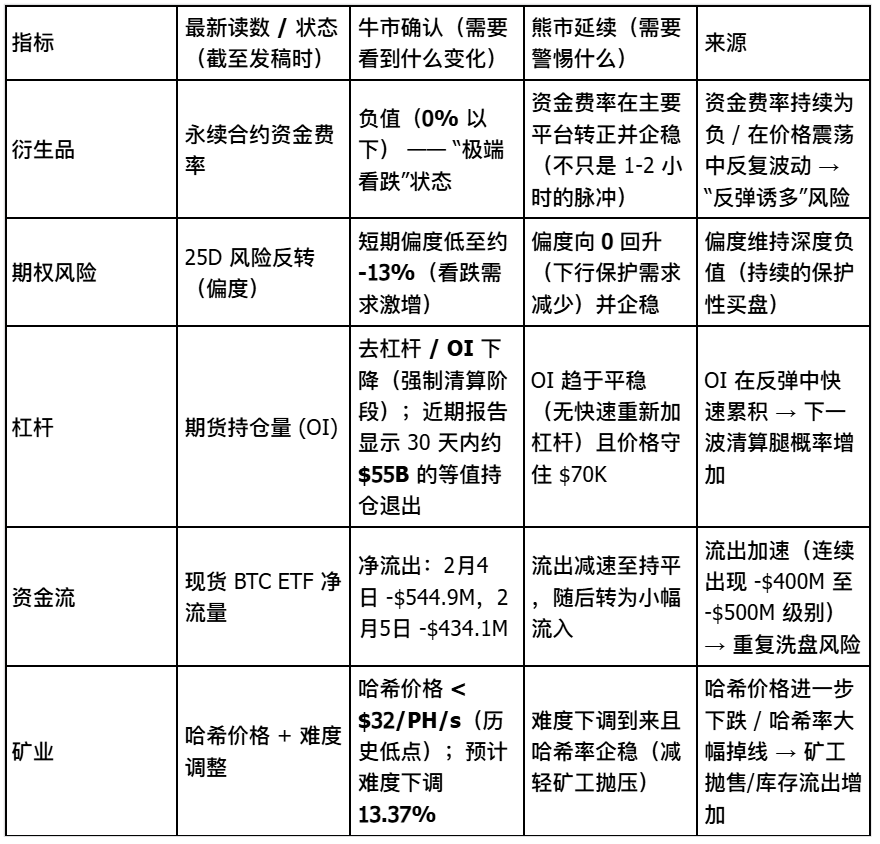
Deribit's research confirmed this spillover effect, noting that derivatives sentiment had turned extremely bearish: negative funding rates, an inverted implied volatility term structure, and the 25-delta risk-reversal skew depressed to around -13%.

This is a classic state of "extreme fear," where positioning amplifies price swings in both directions.

Policy narratives added fuel to the fire. According to Reuters, the market reacted violently to elected President Donald Trump's choice of Kevin Warsh as Fed chair, with traders interpreting it as a signal of future balance sheet contraction and liquidity tightening.

Meanwhile, miners faced significant profit pressure. According to TheMinerMag, the hash price fell below $32 per PH/s, and network difficulty was expected to drop by about 13.37% in two days. However, this relief mechanism had not yet taken effect before prices broke below support levels.
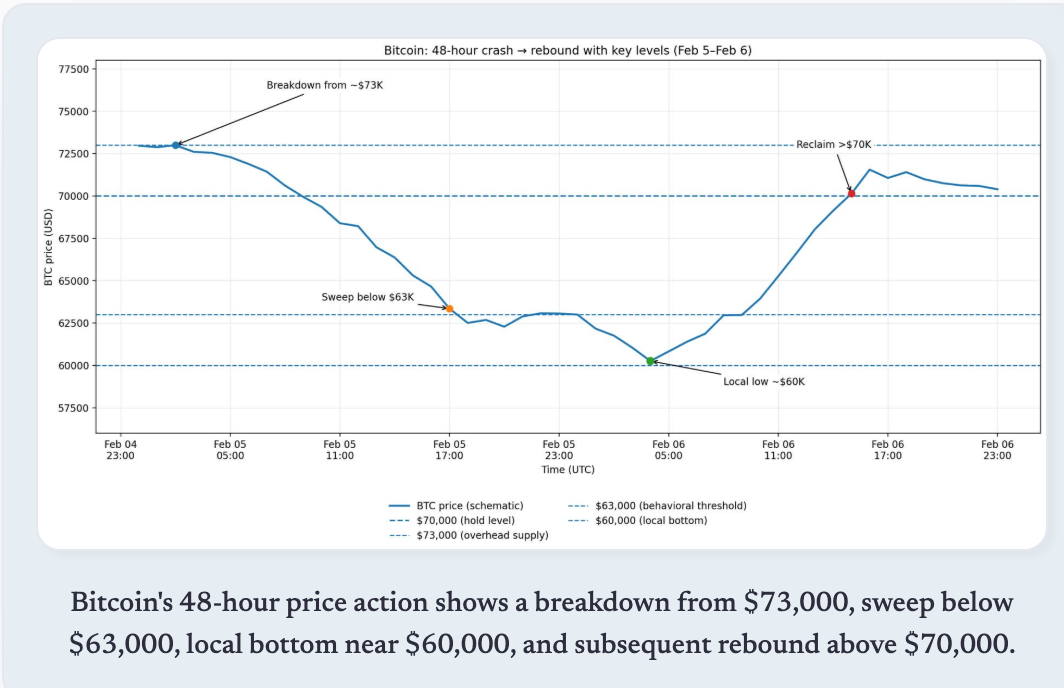
Bitcoin's price action over 48 hours, showing the crash from $73,000, the break below $63,000 triggering stop-losses, local bottoming near $60,000, and the subsequent rebound to above $70,000.

Macro Reversal and Squeeze Mechanism

On February 6, the market opened at the previous day's close, then fell to an intraday low near $60,000 before skyrocketing to a high of $71,422. After three failed attempts to break above this level, the price retreated below $70,000.

The catalyst did not originate from within the crypto industry but from a sharp turnaround in cross-asset movements. Wall Street performed strongly: the S&P 500 rose 1.97%, the Nasdaq gained 2.18%, the Dow Jones increased by 2.47%, and the Philadelphia Semiconductor Index (SOX) surged 5.7%.

Metal prices rebounded猛烈ly, with gold up 3.9% and silver up 8.6%, while the U.S. dollar index fell 0.2%, signaling a loosening of financial conditions.

Bitcoin moved mechanically with this shift. The correlation was evident: as tech stocks stabilized and metals rebounded, Bitcoin was pulled up through common risk exposures.

However, the violence of this rebound also reflected derivatives positioning. A skew near -13%, negative funding rates, and an inverted volatility structure created conditions where any macro-positive catalyst could trigger short-covering and forced repositioning.

This rebound was essentially driven by a liquidity event and amplified by the unwinding of crowded short positions.

Nonetheless, forward-looking signals remain bearish. Data from Deribit shows that for options expiring on February 27, put open interest is heavily concentrated at strike prices between $60,000 and $50,000.

Deribit's Sean Dawson told Reuters that demand for downside protection was "extreme." This is not hindsight analysis but rather traders explicitly hedging against the next drop, even after the rebound.
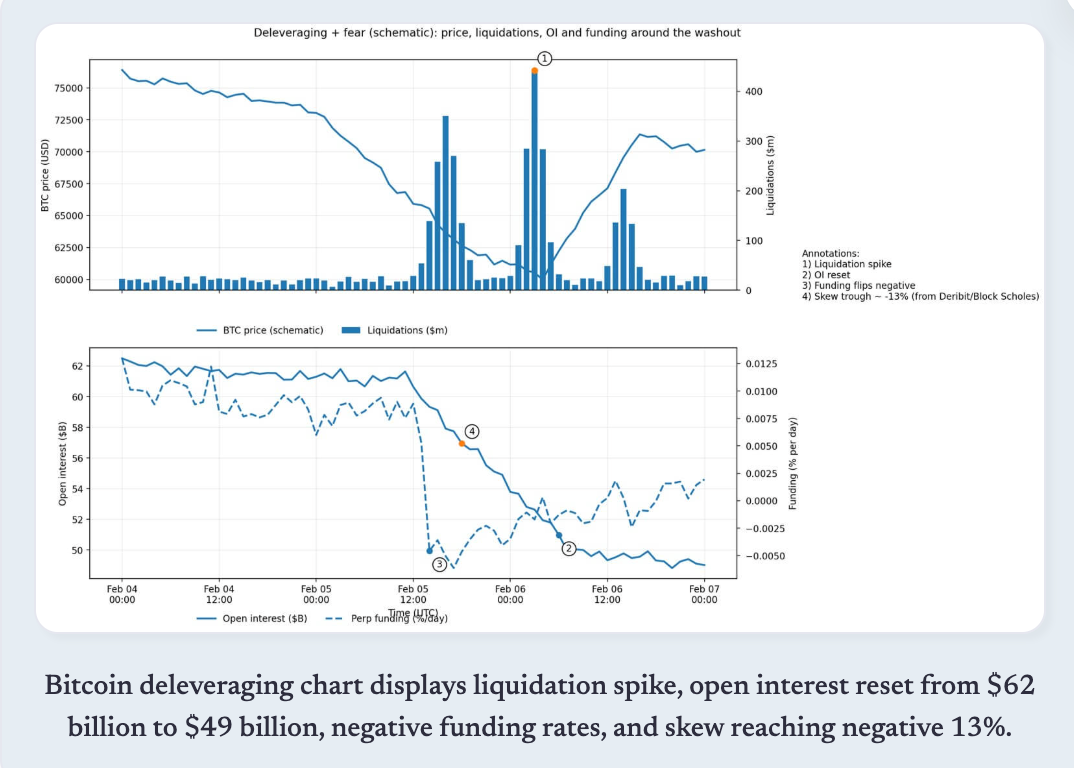
Bitcoin deleveraging chart, showing the surge in liquidations, open interest reset from $62 billion to $49 billion, negative funding rates, and skew hitting -13%.

Can $70K Hold? Analytical Framework

The logic for holding $70,000 is based on three conditions.

First, the macro rebound needs to be sustained, with tech stocks continuing to stabilize and U.S. Treasury yields and the dollar not tightening again. This rebound was clearly a cross-asset联动; if U.S. stocks turn lower again, Bitcoin will not be immune.

Second, leverage needs to continue cooling off with no new forced selling. Open interest has already dropped significantly, reducing the risk of a "vacuum drop."

Third, miner pressure needs to be substantially alleviated when the difficulty adjustment takes effect. If prices can hold steady within the adjustment window, the expected 13.37% difficulty reduction will reduce marginal selling pressure and allow the hash rate to stabilize.

Arguments supporting another washout also have three reasons:

First, options positioning remains bearish. The largest put concentrations for late February are at $60,000–$50,000, a forward-looking signal embedded in the market's implied probabilities, not lagging sentiment.

Second, derivatives signals remain fragile. Extreme skew, recently frequent negative funding rates, and an inverted volatility structure are more consistent with a "relief rally" within a fear regime than a trend reversal.

Third, ETF flow data shows持续outflows. As of February 5, monthly net outflows for Bitcoin ETFs had reached $690 million. Although data for February 6 is not yet available, existing patterns suggest institutional allocators have not shifted from "de-risking" to "re-engagement."

Signal Dashboard
The True Significance of $70K

This price level itself holds no magic. Its importance lies in its position above the on-chain absorption cluster of $66,900 to $70,600 identified by Glassnode.

Holding $70,000 means this cluster has absorbed enough supply to temporarily stabilize prices. However, holding firm requires not only technical support but also the return of spot demand, the unwinding of derivatives hedge positions, and the stabilization of institutional flows.

The rebound from $60,000 was real, but its composition is crucial. If macro conditions change, cross-asset stability will reverse.

Forced position unwinding created a mechanical rebound, which does not necessarily translate into a sustained trend. Options traders are still pricing in a significant probability of a drop toward $50,000–$60,000 within the next three weeks.

Bitcoin has reclaimed $70,000 but is currently consolidating below it. This suggests a pause before the next test, and the outcome of that test depends on three conditions occurring sequentially: maintained macro risk appetite, a slowdown or reversal in ETF outflows, and normalized derivatives sentiment.

The market delivered a violent snapback, but the forward curve and flow data indicate that traders are not yet betting on its persistence. $70,000 is not the endgame; it is merely the baseline that will determine the winner of the next phase of the debate.


Twitter:https://twitter.com/BitpushNewsCN

BitPush TG Discussion Group:https://t.me/BitPushCommunity

BitPush TG Subscription: https://t.me/bitpush

Original article link:https://www.bitpush.news/articles/7610357

Preguntas relacionadas

QWhat were the main factors that triggered Bitcoin's violent rebound from $60,000 to $70,000?

AThe rebound was primarily driven by a cross-asset stabilization and forced rebalancing of positions, not strong spot buying. It was amplified by a macro market recovery, including strong performance in tech stocks (S&P 500 up 1.97%, Nasdaq up 2.18%), a rebound in metals (gold up 3.9%, silver up 8.6%), and a short squeeze due to extreme bearish derivatives positioning with negative funding rates and inverted volatility structures.

QWhy did the options market indicate a bearish outlook despite the price rebound to $70,000?

AOptions traders were heavily hedging against further downside risk, with significant put open interest concentrated at strike prices between $50,000 and $60,000 for late February expiries. This reflected embedded market expectations of a potential second drop, rather than confidence in the sustainability of the rebound.

QWhat role did miners play in the market dynamics during Bitcoin's price crash and recovery?

AMiners faced severe profit pressure as the hash price dropped below $32 per PH/s, and the network difficulty was expected to decrease by about 13.37%. This created selling pressure from miners, though the difficulty adjustment had not yet taken effect at the time of the crash, contributing to the market's fragility.

QWhat conditions are necessary for Bitcoin to sustainably hold above $70,000 according to the analysis?

AThree key conditions are needed: 1) sustained macro rebound with stable tech stocks and relaxed financial conditions (lower U.S. Treasury yields and dollar strength), 2) continued cooling of leverage without new forced selling, and 3) relief in miner pressure post-difficulty adjustment to reduce marginal selling. Additionally, ETF flows need to stabilize or reverse from outflows to inflows.

QHow did external macroeconomic events influence Bitcoin market sentiment and price action?

AExternal events significantly impacted sentiment: a sell-off in tech stocks and metals (e.g., silver dropping 18%) initially triggered risk-off sentiment. Later, rumors of Donald Trump appointing Kevin Warsh as Fed chair raised fears of liquidity tightening and balance sheet contraction, exacerbating the crash. The subsequent rebound was tied to a macro reversal, including equity gains and metal recoveries, showing Bitcoin's correlation with broader financial markets.

Lecturas Relacionadas

Will the Fed Still Cut Interest Rates? Tonight's Data Is Crucial

The core debate surrounding the Federal Reserve's potential interest rate cuts is intensifying amid geopolitical conflict and rebounding inflation. The key question is whether high energy prices will cause persistent inflation or weaken consumer demand enough to force the Fed to cut rates. Citigroup presents a bullish case for cuts, arguing that oil supply disruptions from the Strait of Hormuz are temporary and will not lead to lasting inflationary pressure. They point to receding bond yields and oil prices as evidence the market is pricing in a short-lived shock. Citi's data also shows tightening financial conditions, a stabilizing labor market, and healthy tax returns, supporting their view that the path to lower rates remains open. Conversely, Deutsche Bank offers a starkly contrasting, more hawkish outlook. They argue the Fed's current policy is already neutral and expect rates to remain unchanged indefinitely. Their view is based on stalled disinflation progress and a shift toward more hawkish rhetoric from key Fed officials like Waller, who cited risks from prolonged Middle East conflict and tariffs. Other officials, including Williams and Hammack, signaled rates would likely stay on hold for a "considerable time." The market pricing has shifted dramatically, now forecasting zero cuts in 2026. The imminent release of the March retail sales "control group" data is highlighted as a critical test. This metric, which excludes gas station sales, will reveal if high gasoline prices are eroding consumer spending in other areas. A weak reading could support the case for imminent rate cuts, while a strong one would bolster the argument for the Fed to hold steady. This data is pivotal for determining the near-term policy path.

marsbitHace 20 min(s)

Will the Fed Still Cut Interest Rates? Tonight's Data Is Crucial

marsbitHace 20 min(s)

The Second Half of Macro Influencer Fu Peng's Career

Fu Peng, a prominent Chinese macroeconomist and former chief economist of Northeast Securities, has joined Hong Kong-based digital asset management firm Bitfire Group (formerly New Huo Group) as its chief economist. This move, announced in April 2026, triggered an 11% surge in Bitfire's stock price. Fu, known for his accessible macroeconomic commentary and large social media following, will focus on integrating digital assets into global asset allocation frameworks, particularly combining FICC (fixed income, currencies, and commodities) with cryptocurrencies for institutional clients. His career includes roles at Lehman Brothers and Solomon International, with significant influence gained through public communication. However, in late 2024, Fu faced temporary social media bans after a controversial private speech at HSBC on China's economic challenges, though he denied regulatory sanctions. He later left Northeast Securities citing health reasons. Bitfire, a licensed virtual asset manager serving high-net-worth clients, seeks to build trust and attract traditional capital through Fu’s expertise and credibility. The partnership represents a strategic shift for both: Fu enters the crypto sector after a traditional finance peak, while Bitfire aims to leverage his macro framework for institutional adoption. Outcomes remain uncertain regarding capital inflows and compatibility within corporate structure.

marsbitHace 1 hora(s)

The Second Half of Macro Influencer Fu Peng's Career

marsbitHace 1 hora(s)

Trading

Spot
Futuros

Artículos destacados

Qué es BITCOIN

Entendiendo HarryPotterObamaSonic10Inu (ERC-20) y Su Posición en el Espacio Cripto En los últimos años, el mercado de criptomonedas ha sido testigo de un aumento en la popularidad de las monedas meme, capturando el interés no solo de los comerciantes, sino también de aquellos que buscan compromiso comunitario y valor de entretenimiento. Entre estos tokens únicos se encuentra HarryPotterObamaSonic10Inu (ERC-20), un proyecto intrigante que mezcla referencias culturales en el tejido de las criptomonedas. Este artículo profundiza en los aspectos clave de HarryPotterObamaSonic10Inu, explorando sus mecanismos, ethos impulsado por la comunidad y su relación con el paisaje cripto más amplio. ¿Qué es HarryPotterObamaSonic10Inu (ERC-20)? Como su nombre sugiere, HarryPotterObamaSonic10Inu es una moneda meme construida sobre la blockchain de Ethereum, clasificada bajo el estándar ERC-20. A diferencia de las criptomonedas tradicionales que pueden enfatizar la utilidad práctica o el potencial de inversión, este token prospera en el valor de entretenimiento y la fuerza de su comunidad. El proyecto tiene como objetivo fomentar un entorno donde los usuarios comprometidos puedan reunirse, compartir ideas y participar en actividades inspiradas por diversos fenómenos culturales. Una característica notable de HarryPotterObamaSonic10Inu es su cero impuestos en las transacciones. Este atractivo elemento tiene como objetivo incentivar el comercio y la participación comunitaria, sin cargos adicionales que puedan disuadir a los comerciantes de pequeña escala. El suministro total de la moneda está establecido en mil millones de tokens, una cifra que marca su intención de mantener una circulación sustancial dentro de la comunidad. Creador de HarryPotterObamaSonic10Inu (ERC-20) Los orígenes de HarryPotterObamaSonic10Inu están algo envueltos en misterio; los detalles sobre el creador siguen siendo desconocidos. El desarrollo de este token carece de un equipo identificable o de un plan explícito, lo cual no es inusual dentro del sector de monedas meme. En cambio, el proyecto ha surgido de manera orgánica, con su progreso muy dependiente del entusiasmo y la participación de su comunidad. Inversores de HarryPotterObamaSonic10Inu (ERC-20) En cuanto a inversiones externas y respaldo, HarryPotterObamaSonic10Inu también sigue siendo ambiguo. El token no lista ninguna fundación de inversión conocida o apoyo organizacional significativo. En cambio, la savia del proyecto es su comunidad de base, que informa su crecimiento y sostenibilidad a través de la acción colectiva y el compromiso en el espacio cripto. ¿Cómo Funciona HarryPotterObamaSonic10Inu (ERC-20)? Como una moneda meme, HarryPotterObamaSonic10Inu opera principalmente fuera de los marcos tradicionales que a menudo rigen el valor de los activos. Hay varios aspectos distintivos que definen cómo funciona el proyecto: Transacciones Sin Impuestos: Sin tarifas impositivas en las transacciones, los usuarios pueden comprar y vender el token libremente sin preocuparse por costos ocultos. Compromiso Comunitario: El proyecto prospera en la interacción comunitaria, aprovechando plataformas de redes sociales para crear entusiasmo y facilitar la participación. Las discusiones, el intercambio de contenido y el compromiso son elementos cruciales que ayudan a expandir su alcance y fomentar la lealtad entre los seguidores. Sin Utilidad Práctica: Cabe señalar que HarryPotterObamaSonic10Inu no ofrece utilidad concreta dentro del ecosistema financiero. Más bien, se clasifica como un token principalmente para actividades de entretenimiento y comunitarias. Referencia Cultural: El token incorpora astutamente elementos de la cultura popular para atraer interés, conectando con entusiastas de los memes y seguidores de las criptomonedas por igual. HarryPotterObamaSonic10Inu ejemplifica cómo las monedas meme operan de manera diferente a los proyectos de criptomonedas más tradicionales, ingresando al mercado como construcciones sociales innovadoras en lugar de activos utilitarios. Cronología de HarryPotterObamaSonic10Inu (ERC-20) La historia de HarryPotterObamaSonic10Inu está marcada por varios hitos notables: Creación: El token surgió de un meme viral, capturando la imaginación de muchos entusiastas de las criptomonedas. Las fechas específicas de creación no están disponibles, subrayando su ascenso orgánico. Listado en Exchanges: HarryPotterObamaSonic10Inu ha llegado a varios exchanges, permitiendo un acceso y comercio más fácil por parte de la comunidad. Iniciativas de Compromiso Comunitario: Actividades continuas destinadas a mejorar la interacción comunitaria, incluyendo concursos, campañas en redes sociales y generación de contenido por parte de fanáticos y defensores. Planes de Expansión Futuros: La hoja de ruta del proyecto incluye el lanzamiento de una colección de NFT, mercancía y un sitio de comercio electrónico relacionado con sus temas culturales, involucrando aún más a la comunidad e intentando añadir más dimensiones a su ecosistema. Puntos Clave Sobre HarryPotterObamaSonic10Inu (ERC-20) Naturaleza Impulsada por la Comunidad: El proyecto prioriza la participación colectiva y la creatividad, asegurando que la involucración de los usuarios esté a la vanguardia de su desarrollo. Clasificación como Moneda Meme: Representa la epítome de las criptomonedas basadas en el entretenimiento, diferenciándose de los vehículos de inversión tradicionales. Sin Afiliación Directa con Bitcoin: A pesar de la similitud en el nombre del ticker, HarryPotterObamaSonic10Inu es distinto y no tiene relación con Bitcoin u otras criptomonedas establecidas. Enfoque en la Colaboración: HarryPotterObamaSonic10Inu está diseñado para crear un espacio para la colaboración y el intercambio de historias entre sus poseedores, proporcionando una vía para la creatividad y el vínculo comunitario. Perspectivas Futuras: La ambición de expandirse más allá de su premisa inicial hacia NFTs y mercancías describe un camino para que el proyecto potencialmente ingrese a avenidas más tradicionales dentro de la cultura digital. A medida que las monedas meme continúan capturando la imaginación de la comunidad de criptomonedas, HarryPotterObamaSonic10Inu (ERC-20) se destaca debido a sus lazos culturales y su enfoque centrado en la comunidad. Si bien puede no encajar en el molde típico de un token impulsado por la utilidad, su esencia radica en la alegría y la camaradería fomentadas entre sus seguidores, destacando la naturaleza en evolución de las criptomonedas en una era cada vez más digital. A medida que el proyecto continúa desarrollándose, será importante observar cómo las dinámicas comunitarias influyen en su trayectoria en el cambiante paisaje de la tecnología blockchain.

1.3k Vistas totalesPublicado en 2024.04.01Actualizado en 2024.12.03

Qué es BITCOIN

Cómo comprar BTC

¡Bienvenido a HTX.com! Hemos hecho que comprar Bitcoin (BTC) sea simple y conveniente. Sigue nuestra guía paso a paso para iniciar tu viaje de criptos.Paso 1: crea tu cuenta HTXUtiliza tu correo electrónico o número de teléfono para registrarte y obtener una cuenta gratuita en HTX. Experimenta un proceso de registro sin complicaciones y desbloquea todas las funciones.Obtener mi cuentaPaso 2: ve a Comprar cripto y elige tu método de pagoTarjeta de crédito/débito: usa tu Visa o Mastercard para comprar Bitcoin (BTC) al instante.Saldo: utiliza fondos del saldo de tu cuenta HTX para tradear sin problemas.Terceros: hemos agregado métodos de pago populares como Google Pay y Apple Pay para mejorar la comodidad.P2P: tradear directamente con otros usuarios en HTX.Over-the-Counter (OTC): ofrecemos servicios personalizados y tipos de cambio competitivos para los traders.Paso 3: guarda tu Bitcoin (BTC)Después de comprar tu Bitcoin (BTC), guárdalo en tu cuenta HTX. Alternativamente, puedes enviarlo a otro lugar mediante transferencia blockchain o utilizarlo para tradear otras criptomonedas.Paso 4: tradear Bitcoin (BTC)Tradear fácilmente con Bitcoin (BTC) en HTX's mercado spot. Simplemente accede a tu cuenta, selecciona tu par de trading, ejecuta tus trades y monitorea en tiempo real. Ofrecemos una experiencia fácil de usar tanto para principiantes como para traders experimentados.

4.6k Vistas totalesPublicado en 2024.12.12Actualizado en 2025.03.21

Cómo comprar BTC

Qué es $BITCOIN

ORO DIGITAL ($BITCOIN): Un Análisis Integral Introducción al ORO DIGITAL ($BITCOIN) ORO DIGITAL ($BITCOIN) es un proyecto basado en blockchain que opera en la red Solana, cuyo objetivo es combinar las características de los metales preciosos tradicionales con la innovación de las tecnologías descentralizadas. Aunque comparte un nombre con Bitcoin, a menudo referido como “oro digital” debido a su percepción como un refugio de valor, ORO DIGITAL es un token separado diseñado para crear un ecosistema único dentro del paisaje Web3. Su meta es posicionarse como un activo digital alternativo viable, aunque los detalles sobre sus aplicaciones y funcionalidades aún están en desarrollo. ¿Qué es ORO DIGITAL ($BITCOIN)? ORO DIGITAL ($BITCOIN) es un token de criptomoneda diseñado explícitamente para su uso en la blockchain de Solana. A diferencia de Bitcoin, que proporciona un papel de almacenamiento de valor ampliamente reconocido, este token parece centrarse en aplicaciones y características más amplias. Aspectos notables incluyen: Infraestructura Blockchain: El token está construido sobre la blockchain de Solana, conocida por su capacidad para manejar transacciones de alta velocidad y bajo costo. Dinámicas de Suministro: ORO DIGITAL tiene un suministro máximo limitado a 100 cuatrillones de tokens (100P $BITCOIN), aunque los detalles sobre su suministro circulante no se han divulgado actualmente. Utilidad: Si bien las funcionalidades precisas no están delineadas explícitamente, hay indicios de que el token podría ser utilizado para diversas aplicaciones, potencialmente involucrando aplicaciones descentralizadas (dApps) o estrategias de tokenización de activos. ¿Quién es el Creador de ORO DIGITAL ($BITCOIN)? En la actualidad, la identidad de los creadores y el equipo de desarrollo detrás de ORO DIGITAL ($BITCOIN) sigue siendo desconocida. Esta situación es típica entre muchos proyectos innovadores dentro del espacio blockchain, particularmente aquellos alineados con las finanzas descentralizadas y fenómenos de monedas meme. Si bien tal anonimato puede fomentar una cultura impulsada por la comunidad, intensifica las preocupaciones sobre la gobernanza y la responsabilidad. ¿Quiénes son los Inversores de ORO DIGITAL ($BITCOIN)? La información disponible indica que ORO DIGITAL ($BITCOIN) no tiene patrocinadores institucionales conocidos ni inversiones destacadas de capital de riesgo. El proyecto parece operar en un modelo de peer-to-peer centrado en el apoyo y la adopción de la comunidad en lugar de rutas de financiamiento tradicionales. Su actividad y liquidez se sitúan principalmente en intercambios descentralizados (DEX), como PumpSwap, en lugar de plataformas de trading centralizadas establecidas, lo que resalta aún más su enfoque de base. Cómo Funciona ORO DIGITAL ($BITCOIN) Los mecanismos operativos de ORO DIGITAL ($BITCOIN) pueden elaborarse en función de su diseño blockchain y atributos de red: Mecanismo de Consenso: Al aprovechar el único proof-of-history (PoH) de Solana combinado con un modelo de proof-of-stake (PoS), el proyecto asegura una validación de transacciones eficiente que contribuye al alto rendimiento de la red. Tokenómica: Si bien los mecanismos deflacionarios específicos no se han detallado extensamente, el vasto suministro máximo de tokens implica que podría atender microtransacciones o casos de uso nicho que aún están por definirse. Interoperabilidad: Existe el potencial de integración con el ecosistema más amplio de Solana, incluyendo varias plataformas de finanzas descentralizadas (DeFi). Sin embargo, los detalles sobre integraciones específicas permanecen no especificados. Cronología de Eventos Clave Aquí hay una cronología que destaca hitos significativos relacionados con ORO DIGITAL ($BITCOIN): 2023: El despliegue inicial del token ocurre en la blockchain de Solana, marcado por su dirección de contrato. 2024: ORO DIGITAL gana visibilidad al estar disponible para trading en intercambios descentralizados como PumpSwap, permitiendo a los usuarios comerciar contra SOL. 2025: El proyecto presencia actividad de trading esporádica y potencial interés en compromisos liderados por la comunidad, aunque no se han documentado asociaciones notables o avances técnicos hasta el momento. Análisis Crítico Fortalezas Escalabilidad: La infraestructura subyacente de Solana soporta altos volúmenes de transacciones, lo que podría mejorar la utilidad de $BITCOIN en varios escenarios de transacción. Accesibilidad: El potencial bajo precio de trading por token podría atraer a inversores minoristas, facilitando una participación más amplia debido a oportunidades de propiedad fraccionada. Riesgos Falta de Transparencia: La ausencia de patrocinadores, desarrolladores o un proceso de auditoría conocidos públicamente puede generar escepticismo sobre la sostenibilidad y confiabilidad del proyecto. Volatilidad del Mercado: La actividad de trading depende en gran medida del comportamiento especulativo, lo que puede resultar en una volatilidad de precios significativa y en incertidumbre para los inversores. Conclusión ORO DIGITAL ($BITCOIN) surge como un proyecto intrigante pero ambiguo dentro del ecosistema de Solana en rápida evolución. Si bien intenta aprovechar la narrativa del “oro digital”, su alejamiento del papel establecido de Bitcoin como refugio de valor subraya la necesidad de una diferenciación más clara de su utilidad y estructura de gobernanza previstas. La aceptación y adopción futura dependerán probablemente de abordar la actual opacidad y de definir sus estrategias operativas y económicas de manera más explícita. Nota: Este informe abarca información sintetizada disponible hasta octubre de 2023, y pueden haber ocurrido desarrollos más allá del período de investigación.

83 Vistas totalesPublicado en 2025.05.13Actualizado en 2025.05.13

Qué es $BITCOIN

Discusiones

Bienvenido a la comunidad de HTX. Aquí puedes mantenerte informado sobre los últimos desarrollos de la plataforma y acceder a análisis profesionales del mercado. A continuación se presentan las opiniones de los usuarios sobre el precio de BTC (BTC).

活动图片