Retail Investors' 'Lead Brother' Serenity vs. Newly Minted Stock God Leopold: How Are the Two Top Hunters Mining AI's 'Physical Limits'?

marsbitPublicado a 2026-05-27Actualizado a 2026-05-27

Resumen

The article profiles two prominent figures, Serenity and Leopold Aschenbrenner, who are gaining attention for their unconventional investment strategies focused on the physical constraints of the AI boom, moving beyond mainstream software narratives. Serenity, an anonymous online trader, advocates a "shiso leaf" theory. He targets small-cap companies with monopolies on critical, overlooked components in the AI hardware supply chain, such as specific semiconductor materials. His deep, technical analysis of bottlenecks in areas like co-packaged optics (CPO) has reportedly yielded massive returns, though his anonymity and focus on illiquid micro-cap stocks pose significant risks for followers. Leopold Aschenbrenner, a former OpenAI researcher, founded a multi-billion dollar hedge fund. His macro thesis argues that physical infrastructure—power grids, land, data centers—is the true bottleneck for AI growth, lagging far behind chip production. Consequently, his fund employs an infrastructure arbitrage strategy: heavily investing in storage and compute infrastructure companies while placing massive bearish bets (put options) against major semiconductor stocks, betting their valuations will correct as physical constraints become apparent. While their methods differ—Serenity drills into microscopic supply chain details, while Leopold takes a macroscopic, infrastructure-focused view—both share a core belief: the real power and investment alpha in the AI era lie in controlling scarc...

Author: Jae, PANews

Over the past two years, the simplest, most profitable first-generation bull strategy was to buy NVIDIA, but this playbook is becoming ineffective. When everyone knows the H100 is in short supply and every earnings report beats expectations like a carbon copy, the alpha disappears.

Truly smart money is beginning to penetrate the software layer and PPT narratives, re-examining the physical foundations underpinning AI operations. This year, two individuals with vastly different styles have become the most-watched new bellwethers in AI investing.

One is an anonymous trader hidden behind a female anime avatar on platform X. He claims to have turned down a job offer from NVIDIA and published a Nature paper, achieving a staggering 45x return this year by dissecting the most fundamental components of the supply chain. No one knows his true identity, only that he goes by Serenity.

The other is a 24-year-old former OpenAI "disciple," who transformed from a frustrated researcher into the founder of a hedge fund now managing

tens of billions of dollars, placing bets based on physical constraints on the repricing of energy, computing infrastructure, and storage. His name is Leopold Aschenbrenner, an anomaly among Silicon Valley elites.

One hunts for "bottleneck" points from the microscopic level; the other bets on the restructuring of "physical bottlenecks" from a macro perspective. Their rise to prominence is not just a clash of two investment strategies, but also a clarion call for the revaluation of underlying assets in the AI era.

Serenity: Mining Invisible Dark Horses with the "Shiso Leaf" Theory

If you have been following the U.S. stock community on X recently, you almost certainly have come across an account named Serenity (@aleabitoreddit). Anime avatar, frequent posts, content mostly about semiconductor materials, optical module substrates, edge computing boards—rarely discussing popular AI applications.

No one knows his true identity. He claims to have a programming and academic background, is a Nature paper author, a RISC-V Foundation member, and even turned down an offer to lead an AI team at NVIDIA back in 2018 when the stock was only $6.

Serenity's claim to fame began in early 2022 on the famous retail investor forum r/wallstreetbets (WSB) on Reddit. At that time, edge indium phosphide substrate producer AXTI was largely ignored. Under the username "AleaBito," he posted an in-depth research thread, pointing directly to it as the material foundation for AI optical modules. Subsequently, this obscure micro-cap stock soared from $12 to nearly $70, a nearly 6x increase. His accurate prediction, however, got him banned from the platform for "inducing hype." In July last year, he moved to platform X and quickly grew into an "AI supply chain detective" with over 400,000 followers, becoming the new leading figure for retail investors in the AI investment circle on X. Some have even created research dashboards based on his tweets.

More impressive than the gains themselves is the research methodology Serenity has impressed upon the market. He condensed his investment philosophy into his self-created "Shiso Leaf Theory."

He uses Tokyo's top sushi restaurants as a metaphor. The ingredient diners crave most is undoubtedly tuna belly (toro). However, the presentation of the entire plate of sushi entirely depends on shiso leaves supplied by specific small farms on the Izu Peninsula: they remove fishy smells, provide decoration, and are indispensable. If these farms' supply is cut off due to weather or logistics, even the finest tuna belly cannot be served, forcing high-end sushi shops to close.

Simply put, the most expensive part is the tuna, but the indispensable part is the shiso leaf.

Mapping this to the AI supply chain, the shiso leaf refers to those small-cap, thinly traded, invisible manufacturers that hold absolute technological monopolies in specific, crucial manufacturing segments.

Compared to conventional data-dumping from financial reports, Serenity's research methodology involves diving deep to the very bottom of the industry chain: digesting materials science papers, mastering physical principles, mapping supply chain diagrams, and even feeding research drafts into multiple AIs for adversarial testing, all to identify every "irreplaceable" bottleneck point (chokepoint).

Over the past two years, Serenity has focused primarily on co-packaged optics (CPO). He believes that as AI cluster scales expand, traditional copper wire connections and pluggable optical modules will hit physical walls in terms of power consumption and speed. CPO, which packages optical devices and silicon chips on the same substrate, will be an inevitable path for the industry.

Based on this thesis, he has successively identified and recommended to the market three high-potential bottleneck targets: Sivers, Raspberry Pi, and Soitec.
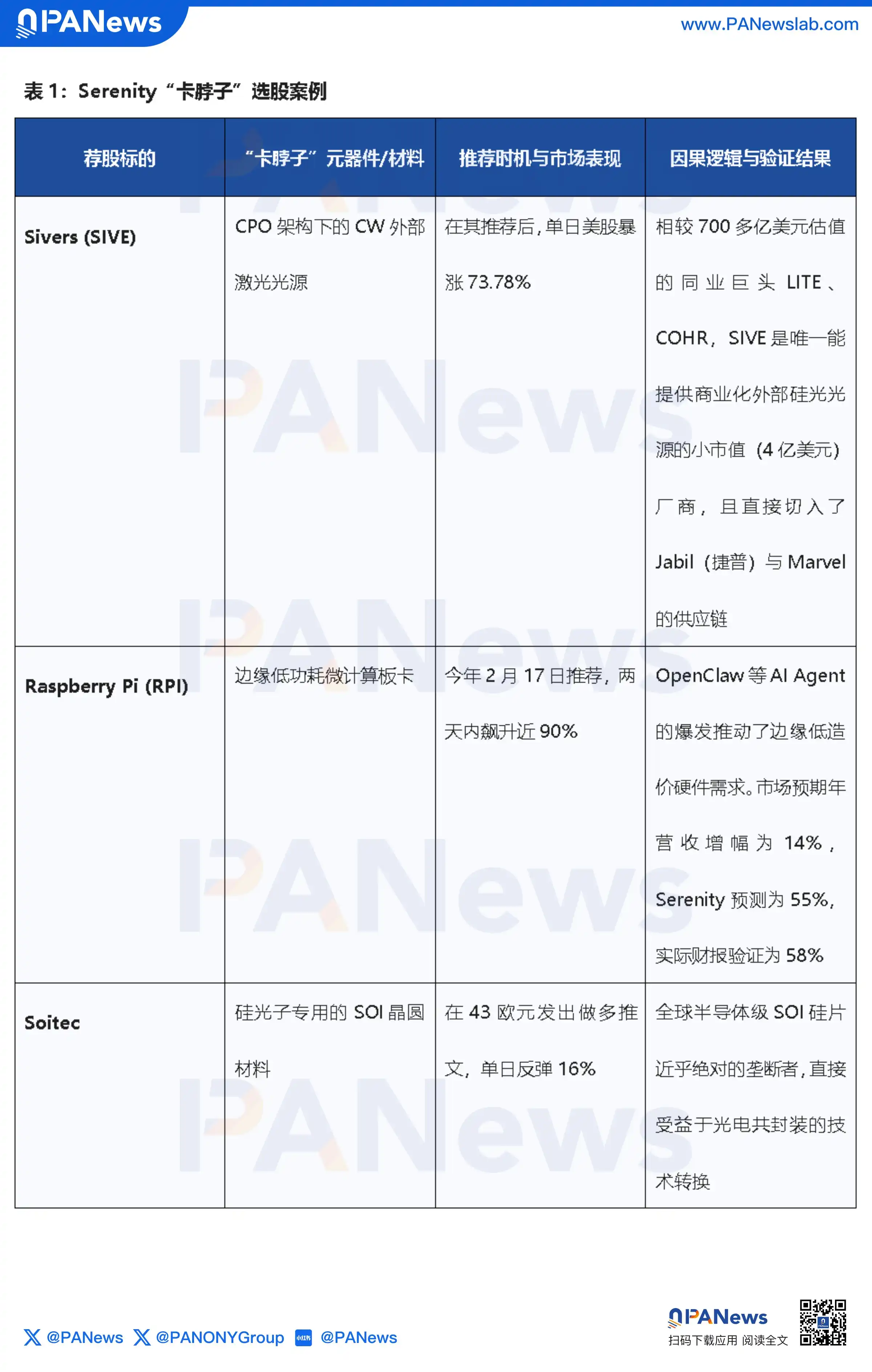
Serenity continues to delve deeper into the very bottom of the supply chain. He has also unearthed NCI, a Japanese chemical company producing semiconductor-grade high-purity phosphorus precursor materials, pushing the "bottleneck point" to the molecular material level.

Leopold: From $200M to $10B, Mastering the Infrastructure Arbitrage Strategy

Unlike Serenity, the elusive folk hunter hidden in the depths of the internet, Leopold Aschenbrenner is a Silicon Valley genius standing in the spotlight, commanding tens of billions in capital.

His resume reads like an "elite template." Graduated top of his class from Columbia University at 19, worked at FTX Future Fund and OpenAI's Superalignment team. In April 2024, however, Leopold was reportedly fired from OpenAI over suspected information leaks.

This event catalyzed his transition into investing. In June 2024, he published a 165-page industry manifesto, "Situational Awareness: The Next Decade." In it, Leopold boldly predicted that AGI would arrive around 2027, with superintelligence emerging by 2030. The real bottleneck to achieving this, he argued, lies not in algorithms and models, but in physical resources like the power grid, land, data centers, and high-bandwidth memory.

Based on this highly forward-looking thesis, he founded the hedge fund Situational Awareness LP. Silicon Valley heavyweights like Nat Friedman, Daniel Gross, and Stripe founders the Collison brothers generously opened their wallets, and a $225 million seed round was swiftly secured.

Leopold's circles are also noteworthy. His fiancée, Avital Balwit, previously worked at the University of Oxford's Future of Humanity Institute (FHI), focusing on issues related to transformative AI, and later joined Anthropic as Chief of Staff to CEO Dario Amodei. FTX was once one of Anthropic's earliest and most important investors. Before FTX's collapse, both Leopold and Avital also held key roles at its philanthropic arm, the FTX Future Fund.

This network provides Leopold with a unique flow of information, cognitive perspective, and resources for his subsequent research framework and investment positioning—perhaps his greatest and most difficult-to-replicate alpha.

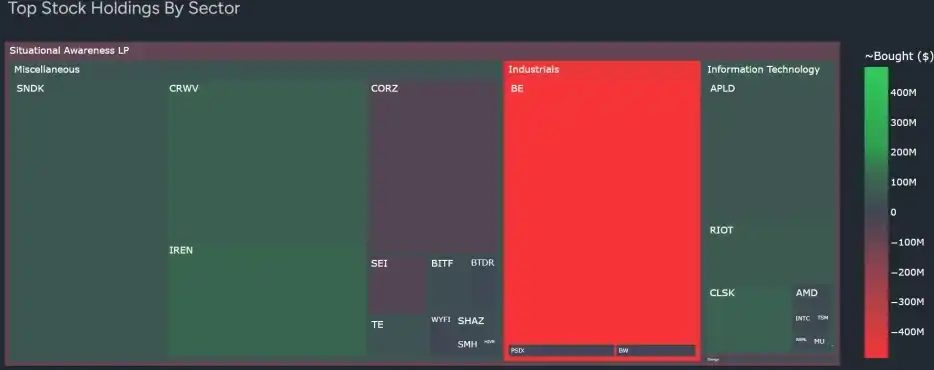
On May 18th, Situational Awareness LP filed its Q1 13F holdings report, revealing Leopold's fund now manages over $10 billion. This document gave the market its first glimpse of his highly concentrated long positions in memory stocks, along with a massive portfolio of put options totaling nearly $8.5 billion targeting the entire semiconductor and chip manufacturing sector.

Judging by his portfolio layout, Leopold employs an infrastructure arbitrage strategy. On one hand, he has made significant purchases of memory hardware manufacturer SanDisk and specialized compute cloud CoreWeave, solidly positioning himself at the hard barriers of physical storage.
On the other hand, he has allocated billions of dollars to put options against NVIDIA (NVDA), TSMC (TSM), Broadcom (AVGO), ASML (ASML), and the Semiconductor ETF (SMH), essentially shorting the entire semiconductor sector.
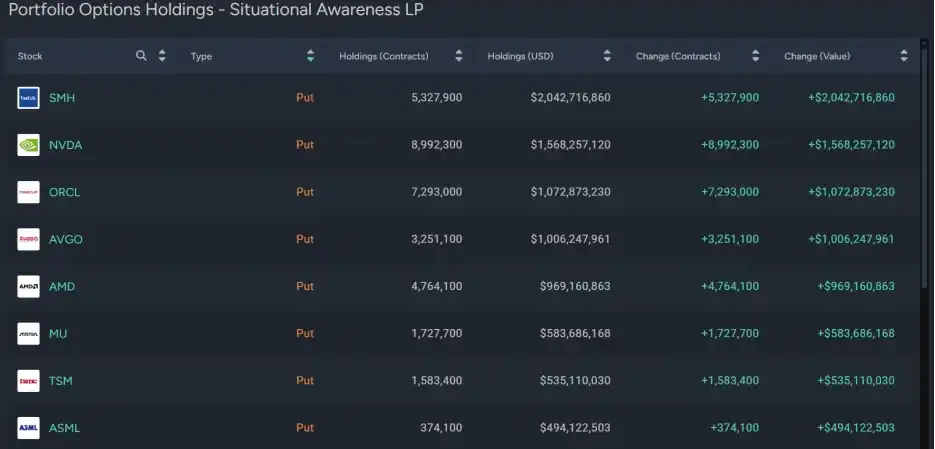
In his view, current valuations in the chip sector have severely detached from the actual construction speed of physical infrastructure like the power grid and data centers. The deployment of AI compute clusters relies on stable electricity, ample land, and mature cooling systems. The construction cycles for these physical infrastructures span 3-5 years, far slower than chip shipment rates. In the short term, the high growth of chip giants is unsustainable, and valuations may face a pullback. Put options would capture profits from this sector downturn.

Crypto enterprises are also part of Leopold's investment map. He has placed a roughly $1 billion long bet on Bitcoin mining companies, heavily buying into IREN, Core Scientific, Riot, CleanSpark, and others. In his eyes, Bitcoin miners are discounted substitutes for AI compute centers, severely undervalued by the market.

Abandoning Software, Emphasizing Physicality: The Hidden Peril of AI Computing's "Toll"

Despite their different "toolkits," the core of Serenity's and Leopold's AI investing is highly similar: abandoning the software layer lacking physical barriers, and heavily investing in hardware constrained by physical laws.

Whether it's the external CW laser light source and high-purity phosphorus in Serenity's view, or the substations and land in Leopold's, they both reveal one point: Regardless of innovation at the model layer, whoever controls scarce resources in the physical world holds the power to levy a "compute toll" on tech giants in the AI era.

However, no strategy is perfect. Both their approaches will face tests on different fronts.

For Serenity, his biggest vulnerability lies in the "liquidity abyss" of micro-cap stocks. When he recommends a micro-cap stock with a market cap of only a few hundred million dollars to his 400,000 followers on X, even a small influx of retail capital can push up the stock price. However, this "frenzy" is built on low liquidity. Once overall market liquidity tightens, or if a recommended company faces setbacks in technology validation, the prices of these micro-cap stocks can plummet, potentially wiping out retail investors who jumped in at high points.

Furthermore, while Serenity's supply chain research is technically thorough, his identity, background, and track record remain unverified. Investors should not worship him as a "stock god" and blindly copy his portfolio wholesale. Blindly following his calls carries high risk. While the micro-cap "bottleneck" strategy is highly explosive, the high capital expenditures, thin margins, and potential customer attrition risks behind these companies mean this strategy is only suitable as a "high-beta catalyst" within an asset allocation framework, complemented by large-cap blue-chip stocks for risk hedging and executed with strict position sizing.

For Leopold, his biggest enemy is the "time lag" in macro dynamics. The fact that physical infrastructure construction lags significantly behind compute demand is entirely valid in terms of causality and is an objective reality. However, capital markets are often driven by irrational sentiment and exhibit longer lag effects, which could allow the high valuations of chip giants to persist longer than expected. When faced with stronger-than-expected earnings reports and short squeezes in stocks like NVIDIA, his massive short positions via put options could incur significant paper losses.
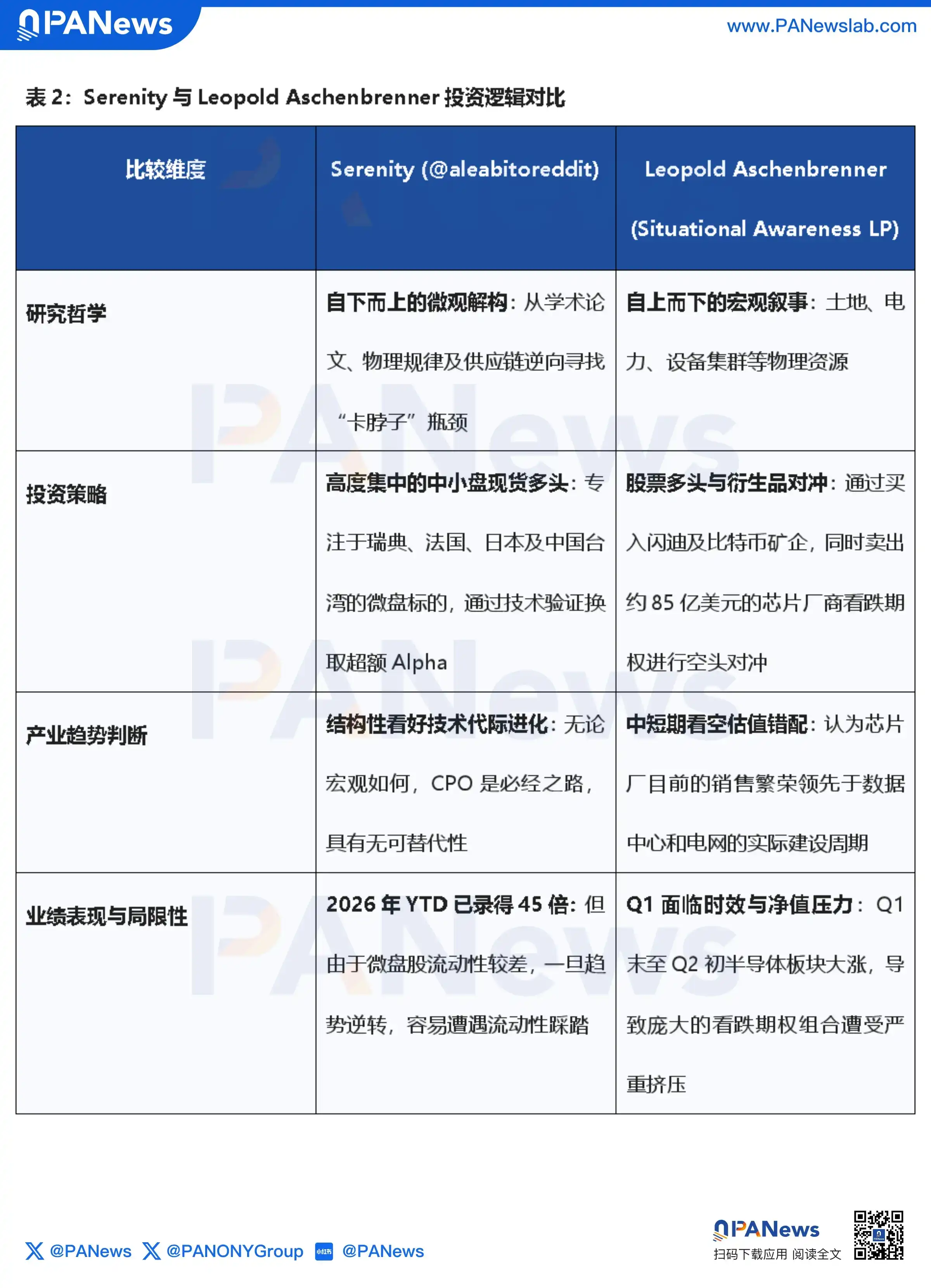
In a way, Serenity and Leopold represent a new phase of AI investment logic. Value capture in the AI industry is shifting from semiconductors themselves to the materials, equipment, power, and land behind the chips.

As model scales and compute demands continue to grow, key links within the AI industry that possess scarcity, technological barriers, and supply constraints are likely to receive increasing market attention in the future.


Preguntas relacionadas

QAccording to the article, what is the core similarity between Serenity and Leopold Aschenbrenner's investment strategies in the AI sector?

ABoth Serenity and Leopold Aschenbrenner's investment strategies share a core similarity: they abandon the software layer, which lacks physical barriers, and instead heavily invest in hardware constrained by physical laws. They focus on the underlying physical bottlenecks and scarce resources of the AI industry.

QHow does Serenity's "Perilla Leaf Theory" apply to finding investment opportunities in the AI supply chain?

ASerenity's "Perilla Leaf Theory" uses the analogy of a top Tokyo sushi restaurant where the most expensive ingredient is tuna belly, but the indispensable item is the perilla leaf from specific small farms. Applied to the AI supply chain, it means targeting small-cap, low-liquidity, hidden champion companies that possess absolute technological monopolies in critical, niche manufacturing segments—the indispensable "chokepoints."

QWhat is Leopold Aschenbrenner's main investment thesis regarding the semiconductor sector, as revealed by his fund's 13F filing?

ALeopold Aschenbrenner's main thesis, revealed in his fund's 13F filing, is that semiconductor sector valuations have become severely disconnected from the actual construction speed of physical infrastructure like power grids and data centers. He believes the slower 3-5 year build cycle for this infrastructure will cause chip companies' high growth to become unsustainable, leading to potential valuation corrections. This is why he holds a massive portfolio of put options against major semiconductor companies and ETFs.

QWhat are the potential risks associated with Serenity's investment approach, as mentioned in the article?

AThe primary risks associated with Serenity's approach are the "liquidity abyss" of micro-cap stocks and unverified personal background. His recommendations can cause sharp price spikes in low-liquidity stocks, but these prices can plummet if market liquidity tightens or the companies face technical setbacks, potentially causing significant losses for followers. Additionally, his identity, background, and track record are unverified, making blind copy-trading highly risky.

QWhy does Leopold Aschenbrenner invest heavily in Bitcoin mining companies, according to the article?

ALeopold Aschenbrenner invests heavily in Bitcoin mining companies because he views them as deeply undervalued, discounted alternatives to AI compute centers. These companies possess critical infrastructure assets like access to stable power and land, which are also essential for AI data centers, making them attractive investment targets within his physical infrastructure-focused strategy.

Lecturas Relacionadas

Justin Sun’s Interview with Hurun Report: A New Order and Certainty for Value Flow in the Era of Transformation

In an interview with *Hurun Report*, Justin Sun, founder of TRON, discussed the evolution of the Web3 industry as it moves from initial exploration to large-scale adoption. He emphasized that the core value of blockchain lies in building an open and inclusive internet of value, enabling anyone globally to transfer and use funds efficiently and at low cost, regardless of location or access to banking. Sun highlighted that projects with lasting impact are those built on genuine demand and real-world usage. He pointed to the stablecoin payment ecosystem as the most mature and scalable application currently, noting that TRON has rapidly become one of the world's largest stablecoin networks. The circulation of USDT on TRON has surpassed $86.3 billion, driven by actual use cases such as cross-border transfers and daily payments, demonstrating strong network effects. Regarding strategy, Sun outlined a methodology combining data-driven iteration, rapid execution, and user-centric focus. He cited the decision to partner with Tether to launch TRC-20 USDT as a key strategic move, based on an assessment of market trends and long-term potential, which has become a significant growth engine for the TRON ecosystem. On globalization, Sun stressed the importance of local compliance and cultural adaptation, noting that success in different markets depends on deep understanding and local partnerships. He also addressed the convergence of AI and blockchain, describing it as a transformative direction where blockchain provides decentralized infrastructure for AI, while AI enhances the intelligence and user experience of blockchain systems. For industry participants and young entrepreneurs, Sun advised continuous learning and adaptability in a fast-changing environment, focusing on building irreplaceable core strengths rather than spreading resources too thinly. Through infrastructure development, global strategy, and technological foresight, TRON aims to advance the practical implementation and evolution of the value internet.

marsbitHace 19 min(s)

Justin Sun’s Interview with Hurun Report: A New Order and Certainty for Value Flow in the Era of Transformation

marsbitHace 19 min(s)

Samsung Leverages Technology Cycles, SK Hynix Relies on HBM, What Enabled Micron to Win a Trillion-Dollar Market Cap?

Micron Technology, the Idaho-based memory chip maker, recently saw its market cap surpass $1 trillion, securing its position as one of the top three DRAM manufacturers alongside Samsung and SK Hynix. Its survival and growth story is marked by a unique combination of political maneuvering and hard-won manufacturing efficiency, but also strategic missteps that now challenge its future. Founded in 1978 in Boise without significant government or capital backing, Micron repeatedly turned to Washington for survival during critical junctures. In the 1980s, it filed anti-dumping complaints against Japanese firms, leading to the U.S.-Japan Semiconductor Agreement. Ironically, this created an opening for Samsung, which Micron had earlier licensed its 64K DRAM technology to. In 2002, Micron avoided heavy fines in a price-fixing investigation by acting as a whistleblower against its competitors, cementing its reputation as a "political opportunist." A major strategic error occurred in 2013 with its $2.5 billion acquisition of bankrupt Japanese firm Elpida. This deal burdened Micron with integrating incompatible manufacturing processes just as the industry was pivoting toward HBM (High Bandwidth Memory), a critical technology for AI. SK Hynix had launched its first HBM chip that same year. By the time AI demand exploded with ChatGPT in 2022, SK Hynix commanded about 85% of the HBM3 market, while Micron, playing catch-up, held only around 3%. In 2017, Micron employed similar tactics against a new competitor, Chinese startup Fujian Jinhua, by alleging intellectual property theft, which led to U.S. sanctions effectively crippling the firm. However, this strategy backfired in 2023 when China banned Micron's products from its critical infrastructure, causing its revenue share from China to plummet from 14% in FY2023 to just 7.1% by FY2025. Today, Micron faces a triple squeeze: it lags in the high-margin HBM race, faces pricing pressure in low-end DRAM from Chinese manufacturers like CXMT, and has lost crucial access to the booming Chinese AI server market. Despite its political strategies, Micron's core strength is its exceptional manufacturing cost control, achieved through decades of engineering. Its DRAM chips have a smaller cell area than its rivals, yielding more chips per wafer. This efficiency has been vital for weathering industry downturns. However, this advantage cannot compensate for the decade lost in HBM development. Micron is now racing to ramp up production of its HBM3E, certified by NVIDIA, and develop HBM4. Its future hinges on whether it can close this technological "time debt" through relentless R&D and execution, in a marathon where its competitors, having started earlier, are not slowing down.

marsbitHace 37 min(s)

Samsung Leverages Technology Cycles, SK Hynix Relies on HBM, What Enabled Micron to Win a Trillion-Dollar Market Cap?

marsbitHace 37 min(s)

Deconstructing Mysterious Researcher Serenity's Chokepoint Algorithm and the Global Revaluation of Equity Assets

Unmasking Serenity's "Chokepoint Theory": A Framework for AI-Era Investment This article deconstructs the investment methodology of the pseudonymous online researcher Serenity (formerly AleaBito on Reddit), who claims extraordinary returns by identifying critical bottlenecks in AI and robotics supply chains. Rejecting Wall Street's typical top-down analysis, Serenity employs a bottom-up, reverse-engineering approach. Starting with an end product like an Nvidia GPU cluster, he meticulously maps the global supply chain down to its most essential, irreplaceable physical components—the "choke points." These are low-profile, often monopolized sub-sectors where a disruption could paralyze entire downstream industries, analogous to a strategic strait controlling global oil flow. His primary focus is the physical evolution of AI data centers, specifically the shift from copper interconnects to silicon photonics and Co-Packaged Optics (CPO). He identifies five critical, monopolized technical barriers within CPO: high-precision fiber alignment components (e.g., FOCI), external light sources and high-power lasers (e.g., SIVE), molecular beam epitaxy equipment (ALRIB/Riber), ultra-high-purity red phosphorus raw materials, and Silicon-on-Insulator (SOI) wafers (Soitec). Serenity extends this framework to humanoid robotics, arguing that while the AI "brain" resides in the US, the physical "body" hardware (actuators, gears, motors) is dominated by Asian manufacturers. He highlights a looming "demand tsunami" for specific rare earth elements essential for robot motors, presenting a severe future supply chain and geopolitical challenge. The article cites several of his investment targets (RPI, SIVE, Soitec, VLN, NBIS) where identifying such choke points, coupled with correcting market mispricings (e.g., ticker code confusion for VLN), allegedly led to significant re-ratings. Ultimately, the article posits that Serenity's core value is not in providing stock picks, but in demonstrating a paradigm: using deep technical analysis to find the silent, indispensable "physical switches" within complex systems, thereby exploiting institutional research blind spots. However, it warns of major risks, including illiquidity in micro-cap stocks, potential "pump-and-dump" accusations, and the foundational gamble that his identified technological paths (like CPO) are the correct and inevitable ones.

marsbitHace 39 min(s)

Deconstructing Mysterious Researcher Serenity's Chokepoint Algorithm and the Global Revaluation of Equity Assets

marsbitHace 39 min(s)

Cross-strait Regulators Jointly Block Hong Kong Stock Account Openings: Where Can Your Money Go Now?

**Summary:** On May 22, 2026, financial regulators in mainland China and Hong Kong launched a synchronized crackdown targeting informal channels used by mainland investors to trade in Hong Kong and US stocks via Hong Kong-based securities firms. The Hong Kong Securities and Futures Commission (SFC) issued a stringent circular to licensed brokers, mandating stricter onboarding procedures for mainland clients. New requirements include a mandatory written declaration stating that all investment funds originate from *outside* mainland China and are from legal sources. The SFC also demanded the closure of accounts opened with suspicious documents and dormant accounts. Simultaneously, China's securities regulator, along with seven other ministries, initiated a two-year rectification plan, penalizing firms like Futu and Tiger Brokers for illegal cross-border operations. This effectively ends the previously common grey-area practice for mainlanders. Immediate impacts are evident. Social media reports show mainland investors traveling to Hong Kong for in-person account openings are now frequently denied after signing the new declaration, even at firms like uSMART that still accept applications. The declaration acts as both a compliance shield for brokers and a filter for clients. While major internet brokers have halted new mainland accounts, limited options remain. A few Hong Kong-licensed firms like uSMART, Fosun Wealth, and Cheerful still offer avenues, but approval is not guaranteed and hinges on proving offshore fund sources. Crucially, funding accounts must now be in the investor's own name at qualified Hong Kong or international banks, blocking previous informal methods like third-party transfers. For compliant access, official channels like Stock Connect, QDII, and the Cross-boundary Wealth Management Connect remain open. Individuals with verifiable overseas residency or status have better prospects. The crackdown signals the definitive end of the loosely regulated expansion period, forcing mainland investors toward stricter, fully compliant pathways for overseas asset allocation.

marsbitHace 44 min(s)

Cross-strait Regulators Jointly Block Hong Kong Stock Account Openings: Where Can Your Money Go Now?

marsbitHace 44 min(s)

Iran and the Fed -- Three Scenarios That Will Impact Global Markets Next

"Three Scenarios for Iran and the Fed Shaping Global Markets" Iranian geopolitics and the Fed's monetary policy path are two dominant themes for markets. Deutsche Bank Research outlines three scenarios linking Iran ceasefire outcomes to Fed policy, with oil prices as the key transmission channel. **Scenario 1: Peace Deal.** A breakthrough leading to the Strait of Hormuz reopening would ease near-term Fed tightening pressure. Recent inflation would be viewed as a temporary energy shock. However, medium-term risks remain; rate hikes could resurface in 2027 if inflation persists. **Scenario 2: Stalemate.** A breakdown in talks and a prolonged Strait closure, but no major escalation, is deemed the scenario with the *highest* Fed hike risk. Sustained high oil prices would feed into core inflation and threaten inflation expectations, while not severely damaging demand enough to give the Fed a reason to pause. This environment could necessitate multiple Fed rate hikes in 2026. **Scenario 3: Conflict Escalation.** Renewed conflict and sharply higher oil prices create a two-way risk for Fed policy. On one hand, it would risk severe inflation expectations de-anchoring, forcing a hawkish response. On the other, extreme oil prices could severely damage demand and the labor market, potentially shifting the Fed's focus toward easing. The ultimate policy decision would depend on which risk materializes first. Overall, Deutsche Bank's framework emphasizes that the path for oil prices, dictated by Iran, will define the nature of inflation pressures and ultimately determine the Fed's policy space. Key signals to watch include ceasefire progress, whether Brent crude stabilizes below $100, and any shift in Fed officials' rhetoric from discussing cuts to potential hikes.

marsbitHace 53 min(s)

Iran and the Fed -- Three Scenarios That Will Impact Global Markets Next

marsbitHace 53 min(s)

Trading

Spot
Futuros
活动图片