Author: Rita
TideGuide
J.P. Morgan analyst Samik Chatterjee recently reiterated his Overweight rating on Coherent (stock code COHR) at an investor conference. The company manufactures optical communication chips and components, and the market underestimates its growth potential. The core logic revolves around three product lines: optical transceivers for data centers, Co-Packaged Optics (CPO) chips, and industrial lasers and thermal solutions.
Data Communication Transceivers, Demand Continues to Rise
First, look at the most mature business line. COHR's 1.6T transceivers are now standard in data centers, and supply remains tight. Demand for 1.6T is already present, the pricing environment is healthy, with no significant pressure observed. Some worry that CPO might cannibalize traditional transceiver business, but the analyst believes the opposite is true. CPO integrates optical and electrical chips, which will actually increase demand for high-end optical components rather than replace them.
CPO and OCS, An Underestimated Opportunity
CPO is currently a major industry focus, with all major chip manufacturers involved. COHR's competitive advantage lies in providing a comprehensive portfolio of optical components. It can supply lasers, isolators, VCSELs, and thermoelectric coolers. COHR covers nearly all the optical components required in a CPO system. This means the value COHR can capture per CPO chip is far greater than with traditional transceivers.
The target market size for Optical Circuit Switches (OCS) is $4 billion, and its application scenarios are expanding. From internal data center traffic optimization, it extends to data center interconnects and even Scale-Up scenarios. COHR uses Liquid Crystal technology, competing against MEMS-based solutions, offering clear advantages in reliability and power consumption.
InP Capacity, The Foundation for Upstream Integration
COHR plans to increase its InP (Indium Phosphide) device capacity fourfold within two years. The transition to 6-inch wafers is underway, with yields exceeding those of mature processes. The company has signed agreements with five substrate suppliers to secure supply, addressing the primary bottleneck for capacity expansion.
Pump lasers are currently in particularly short supply. COHR is one of only two global high-quality suppliers, holding about 70% share for certain models. This tight supply environment presents a strategic opportunity: vertical integration. Moving beyond selling just laser components to selling complete line cards or systems. The average selling price per solution can increase by more than tenfold.
Raising Gross Margin Targets, Cost Structure Improving
The company reaffirmed its gross margin target of greater than 42%, hinting at potential future increases. The drivers come from three aspects: premium pricing for high-end products, cost improvements from the transition to 6-inch wafers, and volume ramp-up of high-margin new products like CPO and OCS. The efficiency of the thermal management material "thermadite" is 2 to 5 times that of copper-based solutions, representing another long-term growth driver.
The Industrial Segment, An Overlooked Growth Point
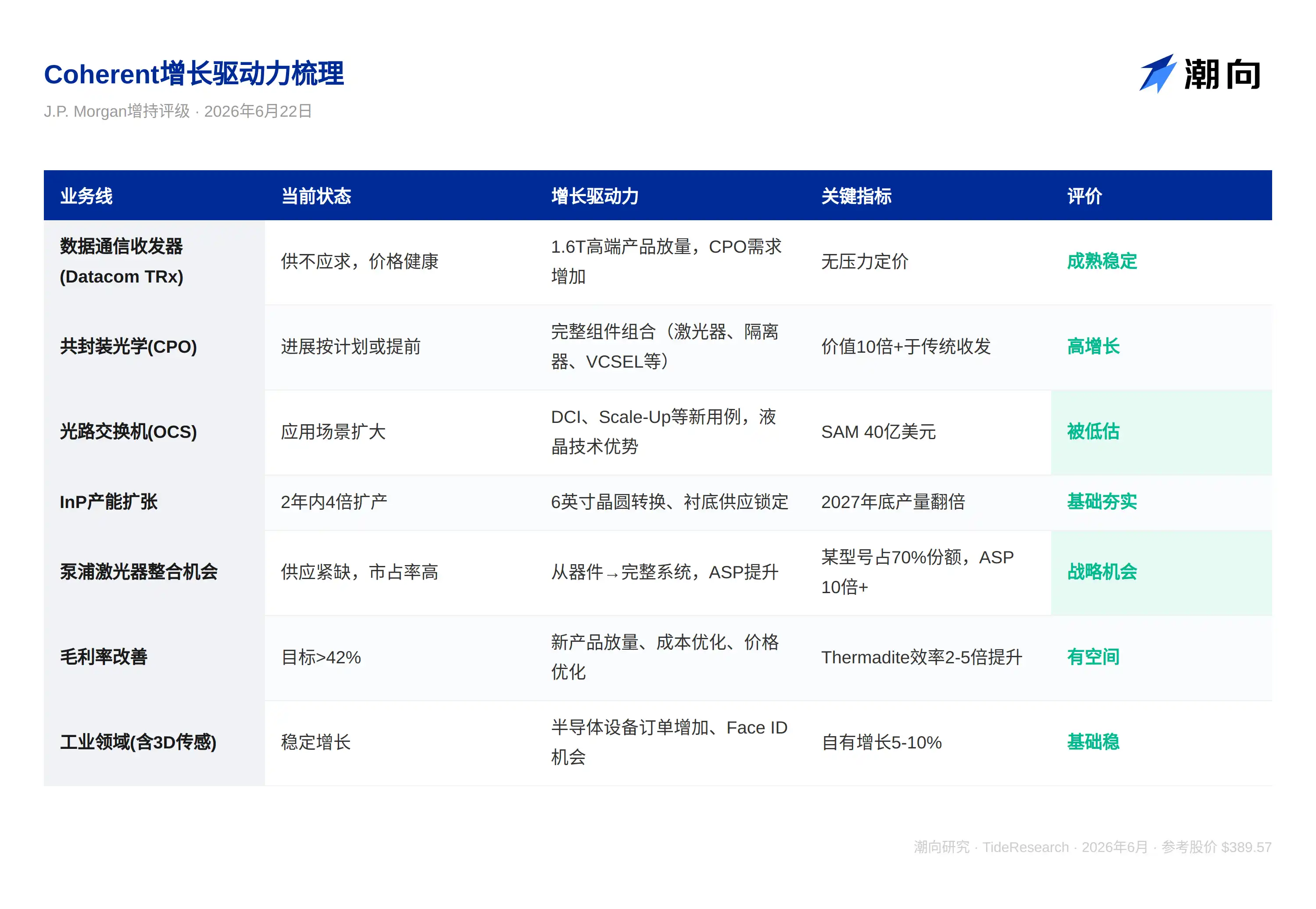
Organic growth in industrial revenue remains steady at 5% to 10%. Semiconductor manufacturing equipment orders are growing. In 3D sensing, Apple's next-generation Face ID might adopt a new protocol, presenting a re-competition opportunity for suppliers.
Optical communication chips are the underlying infrastructure for data centers. AI is driving higher computing power demands, which in turn increases the need for high-speed optical interconnects. COHR holds a critical position in this supply chain. The new opportunities in CPO and OCS, stable growth in the industrial segment, and room for gross margin improvement all support the Overweight rating.
Disclaimer
This article is TideResearch's analysis and interpretation of a third-party brokerage research report. The ratings, price targets, earnings forecasts, and related judgments cited herein are the views of the J.P. Morgan analyst, representing only the stance of their affiliated institution. They do not represent TideResearch's views and do not constitute any investment advice.
Please note three points while reading: First, ratings are analysts' comprehensive judgments on a company's prospects and are subject to frequent adjustments based on performance and market conditions. Second, sell-side research reports are inherently bullish, and some covered companies may have investment banking relationships with the brokerage. Third, the value of research reports lies in their core logic and underlying assumptions, not just a specific price target. Focus on the logic, not just the rating.
Markets involve risks, and investment decisions should be made independently. This article should not be used as a basis for trading any securities.
Data Source: Coherent Corp Investor Conference Minutes (J.P. Morgan, Samik Chatterjee, June 22, 2026)
TideResearch · June 2026