Unexpected Positive News for Altcoin Emerges Amid Sudden Market Surge!

cryptonews.ruPublicado a 2026-08-19Actualizado a 2026-08-19

Resumen

Grayscale Investments has submitted a fourth amended S-3/A registration statement to the SEC for its Grayscale Zcash Trust, aiming to list shares on NYSE Arca under the ticker "ZCSH." The trust seeks to directly hold Zcash (ZEC) and offer investors exposure to its price movements without directly owning the cryptocurrency. If approved, the existing company will be renamed. Coinbase will serve as the primary broker and custodian, with Bank of New York Mellon as transfer agent. The filing also reveals that a subsidiary of Grayscale's parent company, Digital Currency Group (DCG), is in discussions to potentially acquire approximately 200,000 ZEC through the trust, though no binding agreement is yet in place.

Grayscale Investments continues the process of coordinating with the U.S. Securities and Exchange Commission (SEC) for its investment product focused on Zcash ($ZEC). The company has filed a fourth amended S-3/A registration statement for the Grayscale Zcash Trust, proposing to list the product on the NYSE Arca exchange under the ticker "ZCSH".

According to a preliminary prospectus published today, Grayscale plans to rename the existing company following approval of the registration statement and the listing of the shares on NYSE Arca. The primary objective of the trust is the direct ownership of $ZEC, the native crypto asset of the Zcash network, and providing investors with an investment vehicle allowing them to gain exposure to its price fluctuations through an exchange without the need to own $ZEC themselves.

As per information contained in the statement, the trust intends to list its shares on the NYSE Arca exchange under the symbol ZCSH. Grayscale also plans for a continuous offering of shares and their periodic sale to investors. The share sale price will be determined based on various metrics, including the price of $ZEC and the market price on NYSE Arca.

The filing also provided details about the trust's operational structure. Coinbase will serve as the primary broker for the product, and Coinbase Custody Trust Company will provide custody services. Bank of New York Mellon is listed as the registrar and administrator.

Another important detail in the S-3/A document is the potential investment being considered through a subsidiary related to Grayscale's parent company, Digital Currency Group (DCG).

According to the statement, a DCG subsidiary is in negotiations to acquire approximately 200,000 $ZEC through the trust. However, it was noted that an agreement between the parties is not yet binding.

*This is not investment advice.

end-content

Preguntas relacionadas

QWhat is the primary objective of the Grayscale Zcash Trust according to the filing?

AThe primary objective of the Grayscale Zcash Trust is to directly own $ZEC, the native crypto asset of the Zcash network, and to provide investors with an investment tool that allows them to gain exposure to its price fluctuations through a stock exchange without having to own $ZEC directly.

QOn which exchange does Grayscale plan to list the shares of the Zcash Trust and under what ticker symbol?

AGrayscale plans to list the shares of the Zcash Trust on the NYSE Arca exchange under the ticker symbol 'ZCSH'.

QWhat key service providers are mentioned in the filing for the Grayscale Zcash Trust, and what are their roles?

AThe filing mentions Coinbase as the primary broker for the product, Coinbase Custody Trust Company as the custody service provider, and Bank of New York Mellon as the registrar and transfer agent.

QWhat potential investment activity is mentioned in the document related to Digital Currency Group (DCG)?

AThe document mentions that a subsidiary of Digital Currency Group (DCG), Grayscale's parent company, is in discussions to acquire approximately 200,000 $ZEC through the Trust, although no binding agreement has been reached yet.

QWhat action does Grayscale plan to take regarding the existing entity upon approval and listing?

AGrayscale plans to rename the existing company (likely the existing trust structure) after the registration statement is approved and the shares are listed on the NYSE Arca.

Lecturas Relacionadas

Uniswap v4 Hook Ecosystem Heats Up: 8 Early Projects Lead the Race, Who Can Build Real Business?

The Uniswap v4 Hook ecosystem is heating up, with eight early-stage projects emerging to explore its potential for customizable trading pool rules. A Hook is an external smart contract attached to a Uniswap v4 liquidity pool, allowing developers to add custom logic before or after key actions like pool creation, liquidity provision, and trading. This enables features like dynamic fees, arbitrage profit redistribution, and complex token execution rules. The article highlights Hookr (a platform for easily composing and deploying Hooks), StonkBrokers (focusing on tokenized stocks and creating "Pair Tokens"), What The Hook (redistributing arbitrage profits), Programmable (a no-code/code launchpad for tokens with Hooks), Claus (an experimental, upgradeable Hook-based token), Fables Finance (a DEX combining Hooks with a ve(3,3) model), The Standard Reserve (a monetary policy experiment using Hooks), and Bordrless (a Solana-based project with a similar programmable token concept). However, the piece emphasizes significant risks for these early projects, including smart contract vulnerabilities, low liquidity and high volatility, and potential disconnects between a Hook's utility and its token's value. The key question remains: which projects can move beyond technical experimentation to build sustainable, real-world business models using Hooks? The ecosystem is growing, but true validation through user adoption and protocol revenue is still needed.

marsbitHace 2 min(s)

Uniswap v4 Hook Ecosystem Heats Up: 8 Early Projects Lead the Race, Who Can Build Real Business?

marsbitHace 2 min(s)

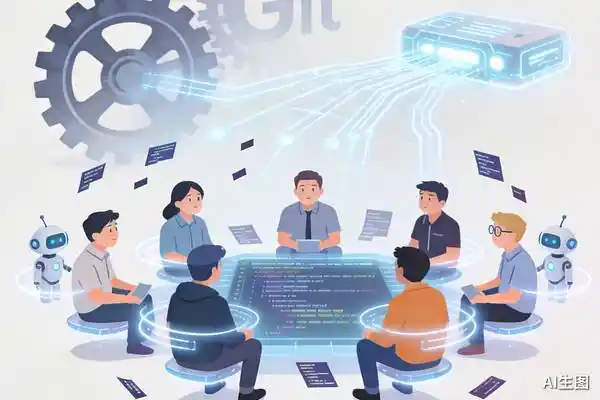
7 People, 5 Months: Anthropic Built a Git Replacement

In a surprising move, Anthropic replaced Git, the dominant version control system for two decades, with its own internally developed system named Scion. This migration was accomplished in just five months by a team of seven engineers, heavily assisted by their AI model, Claude. The primary driver was the explosive growth of AI-powered software development at Anthropic. By September, the company was handling over 30,000 code merges per day—a 12x increase in just four months—straining Git's decentralized, offline-friendly architecture which was not designed for such massive, centralized, and always-online agent-driven workflows. Scion was designed from the ground up for this new paradigm. Its core principles include: assuming clients (AI agents and automation) are always online; offloading complex computations (like blame, diff, merges) to scalable servers; providing a full API for source control queries to eliminate local repo needs for many tasks; and enabling highly efficient, sparse, and virtualized checkouts. Key to Scion's performance is its data structure. Instead of Git's commit-and-tree model, it uses a "Changeset" stored in a write-ahead log, which records only changed files. This allows for extremely high-throughput ingestion. Additional "derived data" structures are built on-demand for operations like blame and history queries. The new architecture employs a distributed, cache-heavy design with daemons (scion-daemon), regional caches (scion-cache), and authoritative servers (scion-server). This resulted in cache hit rates over 99%, a 200x reduction in CPU/memory usage compared to their previous Git mirror infrastructure, and code checkouts that are now seconds instead of minutes. Claude played a crucial role, not only in accelerating development but also in significantly improving code quality, performance, and test coverage. The project also led to innovations in security, access control, and system monitoring using AI "Superfans." Anthropic emphasizes that Scion is not a general-purpose Git replacement. It is tailored for massive monorepos driven by vast numbers of AI agents. However, they share their learnings in hopes that the broader ecosystem can adapt some of Scion's effective patterns—like server-side APIs and optimized protocols—to enhance Git for emerging large-scale, AI-augmented development environments.

marsbitHace 40 min(s)

7 People, 5 Months: Anthropic Built a Git Replacement

marsbitHace 40 min(s)

Trading

Spot
活动图片