Reddit Weekly Hot Stock Watch: RKLB/LUNR/ASTS Plunge Collectively, Is the Space Sector Still Worth Considering?

marsbitPublicado a 2026-06-08Actualizado a 2026-06-08

Resumen

Reddit's stock communities witnessed a concentrated surge in discussion around space stocks last week, with SPCE, RKLB, LUNR, and ASTS leading the chatter. This often signals an underlying catalyst for investor attention. However, despite being grouped as "space plays," these companies have vastly different fundamentals and recent performances. While SPCE (Virgin Galactic) saw a 22% single-day surge—potentially fueled by short covering and fallout from Blue Origin's rocket test anomaly—the other three stocks declined sharply. RKLB dropped 15%, LUNR fell 13%, and ASTS was down 7%. This divergence highlights they are not a monolithic sector. The downturn for RKLB, LUNR, and ASTS stemmed from multiple headwinds converging: Blue Origin's New Glenn rocket explosion (directly impacting ASTS's launch plans), anticipation of SpaceX's massive IPO drawing funds away from these "alternative" public space stocks, and insider selling at RKLB after significant rallies. A closer look reveals key differences: RKLB stands out with substantial, growing revenue ($113.9M in Q1) and a $2.2B backlog, though its high valuation (~80x Forward P/S) prices in success for its upcoming Neutron rocket. LUNR's reported revenue growth is largely acquisition-driven, with its core moon landing business facing a crucial test with the upcoming IM-3 mission. ASTS has a large potential market in space-based cellular connectivity but faces significant execution risk, especially after the Blue Origin launch setb...

Author: David, Deep Tide TechFlow
On Reddit's stock subreddit communities, stocks with skyrocketing discussion volume aren't necessarily worth buying, but they are definitely getting attention because there's usually a catalyst behind the discussions.

Our monitoring tools scan daily changes in discussion volume and sentiment distribution across several major stock communities on Reddit, fishing out abnormal signals for further analysis.

Last week's hot discussion signals were concentrated in the space sector:

SPCE (Virgin Galactic) topped the hot list with 2,828 discussion threads in 24 hours; meanwhile, RKLB (Rocket Lab) discussion volume surged 3.3 times, and LUNR (Intuitive Machines) and ASTS (AST SpaceMobile) also appeared frequently in the hot discussion zone.
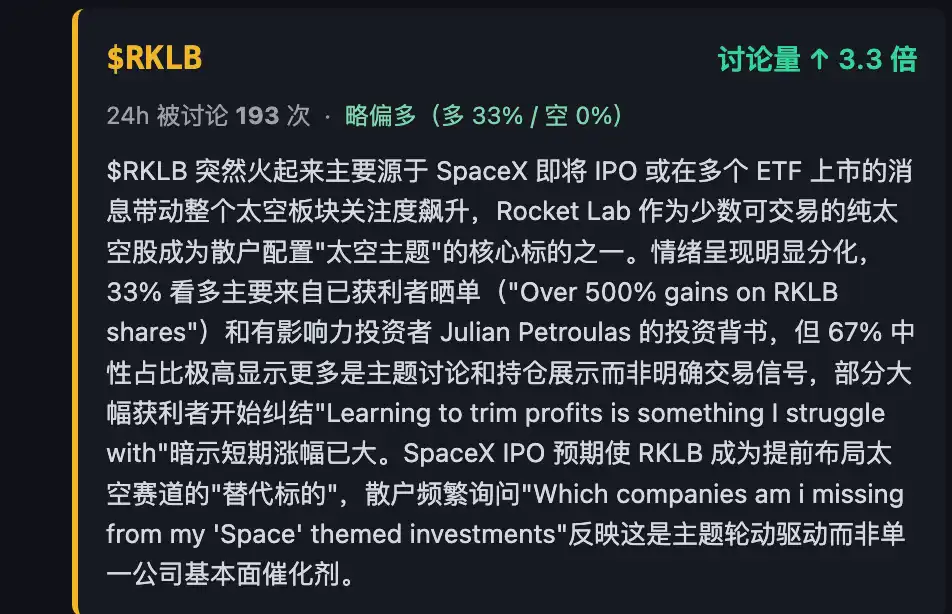
These four stocks are often bundled together on Reddit because they are among the few pure-play space stocks accessible to retail investors. In the years before SpaceX goes public, these are the substitutes for retail investors to allocate to a 'space theme'.

Currently, common discussions in Reddit's US stock communities include "Which companies am I missing from my space themed investments?", which to some extent reflects the spillover effect of SpaceX sentiment and the expectation among foreign retail investors that it will ignite the space concept, prompting them to position themselves early.

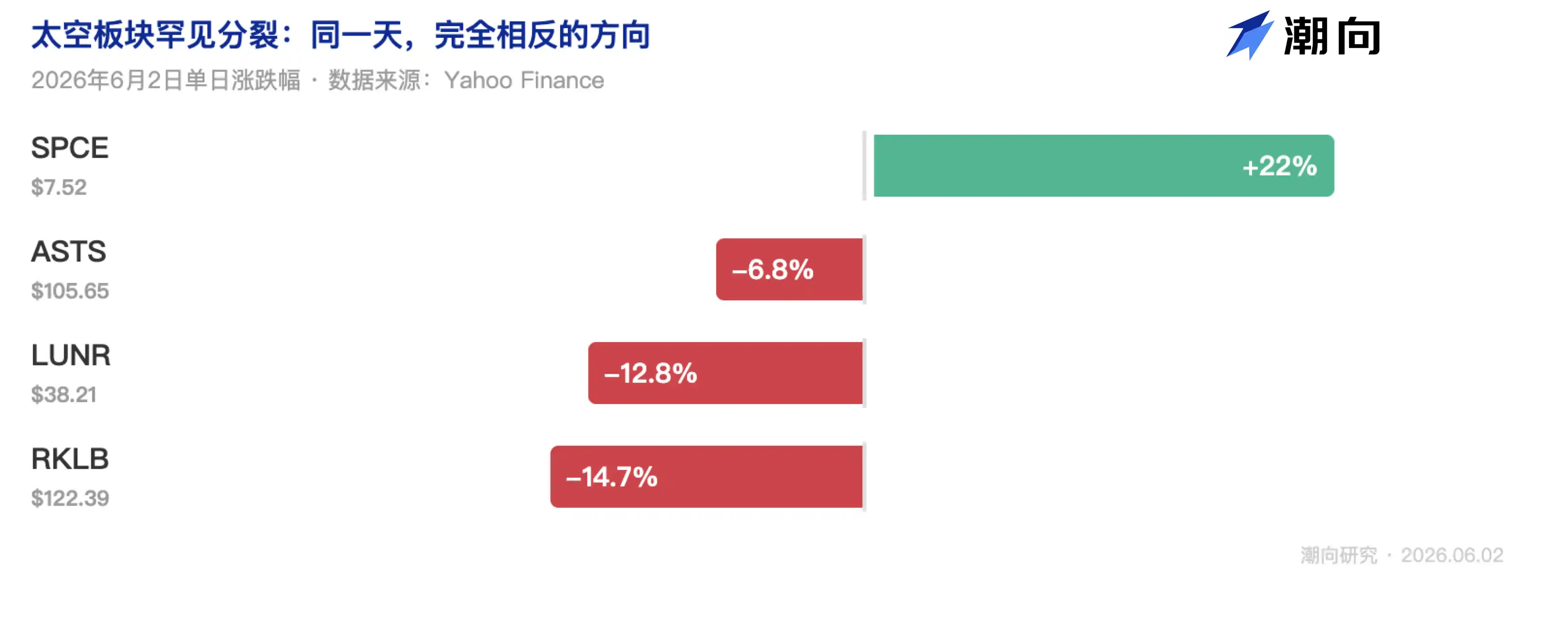
Looking at the current trends of these stocks, they have moved in completely opposite directions within the same sector: SPCE soared 22% in a single day, while RKLB fell 15%, LUNR fell 13%, and ASTS fell 7%.

Therefore, in the current hot discussions, SPCE attracted new attention due to its profit-making effect, while RKLB/LUNR/ASTS generated discussions from existing holders due to price declines or loss anxiety.

If you are also watching the space sector or have corresponding holdings, the following analysis of the recent developments of these 4 US stocks might provide some assistance for decision-making.
Most Space Stocks Fell, Impacted by Overlapping Negative Events

Except for $SPCE, this wave of decline in space stocks involved at least 3 negative events that happened to coincide in the same week.

Blue Origin Rocket Explosion.

Blue Origin is the space company founded by Amazon's Jeff Bezos. Its New Glenn heavy-lift rocket competes in the same market as SpaceX's Falcon Heavy and Rocket Lab's Neutron, which is under development. On May 29, during a static fire test at Cape Canaveral, the New Glenn rocket exploded, prompting the FAA (Federal Aviation Administration, which must approve all commercial launches) to immediately ground it.

This event had the biggest impact on $ASTS:

The company plans to launch 45-60 satellites into orbit before the end of the year, and Blue Origin is one of its primary launch suppliers. The grounding directly eliminates one launch pathway.

$RKLB itself doesn't use New Glenn for launches, but its own Neutron under development is a competitor. The explosion reminded investors that building rockets really can lead to explosions. Another space stock, $LUNR, was affected more by sector-wide sentiment spillover.

However, $SPCE actually benefited. Virgin Galactic operates suborbital space tourism, directly competing with Blue Origin's New Shepard business. After the New Glenn explosion, market funds flowed out of Blue Origin-related stocks, with some moving into SPCE. Additionally, SPCE has a relatively smaller market cap, making its price more prone to volatile swings.

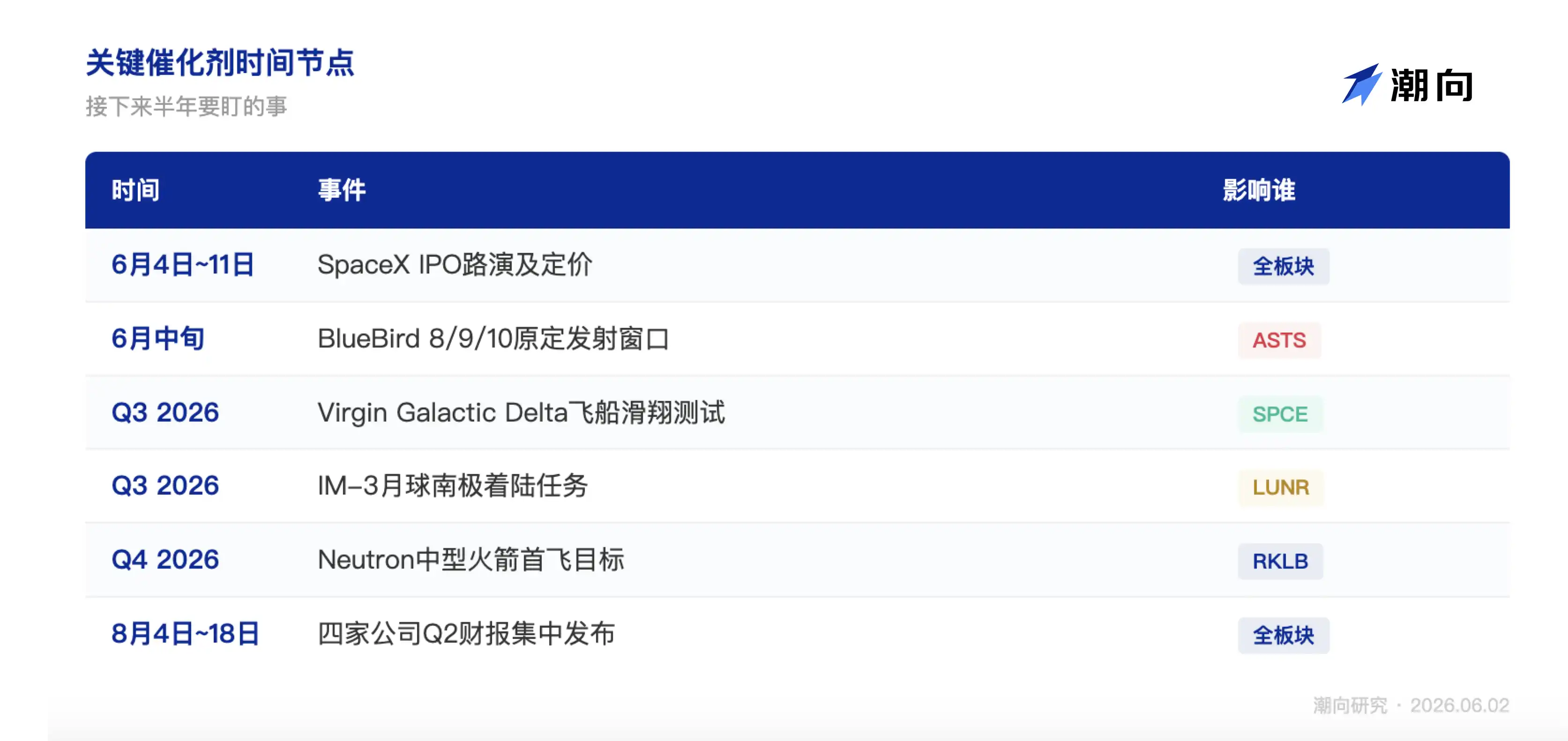
SpaceX IPO Pricing Could Happen as Early as June 11.

SpaceX confidentially submitted its S-1 filing in April, targeting a valuation of $1.8 trillion and raising up to $75 billion, potentially the largest IPO in Wall Street history. Over the past few years, RKLB, LUNR, and ASTS were popular partly because SpaceX wasn't public, making them the only entry points for retail investors into space. Now that the main player is arriving, some capital will naturally move out of these substitutes to make room for SpaceX.

Insiders Themselves Are Selling.

Public data shows RKLB's CEO Peter Beck sold approximately 2.51 million shares over the past 6 months, cashing out about $142 million. The President, COO, and General Counsel also recently reduced their holdings, totaling about $18 million.

Some of this was part of pre-arranged 10b5-1 plans (a preset trading arrangement for compliant CEO selling), but the timing was chosen near historical highs. Over the past year, RKLB rose 412%, ASTS rose 437%, and LUNR rose 267%, so profit-taking pressure was already relatively loose.

The Four 'Space Companies' Are Not Doing the Same Thing

Retail investors tend to treat SPCE, RKLB, LUNR, and ASTS as one sector and trade them together, but these four companies have completely different businesses, revenue stages, and risk profiles.
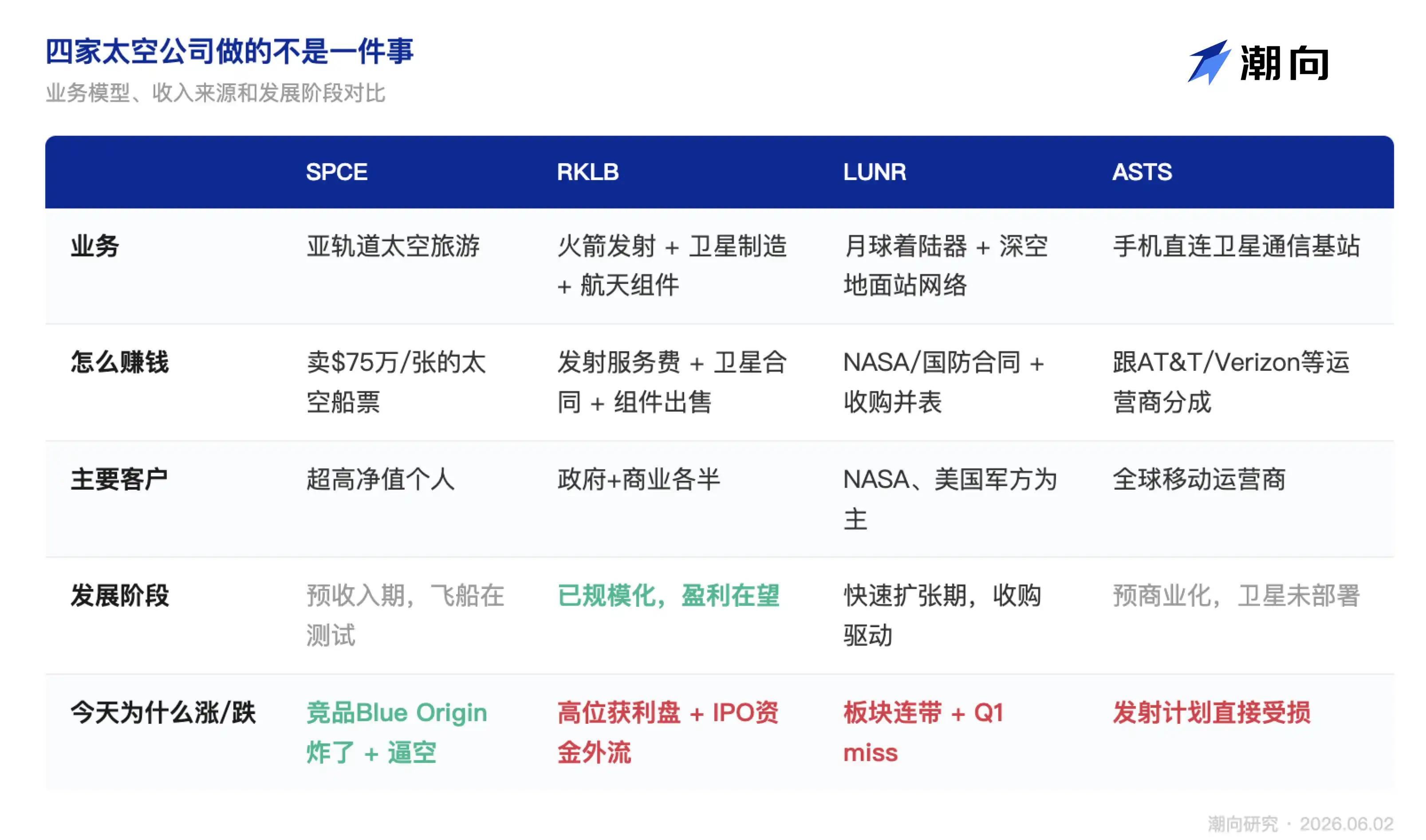
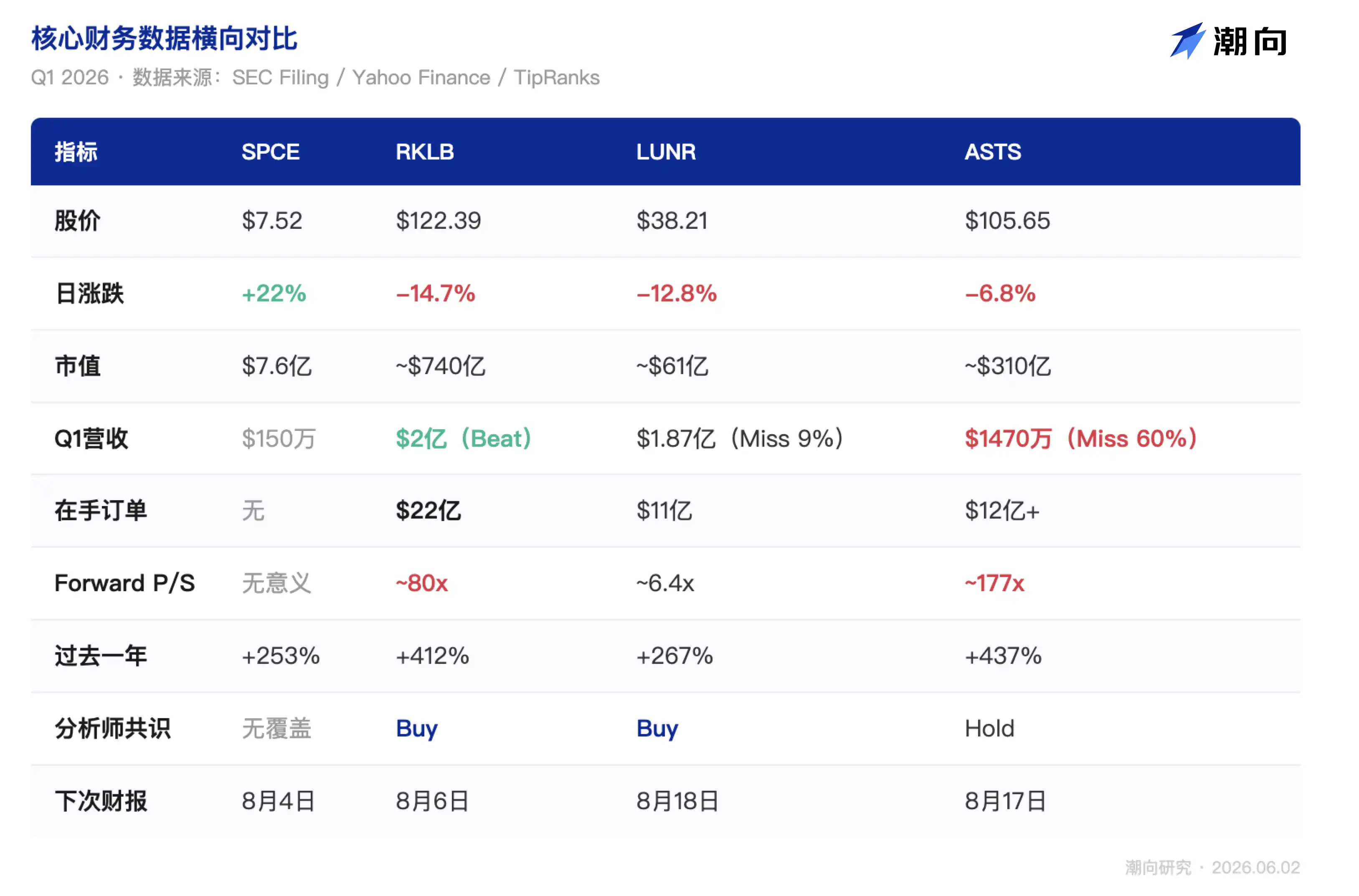
From the table above, RKLB is the only one among the four with substantial and accelerating revenue.

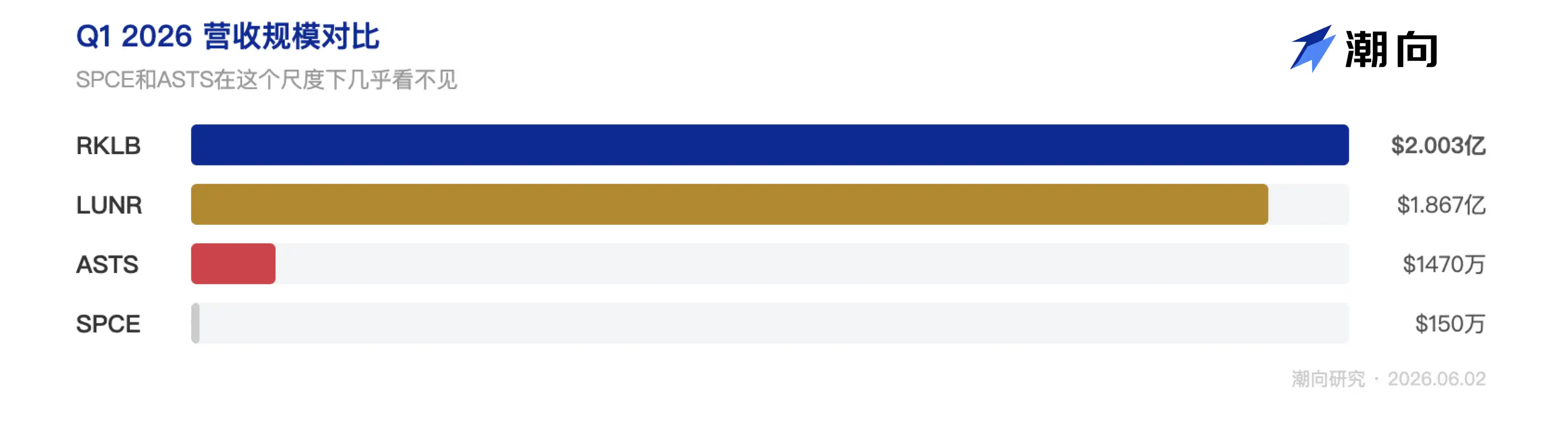
Looking at this year's Q1 revenue for these companies, RKLB's revenue was earned deal by deal, increasing 63.5% year-over-year, beating analyst expectations. LUNR's number is similar in size, but a large portion comes from consolidating the revenue of Lanteris, a company it acquired for $800 million this year. Excluding that part, its organic growth is less dramatic, and its final revenue still missed analyst expectations by 9%.

ASTS and SPCE's revenue bars are almost invisible in this chart; their revenue scale is negligible compared to the first two.
RKLB: The Only One with Accelerating Fundamentals, But $122 Is No Longer Cheap

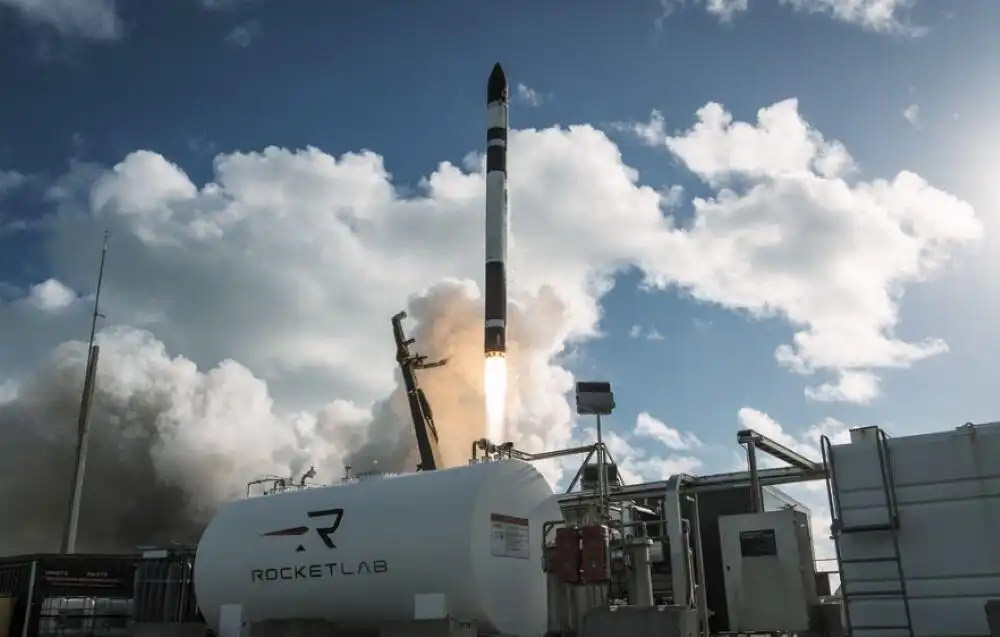
Rocket Lab is the second-largest US rocket company. Its self-developed Electron small rocket has completed over 50 launches, while also building satellite platforms and space components sold to NASA, the Department of Defense, and commercial customers. Government and commercial revenues are roughly split, making its customer base much more diversified than the other three.

The company's biggest variable is the Neutron medium-lift launch vehicle currently under development. Neutron is positioned as a direct competitor to SpaceX's Falcon 9. If its maiden flight succeeds, RKLB would upgrade from a 'small launch service provider' to 'the only listed company besides SpaceX capable of launching medium payloads.' The target for the first flight is Q4 2026, but it has been delayed twice before (due to a first-stage tank test failure causing schedule adjustments). This also means valuations differ vastly between success and failure scenarios.
Regarding this company's Q1 financial figures, they are visible in the charts later. Here are three things the table doesn't show:

First, within its $2.2 billion backlog, there's an $816 million SDA (Space Development Agency) satellite contract, the largest single order in Rocket Lab's history, indicating the company is transitioning from a launch service provider to a 'full-stack space supplier.'

Second, Q1 saw the signing of 5 exclusive Neutron launch contracts, meaning customers booked flights before the rocket even flew, showing increasing market confidence in Neutron.

Third, CEO Peter Beck cashed out $142 million over the past six months. Although part of a 10b5-1 plan, this level of selling is not insignificant within the aerospace industry.

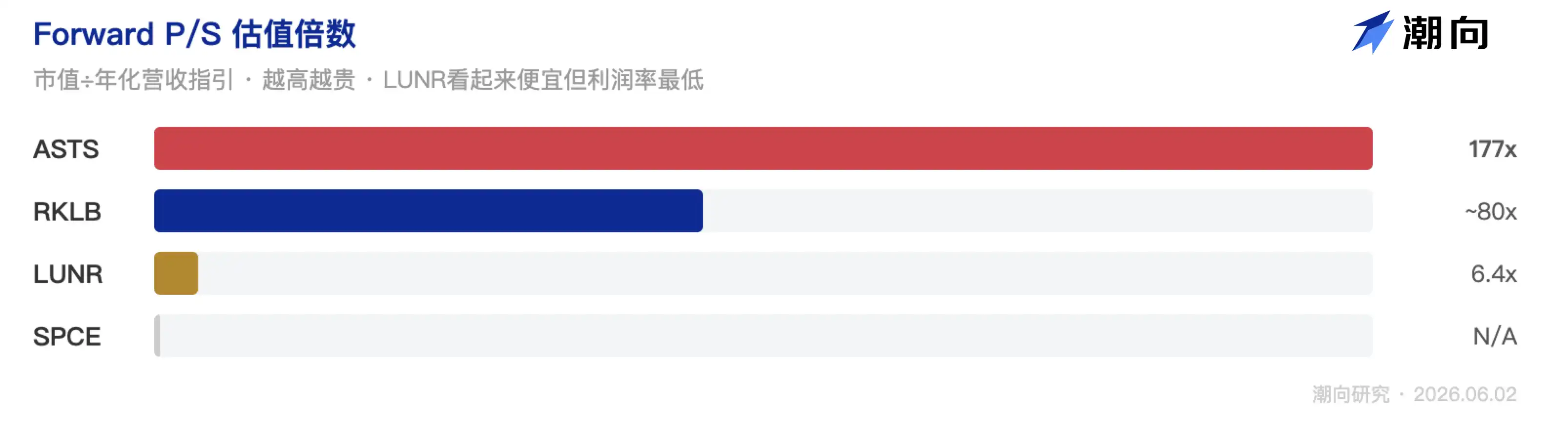
In terms of valuation, the company's Forward P/S is around 80x. This multiple embeds three assumptions: Neutron's success, continued growth in defense contracts, and further gross margin expansion. Any failure to meet these could challenge sustaining this valuation.

Overall, the current price of $122 has already priced in good news relatively fully. A return to the $96~$102 range (near the 50-day moving average) would offer a much better risk-reward ratio.

Tide Direction Judgment: Leaning bullish, but waiting for a better price is advisable. Core catalysts are Q4 Neutron maiden flight progress and the Q2 earnings report on August 6.

The Other Three: Need to Wait for More Catalysts, Beware of Squeeze Rallies

We can pull the core financial metrics of these 4 hot space stocks together for a more intuitive view:
LUNR: $187M Revenue Tripled, But Mainly from Acquisitions

Intuitive Machines delivers NASA equipment to the lunar surface and is a core contractor for NASA's CLPS (Commercial Lunar Payload Services) program. The Q1 revenue tripling looks impressive, but the $800 million acquisition of Lanteris and its consolidation was the primary contributor; organic growth is far from the stated 199%.

On the other hand, revenue missed expectations by 9%, and EPS missed by four times.

The IM-3 lunar landing mission in the second half of the year is the decisive milestone. The previous IM-1 lander tipped over, and IM-2 landed but had limited communication. If IM-3 can achieve a soft landing at the lunar South Pole, follow-on NASA contracts are likely; failure would significantly discount the whole story.

A Forward P/S of 6.4x appears the cheapest, but gross margin is only 19%, so a low P/S doesn't equal undervaluation. The analyst target price is $40.78, and the current $38.21 is already close.

Tide Direction Judgment: Neutral to slightly bearish. Wait for IM-3 results.

ASTS: The Biggest Story, But Blue Origin Grounding Directly Disrupts the Script

AST SpaceMobile is building a space-based cellular network, allowing standard phones to connect directly to satellites for internet without modification. The 4 billion people worldwide without signal are the potential market. AT&T and Verizon have signed cooperation agreements, and the FCC has issued licenses.
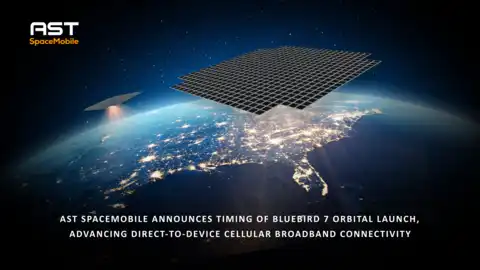
The story framework is not the problem; the issue may lie in the execution timeline. To achieve meaningful coverage, it needs to launch 45-60 BlueBird satellites into orbit before year-end, but Blue Origin's grounding directly eliminated one launch pathway.

Satellite analyst Tim Farrar warned that realistically only 3-5 Falcon 9 launches might be available this year. Deutsche Bank has already downgraded its rating to Hold. The average analyst target price is $82.24, 22% lower than the current price.

The company holds $3.5 billion in cash, so it's not short on funds in the near term. However, a Forward P/S of 177x prices in all satellites launching on time.

Tide Direction Judgment: High risk. Wait for Blue Origin's return-to-flight schedule to become clear before considering.

SPCE: The Most Discussed on Reddit, Beware of Short Squeeze

Virgin Galactic operates suborbital space tourism, with tickets costing $750,000. After pausing commercial flights in 2024 to focus on developing the Delta spacecraft, Q3 plans include glide tests and Q4 power tests. Q1 revenue was $1.5 million (not billion), with a market cap of $760 million.

The driving forces behind this surge are: Blue Origin competitor's incident + short interest of 23.2% triggering a short squeeze + retail FOMO. Trading volume reached 12 times the daily average, triggering a volatility halt intraday.

The RSI has reached 90 (this indicator fluctuates between 0 and 100; exceeding 70 is considered overbought, and 90 is an extreme state...).

Tide Direction Judgment: Avoid. No revenue support, no profitability timeline. Highest Reddit discussion volume does not equal the highest investment value.
Has It Fallen into a Golden Pit? Still Too Early to Say

Answering the article's title question: We believe it's not a golden pit yet, but if the decline continues, RKLB might be approaching a reasonable entry range.

The Blue Origin explosion is a material negative (directly impacting ASTS's launch plans). The SpaceX IPO is a short-term capital flow shock (sector attention might actually rise post-listing). High-level profit-taking itself is healthy.

The long-term logic for the sector isn't broken, but short-term pricing has indeed run ahead of fundamentals.

If we must rank these four. RKLB is the only one worth seriously tracking. With its $2.2 billion backlog, 43% gross margin, and continuous beats, its scarcity as the 'only listed full-stack space company' might actually become more pronounced after SpaceX goes public.

But the current $122 is probably still expensive; $96~$102 looks more like a reasonable range.
-----
This article is based on public information and independent analysis, for reference only, and does not constitute investment advice. Investing involves risks, caution is advised when entering the market.

Data Sources: Yahoo Finance · SEC Filing · TradingView · Reddit/ApeWisdom · Stocktwits · CNBC · TipRanks · Simply Wall St

Tide Research · TideResearch · June 2, 2026

Preguntas relacionadas

QAccording to the article, what were the three main negative events that impacted the space stocks RKLB, LUNR, and ASTS in the same week?

AThe three main negative events were: 1) The explosion and subsequent FAA grounding of Blue Origin's New Glenn rocket, which is a launch supplier for ASTS. 2) The impending SpaceX IPO, which could draw capital away from these 'substitute' space stocks. 3) Insider selling, particularly by RKLB's CEO Peter Beck, which raised concerns among investors.

QHow does the business model and revenue stage of Rocket Lab (RKLB) differ from the other three space companies (SPCE, LUNR, ASTS) discussed in the article?

ARocket Lab (RKLB) is fundamentally different as it is the only one with substantial and accelerating revenue, primarily from launch services and aerospace components for government and commercial clients. The other three are in earlier, more speculative revenue stages: SPCE has negligible revenue from space tourism, LUNR's recent revenue surge is largely from an acquisition, and ASTS is pre-revenue, focused on building a satellite-to-phone network.

QWhat is the single biggest upcoming catalyst and risk factor for Rocket Lab (RKLB), as highlighted in the article?

AThe biggest upcoming catalyst and risk factor for Rocket Lab is the first launch of its medium-lift Neutron rocket, targeted for Q4 2026. Success would elevate RKLB to the only other public company capable of medium payload launches alongside SpaceX, greatly increasing its valuation potential. However, failure or further delays could jeopardize this valuation. Its current high Forward P/S ratio of around 80 heavily depends on this success.

QWhy does the article advise caution regarding Virgin Galactic (SPCE) despite its recent 22% surge in price?

AThe article advises caution regarding Virgin Galactic because its recent surge is primarily driven by a short squeeze (23.2% short interest), spillover from Blue Origin's competitor failure, and retail FOMO, not fundamental business strength. With negligible revenue ($1.5M in Q1), no clear timeline for profitability, and technical indicators like RSI reaching 90 (extreme overbought), the stock lacks a fundamental basis for the rally.

QWhat is the article's overall conclusion about the current investment attractiveness of the space sector, specifically regarding whether a 'golden buying opportunity' has emerged?

AThe article concludes it is not yet a 'golden buying opportunity' for the space sector overall. While the long-term logic remains intact, short-term prices have outpaced fundamentals due to the recent negative events. Among the four stocks, RKLB is considered the most worthy of tracking, but its current price of $122 is seen as expensive. The article suggests a more reasonable entry point for RKLB would be in the $96-$102 range. For the others, it advises waiting for more definitive catalysts.

Lecturas Relacionadas

Farewell to Traditional Bull and Bear Markets, Deciphering the Logic of Today's Bubble Rotation

"Farewell to Traditional Bulls and Bears: Understanding Today's Market Logic of Bubble Rotation" The article draws a parallel between modern financial markets and a meteorological chain of thunderstorms, contrasting it with the past's slower-moving, more predictable 'layered cloud' systems of long bull/bear cycles and gradual sector rotations. The author argues that today's market has undergone a permanent structural shift, creating an environment where discrete, intense thematic bubbles (e.g., AI, GLP-1 drugs, crypto, robotics, quantum tech) sequentially form, swell, and burst. These 'storm cells' are triggered when capital fleeing a dying bubble acts like a meteorological 'cold air wedge,' forcing the warm, moist capital of latent interest in a new sector to rapidly rise and condense into the next speculative frenzy. This new 'convective' market regime is driven by eight fundamental changes: 1. Democratization of speculation via zero-commission trading, gamified apps, and heavy retail participation in instruments like 0DTE options. 2. Permanent, price-insensitive buying pressure from defined-contribution retirement plans (e.g., 401(k)s). 3. Passive investing creating inelastic market participants that amplify momentum, especially into mega-cap stocks. 4. The dominance of multi-strategy funds and high-frequency trading (HFT), weakening price discovery and creating fragile microstructure prone to synchronized sell-offs. 5. Artificially suppressed volatility that eventually erupts in violent spikes. 6. A transformed market index heavily weighted toward long-duration, narrative-driven tech companies instead of stable, cyclical industrials. 7. The total elimination of information delay, accelerating fear-of-missing-out (FOMO) and herd behavior. 8. A persistently loose fiscal and monetary policy environment. These structural shifts are deemed irreversible. The article outlines the common lifecycle of these thematic bubbles: latency, catalyzing event, narrative formation, peak divergence, and rupture—with outflowing capital seeding the next bubble. In this environment, two investor archetypes can thrive: deep domain experts who understand underlying technologies and business models, and disciplined trend-followers. The author concludes that while emotionally challenging, recognizing this new "climate" is crucial. The key is to elevate one's perspective above the immediate storm to see the cyclical chain of bubbles, avoiding being swept away by the emotions of any single thematic frenzy.

Foresight NewsHace 19 min(s)

Farewell to Traditional Bull and Bear Markets, Deciphering the Logic of Today's Bubble Rotation

Foresight NewsHace 19 min(s)

Michael Saylor's Latest Article: Bitcoin Must Find Balance Between Uniqueness and Universal Value

Michael Saylor outlines four key Bitcoin ideologies shaping its future: * **Bitcoin Maximalists** see Bitcoin as the dominant digital monetary network and a breakthrough in economic empowerment, emphasizing its superior property rights and role as a sound money solution. * **Bitcoin Capitalists** focus on integration, believing Bitcoin must embed into the global economy—through institutions, capital markets, and financial products—to reach its full potential as digital capital. * **Bitcoin Technologists** advocate for continuous protocol improvements in scalability, privacy, and security to adapt to evolving needs and threats, while acknowledging the high bar for change. * **Bitcoin Fundamentalists** guard Bitcoin's core principles of self-custody, decentralization, and censorship resistance, warning against dilution from institutions or risky modifications. Saylor argues that a healthy Bitcoin ecosystem requires a balance of these perspectives. Bitcoin's path forward involves disciplined expansion: preserving its immutable core (Fundamentalist insight), recognizing its dominant status (Maximalist view), integrating with the global economy (Capitalist drive), and enabling careful innovation, primarily in higher layers (Technologist role). The challenge is to maintain Bitcoin's unique properties while making it useful for the world, ensuring it remains Bitcoin as it grows.

Foresight NewsHace 51 min(s)

Michael Saylor's Latest Article: Bitcoin Must Find Balance Between Uniqueness and Universal Value

Foresight NewsHace 51 min(s)

Why Does Crypto Always Build 'Casinos', But Rarely Creates 'Indispensable Products'?

The article explores why cryptocurrency has primarily fostered speculation rather than essential, "sticky" consumer products. It introduces the concept of "sofalarity"—the point where a platform's convenience becomes so ingrained that leaving feels unthinkable. While Big Tech creates this lock-in through ecosystem control and data harvesting, crypto lacks equivalent everyday utility. Its appeal hinges on the variable rewards of price volatility, akin to gambling, which drives engagement but not dependency. The author argues crypto's core promise—fixing opaque backend systems like correspondent banking—solves problems most people never see or feel, failing to deliver a tangible "aha moment" of improved daily life. This need for explanation hinders mass adoption. Meanwhile, platforms like Google and Meta monetize vast behavioral data, a treasure trove crypto's transparent ledgers (recording only financial transactions) cannot match for predictive insight. The piece further questions whether crypto's potential lies in consumer super-apps or, more plausibly, in becoming enterprise-grade infrastructure—modern settlement rails. It concludes with a critical look at Real-World Asset (RWA) tokenization, suggesting it may merely digitize and accelerate corporate extraction (e.g., in housing or healthcare) rather than democratize access, as the technology itself is a neutral tool. True disruption, the author implies, requires building sovereign systems outside exploitative platforms.

marsbitHace 1 hora(s)

Why Does Crypto Always Build 'Casinos', But Rarely Creates 'Indispensable Products'?

marsbitHace 1 hora(s)

Trading

Spot
Futuros

Artículos destacados

Qué es $S$

Entendiendo SPERO: Una Visión General Completa Introducción a SPERO A medida que el panorama de la innovación continúa evolucionando, la aparición de tecnologías web3 y proyectos de criptomonedas juega un papel fundamental en la configuración del futuro digital. Un proyecto que ha atraído la atención en este campo dinámico es SPERO, denotado como SPERO,$$s$. Este artículo tiene como objetivo reunir y presentar información detallada sobre SPERO, para ayudar a entusiastas e inversores a comprender sus fundamentos, objetivos e innovaciones dentro de los dominios web3 y cripto. ¿Qué es SPERO,$$s$? SPERO,$$s$ es un proyecto único dentro del espacio cripto que busca aprovechar los principios de descentralización y tecnología blockchain para crear un ecosistema que promueva la participación, la utilidad y la inclusión financiera. El proyecto está diseñado para facilitar interacciones de igual a igual de nuevas maneras, proporcionando a los usuarios soluciones y servicios financieros innovadores. En su esencia, SPERO,$$s$ tiene como objetivo empoderar a los individuos al proporcionar herramientas y plataformas que mejoren la experiencia del usuario en el espacio de las criptomonedas. Esto incluye habilitar métodos de transacción más flexibles, fomentar iniciativas impulsadas por la comunidad y crear caminos para oportunidades financieras a través de aplicaciones descentralizadas (dApps). La visión subyacente de SPERO,$$s$ gira en torno a la inclusividad, buscando cerrar brechas dentro de las finanzas tradicionales mientras aprovecha los beneficios de la tecnología blockchain. ¿Quién es el Creador de SPERO,$$s$? La identidad del creador de SPERO,$$s$ sigue siendo algo oscura, ya que hay recursos públicos limitados que proporcionan información de fondo detallada sobre su(s) fundador(es). Esta falta de transparencia puede derivarse del compromiso del proyecto con la descentralización, una ética que muchos proyectos web3 comparten, priorizando las contribuciones colectivas sobre el reconocimiento individual. Al centrar las discusiones en torno a la comunidad y sus objetivos colectivos, SPERO,$$s$ encarna la esencia del empoderamiento sin señalar a individuos específicos. Como tal, comprender la ética y la misión de SPERO sigue siendo más importante que identificar a un creador singular. ¿Quiénes son los Inversores de SPERO,$$s$? SPERO,$$s$ cuenta con el apoyo de una diversa gama de inversores que van desde capitalistas de riesgo hasta inversores ángeles dedicados a fomentar la innovación en el sector cripto. El enfoque de estos inversores generalmente se alinea con la misión de SPERO, priorizando proyectos que prometen avances tecnológicos sociales, inclusión financiera y gobernanza descentralizada. Estas fundaciones de inversores suelen estar interesadas en proyectos que no solo ofrecen productos innovadores, sino que también contribuyen positivamente a la comunidad blockchain y sus ecosistemas. El respaldo de estos inversores refuerza a SPERO,$$s$ como un contendiente notable en el dominio de proyectos cripto que evoluciona rápidamente. ¿Cómo Funciona SPERO,$$s$? SPERO,$$s$ emplea un marco multifacético que lo distingue de los proyectos de criptomonedas convencionales. Aquí hay algunas de las características clave que subrayan su singularidad e innovación: Gobernanza Descentralizada: SPERO,$$s$ integra modelos de gobernanza descentralizada, empoderando a los usuarios para participar activamente en los procesos de toma de decisiones sobre el futuro del proyecto. Este enfoque fomenta un sentido de propiedad y responsabilidad entre los miembros de la comunidad. Utilidad del Token: SPERO,$$s$ utiliza su propio token de criptomoneda, diseñado para servir diversas funciones dentro del ecosistema. Estos tokens permiten transacciones, recompensas y la facilitación de servicios ofrecidos en la plataforma, mejorando la participación y la utilidad general. Arquitectura en Capas: La arquitectura técnica de SPERO,$$s$ apoya la modularidad y escalabilidad, permitiendo la integración fluida de características y aplicaciones adicionales a medida que el proyecto evoluciona. Esta adaptabilidad es fundamental para mantener la relevancia en el cambiante paisaje cripto. Participación de la Comunidad: El proyecto enfatiza iniciativas impulsadas por la comunidad, empleando mecanismos que incentivan la colaboración y la retroalimentación. Al nutrir una comunidad sólida, SPERO,$$s$ puede abordar mejor las necesidades de los usuarios y adaptarse a las tendencias del mercado. Enfoque en la Inclusión: Al ofrecer tarifas de transacción bajas e interfaces amigables para el usuario, SPERO,$$s$ busca atraer a una base de usuarios diversa, incluyendo a individuos que anteriormente pueden no haber participado en el espacio cripto. Este compromiso con la inclusión se alinea con su misión general de empoderamiento a través de la accesibilidad. Cronología de SPERO,$$s$ Entender la historia de un proyecto proporciona información crucial sobre su trayectoria de desarrollo y hitos. A continuación se presenta una cronología sugerida que mapea eventos significativos en la evolución de SPERO,$$s$: Fase de Conceptualización e Ideación: Las ideas iniciales que forman la base de SPERO,$$s$ fueron concebidas, alineándose estrechamente con los principios de descentralización y enfoque comunitario dentro de la industria blockchain. Lanzamiento del Whitepaper del Proyecto: Tras la fase conceptual, se lanzó un whitepaper completo que detalla la visión, los objetivos y la infraestructura tecnológica de SPERO,$$s$ para generar interés y retroalimentación de la comunidad. Construcción de Comunidad y Primeras Interacciones: Se realizaron esfuerzos de divulgación activa para construir una comunidad de primeros adoptantes y posibles inversores, facilitando discusiones en torno a los objetivos del proyecto y obteniendo apoyo. Evento de Generación de Tokens: SPERO,$$s$ llevó a cabo un evento de generación de tokens (TGE) para distribuir sus tokens nativos a los primeros seguidores y establecer liquidez inicial dentro del ecosistema. Lanzamiento de la dApp Inicial: La primera aplicación descentralizada (dApp) asociada con SPERO,$$s$ se puso en marcha, permitiendo a los usuarios interactuar con las funcionalidades centrales de la plataforma. Desarrollo Continuo y Alianzas: Actualizaciones y mejoras continuas a las ofertas del proyecto, incluyendo alianzas estratégicas con otros actores en el espacio blockchain, han moldeado a SPERO,$$s$ en un jugador competitivo y en evolución en el mercado cripto. Conclusión SPERO,$$s$ se erige como un testimonio del potencial de web3 y las criptomonedas para revolucionar los sistemas financieros y empoderar a los individuos. Con un compromiso con la gobernanza descentralizada, la participación comunitaria y funcionalidades diseñadas de manera innovadora, allana el camino hacia un paisaje financiero más inclusivo. Como con cualquier inversión en el espacio cripto que evoluciona rápidamente, se anima a los posibles inversores y usuarios a investigar a fondo y participar de manera reflexiva con los desarrollos en curso dentro de SPERO,$$s$. El proyecto muestra el espíritu innovador de la industria cripto, invitando a una mayor exploración de sus innumerables posibilidades. Mientras el viaje de SPERO,$$s$ aún se desarrolla, sus principios fundamentales pueden, de hecho, influir en el futuro de cómo interactuamos con la tecnología, las finanzas y entre nosotros en ecosistemas digitales interconectados.

72 Vistas totalesPublicado en 2024.12.17Actualizado en 2024.12.17

Qué es $S$

Qué es AGENT S

Agent S: El Futuro de la Interacción Autónoma en Web3 Introducción En el paisaje en constante evolución de Web3 y las criptomonedas, las innovaciones están redefiniendo constantemente cómo los individuos interactúan con las plataformas digitales. Uno de estos proyectos pioneros, Agent S, promete revolucionar la interacción humano-computadora a través de su marco agente abierto. Al allanar el camino para interacciones autónomas, Agent S busca simplificar tareas complejas, ofreciendo aplicaciones transformadoras en inteligencia artificial (IA). Esta exploración detallada profundizará en las complejidades del proyecto, sus características únicas y las implicaciones para el dominio de las criptomonedas. ¿Qué es Agent S? Agent S se presenta como un marco agente abierto innovador, diseñado específicamente para abordar tres desafíos fundamentales en la automatización de tareas informáticas: Adquisición de Conocimiento Específico del Dominio: El marco aprende inteligentemente de diversas fuentes de conocimiento externas y experiencias internas. Este enfoque dual le permite construir un rico repositorio de conocimiento específico del dominio, mejorando su rendimiento en la ejecución de tareas. Planificación a Largo Plazo de Tareas: Agent S emplea planificación jerárquica aumentada por la experiencia, un enfoque estratégico que facilita la descomposición y ejecución eficiente de tareas complejas. Esta característica mejora significativamente su capacidad para gestionar múltiples subtareas de manera eficiente y efectiva. Manejo de Interfaces Dinámicas y No Uniformes: El proyecto introduce la Interfaz Agente-Computadora (ACI), una solución innovadora que mejora la interacción entre agentes y usuarios. Utilizando Modelos de Lenguaje Multimodal de Gran Escala (MLLMs), Agent S puede navegar y manipular diversas interfaces gráficas de usuario sin problemas. A través de estas características pioneras, Agent S proporciona un marco robusto que aborda las complejidades involucradas en la automatización de la interacción humana con las máquinas, preparando el terreno para una multitud de aplicaciones en IA y más allá. ¿Quién es el Creador de Agent S? Si bien el concepto de Agent S es fundamentalmente innovador, la información específica sobre su creador sigue siendo elusiva. El creador es actualmente desconocido, lo que resalta ya sea la etapa incipiente del proyecto o la elección estratégica de mantener a los miembros fundadores en el anonimato. Independientemente de la anonimidad, el enfoque sigue siendo en las capacidades y el potencial del marco. ¿Quiénes son los Inversores de Agent S? Dado que Agent S es relativamente nuevo en el ecosistema criptográfico, la información detallada sobre sus inversores y patrocinadores financieros no está documentada explícitamente. La falta de información disponible públicamente sobre las bases de inversión u organizaciones que apoyan el proyecto plantea preguntas sobre su estructura de financiamiento y hoja de ruta de desarrollo. Comprender el respaldo es crucial para evaluar la sostenibilidad del proyecto y su posible impacto en el mercado. ¿Cómo Funciona Agent S? En el núcleo de Agent S se encuentra una tecnología de vanguardia que le permite funcionar de manera efectiva en diversos entornos. Su modelo operativo se basa en varias características clave: Interacción Humano-Computadora Similar a la Humana: El marco ofrece planificación avanzada de IA, esforzándose por hacer que las interacciones con las computadoras sean más intuitivas. Al imitar el comportamiento humano en la ejecución de tareas, promete elevar las experiencias de los usuarios. Memoria Narrativa: Empleada para aprovechar experiencias de alto nivel, Agent S utiliza memoria narrativa para hacer un seguimiento de las historias de tareas, mejorando así sus procesos de toma de decisiones. Memoria Episódica: Esta característica proporciona a los usuarios una guía paso a paso, permitiendo que el marco ofrezca apoyo contextual a medida que se desarrollan las tareas. Soporte para OpenACI: Con la capacidad de ejecutarse localmente, Agent S permite a los usuarios mantener el control sobre sus interacciones y flujos de trabajo, alineándose con la ética descentralizada de Web3. Fácil Integración con APIs Externas: Su versatilidad y compatibilidad con varias plataformas de IA aseguran que Agent S pueda encajar sin problemas en ecosistemas tecnológicos existentes, convirtiéndolo en una opción atractiva para desarrolladores y organizaciones. Estas funcionalidades contribuyen colectivamente a la posición única de Agent S dentro del espacio cripto, ya que automatiza tareas complejas y de múltiples pasos con una intervención humana mínima. A medida que el proyecto evoluciona, sus posibles aplicaciones en Web3 podrían redefinir cómo se desarrollan las interacciones digitales. Cronología de Agent S El desarrollo y los hitos de Agent S pueden encapsularse en una cronología que resalta sus eventos significativos: 27 de septiembre de 2024: El concepto de Agent S fue lanzado en un documento de investigación integral titulado “Un Marco Agente Abierto que Usa Computadoras Como un Humano”, mostrando las bases del proyecto. 10 de octubre de 2024: El documento de investigación fue puesto a disposición del público en arXiv, ofreciendo una exploración profunda del marco y su evaluación de rendimiento basada en el benchmark OSWorld. 12 de octubre de 2024: Se lanzó una presentación en video, proporcionando una visión visual de las capacidades y características de Agent S, involucrando aún más a posibles usuarios e inversores. Estos marcadores en la cronología no solo ilustran el progreso de Agent S, sino que también indican su compromiso con la transparencia y la participación comunitaria. Puntos Clave Sobre Agent S A medida que el marco Agent S continúa evolucionando, varios atributos clave destacan, subrayando su naturaleza innovadora y potencial: Marco Innovador: Diseñado para proporcionar un uso intuitivo de las computadoras similar a la interacción humana, Agent S aporta un enfoque novedoso a la automatización de tareas. Interacción Autónoma: La capacidad de interactuar de manera autónoma con las computadoras a través de GUI significa un salto hacia soluciones informáticas más inteligentes y eficientes. Automatización de Tareas Complejas: Con su metodología robusta, puede automatizar tareas complejas y de múltiples pasos, haciendo que los procesos sean más rápidos y menos propensos a errores. Mejora Continua: Los mecanismos de aprendizaje permiten a Agent S mejorar a partir de experiencias pasadas, mejorando continuamente su rendimiento y eficacia. Versatilidad: Su adaptabilidad en diferentes entornos operativos como OSWorld y WindowsAgentArena asegura que pueda servir a una amplia gama de aplicaciones. A medida que Agent S se posiciona en el paisaje de Web3 y criptomonedas, su potencial para mejorar las capacidades de interacción y automatizar procesos significa un avance significativo en las tecnologías de IA. A través de su marco innovador, Agent S ejemplifica el futuro de las interacciones digitales, prometiendo una experiencia más fluida y eficiente para los usuarios en diversas industrias. Conclusión Agent S representa un audaz avance en la unión de la IA y Web3, con la capacidad de redefinir cómo interactuamos con la tecnología. Aunque aún se encuentra en sus primeras etapas, las posibilidades para su aplicación son vastas y atractivas. A través de su marco integral que aborda desafíos críticos, Agent S busca llevar las interacciones autónomas al primer plano de la experiencia digital. A medida que nos adentramos más en los reinos de las criptomonedas y la descentralización, proyectos como Agent S sin duda desempeñarán un papel crucial en la configuración del futuro de la tecnología y la colaboración humano-computadora.

476 Vistas totalesPublicado en 2025.01.14Actualizado en 2025.01.14

Qué es AGENT S

Cómo comprar S

¡Bienvenido a HTX.com! Hemos hecho que comprar Sonic (S) sea simple y conveniente. Sigue nuestra guía paso a paso para iniciar tu viaje de criptos.Paso 1: crea tu cuenta HTXUtiliza tu correo electrónico o número de teléfono para registrarte y obtener una cuenta gratuita en HTX. Experimenta un proceso de registro sin complicaciones y desbloquea todas las funciones.Obtener mi cuentaPaso 2: ve a Comprar cripto y elige tu método de pagoTarjeta de crédito/débito: usa tu Visa o Mastercard para comprar Sonic (S) al instante.Saldo: utiliza fondos del saldo de tu cuenta HTX para tradear sin problemas.Terceros: hemos agregado métodos de pago populares como Google Pay y Apple Pay para mejorar la comodidad.P2P: tradear directamente con otros usuarios en HTX.Over-the-Counter (OTC): ofrecemos servicios personalizados y tipos de cambio competitivos para los traders.Paso 3: guarda tu Sonic (S)Después de comprar tu Sonic (S), guárdalo en tu cuenta HTX. Alternativamente, puedes enviarlo a otro lugar mediante transferencia blockchain o utilizarlo para tradear otras criptomonedas.Paso 4: tradear Sonic (S)Tradear fácilmente con Sonic (S) en HTX's mercado spot. Simplemente accede a tu cuenta, selecciona tu par de trading, ejecuta tus trades y monitorea en tiempo real. Ofrecemos una experiencia fácil de usar tanto para principiantes como para traders experimentados.

968 Vistas totalesPublicado en 2025.01.15Actualizado en 2026.06.02

Cómo comprar S

Discusiones

Bienvenido a la comunidad de HTX. Aquí puedes mantenerte informado sobre los últimos desarrollos de la plataforma y acceder a análisis profesionales del mercado. A continuación se presentan las opiniones de los usuarios sobre el precio de S (S).

活动图片














