May 15th was the statutory deadline for institutional investors to submit Q1 13F forms to the U.S. SEC.,As the documents are publicly released, the crypto holdings of major Wall Street institutions are coming into focus..
Among them,JPMorgan bucked the trend by increasing its Bitcoin ETF holdings by 174%, while Jane Street cut IBIT by 71% and shifted towards Ethereum. Wells Fargo initiated positions in Ethereum ETFs against the downtrend. BlackRock's on-chain portfolio shrank by over $20 billion but still kept buying Bitcoin.
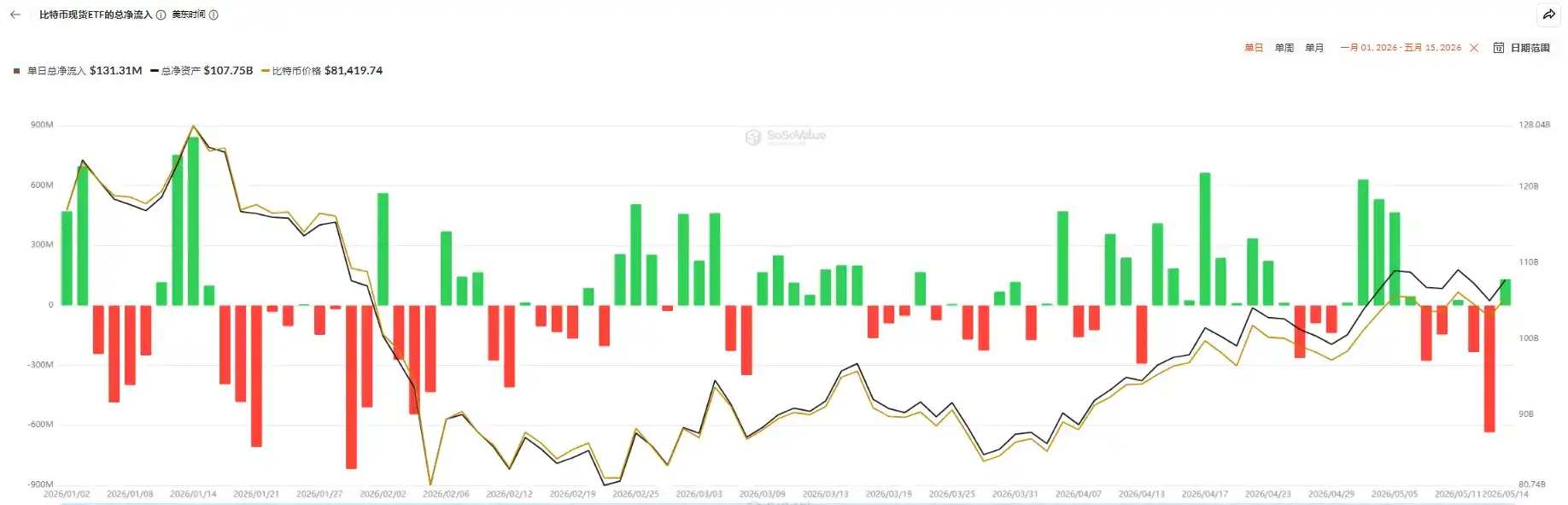
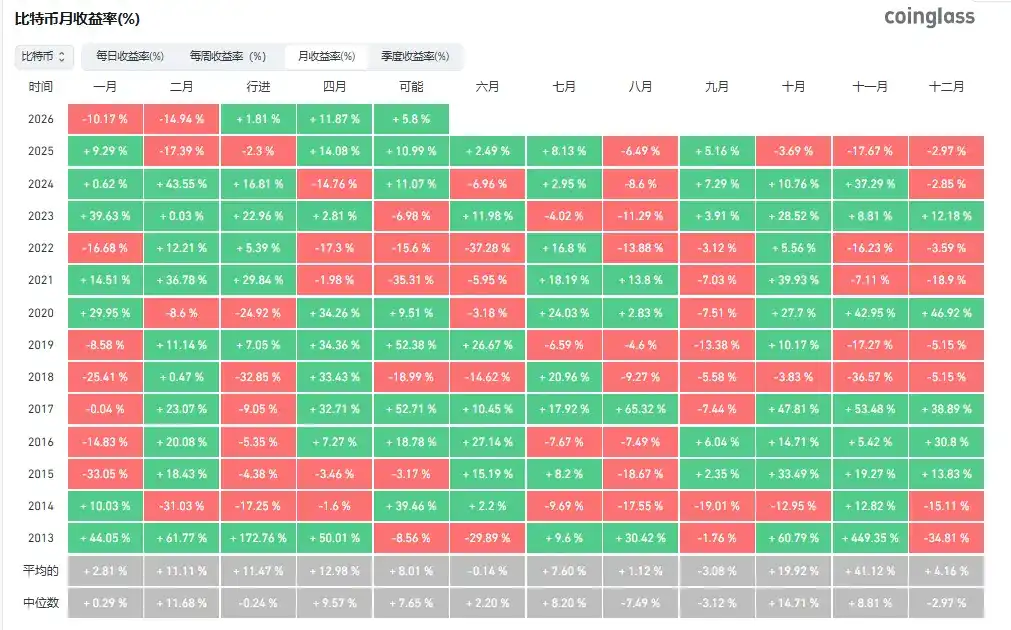
The crypto market experienced a significant correction in Q1. Bitcoin fell approximately 23.8% for the quarter, its worst Q1 performance since 2018. The total crypto market cap declined by 20.4%, down about 45% from its October 2025 peak. Spot Bitcoin ETFs saw net outflows of approximately $497 million for the quarter.,JPMorgan analysis shows that overall digital asset inflows in Q1 were only about $11 billion, roughly one-third of the same period last year.,Market momentum has clearly slowed.
In this market environment, institutional operations showed significant divergence.
Jane Street:IBIT Holdings Down 71%, Increases Galaxy Digital
As one of Wall Street's most active proprietary trading firms, Jane Street's Q1 moves drew the most market attention.
According to its latest 13F filing, Jane Street significantly reduced its Bitcoin ETF holdings.Among them,Its holding in BlackRock's iShares Bitcoin Trust (IBIT) decreased by approximately 71% quarter-over-quarter to about 5.9 million shares, valued at approximately $225 million; its holding in Fidelity Wise Origin Bitcoin Fund (FBTC) was cut by about 60% to about 2 million shares.
On the other hand, Jane Street notably increased its allocation to Ethereum. Its holding in BlackRock's iShares Ethereum Trust (ETHA) nearly doubled, and its holding in Fidelity's Ethereum Fund (FETH) also saw a significant increase. Combined, these two positions added approximately $82 million in exposure.
Regarding crypto-related stocks, Galaxy Digital holdings surged from about 17,000 shares to about 1.5 million shares; Riot Platforms holdings increased from about 5 million shares to about 7.4 million shares; Coinbase was also slightly increased. Its holdings in Strategy decreased from about 968,000 shares to about 210,000 shares, a reduction of about 78%. Holdings in several Bitcoin mining companies also contracted simultaneously, involving IREN, Cipher Mining, TeraWulf, and Core Scientific.
It should be noted that Jane Street recorded a record $16.1 billion in trading revenue in Q1. The 13F only discloses long equity holdings at quarter-end and does not include derivatives or short positions. Bitwise analyst Jeff Park pointed out that Jane Street had previously increased its Strategy holding by over 470% in a prior quarter, so this quarter's reduction is more likely due to the unwinding of basis trades rather than a directional bearish view on Bitcoin.
JPMorgan:Significantly Increases Bitcoin ETF, Exits XRP ETF
In contrast to Jane Street is JPMorgan. The bank continued to accumulate Bitcoin holdings during a period when the price fell below $80,000. Its IBIT holdings increased from about 3 million shares to about 8.3 million shares, a gain of approximately 174%, adding about $162 million in market value.
Furthermore,the bank'sBitwise Bitcoin ETF (BITB)holdingincreased by about 900%, Fidelity's FBTC by about 450%, and the Bitcoin futures-tracking ProShares Bitcoin Strategy ETF (BITO) by over 3000%.
Regarding other crypto assets, JPMorgan initiated a position in Bitwise Solana Staking ETF (BSOL), buying about 47,500 shares, and increased its holding in BlackRock's iShares Ethereum Trust (ETHA) by about 36%. Concurrently, the bank completely exited its position in the Bitwise XRP ETF.
At the stock level,JPMorganchose to increase its holdings in Strategy, MARA Holdings, and Core Scientific, while reducing its holdings in Coinbase, Galaxy Digital, and Robinhood.
Wells Fargo:Buys Ethereum ETF Against the Downtrend, Nearly Exits Galaxy Digital
Wells Fargo's moves also showed pronounced internal differentiation.
Regarding Ethereum, its BlackRock ETHA holding increased from about 673,000 shares to about 1.1 million shares, a gain of about 63.5%; its Bitwise Ethereum ETF (ETHW) holding increased by about 37%. The combined market value of these two positions is approximately $21.5 million. This increase occurred against the backdrop of Ethereum experiencing consecutive quarterly declines—down about 28% in Q4 2025 and about 29% in Q1 2026—while spot Ethereum ETFs saw net outflows of about $769 million for the quarter.
Regarding Bitcoin, Wells Fargo's allocation was more dispersed. IBIT was slightly reduced, but Bitwise Bitcoin ETF increased by about 24%, and Grayscale Bitcoin Mini Trust increased by about 41%. Bitcoin ETFs as a whole still constitute the majority of its crypto exposure, with the IBIT position alone valued at about $250 million.
At the stock level, Wells Fargo increased its Strategy holding from about 323,000 shares to about 726,000 shares, a gain of about 125%, adding about $41.6 million in exposure. Concurrently, its Galaxy Digital holding plummeted from about 2.5 million shares to about 78,600 shares, a decrease of about 97%, reducing exposure by about $54.7 million.
BlackRock: Increases Strategy and Bitmine, Continues Buying Bitcoin On-Chain
As the world's largest asset manager, BlackRock's Q1 13F filing shows it holds a certain scale of crypto-related stocks.
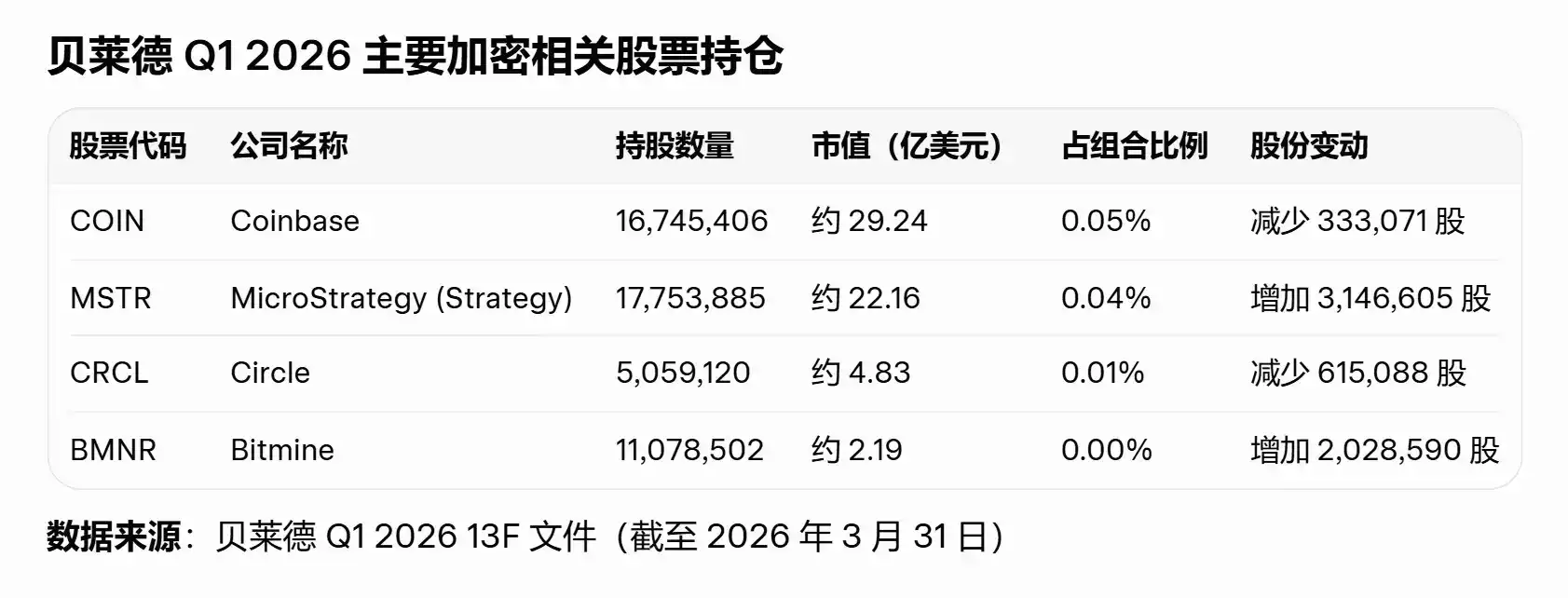
Among them,its Coinbase (COIN) holding was about 16.75 million shares, valued at about $2.92 billion, slightly reduced by about 333,000 shares from the previous quarter; its Circle (CRCL) holding was about 5.06 million shares, valued at about $483 million, reduced by about 615,000 shares.
Its Strategy (MSTR) holding increased to about 17.75 million shares, valued at about $2.22 billion, an increase of about 3.147 million shares; its Ethereum treasury company Bitmine (BMNR) holding increased to about 11.08 million shares, valued at about $219 million, an increase of about 2.029 million shares.
The combined market value of these four positions is about $5.8 billion. While this represents a limited portion of its total holdings of about $5.72 trillion, the simultaneous increase in Strategy and Bitmine shows that BlackRock maintains recognition for both the Bitcoin and Ethereum treasury narratives.
Regarding on-chain data, during Q1, BlackRock's Bitcoin holdings increased from about 770,000 BTC to about 785,000 BTC, a net purchase of about 15,000 BTC. However, due to price decline, the market value dropped from about $68 billion to about $51.8 billion. Its Ethereum holdings decreased from about 3.47 million ETH to about 3.06 million ETH, a net outflow of about 410,000 ETH. Overall, the crypto portfolio's market value shrank by about $20.4 billion, primarily driven by price declines.
Additionally,IBIT's Q1 average daily trading volume exceeded $3.2 billion. Among the 62 trading days in the quarter, 48 days recorded net inflows. On January 27th, single-day inflows reached about $1.3 billion, setting a single-day record. It should be noted that on-chain holding changes essentially reflect client fund flows through the ETF, not BlackRock's own directional bets.
ARK Invest:Heavily Bets on Circle in Stablecoin Sector
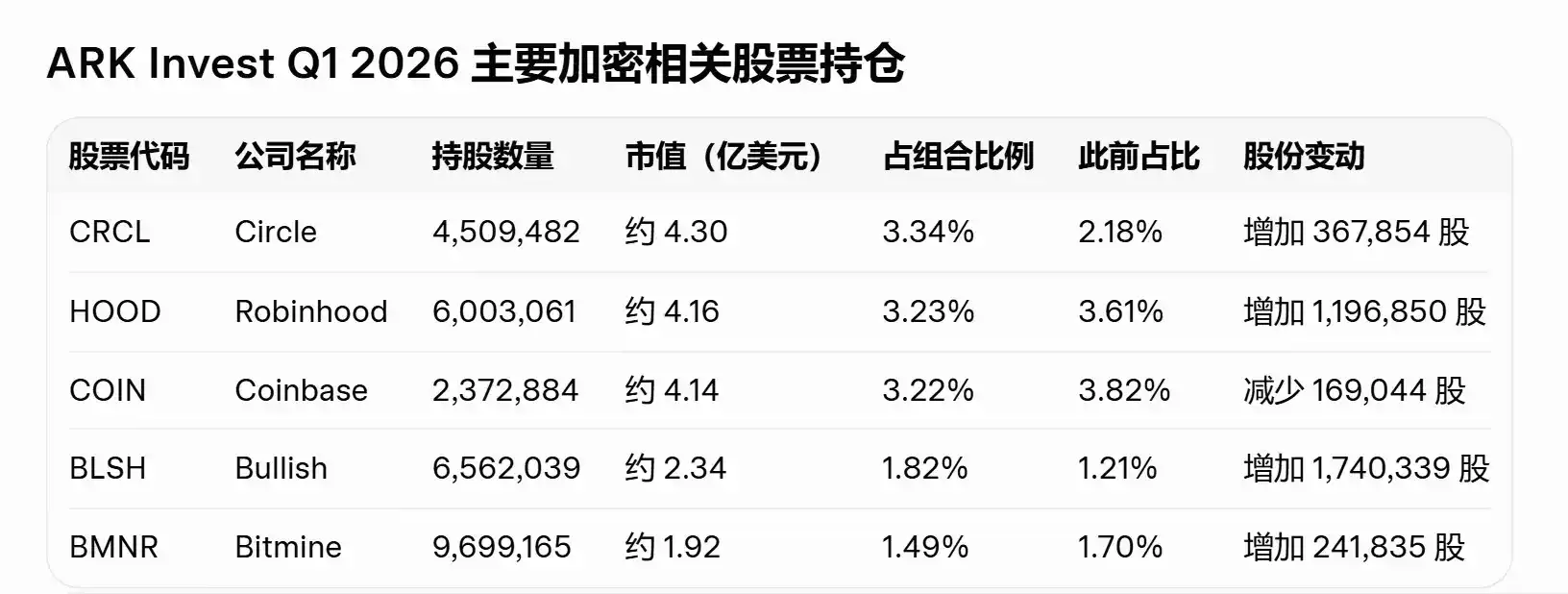
ARK Invest, led by Cathie Wood and the issuer of the ARKB Bitcoin spot ETF, disclosed crypto-related stocks held by its actively managed funds in its 13F.The filing shows ARK increased its holdings in Circle (CRCL), Robinhood (HOOD), Bullish (BLSH), and Bitmine (BMNR) in Q1, while slightly reducing its Coinbase (COIN) holding.
In terms of timing, ARK bought approximately $72 million worth of crypto-related stocks across its ARKF, ARKK, and ARKW funds when Bitcoin fell near $75,000 in February, continuing its consistent strategy of buying on dips.
Among them, ARK's bet on Circle (CRCL)significantlyincreased, with holdings rising to about 4.509 million shares, raising its portfolio weight from 2.18% to 3.34%. In Q2, ARK continued to increase itsCRCL holdings.
Circle's recently released Q1 earnings showed revenue growth of 20% year-over-year, USDC circulation rising to $77 billion, and transaction volume growing 263% year-over-year, further validating ARK's stablecoin sector bet.
Other Institutions' Actions
Other institutions also had notable moves.Asset manager WisdomTree launched a tokenized money market fund this quarter, driving net inflows of $98 million into digital assets in Q1. By the end of March, its digital assets under management reached a record $867 million.
Grayscale completed rebalancing of its funds. Its DeFi Fund introduced the Ethena token (ENA) with a 13.59% weight, while removing Aerodrome Finance. In its Smart Contract Platform Fund, Ethereum's weight increased to 30.14%, once again surpassing Solana's 29.69%.
Dongfang Harbor, managed by Chinese investor Dan Bin, disclosed in its latest 13F an increase of 31,700 shares of CRCL, valued at about $3.02 million.
Although Morgan Stanley's Q1 13F has not yet been disclosed, its Bitcoin ETF (MSBT), launched on April 8th, has recorded cumulative net inflows of $193.6 million to date, with net assets reaching $239.6 million. In its first month, it saw net inflows for 17 trading days, was flat for 5 days, and had no single day of net outflows.
Three Signals from Institutional Crypto Allocation
Reviewing these operations reveals three noteworthy trends.
First, institutional interest in Ethereum allocation is rising.Jane Street, Wells Fargo, and JPMorgan all increased their Ethereum ETF exposure in Q1, precisely during a period of general market outflows. This reflects that some institutions are beginning to view it as infrastructure for long-term allocation.
Second, the divergence regarding Bitcoin stems more from strategic differences than judgment disagreements.JPMorgan's systematic accumulation at lower prices is a typical long-term allocation path; Jane Street's significant reduction, coupled with its record quarterly revenue, is more akin to a trading strategy adjustment.
Third, crypto-related stocks are becoming an unavoidable allocation option for institutions.With companies like Circle, Coinbase, and Strategy going public or continuing to expand, these stocks have evolved from peripheral holdings to core holdings for some institutions. ARK ranks Circle as its sixth-largest holding in ARKK, and Dongfang Harbor also quickly established a position after Circle's IPO. Circle's year-to-date gain exceeds50%, and the stablecoin infrastructure logic behind it is gaining recognition from more and more institutions.
Divergence is also evident in specific stock selection. Galaxy Digital was the stock with the greatest institutional divergence this quarter—Wells Fargo nearly exited, reducing by about 97%; JPMorgan also reduced; but Jane Street increased its holdings from about 17,000 shares to about 1.5 million shares, essentially starting a position from scratch. Meanwhile, multiple institutions jointly chose to increase their holdings in Strategy, using it as a stock proxy for Bitcoin.
Now Q2 is also more than half over.,The institutions that continued to accumulate at lower prices in Q1 are now beginning to be validated.
In April, Bitcoin rose approximately 11.87%, and Ethereum rose about 7.3%. Spot Bitcoin ETFs saw net inflows of about $2.44 billion in April, the highest in nearly six months, with total assets under management exceeding $100 billion for the first time. Among them, BlackRock's IBIT had net inflows of about $2.013 billion in April, and Morgan Stanley's MSBT had net inflows of about $194 million in its first month. Bitcoin has now returned above $80,000, indicating some repair in market risk appetite.
As of publication,13F filings from major institutions and hedge funds such as Goldman Sachs, Morgan Stanley, and Millennium have not yet been released, and they are expected to be disclosed intensively today and tomorrow. Once released, this picture of institutional holding divergence will be more complete.