Pump.fun surges 12% as holder count hits record high – 2 metrics could cap gains

ambcryptoPublicado a 2026-06-29Actualizado a 2026-06-29

Resumen

The token of memecoin launch platform Pump.fun (PUMP) surged 12% as sentiment improved alongside renewed interest in memecoins. On-chain data showed strong investor participation, with the holder count reaching a record high of 122,440. Total Value Locked (TVL) also saw a significant increase of roughly $15.7 million, rising to $217.7 million and indicating fresh capital inflows. However, key protocol performance metrics contrasted with this positive price action and investor growth. Data revealed substantial declines in launchpad volume (down 86.7% to $5.8M), generated fees (down 35.6% to $587,200), and protocol revenue (down 23% to $147.8M). These drops suggest underlying user activity and platform utility remain weak. While the recent surge is supported by growing holder numbers and TVL, the sustainability of the rally is uncertain. For gains to be firmly supported, a recovery in fundamental protocol usage metrics is likely needed.

Sentiment around cryptocurrency memecoin launch platform Pump.fun [PUMP] has turned positive again following renewed interest in memecoins over the past day.

The platform’s native token moved alongside that momentum, with PUMP surging 12% over the past day.

Even so, the rally remained tied to the platform’s underlying health, leaving investors exposed if protocol activity failed to recover.

Why are investors buying PUMP?

PUMP’s recent rally has coincided with growing investor participation. The token’s holder count reached a record 122,440, while retail investors accounted for roughly 38% of holders.

That increase also appeared in on-chain data, suggesting fresh capital supported the recent move.
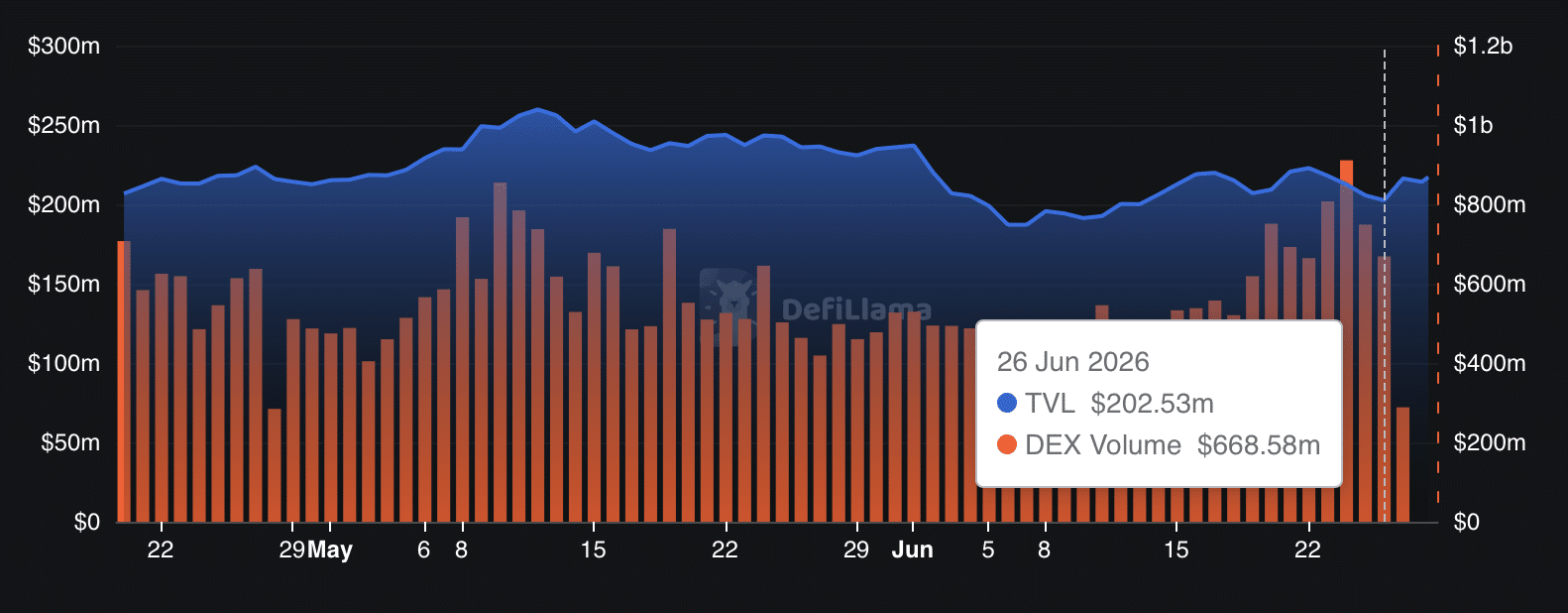
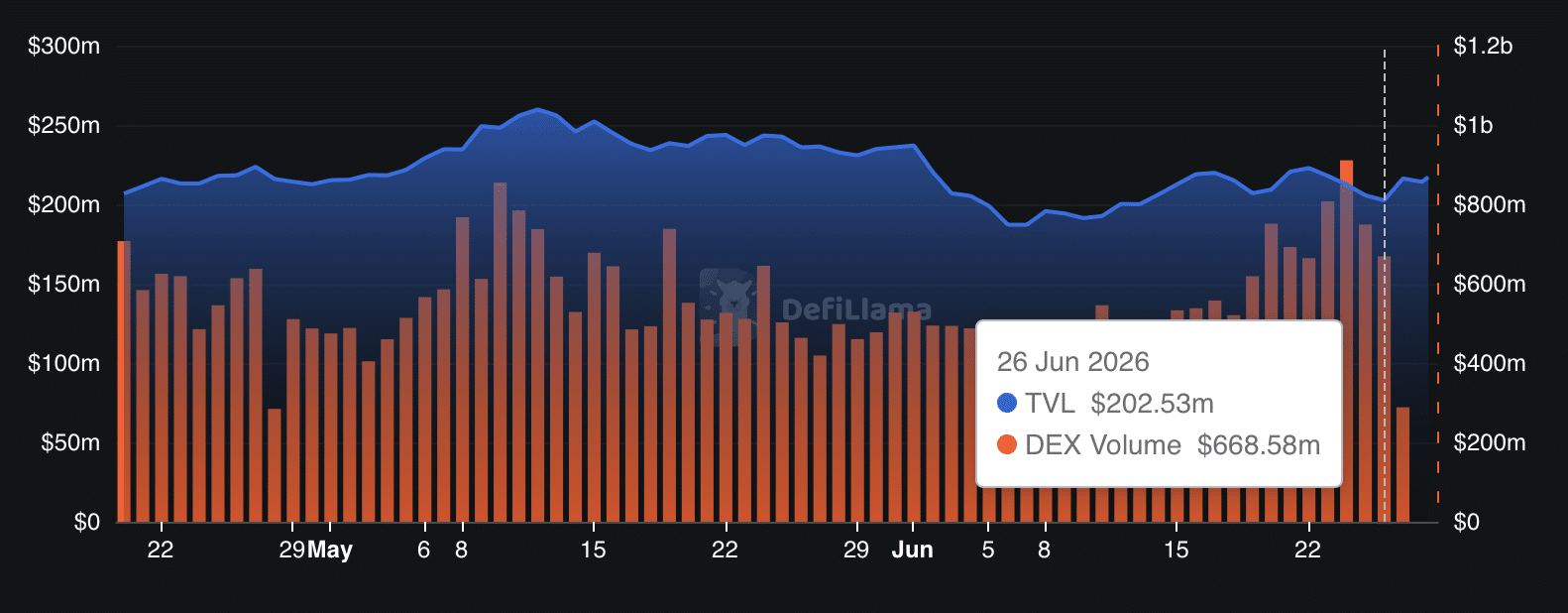
Source: DeFiLlama

Between the 26th of June and now, investors added roughly $15.7 million to Total Value Locked (TVL), lifting it to $217.7 million. Those inflows suggested investors committed more capital despite recent volatility.

Total Value Locked measures assets deposited into DeFi protocols. Rising TVL often reflects stronger long-term conviction while investors earn yield.

Is the protocol keeping up?

However, rising TVL did not match the protocol’s underlying performance.

Pump.fun continued underperforming across key metrics, including revenue, fees, and launchpad volume.

Data from Artemis showed launchpad volume and fees generated by memecoins on the platform fell 86.7% and 35.6% to $5.8 million and $587,200, respectively.
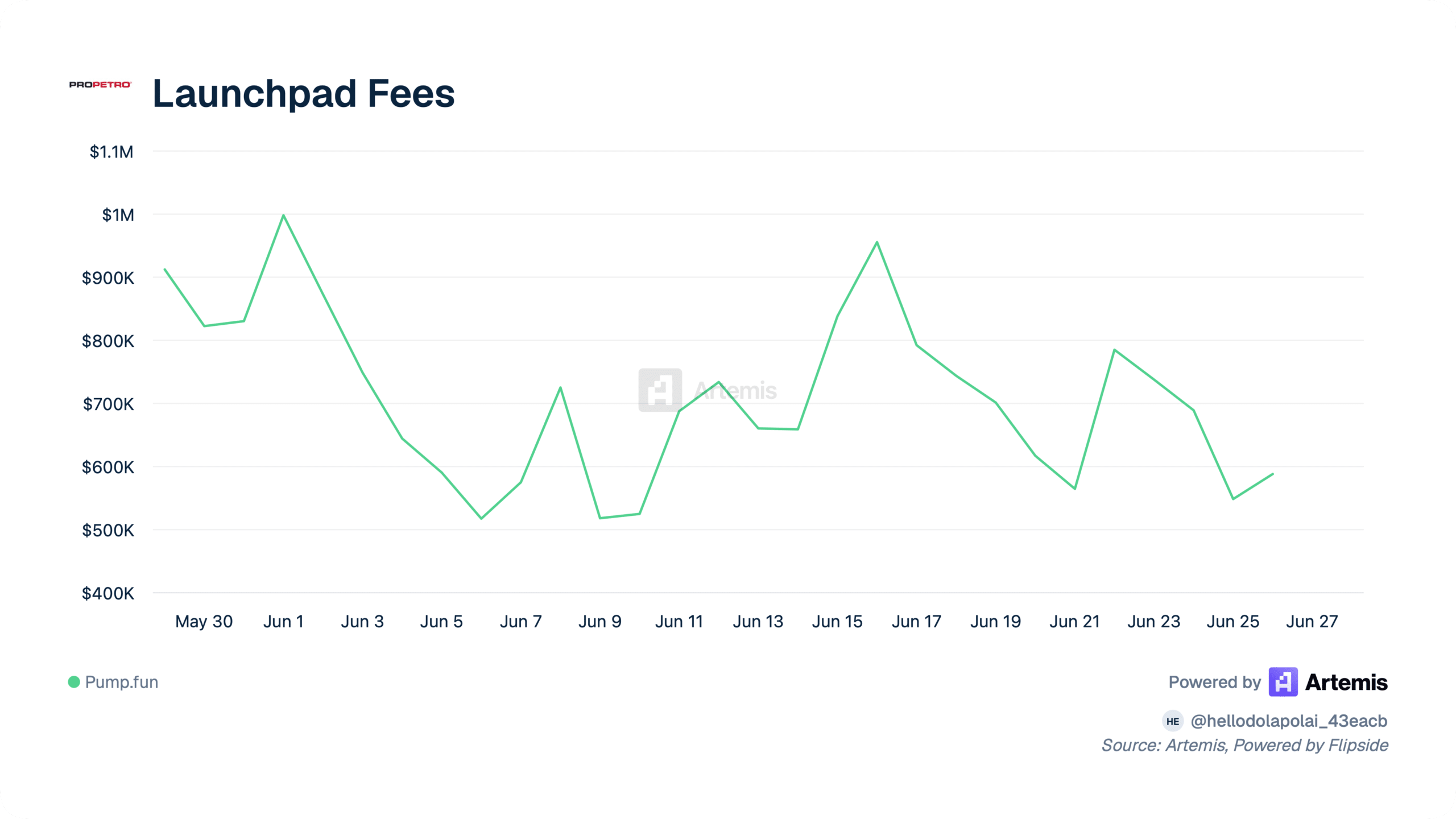
Source: Artemis

Those declines suggested user activity remained weak despite improving investor sentiment.

Lower activity reduced fee generation and limited protocol utility, making it harder for the recent price recovery to gain stronger fundamental support.

Revenue reflected the same trend.

Protocol revenue fell 23% to $147.8 million, reinforcing signs of slowing activity.

Historically, sustained token rallies have been easier to support when protocol usage improves alongside price. Until those metrics recover, PUMP’s recent optimism could remain vulnerable.


Final Summary

  • PUMP gained 12%, holder count hit a record, and TVL increased sharply, signaling renewed market interest.
  • If protocol metrics fail to recover, investor optimism may prove difficult to sustain.

Preguntas relacionadas

QWhat happened to Pump.fun's native token price recently and by how much did it surge?

APump.fun's native token, PUMP, surged 12% over the past day.

QWhat record high was reached by the PUMP token according to the article?

AThe holder count for the PUMP token reached a record high of 122,440.

QWhat metric saw an increase of roughly $15.7 million since June 26th, indicating investor commitment?

AThe Total Value Locked (TVL) increased by roughly $15.7 million, lifting it to $217.7 million.

QAccording to data from Artemis, what was the percentage decline in launchpad volume on the Pump.fun platform?

ALaunchpad volume on the Pump.fun platform fell by 86.7%.

QWhat is the main concern for the sustainability of PUMP's recent price recovery, as highlighted in the article's summary?

AThe main concern is that if protocol metrics (like revenue, fees, and launchpad volume) fail to recover, the recent investor optimism and price gains may be difficult to sustain.

Lecturas Relacionadas

Introduction to the Concept of World Models: A Story from Psychology to the Main Battlefield of AI

**World Models: From Psychology to AI's Core Concept** "World model" is a trending but often confusing term in AI, describing a system that allows machines to internally simulate, predict, and rehearse potential outcomes before taking real-world action—like a mental "sandbox." While definitions vary—Yann LeCun emphasizes physical understanding, OpenAI's Sora is a video-based "world simulator," Google DeepMind's Genie 3 creates interactive 3D environments, and companies like Alibaba and Tesla focus on practical applications—the core goal is consistent: reduce reliance on vast real-world data by creating an internal, predictive model for safer and more efficient AI. The concept has deep roots, tracing back to psychologist Kenneth Craik (1943). In AI, it was revitalized by researchers like David Ha and Jürgen Schmidhuber (2018). Major technical approaches include: 1) generative video models (e.g., Sora) for visual realism; 2) abstract predictive models (e.g., LeCun's JEPA) for efficiency and physical reasoning; and 3) explicit 3D simulators (e.g., NVIDIA Omniverse) for precision. Fei-Fei Li proposes a classification based on the AI action loop: renderers (output observations), simulators (output world states), and planners (output actions). The emerging "World Action Model" (WAM) paradigm aims to unify future prediction and action generation. An industry framework is forming: upstream (data, compute, sensors), midstream (general and vertical platforms), and downstream applications (autonomous driving, robotics, gaming, etc.). Autonomous driving is currently the most mature use case. The current lack of a unified definition reflects the field's early, dynamic stage, similar to past tech revolutions. Different approaches—focusing on pixels, physics, or behavior—represent parallel explorations of how best to compress and understand the world. This diversity, while seemingly chaotic, signals that world models have moved from an academic idea to a critical industrial battleground, ultimately aiming to give machines the ability to understand, imagine, and reason about the world.

marsbitHace 3 min(s)

Introduction to the Concept of World Models: A Story from Psychology to the Main Battlefield of AI

marsbitHace 3 min(s)

Building the Bright Path While Secretly Crossing Chencang: Is Walsh Paving the Way for a September "Rate Cut"?

The title "Building the Plank Road Openly While Secretly Crossing at Chencang: Is Walsh Paving the Way for a September 'Rate Cut'?" suggests Federal Reserve Chair Kevin Walsh's hawkish stance may be a deliberate smokescreen. Academy Securities analyst Peter Tchir argues in a report that markets, currently pricing a 75% chance of a September hike, are missing a potential path to a September rate cut that Walsh himself might be quietly preparing. Tchir posits that Walsh's hawkish rhetoric aims to suppress long-term yield risks (with the 10-year Treasury yield falling recently) while creating room for a narrative shift based on upcoming data. The potential political endgame, according to this view, could be rate cuts in September and October, ahead of the midterm elections. This hinges on a political logic where the Trump administration's preference for lower rates remains unchanged. A core part of Tchir's argument involves redefining inflation metrics. He contends the Fed under Walsh may deprioritize the PCE index, criticizing its lagging components like Owners' Equivalent Rent (OER). Instead, he points to alternative, more real-time indicators like the New Tenant Repeat Rent Index (NTRR) and the Truflation daily index, which shows core inflation around 1.45%. He suggests the Fed could shift its data narrative to justify policy easing. Furthermore, Tchir downplays AI-driven inflation fears. He argues that consumer price sensitivity, evidenced by negative market reactions to price hikes (e.g., Apple), contradicts persistent inflation narratives. He also separates AI/data center spending—which he sees as relatively rate-insensitive—from broader consumer affordability issues, implying rate hikes are misdirected. Based on this analysis, Tchir sees a re-pricing of rate cut expectations as likely, creating opportunities in short-duration Treasuries. He maintains a neutral-to-slightly-bullish view on the long end of the yield curve. For equities, he recommends a significant overweight in energy (especially global nuclear assets) and, within defense/security themes, an overweight in biotech/pharma versus an underweight in semiconductors, expressing caution on AI/data center valuations.

marsbitHace 29 min(s)

Building the Bright Path While Secretly Crossing Chencang: Is Walsh Paving the Way for a September "Rate Cut"?

marsbitHace 29 min(s)

"King of Shilling" Hayes Strikes Again, This Time Setting His Sights on Deribit

On June 29, BitMEX co-founder Arthur Hayes acquired approximately 6.16 million SYN tokens via OTC platform Flowdesk, valued at around $2.2 million. Subsequently, Hayes publicly endorsed SYN on X, calling it one of the most asymmetric investments he's seen since HYPE and declaring it time for an on-chain options DEX to challenge industry leader Deribit, naming Hypercall as that challenger. The article details the evolution of the Synapse Protocol, originally launched in 2021 as a cross-chain messaging and liquidity network. While its TVL peaked above $1 billion during the last bull market, it has since declined. The protocol's team has since built Hypercall, an on-chain options trading platform on Hyperliquid's HyperEVM, which supports trading options on "any asset" with features like 24/7 trading and defined risk limited to the premium paid. Deribit, founded in 2016, is highlighted as the dominant centralized crypto options exchange, commanding roughly 85% market share in BTC and ETH options. Its strengths include deep liquidity and professional tools, though it faces critiques over custody risk, KYC requirements, and regulatory uncertainty. The analysis suggests Hypercall's potential lies in decentralization, permissionless access, and transparency, potentially carving a niche in DeFi-native and emerging asset options. However, it faces significant challenges competing with Deribit's established network effect and liquidity depth. The piece concludes by noting Hayes's recent and mixed "call" history, referencing his previous promotion and subsequent sale of HYPE, as well as a controversial price target report for CARDS from his family office, Maelstrom, which was followed by a significant price drop for the asset. This activity has drawn criticism, with some accusing Hayes of creating exit liquidity for his followers.

Foresight NewsHace 1 hora(s)

"King of Shilling" Hayes Strikes Again, This Time Setting His Sights on Deribit

Foresight NewsHace 1 hora(s)

One Year After the Crash of Crypto Treasury Companies, Copycats Are Already Making a Comeback

One year after the collapse of digital asset treasury (DAT) companies, which wiped out up to 99% for early investors, the scheme has returned in a new guise. Recently, Triller Group announced it would become a "SpaceX treasury company," causing its market cap to surge. This follows the rebranding of another firm, LGHL, now targeting a token called HYPE. The original model, popularized by MicroStrategy (MSTR) and its "Bitcoin yield" narrative, saw companies trading at massive premiums to their underlying crypto holdings. However, most followers like TwentyOne, Metaplanet, and Nakamoto have crashed 80-95%+ from their peaks, erasing nearly all value for late investors. The author argues these structures have no fundamental reason to trade at premiums when low-fee Bitcoin ETFs or direct ownership exist. The cycle persists due to speculative demand driven by FOMO, gamification, and a belief the system is rigged, met by insiders and promoters who profit from the pump-and-dump dynamics. Drawing a parallel to the 1637 Tulip Mania, the piece concludes that such frenzies are not a bug but a recurring product of markets, where greater fools provide demand and insiders supply the schemes. Despite holding Bitcoin personally, the author condemns this specific packaging of assets into leveraged corporate vehicles marketed as innovation, a cycle seemingly unstoppable until a major crash.

marsbitHace 1 hora(s)

One Year After the Crash of Crypto Treasury Companies, Copycats Are Already Making a Comeback

marsbitHace 1 hora(s)

Trading

Spot
活动图片