Number of Active XRP Addresses Reaches Two-Month High Amid Worsening Market Sentiment

cryptonews.ruPublicado a 2026-08-16Actualizado a 2026-08-16

Resumen

On August 14th, activity on the XRP Ledger surged to a two-month high, with 49,929 active addresses recorded in a 24-hour period. This spike occurred despite market sentiment towards XRP hitting a three-month low, as the token traded below $1, highlighting a sharp divergence between on-chain activity and retail investor mood. The data from Santiment shows that average daily active addresses had already risen to around 35,700 by August 12th, up from approximately 26,400 in July—a nearly 35% increase. However, the number of new addresses remained flat, suggesting the surge was driven by existing addresses becoming more active rather than an influx of new users. Analysts caution that while high address activity indicates increased network participation, it doesn't specify whether the activity stems from new investors, institutional moves, exchange transactions, or existing holders. Concurrently, the bearish sentiment, tracked from social platforms like X and Reddit, reflects crowd psychology rather than fundamental network health. The report notes that the XRP Ledger's validator-based consensus allows for such on-chain activity to grow independently of short-term price pessimism. Furthermore, broader ecosystem development, including Ripple's reported $550 million in investments since 2017 into grants and institutional infrastructure for tokenized assets, provides a long-term context separate from current price trends. The key question is whether the elevated address activity...

On August 14th, activity on the $XRP Ledger surged to a two-month high: analytics firm Santiment recorded 49,929 active addresses in 24 hours, despite sentiment towards $XRP reaching a three-month low. This increase occurred as $XRP traded below the $1 mark, leading to a sharp divergence between on-chain activity and retail investor sentiment.

Santiment stated:

"Throughout this week, negative sentiment towards $XRP has intensified sharply as prices (so far) have failed to rise. User sentiment is now at a three-month low on X, Reddit, Telegram, and other crypto channels."

The latest spike continued an upward trend observed earlier in August, when the average number of daily active addresses was around 35,700 as of August 12th, compared to roughly 26,400 in July. The number of active $XRP addresses increased by nearly 35%, while new addresses averaged about 2,260 per day, virtually unchanged from July's figure of 2,270, indicating more active use of existing addresses rather than clear evidence of rapid user growth.

Santiment reported:

"The $XRP Ledger, on the other hand, is not so inactive. $XRP just recorded 49,929 active addresses in a single 24-hour period – the highest level of activity in over 2 months, after activity fell to near 2026 lows earlier in July."
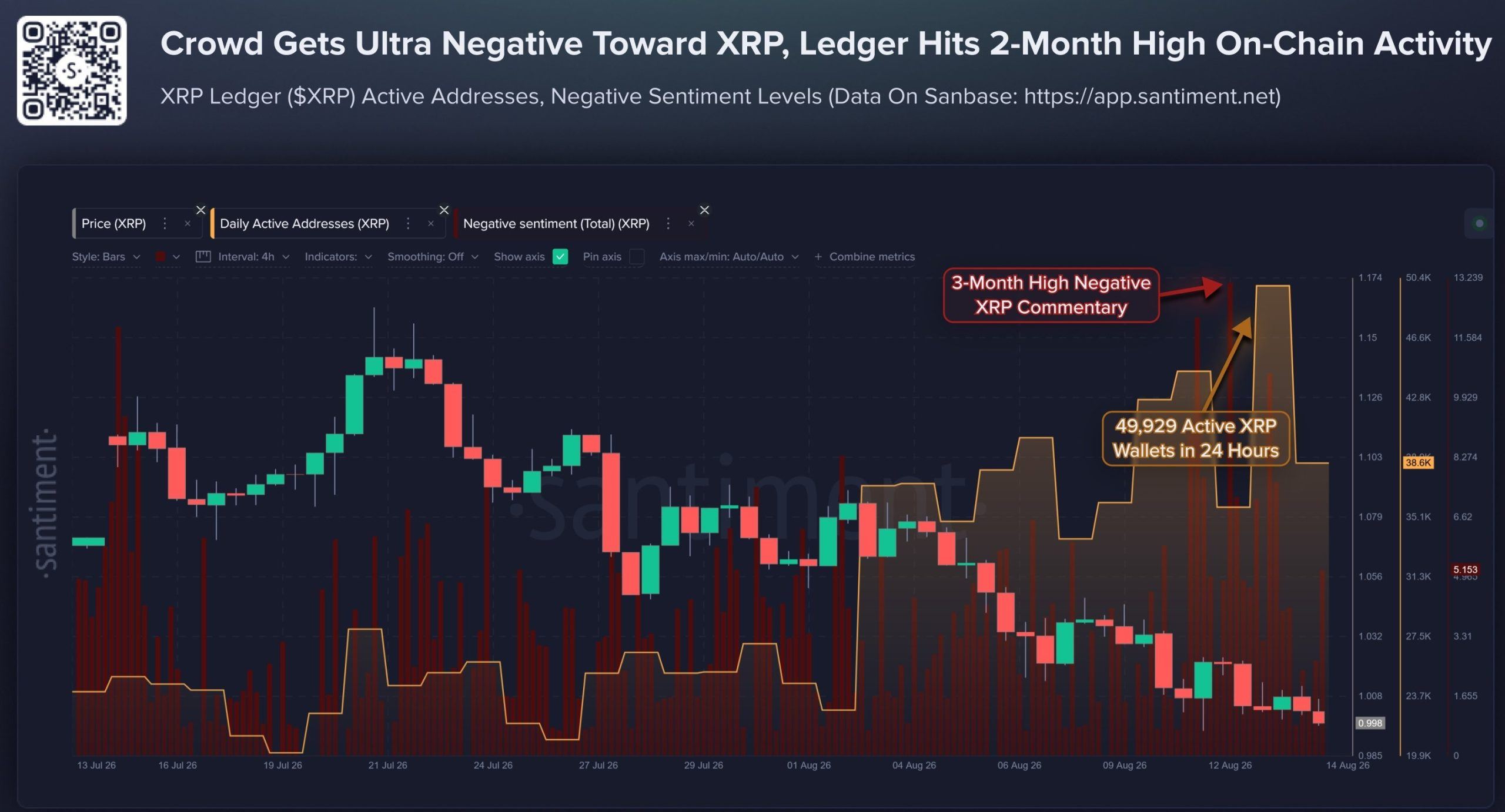
Santiment data shows activity on the $XRP Ledger increased to 49,929 active addresses in a 24-hour period, while sentiment for $XRP reached a three-month low.

This distinction is important to consider when interpreting on-chain activity. A blockchain address does not necessarily correspond to a single individual user, as wallets can generate and manage multiple addresses. Therefore, a higher number of active addresses indicates increased network participation but does not clarify whether this activity was related to new investors, institutional transfers, exchange movements, or repeated transactions by existing participants.

Bearish Comments Contrast with On-Chain Activity

The sentiment metric from Santiment tracks discussions on X, Reddit, Telegram, and other crypto channels, so the three-month sentiment low is more an indicator of crowd psychology than network fundamentals. Sentiment analysis can factor in social media, news, and other signals to assess trader attitudes, which can differ significantly from blockchain activity or long-term adoption trends.

Bearish sentiment also does not mean $XRP has entered or will remain in a definitive market phase. Bear markets are typically characterized by falling prices and weakening confidence, while individual sentiment indicators can change faster than overall price trends. Thus, the current signal for $XRP reflects unusually negative commentary, not a prediction of a reversal or a confirmation of future price direction.

The $XRP Ledger itself operates independently of these social signals. The $XRP Ledger uses a validator-based consensus process instead of proof-of-work mining, where validators agree on the order and validity of transactions before finalizing new ledger versions. This architecture allows activity to increase even when market participants maintain pessimistic outlooks on $XRP's short-term price dynamics.

XRPL Development Provides Broader Network Context

Network development represents another metric to consider separately from short-term price and market sentiment data. Ripple has reported investing over $550 million into $XRP Ledger ecosystem initiatives since 2017, including grants, incentives, partnership programs, and development programs aimed at supporting payments, tokenization, decentralized finance, and other applications.

Ripple has also expanded its institutional strategy for tokenized assets, stablecoins, custody, trading, and credit infrastructure. Its expanded institutional XRPL stack connects tokenized assets with settlement, liquidity, and collateral systems, although available data does not point to these initiatives as the cause of the August 14th activity spike.

Strategic investments have extended these efforts into regulated fund management and tokenized capital market infrastructure. Ripple's investments in Zilo and Licuido target issuance, trading, settlement, and collateral functions, serving as further evidence of XRPL's development, though not establishing a direct link to the recent rise in active addresses.

Santiment noted:

"If $XRP holds its structure and demand recovers, today's negativity could be tomorrow's story of a favorable market entry."

This statement reflects a conditional market interpretation, not proof of a price recovery beginning. The next test will be whether active address levels remain elevated following the one-day spike amidst ongoing bearish sentiment, showing whether this divergence extends beyond a short-term network activity surge.

end-content

Criptos en tendencia

Preguntas relacionadas

QAccording to the article, what is the key contradiction reported regarding XRP on August 14th?

AOn August 14th, the number of active addresses on the XRP Ledger surged to a two-month high of 49,929, while market sentiment towards XRP hit a three-month low. This created a sharp divergence between on-chain activity and investor mood.

QWhat does the article suggest is the likely reason for the increase in active XRP addresses, based on the data about new addresses?

AThe increase in active addresses is likely due to more intensive use of existing addresses rather than an influx of new users. Data shows the number of new addresses created daily remained virtually unchanged from July to August, while active addresses rose significantly.

QHow does the XRP Ledger's consensus mechanism differ from Bitcoin's, and why is this relevant to the reported activity?

AThe XRP Ledger uses a validator-based consensus mechanism, not Bitcoin's proof-of-work mining. This architecture allows network activity to grow independently of short-term market sentiment and price predictions, which explains why activity can increase even when traders are pessimistic.

QWhat broader ecosystem development efforts by Ripple are mentioned in the article, and how are they characterized in relation to the recent activity spike?

AThe article mentions Ripple has invested over $550 million since 2017 into the XRPL ecosystem, including grants and development programs for payments, tokenization, and DeFi. It also details Ripple's expanded strategy in tokenized assets and institutional infrastructure. However, the article states these initiatives are not directly linked as the cause of the August 14th activity spike.

QWhat does the Santiment statement quoted at the end of the article imply about the current market situation for XRP?

ASantiment's statement implies that the current negative sentiment could represent a potential buying opportunity if XRP's underlying structure holds and demand recovers. However, the article clarifies this is a conditional market interpretation, not proof of an imminent price recovery. The key test will be whether the high activity levels persist.

Lecturas Relacionadas

Media: Anthropic Aims for Revenue Up to $200 Billion by 2028 Ahead of IPO

Anthropic, the AI company behind Claude, is reportedly projecting its revenue could reach between $190 billion and $200 billion by 2028, according to sources cited by Reuters. This forecast, significantly higher than its reported $47 billion annual run-rate in May 2026, is being used by investors and bankers to value the company ahead of a potential IPO. Anthropic has confidentially filed with the SEC, with listing details dependent on market conditions and regulatory approval. The valuation reportedly applies a revenue multiple (EV/Revenue) to these future 2028 figures, an approach common for high-growth tech firms but unusual for a forecast two years ahead of an IPO. This reflects confidence in Anthropic's rapid scaling; its annual run-rate grew tenfold yearly for three years leading into 2026, jumping from ~$9B in late 2025 to over $47B by May 2026. Investors are betting the company's massive spending on GPUs, model training, and infrastructure will eventually outpace costs, leading to expanding margins. Public companies like Palantir, Cloudflare, and SpaceX, valued at high multiples of their forward revenue, serve as benchmarks. While this forward-looking method has precedents, some analysts question the sustainability of such valuations and the actual productivity gains from AI. Despite these concerns, earlier reports suggested Anthropic could be valued at over $1 trillion for its IPO.

cryptonews.ruHace 19 min(s)

Media: Anthropic Aims for Revenue Up to $200 Billion by 2028 Ahead of IPO

cryptonews.ruHace 19 min(s)

Open Blockchain Business: Who Gets the Fees and Why a Foundation is Needed

Business of Open Blockchain: Who Gets the Fees and Why a Foundation is Needed In public blockchains, user transaction fees do not simply become "revenue" for a single entity. The flow of money is complex and protocol-dependent. In Ethereum, fees consist of a base fee (burned, permanently removing ETH from circulation) and a priority tip (paid to the validator). In Solana, half the base fee is burned and half goes to the validator, while priority fees go entirely to validators. Thus, "fees" are not synonymous with "project revenue"; they may go to network operators or be destroyed. Foundations like the Ethereum Foundation do not take a cut of user fees. They are funded by their own treasuries, which can generate income (e.g., from staking rewards) and finance ecosystem development, research, and security. Their role is to fund public goods that are hard to monetize directly. Developers of open-source blockchain code can monetize through services, not the code itself. For example, Optimism provides its technology freely but sells enterprise support and managed services (OP Enterprise). Additionally, networks built on Optimism's tech, like Coinbase's Base, share a portion of their revenue with the Optimism ecosystem via agreements, creating an economic link. Token holders do not automatically receive fees as dividends. In Optimism, a portion of protocol revenue is now used to buy back and treasury-lock OP tokens, creating an indirect link between network usage and token economics. In Ethereum, fee burning reduces ETH supply but doesn't distribute funds to all holders; stakers and validators receive direct rewards. For evaluation, analysts should look beyond total fee figures. Key questions are: Who paid and for what? Where did the money go (to validators, operators, treasury, or burning)? What were the recipient's costs? Is there a mechanism linking this income to the token? The same fee amount impacts different blockchain economies in vastly different ways depending on these factors.

cryptonews.ruHace 20 min(s)

Open Blockchain Business: Who Gets the Fees and Why a Foundation is Needed

cryptonews.ruHace 20 min(s)

Trading

Spot

Artículos destacados

Qué es XRP 2.0

XRP 2.0: Una Nueva Frontera en el Panorama de las Criptomonedas Introducción a XRP 2.0 En el siempre cambiante ámbito de las criptomonedas, nuevos proyectos surgen continuamente, compitiendo por atención y adopción. Una de estas iniciativas prometedoras es XRP 2.0, un nuevo proyecto de criptomoneda diseñado para aprovechar la tecnología blockchain avanzada y metodologías de encriptación robustas. Aunque el nombre establece paralelismos con el XRP de Ripple, es crucial señalar que XRP 2.0 opera de manera independiente, enfocándose en mejorar la seguridad de las transacciones, la privacidad y la escalabilidad. A medida que el panorama financiero digital abraza cada vez más soluciones descentralizadas, XRP 2.0 busca contribuir de manera significativa a web3 y a la expansión general de los proyectos de criptomonedas. ¿Qué es XRP 2.0? En esencia, XRP 2.0 es un proyecto de criptomoneda que busca crear un ecosistema de moneda digital seguro y descentralizado. Su tecnología fundamental integra principios avanzados de blockchain con técnicas de encriptación de vanguardia. El objetivo principal de XRP 2.0 es establecerse como una plataforma confiable y eficiente que permita la ejecución rápida de transacciones mientras prioriza la protección de la privacidad de sus usuarios. El proyecto se promociona como una solución a muchas limitaciones enfrentadas por las criptomonedas existentes, proponiendo un sistema que puede manejar un mayor volumen de transacciones con mejor velocidad y privacidad. Esta versatilidad posiciona a XRP 2.0 como un competidor significativo en un mercado plagado de diversas monedas digitales. ¿Quién es el Creador de XRP 2.0? La identidad del creador detrás de XRP 2.0 ha sido señalada como 'Wilbur.' Sin embargo, los detalles completos sobre Wilbur o su entidad asociada siguen siendo elusivos. La anonimidad de muchos creadores de criptomonedas no es un fenómeno poco común en la industria, a menudo diseñado para mantener un grado de privacidad y seguridad. ¿Quiénes son los Inversores de XRP 2.0? Hasta ahora, la información específica relacionada con las fundaciones o organizaciones de inversión que apoyan a XRP 2.0 no está disponible públicamente. En el sector de las criptomonedas, el respaldo de inversores respetables puede influir significativamente en la credibilidad y el éxito de un proyecto, sin embargo, la transparencia sobre los patrocinadores financieros de XRP 2.0 no se ha establecido. ¿Cómo Funciona XRP 2.0? XRP 2.0 se destaca al emplear una combinación de tecnología blockchain y algoritmos de encriptación avanzados que aseguran transacciones seguras y descentralizadas. Su estructura innovadora incluye características únicas diseñadas para fomentar el compromiso del usuario y ampliar las funcionalidades más allá de las transacciones convencionales de criptomonedas. Entre estas características, XRP 2.0 incorpora capacidades impulsadas por IA, como funcionalidades de texto a imagen y de texto a voz. Estas adiciones están diseñadas para mejorar la experiencia interactiva de los usuarios, promoviendo una mayor aplicabilidad en diversos sectores. Al unir avances tecnológicos con un diseño centrado en el usuario, XRP 2.0 busca captar la atención de una amplia gama de individuos y empresas que buscan integrar soluciones de criptomonedas en sus marcos operativos. Cronología de XRP 2.0 Entender XRP 2.0 requiere examinar los hitos que han definido su viaje hasta ahora: 23 de julio de 2023: Se presenta XRP 2.0 como un nuevo proyecto de criptomonedas, con el objetivo de revolucionar las capacidades de transacciones seguras y descentralizadas en el ámbito de blockchain. 8 de septiembre de 2023: Se lanza otro proyecto, XRP20, marcando la aparición de un token ERC-20 en la blockchain de Ethereum que no guarda relación con XRP 2.0. 13 de noviembre de 2023: El Libro Mayor de XRP experimenta una actualización significativa con el lanzamiento de la versión 2.0.0 del software del servidor rippled. Es esencial señalar que este desarrollo está desconectado del proyecto de criptomonedas XRP 2.0. Puntos Clave sobre XRP 2.0 Para destilar la esencia de XRP 2.0, surgen varios factores críticos: Características Únicas: La inclusión de características como texto a imagen y texto a voz impulsadas por IA diversifica aún más las aplicaciones potenciales de XRP 2.0. Tecnología Blockchain: El marco utiliza mecanismos avanzados de blockchain y protocolos de encriptación, asegurando un entorno seguro y descentralizado para las transacciones. Escalabilidad y Privacidad: XRP 2.0 prioriza la protección mejorada de la privacidad en los procesos de transacción y la escalabilidad necesaria para acomodar una base de usuarios creciente. No Afiliación con Ripple: Es importante destacar que, a pesar de su nombre, XRP 2.0 no tiene ninguna lealtad ni colaboración con el XRP de Ripple, diferenciando su marco operativo y objetivos dentro del ecosistema de criptomonedas. Conclusión XRP 2.0 representa una ambiciosa aventura en la esfera de las criptomonedas, buscando ofrecer una combinación de seguridad, privacidad y eficiencia en las transacciones digitales. Al integrar tecnologías sofisticadas y características amigables para el usuario, el proyecto se propone ampliar los horizontes de lo que la criptomoneda puede lograr en la economía digital de hoy. Si bien la anonimidad de su creador y la falta de inversores revelados pueden generar cuestionamientos para algunos, el enfoque de XRP 2.0 en funcionalidades avanzadas y descentralización realza su atractivo en un mercado de criptomonedas cada vez más abarrotado. A medida que el paisaje de las criptomonedas sigue evolucionando, XRP 2.0 podría emerger como un jugador crucial en la expansión de soluciones blockchain seguras y escalables.

313 Vistas totalesPublicado en 2024.04.05Actualizado en 2024.12.03

Qué es XRP 2.0

Cómo comprar XRP

¡Bienvenido a HTX.com! Hemos hecho que comprar XRP (XRP) sea simple y conveniente. Sigue nuestra guía paso a paso para iniciar tu viaje de criptos.Paso 1: crea tu cuenta HTXUtiliza tu correo electrónico o número de teléfono para registrarte y obtener una cuenta gratuita en HTX. Experimenta un proceso de registro sin complicaciones y desbloquea todas las funciones.Obtener mi cuentaPaso 2: ve a Comprar cripto y elige tu método de pagoTarjeta de crédito/débito: usa tu Visa o Mastercard para comprar XRP (XRP) al instante.Saldo: utiliza fondos del saldo de tu cuenta HTX para tradear sin problemas.Terceros: hemos agregado métodos de pago populares como Google Pay y Apple Pay para mejorar la comodidad.P2P: tradear directamente con otros usuarios en HTX.Over-the-Counter (OTC): ofrecemos servicios personalizados y tipos de cambio competitivos para los traders.Paso 3: guarda tu XRP (XRP)Después de comprar tu XRP (XRP), guárdalo en tu cuenta HTX. Alternativamente, puedes enviarlo a otro lugar mediante transferencia blockchain o utilizarlo para tradear otras criptomonedas.Paso 4: tradear XRP (XRP)Tradear fácilmente con XRP (XRP) en HTX's mercado spot. Simplemente accede a tu cuenta, selecciona tu par de trading, ejecuta tus trades y monitorea en tiempo real. Ofrecemos una experiencia fácil de usar tanto para principiantes como para traders experimentados.

1.6k Vistas totalesPublicado en 2024.12.10Actualizado en 2026.06.02

Cómo comprar XRP

Discusiones

Bienvenido a la comunidad de HTX. Aquí puedes mantenerte informado sobre los últimos desarrollos de la plataforma y acceder a análisis profesionales del mercado. A continuación se presentan las opiniones de los usuarios sobre el precio de XRP (XRP).

活动图片