Publicly Pumping Ethereum, Internally Bearish in Reports: Is Tom Lee's Team Still Trustworthy?

marsbitPublicado a 2025-12-23Actualizado a 2025-12-23

Resumen

Tom Lee, co-founder of Fundstrat and a prominent public Ethereum bull, faces credibility questions after an internal Fundstrat report presented a bearish short-term outlook, contrasting his highly optimistic public statements. Publicly, Lee repeatedly called Ethereum to reach $12,000-$15,000 by end-2025 and declared it "severely undervalued" at $3,000. He has been a vocal "perma-bull" in media appearances. However, Fundstrat's internal 2026 Crypto Outlook report, led by Digital Asset Strategist Sean Farrell, advised paying subscribers to expect a significant market correction in early 2026. Its base case predicted ETH could fall to $1,800-$2,000 and BTC to $60,000-$65,000, citing macroeconomic risks like a potential U.S. government shutdown and Federal Reserve leadership change. The report recommended clients increase cash/stablecoin holdings and wait for better entry points, while maintaining a long-term bullish year-end 2026 target of $4,500 for ETH. Fundstrat responded that the discrepancy stems from different analysts serving different client types: Lee's long-term, structural views are for traditional investors with low (1%-5%) crypto allocations, while Farrell's tactical, short-term risk management is for crypto-heavy portfolios. Critics argue this distinction was never clearly disclosed in Lee's public media appearances, which serve as marketing for Fundstrat's subscription service. Further complicating matters, Lee is also Chairman of BitMine, a company adopting a...

Author| Aki WuShuo Blockchain

If one were to choose the most representative figure for the Ethereum bull narrative in 2025, Tom Lee, Chairman of Ethereum treasury company BitMine and Co-founder & Chief Investment Officer of Fundstrat, would often be placed in the most prominent position. He has repeatedly emphasized in public statements that ETH is undervalued, stating at the Binance Blockchain Week on December 4th that Ethereum at $3,000 was "severely undervalued," and has previously given a high target price judgment of "$15,000 for ETH by the end of 2025." As a Wall Street veteran known as the "Wall Street Soothsayer" and a strategist long active in media and institutional roadshows, Tom Lee's views are often seen as a sentiment barometer by the market.

However, when the market shifts its gaze from the camera to internal institutional documents, the tone reverses: in the latest 2026 outlook strategy advice from Fundstrat, founded by Tom Lee, for its internal subscription clients, a contrary view is presented. Its baseline forecast suggests that crypto assets may experience a significant pullback in the first half of 2026, with an ETH target range of $1800–$2000. This discrepancy between "publicly calling for gains" and "internal bearishness" has also pushed Tom Lee himself and his associated institutions into the spotlight of public opinion.

Core Predictions and Views of Fundstrat's "2026 Crypto Outlook"

The report was issued by Sean Farrell, an analyst at Fundstrat responsible for crypto asset research, currently serving as Head of Digital Asset Strategy, primarily covering strategy research and view output related to the crypto market and blockchain. The report is mainly aimed at its internal subscription-based clients, with a monthly subscription fee of $249.

The report paints a starkly different short-term market expectation for internal clients than the public sentiment, anticipating a significant market correction in the first half of 2026: Bitcoin could fall to $60,000–$65,000, Ethereum to $1,800–$2,000, and Solana to $50–$75, stating that these correction zones would be good opportunities to build long positions. If the market does not experience a deep correction as expected, the team also tends to maintain a defensive strategy, waiting for clear trend strengthening signals before entering the market.
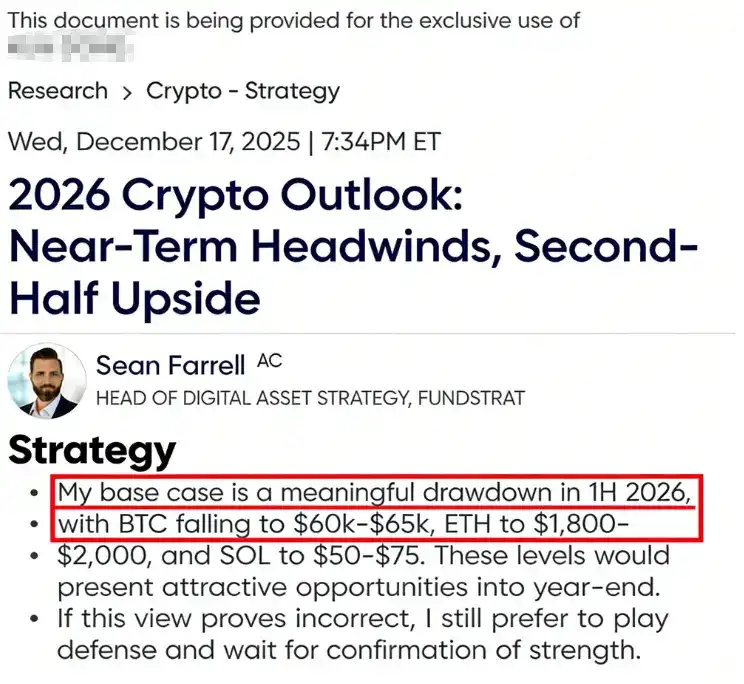
The report explains that the above pessimistic scenario is not a turn towards a long-term bear market but a "strategic reset" risk management measure. Fundstrat points out several short-term headwinds that could suppress the crypto market in early 2026: including a potential US government shutdown, uncertainty in international trade policy, fading confidence in AI investment returns, and policy suspense brought by the Federal Reserve Chair succession, among others.

These macro factors combined with high volatility could trigger a valuation pullback for crypto assets in a tight liquidity environment. Fundstrat emphasizes that this adjustment is a "correction, not a crash," believing that sharp declines are often the prelude to a new round of gains. After digesting risks in the first half of the year, the market is expected to strengthen again in the second half.

The report even gives optimistic targets for the end of 2026: Bitcoin $115,000, Ethereum $4,500, and特别提到以太坊可能在本轮调整中表现出相对强势, the report points out that Ethereum has some structural advantages: after switching to PoS consensus, there is no selling pressure from miners, unlike Bitcoin which has持续抛售的压力 from miners; it also lacks potential selling pressure factors from large holders like MicroStrategy. Furthermore, compared to Bitcoin, Ethereum faces lower concerns about quantum computing threats.

These factors mean that Ethereum may better resist selling pressure in the medium term. It can be seen that the tone of Fundstrat's internal research report is偏向谨慎, although long-term仍然看涨, but short-term it advises internal clients to increase holdings of cash and stablecoins and patiently wait for better entry points.

Tom Lee's Publicly Optimistic Predictions for Ethereum in 2025

In stark contrast to Fundstrat's internal report, its co-founder Tom Lee has played the role of a "super bull" in public场合 throughout 2025,多次发布远超市场实际的 Bitcoin and Ethereum price expectations:

Bullish on Bitcoin early in the year, according to CoinDesk, Tom Lee raised his Bitcoin year-end 2025 target to a high of approximately $250,000 at the beginning of the year. In July-August 2025, as Ethereum prices surged strongly接近历史高位, Tom Lee publicly stated that Ethereum could reach $12,000–$15,000 by the end of 2025, calling it one of the biggest macro investment opportunities for the next 10–15 years.

In August, he further raised the target price on CNBC, stating that Ethereum was entering a key inflection point similar to Bitcoin's in 2017. In 2017, Bitcoin started from less than $1,000 and rose to $12,000 (Note:原文为12万美元,但历史高点是约2万,此处按原文12万翻译,但加注说明历史事实是约2万) driven by the "digital gold" narrative, achieving 120-fold growth. Since the "Genius Act" gave the green light to stablecoins, ushering in a "ChatGPT moment" for the crypto industry, and the core advantage of smart contracts does not apply to Bitcoin, he predicted this is Ethereum's "2017 moment," and a price increase from $3,700 to $30,000 or even higher is not impossible.

Super cycle rhetoric: Entering the autumn行情, Tom Lee依然维持极端乐观立场. In November 2025, he stated in an interview, "We believe ETH is开启类似 2017–2021 年 Bitcoin那样的超级周期",暗示 Ethereum has the potential to replicate Bitcoin's hundred-fold increase trajectory in the coming years.

Dubai Summit speech: At the Binance Blockchain Week in early December 2025, Tom Lee again shocked with bullish shouts, predicting that Bitcoin could soar to $250,000 "within months," and直言当时约 $3,000 的 Ethereum price was "severely undervalued".

He pointed out through historical data comparison that if the ETH/BTC ratio returns to its eight-year average (approx. 0.07), the ETH price could reach $12,000; if it returns to the 2021 relative high (approx. 0.16), then ETH could rise to $22,000; and in an extreme scenario where the ETH/BTC ratio rises to 0.25, theoretically Ethereum's valuation could exceed $60,000.

Short-term new high expectations: Even facing market volatility at the end of the year, Tom Lee did not收敛 his bullish言论. In mid-December 2025, he stated in a CNBC interview that "I don't think this rally is over yet," and bet that Bitcoin and Ethereum will hit new all-time highs before the end of January next year. At that time, Bitcoin had already risen above the 2021 high, while Ethereum was around $3,000, still about 40% away from its historical high of $4,954.

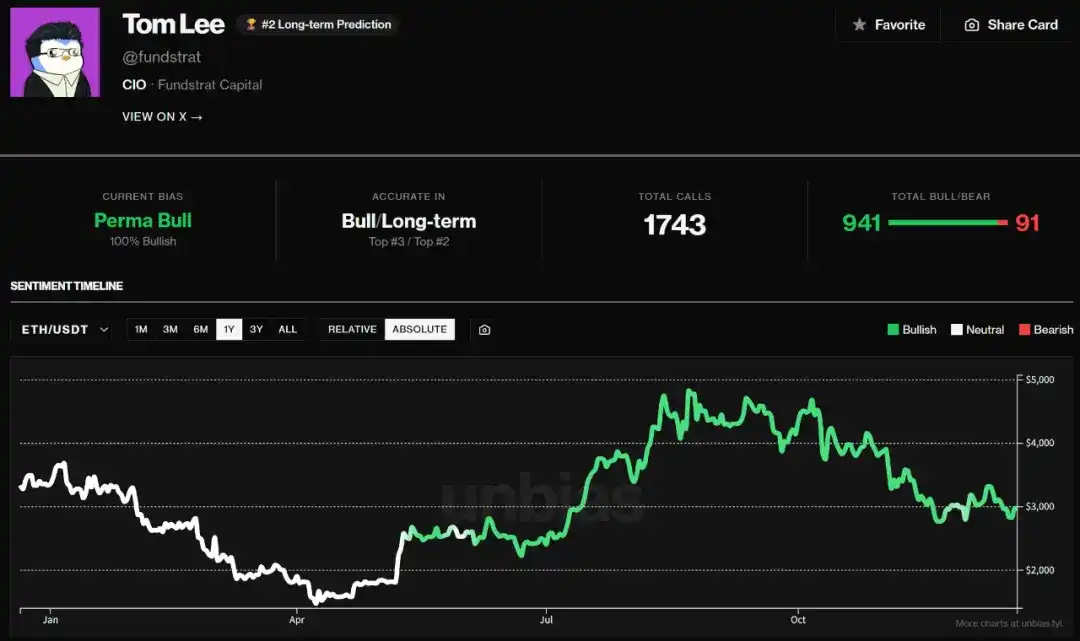
The above list of predictions covers almost most of the time nodes in 2025. On the unbias fyi Fundstrat analysis page, Tom Lee is labeled as a "Perma Bull (长期多头)". Every time he speaks, he gives the market higher target prices and more optimistic time horizons. However, these激进预测 are far from the actual price movements. This series of facts has led the market to question the credibility of the "Wall Street Soothsayer" Tom Lee.
Who is Tom Lee

Thomas Jong Lee, often referred to as Tom Lee, is a well-known US stock market strategist, research director, and financial commentator. He started on Wall Street in the 1990s, working at Kidder Peabody and Salomon Smith Barney, joined J.P. Morgan in 1999 and served as Chief Equity Strategist from 2007.

In 2014, he co-founded the independent research institution Fundstrat Global Advisors and served as Head of Research, transitioning from an investment bank strategist to the head of an independent research institution. He is regarded as one of the较早将 Bitcoin纳入主流估值讨论的 Wall Street strategists. In 2017, he published a report titled "A framework for valuing bitcoin as a substitute for gold,"首次提出 Bitcoin has the potential to partially replace gold as a store of value.

Due to his highly media-oriented research and views, Tom Lee often appears on mainstream financial programs and events as the "Head of Research at Fundstrat" (including CNBC related program/event pages and video content referencing his title). Since 2025, his influence has further extended to the "Ethereum Treasury" narrative: According to Reuters, BitMine, after advancing financing related to Ethereum treasury strategy, added Fundstrat's Thomas Lee to its board of directors to support its Ethereum-oriented treasury strategy. Meanwhile, Fundstrat also continues to release market outlooks and view snippets featuring Tom Lee as the core through its own YouTube channel.

Contradiction: The Contrast Between Public High-Profile Pumping and Internal Caution

The contradictory statements made by Tom Lee and his team on different occasions have sparked heated discussions within the circle about their motives and integrity. In response to the recent controversy, Sean Farrell, Head of Digital Asset Strategy at Fundstrat, posted a response stating that there is a misunderstanding of Fundstrat's research process externally.

He stated that Fundstrat has multiple analysts internally, each using independent research frameworks and time scales to serve the goals of different types of clients; among them, Tom Lee's research is more oriented towards traditional asset management institutions and "low allocation" investors (typically allocating only 1%–5% of assets to BTC/ETH), emphasizing long-term discipline and structural trends, while he himself mainly serves portfolios with a higher proportion of crypto assets (approx. 20%+). However, Tom Lee himself did not declare that he was targeting the group that "allocates 1%–5% of assets to BTC/ETH" when publicly pumping ETH.
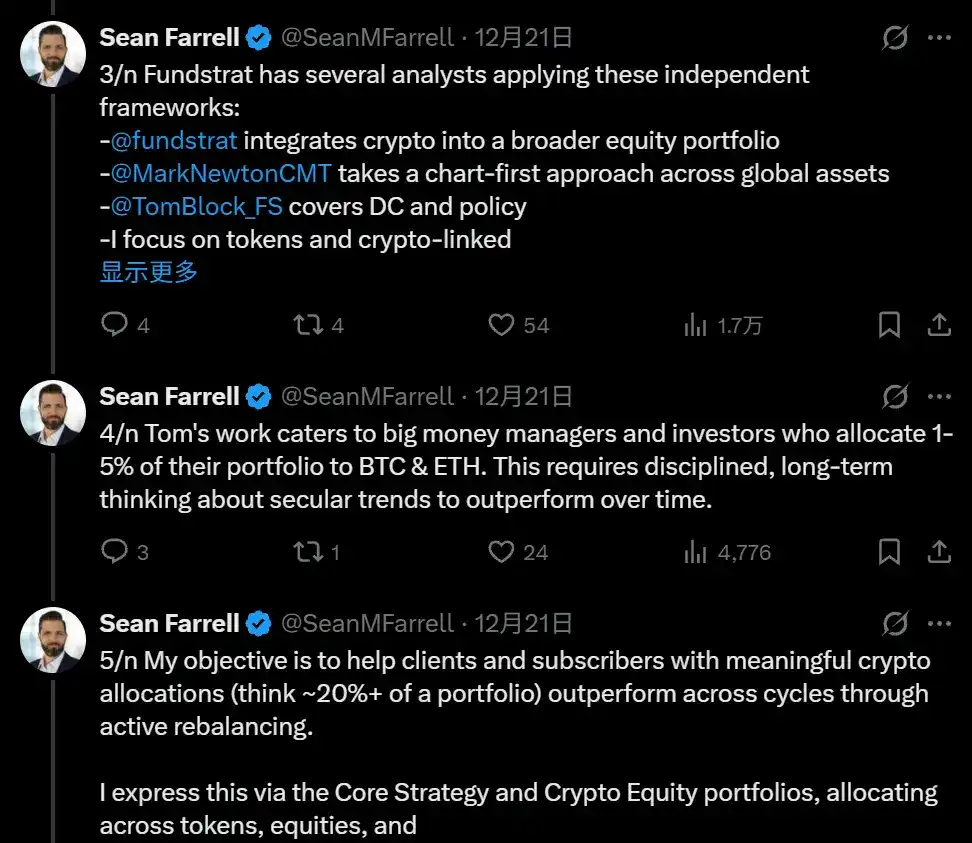
Farrell further stated that his cautious baseline scenario for the first half of 2026 is about risk management, not a turn towards bearishness on the long-term prospects of crypto. He believes that current market pricing is偏向"近乎完美", but risks such as government shutdowns, trade volatility, uncertainty in AI capital expenditure, and the Federal Reserve Chair succession remain. He also listed his historical performance, stating that his token portfolio has grown approximately 3 times since mid-January 2023, and his crypto stock portfolio has risen about 230% since its inception, with an excess of about 40% relative to BTC. During their respective existence, both have likely outperformed most liquid funds. But this wording seems more like a weak justification for Bitmine's $3 billion paper loss and the founder's contradictory statements.

Conclusion: The Contrast Isn't the Problem Itself; the Problem Lies in Disclosure and Boundaries

What真正引起争议 about this matter is not that Fundstrat has different frameworks, but that the co-founder lacks sufficiently clear scope of application and interest disclosure between the public communication end and the service end.

Sean Farrell's explanation of the contradictory statements using service to different types of clients is logically viable, but at the communication level, it still cannot avoid three problems:

1. When Tom Lee frequently expresses strong optimism about ETH in public videos and media interviews, the audience does not默认 this is "only applicable to long-term allocation discussions for low allocation positions," let alone automatically understand the implied risk premises, time scales, and probability weights. He himself has not publicly made clear clarifications and scope of application regarding this.

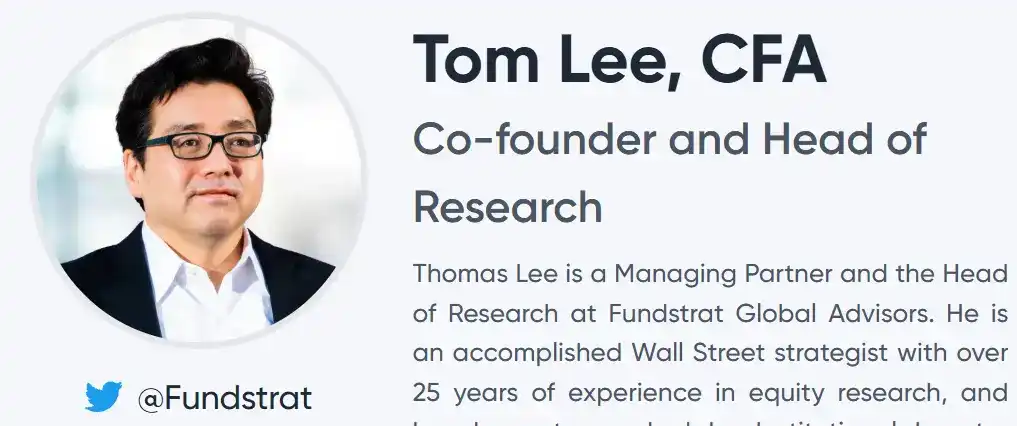
2. The subscription model of FS Insight /Fundstrat is essentially "research monetization". The official website page directly displays subscription guides like "Start Free Trial" and features Tom Lee for promotion. Tom Lee is the core招牌人物 at Fundstrat. The FS Insight page directly labels him as "Tom Lee, CFA / Head of Research". When traffic and subscription growth come more from Tom Lee's public interviews in various media, how does the company convince the public that "this is just expressing personal views".
3. Public information shows that Tom Lee concurrently serves as Chairman of the Board of Ethereum treasury strategy company BitMine Immersion Technologies (BMNR), and the company regards ETH as one of its core treasury directions. Under this identity structure, his continuous "bullish on ETH" communication externally will naturally be interpreted by the market as highly consistent with the interests of the associated entity. For CFA charterholders, professional ethics also emphasize making "full and clear disclosure" of matters that may affect independence and objectivity.

Such controversies usually involve compliance issues: anti-fraud and conflict of interest disclosure. In the context of US securities law, Rule 10b-5 is a typical anti-fraud clause, the core of which is to prohibit material false or misleading statements related to securities transactions.

Furthermore, Fundstrat's entity structure makes the controversy more complex: Fundstrat Global Advisors emphasizes in its terms and disclosure documents that it is a research company, "not a registered investment adviser, nor a broker-dealer," and subscription research is "for client use only." But at the same time, Fundstrat Capital LLC clearly provides advisory services as an "SEC-registered investment adviser (RIA)".

Considering that public interviews and the operation of the Fundstrat Youtube channel事实上承担了"customer acquisition/marketing" functions, another question arises: which content belongs to personal research dissemination, and which content belongs to company marketing. If an institution's public video channels continuously publish "pumping snippets," while the subscription service端 publishes "bearish for the first half of the year" predictions, and does not simultaneously present key limiting conditions and risk frameworks on the public communication end, then it will at least constitute a selective presentation under information asymmetry.
This may not violate the law, but it will continuously erode public trust in the independence and credibility of research, and will also blur the boundaries between "research — marketing — narrative mobilization." For research institutions whose reputation is one of their core businesses, this kind of trust cost will eventually backlash against the brand itself.


Preguntas relacionadas

QWhat is the main contradiction highlighted in the article regarding Tom Lee and his team at Fundstrat?

AThe article highlights a contradiction between Tom Lee's public optimism about Ethereum, where he repeatedly called it 'severely undervalued' and predicted high price targets like $15,000 by end of 2025, and Fundstrat's internal research report for subscribers, which projected a significant market correction in early 2026 with Ethereum potentially falling to $1,800–$2,000.

QWhat reasons does Fundstrat's internal report give for expecting a crypto market correction in early 2026?

AFundstrat's internal report cites several short-term headwinds that could pressure the crypto market in early 2026, including a potential U.S. government shutdown, uncertainty around international trade policies, fading confidence in AI investment returns, and policy suspense due to the Federal Reserve Chair transition.

QHow did Sean Farrell from Fundstrat attempt to explain the differing public and internal statements?

ASean Farrell, Fundstrat's Head of Digital Asset Strategy, explained that the firm has multiple analysts using independent research frameworks for different client types. He stated that Lee's public comments are aimed at traditional asset managers making small allocations (1%–5%), emphasizing long-term trends, while his own research serves clients with heavier crypto allocations (~20%+) and focuses on shorter-term risk management.

QWhat potential ethical and compliance issues does the article raise about Tom Lee's actions?

AThe article raises issues related to anti-fraud regulations (like SEC's Rule 10b-5 against misleading statements) and conflict of interest disclosure. It questions whether Lee's public 'pumping' of ETH was sufficiently distinguished from corporate marketing, especially given his role as Chairman of BitMine, a company with an Ethereum-focused treasury strategy, creating a potential conflict that may not have been fully and clearly disclosed.

QWhat is the article's conclusion about the core problem with Fundstrat's contradictory messaging?

AThe article concludes that the core problem is not the existence of different internal research frameworks, but rather a lack of clear disclosure and boundaries in public communication. It criticizes the selective presentation of overly optimistic public soundbites for marketing and traffic, which creates an information asymmetry and erodes trust in the research firm's independence and credibility.

Lecturas Relacionadas

DeepSeek No Longer Wants to Focus Only on Large Models

DeepSeek, a leading Chinese AI company, has released its new model series DeepSeek-V4, featuring two versions: the high-performance V4-Pro with 1.6 trillion parameters and the cost-efficient V4-Flash. Both support 1 million token context windows and use Mixture-of-Experts (MoE) architecture to improve efficiency. The company continues its strategy of offering competitive pricing, with input tokens priced as low as ¥0.2 per million tokens. A key revelation is DeepSeek’s explicit link between future price reductions and the mass availability of Huawei’s Ascend 950 AI chips in the second half of the year. This signals a strategic shift from relying solely on algorithmic and engineering optimizations to integrating domestic computing power into its core cost structure. DeepSeek has adapted its inference system to run efficiently on both NVIDIA GPUs and Huawei NPUs, potentially challenging NVIDIA's CUDA ecosystem dominance. Concurrently, DeepSeek is reportedly seeking significant external investment, with a pre-money valuation of around ¥300 billion. This move highlights growing pressures in scaling compute infrastructure, retaining top talent—amid recent departures of key researchers—and accelerating commercialization efforts. The company has also updated its consumer app with tiered model access, indicating a stronger product focus. The V4 release underscores that China's AI competition is evolving beyond pure model capability into a broader contest involving compute supply chains, engineering systems, financing, and talent strategy.

marsbitHace 2 min(s)

DeepSeek No Longer Wants to Focus Only on Large Models

marsbitHace 2 min(s)

Trading

Spot
Futuros

Artículos destacados

Qué es $S$

Entendiendo SPERO: Una Visión General Completa Introducción a SPERO A medida que el panorama de la innovación continúa evolucionando, la aparición de tecnologías web3 y proyectos de criptomonedas juega un papel fundamental en la configuración del futuro digital. Un proyecto que ha atraído la atención en este campo dinámico es SPERO, denotado como SPERO,$$s$. Este artículo tiene como objetivo reunir y presentar información detallada sobre SPERO, para ayudar a entusiastas e inversores a comprender sus fundamentos, objetivos e innovaciones dentro de los dominios web3 y cripto. ¿Qué es SPERO,$$s$? SPERO,$$s$ es un proyecto único dentro del espacio cripto que busca aprovechar los principios de descentralización y tecnología blockchain para crear un ecosistema que promueva la participación, la utilidad y la inclusión financiera. El proyecto está diseñado para facilitar interacciones de igual a igual de nuevas maneras, proporcionando a los usuarios soluciones y servicios financieros innovadores. En su esencia, SPERO,$$s$ tiene como objetivo empoderar a los individuos al proporcionar herramientas y plataformas que mejoren la experiencia del usuario en el espacio de las criptomonedas. Esto incluye habilitar métodos de transacción más flexibles, fomentar iniciativas impulsadas por la comunidad y crear caminos para oportunidades financieras a través de aplicaciones descentralizadas (dApps). La visión subyacente de SPERO,$$s$ gira en torno a la inclusividad, buscando cerrar brechas dentro de las finanzas tradicionales mientras aprovecha los beneficios de la tecnología blockchain. ¿Quién es el Creador de SPERO,$$s$? La identidad del creador de SPERO,$$s$ sigue siendo algo oscura, ya que hay recursos públicos limitados que proporcionan información de fondo detallada sobre su(s) fundador(es). Esta falta de transparencia puede derivarse del compromiso del proyecto con la descentralización, una ética que muchos proyectos web3 comparten, priorizando las contribuciones colectivas sobre el reconocimiento individual. Al centrar las discusiones en torno a la comunidad y sus objetivos colectivos, SPERO,$$s$ encarna la esencia del empoderamiento sin señalar a individuos específicos. Como tal, comprender la ética y la misión de SPERO sigue siendo más importante que identificar a un creador singular. ¿Quiénes son los Inversores de SPERO,$$s$? SPERO,$$s$ cuenta con el apoyo de una diversa gama de inversores que van desde capitalistas de riesgo hasta inversores ángeles dedicados a fomentar la innovación en el sector cripto. El enfoque de estos inversores generalmente se alinea con la misión de SPERO, priorizando proyectos que prometen avances tecnológicos sociales, inclusión financiera y gobernanza descentralizada. Estas fundaciones de inversores suelen estar interesadas en proyectos que no solo ofrecen productos innovadores, sino que también contribuyen positivamente a la comunidad blockchain y sus ecosistemas. El respaldo de estos inversores refuerza a SPERO,$$s$ como un contendiente notable en el dominio de proyectos cripto que evoluciona rápidamente. ¿Cómo Funciona SPERO,$$s$? SPERO,$$s$ emplea un marco multifacético que lo distingue de los proyectos de criptomonedas convencionales. Aquí hay algunas de las características clave que subrayan su singularidad e innovación: Gobernanza Descentralizada: SPERO,$$s$ integra modelos de gobernanza descentralizada, empoderando a los usuarios para participar activamente en los procesos de toma de decisiones sobre el futuro del proyecto. Este enfoque fomenta un sentido de propiedad y responsabilidad entre los miembros de la comunidad. Utilidad del Token: SPERO,$$s$ utiliza su propio token de criptomoneda, diseñado para servir diversas funciones dentro del ecosistema. Estos tokens permiten transacciones, recompensas y la facilitación de servicios ofrecidos en la plataforma, mejorando la participación y la utilidad general. Arquitectura en Capas: La arquitectura técnica de SPERO,$$s$ apoya la modularidad y escalabilidad, permitiendo la integración fluida de características y aplicaciones adicionales a medida que el proyecto evoluciona. Esta adaptabilidad es fundamental para mantener la relevancia en el cambiante paisaje cripto. Participación de la Comunidad: El proyecto enfatiza iniciativas impulsadas por la comunidad, empleando mecanismos que incentivan la colaboración y la retroalimentación. Al nutrir una comunidad sólida, SPERO,$$s$ puede abordar mejor las necesidades de los usuarios y adaptarse a las tendencias del mercado. Enfoque en la Inclusión: Al ofrecer tarifas de transacción bajas e interfaces amigables para el usuario, SPERO,$$s$ busca atraer a una base de usuarios diversa, incluyendo a individuos que anteriormente pueden no haber participado en el espacio cripto. Este compromiso con la inclusión se alinea con su misión general de empoderamiento a través de la accesibilidad. Cronología de SPERO,$$s$ Entender la historia de un proyecto proporciona información crucial sobre su trayectoria de desarrollo y hitos. A continuación se presenta una cronología sugerida que mapea eventos significativos en la evolución de SPERO,$$s$: Fase de Conceptualización e Ideación: Las ideas iniciales que forman la base de SPERO,$$s$ fueron concebidas, alineándose estrechamente con los principios de descentralización y enfoque comunitario dentro de la industria blockchain. Lanzamiento del Whitepaper del Proyecto: Tras la fase conceptual, se lanzó un whitepaper completo que detalla la visión, los objetivos y la infraestructura tecnológica de SPERO,$$s$ para generar interés y retroalimentación de la comunidad. Construcción de Comunidad y Primeras Interacciones: Se realizaron esfuerzos de divulgación activa para construir una comunidad de primeros adoptantes y posibles inversores, facilitando discusiones en torno a los objetivos del proyecto y obteniendo apoyo. Evento de Generación de Tokens: SPERO,$$s$ llevó a cabo un evento de generación de tokens (TGE) para distribuir sus tokens nativos a los primeros seguidores y establecer liquidez inicial dentro del ecosistema. Lanzamiento de la dApp Inicial: La primera aplicación descentralizada (dApp) asociada con SPERO,$$s$ se puso en marcha, permitiendo a los usuarios interactuar con las funcionalidades centrales de la plataforma. Desarrollo Continuo y Alianzas: Actualizaciones y mejoras continuas a las ofertas del proyecto, incluyendo alianzas estratégicas con otros actores en el espacio blockchain, han moldeado a SPERO,$$s$ en un jugador competitivo y en evolución en el mercado cripto. Conclusión SPERO,$$s$ se erige como un testimonio del potencial de web3 y las criptomonedas para revolucionar los sistemas financieros y empoderar a los individuos. Con un compromiso con la gobernanza descentralizada, la participación comunitaria y funcionalidades diseñadas de manera innovadora, allana el camino hacia un paisaje financiero más inclusivo. Como con cualquier inversión en el espacio cripto que evoluciona rápidamente, se anima a los posibles inversores y usuarios a investigar a fondo y participar de manera reflexiva con los desarrollos en curso dentro de SPERO,$$s$. El proyecto muestra el espíritu innovador de la industria cripto, invitando a una mayor exploración de sus innumerables posibilidades. Mientras el viaje de SPERO,$$s$ aún se desarrolla, sus principios fundamentales pueden, de hecho, influir en el futuro de cómo interactuamos con la tecnología, las finanzas y entre nosotros en ecosistemas digitales interconectados.

72 Vistas totalesPublicado en 2024.12.17Actualizado en 2024.12.17

Qué es $S$

Qué es AGENT S

Agent S: El Futuro de la Interacción Autónoma en Web3 Introducción En el paisaje en constante evolución de Web3 y las criptomonedas, las innovaciones están redefiniendo constantemente cómo los individuos interactúan con las plataformas digitales. Uno de estos proyectos pioneros, Agent S, promete revolucionar la interacción humano-computadora a través de su marco agente abierto. Al allanar el camino para interacciones autónomas, Agent S busca simplificar tareas complejas, ofreciendo aplicaciones transformadoras en inteligencia artificial (IA). Esta exploración detallada profundizará en las complejidades del proyecto, sus características únicas y las implicaciones para el dominio de las criptomonedas. ¿Qué es Agent S? Agent S se presenta como un marco agente abierto innovador, diseñado específicamente para abordar tres desafíos fundamentales en la automatización de tareas informáticas: Adquisición de Conocimiento Específico del Dominio: El marco aprende inteligentemente de diversas fuentes de conocimiento externas y experiencias internas. Este enfoque dual le permite construir un rico repositorio de conocimiento específico del dominio, mejorando su rendimiento en la ejecución de tareas. Planificación a Largo Plazo de Tareas: Agent S emplea planificación jerárquica aumentada por la experiencia, un enfoque estratégico que facilita la descomposición y ejecución eficiente de tareas complejas. Esta característica mejora significativamente su capacidad para gestionar múltiples subtareas de manera eficiente y efectiva. Manejo de Interfaces Dinámicas y No Uniformes: El proyecto introduce la Interfaz Agente-Computadora (ACI), una solución innovadora que mejora la interacción entre agentes y usuarios. Utilizando Modelos de Lenguaje Multimodal de Gran Escala (MLLMs), Agent S puede navegar y manipular diversas interfaces gráficas de usuario sin problemas. A través de estas características pioneras, Agent S proporciona un marco robusto que aborda las complejidades involucradas en la automatización de la interacción humana con las máquinas, preparando el terreno para una multitud de aplicaciones en IA y más allá. ¿Quién es el Creador de Agent S? Si bien el concepto de Agent S es fundamentalmente innovador, la información específica sobre su creador sigue siendo elusiva. El creador es actualmente desconocido, lo que resalta ya sea la etapa incipiente del proyecto o la elección estratégica de mantener a los miembros fundadores en el anonimato. Independientemente de la anonimidad, el enfoque sigue siendo en las capacidades y el potencial del marco. ¿Quiénes son los Inversores de Agent S? Dado que Agent S es relativamente nuevo en el ecosistema criptográfico, la información detallada sobre sus inversores y patrocinadores financieros no está documentada explícitamente. La falta de información disponible públicamente sobre las bases de inversión u organizaciones que apoyan el proyecto plantea preguntas sobre su estructura de financiamiento y hoja de ruta de desarrollo. Comprender el respaldo es crucial para evaluar la sostenibilidad del proyecto y su posible impacto en el mercado. ¿Cómo Funciona Agent S? En el núcleo de Agent S se encuentra una tecnología de vanguardia que le permite funcionar de manera efectiva en diversos entornos. Su modelo operativo se basa en varias características clave: Interacción Humano-Computadora Similar a la Humana: El marco ofrece planificación avanzada de IA, esforzándose por hacer que las interacciones con las computadoras sean más intuitivas. Al imitar el comportamiento humano en la ejecución de tareas, promete elevar las experiencias de los usuarios. Memoria Narrativa: Empleada para aprovechar experiencias de alto nivel, Agent S utiliza memoria narrativa para hacer un seguimiento de las historias de tareas, mejorando así sus procesos de toma de decisiones. Memoria Episódica: Esta característica proporciona a los usuarios una guía paso a paso, permitiendo que el marco ofrezca apoyo contextual a medida que se desarrollan las tareas. Soporte para OpenACI: Con la capacidad de ejecutarse localmente, Agent S permite a los usuarios mantener el control sobre sus interacciones y flujos de trabajo, alineándose con la ética descentralizada de Web3. Fácil Integración con APIs Externas: Su versatilidad y compatibilidad con varias plataformas de IA aseguran que Agent S pueda encajar sin problemas en ecosistemas tecnológicos existentes, convirtiéndolo en una opción atractiva para desarrolladores y organizaciones. Estas funcionalidades contribuyen colectivamente a la posición única de Agent S dentro del espacio cripto, ya que automatiza tareas complejas y de múltiples pasos con una intervención humana mínima. A medida que el proyecto evoluciona, sus posibles aplicaciones en Web3 podrían redefinir cómo se desarrollan las interacciones digitales. Cronología de Agent S El desarrollo y los hitos de Agent S pueden encapsularse en una cronología que resalta sus eventos significativos: 27 de septiembre de 2024: El concepto de Agent S fue lanzado en un documento de investigación integral titulado “Un Marco Agente Abierto que Usa Computadoras Como un Humano”, mostrando las bases del proyecto. 10 de octubre de 2024: El documento de investigación fue puesto a disposición del público en arXiv, ofreciendo una exploración profunda del marco y su evaluación de rendimiento basada en el benchmark OSWorld. 12 de octubre de 2024: Se lanzó una presentación en video, proporcionando una visión visual de las capacidades y características de Agent S, involucrando aún más a posibles usuarios e inversores. Estos marcadores en la cronología no solo ilustran el progreso de Agent S, sino que también indican su compromiso con la transparencia y la participación comunitaria. Puntos Clave Sobre Agent S A medida que el marco Agent S continúa evolucionando, varios atributos clave destacan, subrayando su naturaleza innovadora y potencial: Marco Innovador: Diseñado para proporcionar un uso intuitivo de las computadoras similar a la interacción humana, Agent S aporta un enfoque novedoso a la automatización de tareas. Interacción Autónoma: La capacidad de interactuar de manera autónoma con las computadoras a través de GUI significa un salto hacia soluciones informáticas más inteligentes y eficientes. Automatización de Tareas Complejas: Con su metodología robusta, puede automatizar tareas complejas y de múltiples pasos, haciendo que los procesos sean más rápidos y menos propensos a errores. Mejora Continua: Los mecanismos de aprendizaje permiten a Agent S mejorar a partir de experiencias pasadas, mejorando continuamente su rendimiento y eficacia. Versatilidad: Su adaptabilidad en diferentes entornos operativos como OSWorld y WindowsAgentArena asegura que pueda servir a una amplia gama de aplicaciones. A medida que Agent S se posiciona en el paisaje de Web3 y criptomonedas, su potencial para mejorar las capacidades de interacción y automatizar procesos significa un avance significativo en las tecnologías de IA. A través de su marco innovador, Agent S ejemplifica el futuro de las interacciones digitales, prometiendo una experiencia más fluida y eficiente para los usuarios en diversas industrias. Conclusión Agent S representa un audaz avance en la unión de la IA y Web3, con la capacidad de redefinir cómo interactuamos con la tecnología. Aunque aún se encuentra en sus primeras etapas, las posibilidades para su aplicación son vastas y atractivas. A través de su marco integral que aborda desafíos críticos, Agent S busca llevar las interacciones autónomas al primer plano de la experiencia digital. A medida que nos adentramos más en los reinos de las criptomonedas y la descentralización, proyectos como Agent S sin duda desempeñarán un papel crucial en la configuración del futuro de la tecnología y la colaboración humano-computadora.

346 Vistas totalesPublicado en 2025.01.14Actualizado en 2025.01.14

Qué es AGENT S

Cómo comprar S

¡Bienvenido a HTX.com! Hemos hecho que comprar Sonic (S) sea simple y conveniente. Sigue nuestra guía paso a paso para iniciar tu viaje de criptos.Paso 1: crea tu cuenta HTXUtiliza tu correo electrónico o número de teléfono para registrarte y obtener una cuenta gratuita en HTX. Experimenta un proceso de registro sin complicaciones y desbloquea todas las funciones.Obtener mi cuentaPaso 2: ve a Comprar cripto y elige tu método de pagoTarjeta de crédito/débito: usa tu Visa o Mastercard para comprar Sonic (S) al instante.Saldo: utiliza fondos del saldo de tu cuenta HTX para tradear sin problemas.Terceros: hemos agregado métodos de pago populares como Google Pay y Apple Pay para mejorar la comodidad.P2P: tradear directamente con otros usuarios en HTX.Over-the-Counter (OTC): ofrecemos servicios personalizados y tipos de cambio competitivos para los traders.Paso 3: guarda tu Sonic (S)Después de comprar tu Sonic (S), guárdalo en tu cuenta HTX. Alternativamente, puedes enviarlo a otro lugar mediante transferencia blockchain o utilizarlo para tradear otras criptomonedas.Paso 4: tradear Sonic (S)Tradear fácilmente con Sonic (S) en HTX's mercado spot. Simplemente accede a tu cuenta, selecciona tu par de trading, ejecuta tus trades y monitorea en tiempo real. Ofrecemos una experiencia fácil de usar tanto para principiantes como para traders experimentados.

715 Vistas totalesPublicado en 2025.01.15Actualizado en 2025.03.21

Cómo comprar S

Discusiones

Bienvenido a la comunidad de HTX. Aquí puedes mantenerte informado sobre los últimos desarrollos de la plataforma y acceder a análisis profesionales del mercado. A continuación se presentan las opiniones de los usuarios sobre el precio de S (S).

活动图片













