Prediction markets emerge as speculative ‘arbitrage arena’ for crypto traders

cointelegraphPublicado a 2025-12-08Actualizado a 2025-12-08

Resumen

Blockchain-based prediction markets are becoming a popular speculative arena for crypto traders seeking higher returns than holding spot cryptocurrencies. According to 10X Research, these markets create significant information asymmetry and arbitrage opportunities, pitting retail traders against data-driven professionals. While sports betting dominates activity, crypto-related outcome markets—like whether BNB will hit $1,500 by December 2025—offer asymmetric payoffs, such as potential 100x returns. However, concerns about insider trading are rising, with accounts like 'AlphaRaccoon' making over $1 million in a day with a near-perfect win rate. Others, such as 'ilovecircle,' are suspected of using AI and machine learning for cross-niche arbitrage, raising questions about market fairness.

Blockchain-based prediction markets are drawing in more speculators as traders hunt for returns that can beat simply holding spot cryptocurrencies, according to a new report.

Prediction markets are emerging as a new speculative arena for traders, pitting casual retail participants against data-driven, professional traders, creating “extreme information asymmetry and meaningful arbitrage windows,” according to a Monday report from crypto research company 10X Research.

While sports bets account for the lion’s share of activity on these platforms, Bitcoin (BTC) and crypto-outcome related events are presenting more niche opportunities that digital asset traders can’t ignore, according to 10X.

“It is a valuable reminder that nearly every major crypto trading venue operated its own market-making or ‘treasury’ desk, not just to provide liquidity, but to stand on the other side of retail flow, and rarely at a loss,” the company wrote.
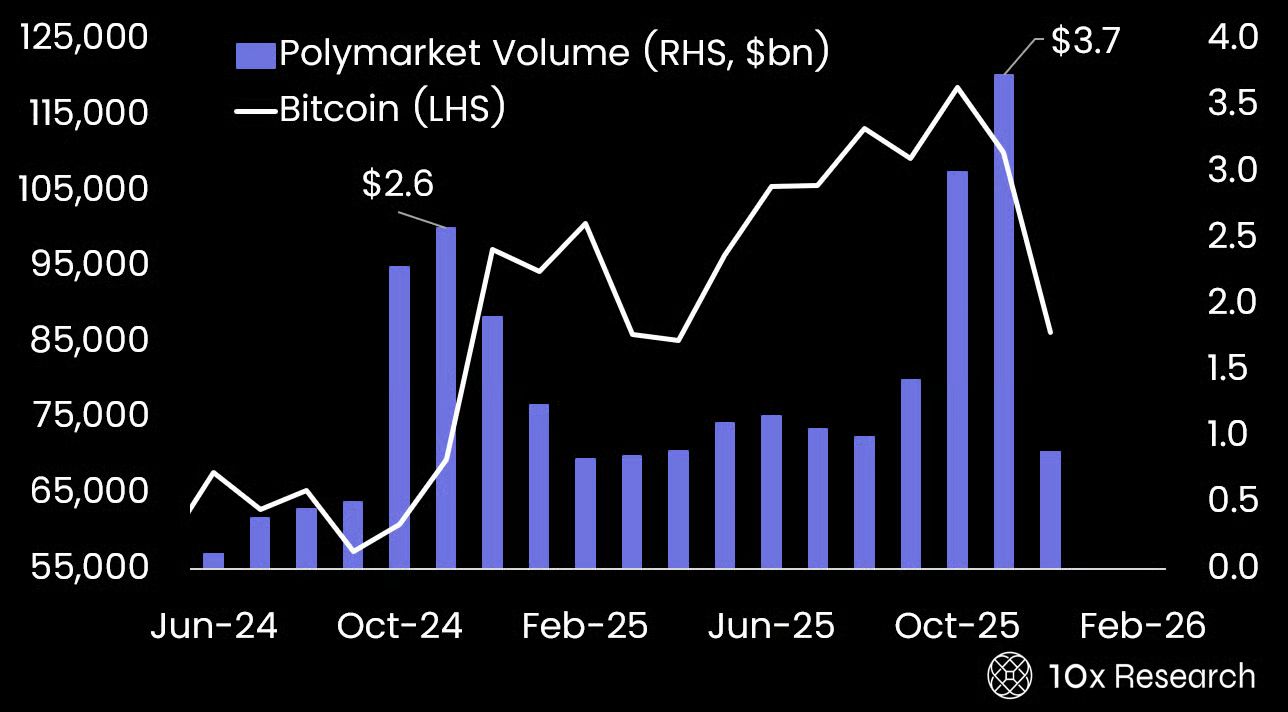
Polymarket volume, right-hand-side price, Bitcoin left-hand-side price. Source: 10x Research

Related: BTC poised for December recovery on ‘macro tailwinds,' Fed rate cut: Coinbase

For quantitative traders, prediction markets can offer asymmetric payoffs that compare favorably with the upside on underlying spot tokens, the report suggested.

For instance, traders on decentralized prediction market Polymarket are betting on whether the BNB (BNB) token will hit $1,500 by Dec. 31, 2025. “Yes” shares on that market recently traded around $0.01, implying a potential 100x payout if the event happens. By comparison, a spot BNB holder would see roughly a 1.65x gain if the token climbed to the same level from current prices.

Related: BitMine buys $199M in Ether as smart money traders bet on ETH decline

High win-rate accounts, AI bots raise Insider trading concerns

However, some prediction market accounts are showing concerning signs of insider trading, particularly a newly emerged account that made over $1 million in a single day by betting on Google search trends.

Polymarket user ‘AlphaRaccoon’ generated $1 million by successfully winning 22 out of 23 placed bets, according to crypto investors Haeju.

“This isn’t a lucky streak. He previously made $150K+ predicting the early release of Gemini 3.0 before results were out,” he wrote in a Thursday X post.
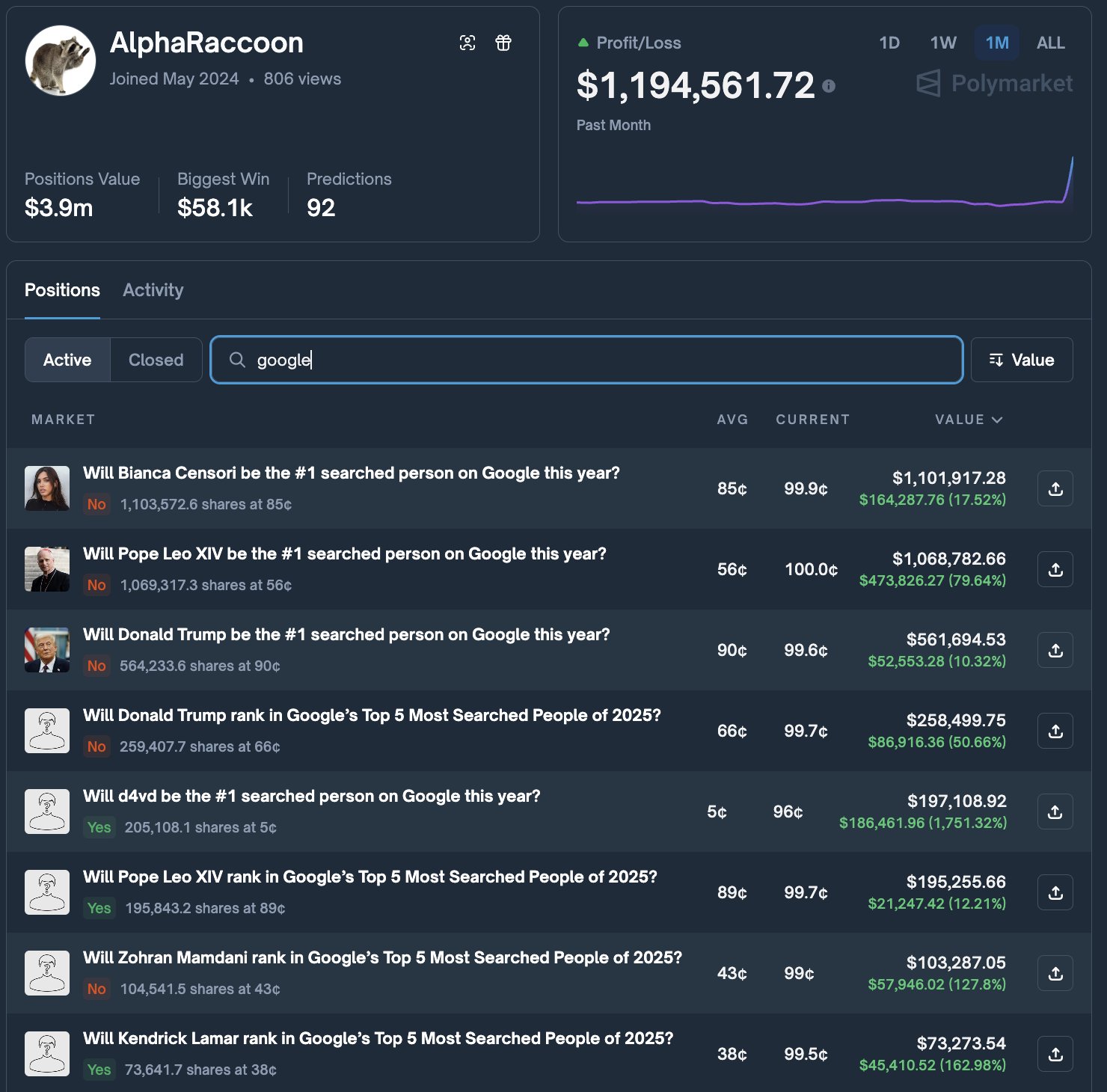
Source: haeju.eth

Others are employing artificial intelligence bots to increase their chances of winning.

Polymarkt user “ilovecircle” earned over $2.2 million during the past two months, boasting a 74% win rate through bets encompassing politics, sports and cryptocurrency.

The user’s volume and winning consistency “almost guarantees” that it is employing a machine learning (ML) model for “cross-niche arbitrage and auto trading,” wrote prediction market trader Archive, in a Sunday X post.

Magazine: Train AI agents to make better predictions... for token rewards

Lecturas Relacionadas

Dalio Warns: AI Boom Shows Signs of a Bubble, Day of Reckoning Will Be the Time of Burst

Ray Dalio, founder of Bridgewater Associates, warns that the current artificial intelligence investment boom shows classic signs of a bubble, which he expects will eventually burst. In a Bloomberg Television interview, he noted that great technological revolutions often lead to capital inflows that create bubbles, making it difficult for investors and companies to calibrate their spending accurately—either overspending to capture market share or underspending and losing their competitive position. This caution comes amid significant rallies in AI-related assets, particularly chipmakers, driven by soaring demand for data centers and high-bandwidth chips, raising debates about overheating valuations. In contrast, Nvidia CEO Jensen Huang recently asserted that investors embracing the AI wave would see "crazy" returns and dismissed concerns over return on investment for data center spending as outdated. Dalio, however, focuses on the risks in the profit realization phase. He argues that bubbles tend to show signs of破裂 when markets transition from investment to the need for tangible returns, describing the burst as a process of converting paper wealth into cash. While acknowledging AI's intrinsic value, he expressed concern over the future profitability of some AI companies, suggesting the market is repeating a familiar pattern. The 76-year-old billionaire, who fully exited Bridgewater in 2025, has a net worth estimated at $21.5 billion according to the Bloomberg Billionaires Index.

marsbitHace 8 min(s)

Dalio Warns: AI Boom Shows Signs of a Bubble, Day of Reckoning Will Be the Time of Burst

marsbitHace 8 min(s)

Privacy Coin Crisis of Confidence! ZEC Plunges Over 56% in a Single Day

Zcash (ZEC), a leading privacy-focused cryptocurrency, experienced a severe crash on June 5th, plummeting over 56% in a single day and erasing nearly two months of gains. The flash crash was triggered by the disclosure of a critical zero-knowledge proof vulnerability within Zcash's Orchard privacy pool, which had existed since the pool's launch in May 2022. The flaw theoretically allowed an attacker to forge unlimited ZEC undetectably due to the pool's privacy features. The vulnerability was discovered on May 29th by independent security researcher Taylor Hornby during a proactive audit commissioned by Shielded Labs, utilizing AI-assisted analysis. The Zcash development team responded swiftly, implementing an emergency soft fork to disable Orchard transactions on June 2nd and executing a permanent hard fork fix (NU6.2) on June 3rd. Despite the technical fix, a major crisis of confidence emerged. The core issue is that Orchard's privacy design makes it cryptographically impossible to prove whether the vulnerability was exploited over the past four years, casting permanent doubt on the historical supply integrity of ZEC. While Shielded Labs argues exploitation was unlikely, the inability to provide definitive proof has severely damaged market trust. This sentiment was exacerbated when BitMEX co-founder Arthur Hayes, a prominent ZEC supporter, announced he was selling his entire position. He stated that privacy assets require "perfect security" rather than "probable safety." The combined effect of the disclosure and Hayes's exit ignited widespread panic selling, leading to massive liquidations and significant price decline. Analysts note the event highlights a fundamental tension within privacy coins: the conflict between verifiable supply and cryptographic privacy.

链捕手Hace 10 min(s)

Privacy Coin Crisis of Confidence! ZEC Plunges Over 56% in a Single Day

链捕手Hace 10 min(s)

Trading

Spot
Futuros
活动图片