Powell: Weakening Employment, Inflation Still High, No One Talks About Rate Hikes Now

marsbitPublicado a 2025-12-11Actualizado a 2025-12-11

Resumen

In his latest address, Federal Reserve Chair Powell highlighted a noticeable cooling in the U.S. labor market, marked by slower hiring and reduced layoffs, declining challenges in recruitment, and diminished household expectations for job opportunities. The unemployment rate has risen to approximately 4.4%, with employment gains significantly weaker than at the start of the year. This slowdown stems partly from reduced labor supply—due to decreased immigration and lower participation rates—but also reflects weakening labor demand itself. On inflation, core PCE remains at 2.8% year-on-year, above the long-term 2% target. While goods inflation has edged up due to tariffs, service inflation continues to moderate. Although overall inflation has declined substantially from its 2022 peak, it has not yet reached a level that fully assures the Fed. The FOMC responded by cutting rates by 25 basis points and initiating short-term Treasury purchases to maintain ample reserves and ensure effective policy transmission. Powell emphasized that, with rising employment risks and persistently elevated inflation, there is no "risk-free" policy path. The Fed must carefully balance its dual mandate constraints. He noted that interest rates are nearing a neutral range, and future policy decisions will be data-dependent, avoiding preset directions and instead being assessed meeting by meeting based on economic conditions and risks.

At the latest press conference, Powell noted that the U.S. labor market is experiencing significant cooling: hiring and layoffs are slowing simultaneously, companies are finding it easier to recruit, households' expectations for job opportunities are declining, and the unemployment rate has risen to about 4.4%. Employment growth has weakened noticeably since the beginning of the year, partly due to a slowdown in labor supply, including reduced immigration and a decline in participation rates, but labor demand itself is also weakening.

Regarding inflation, core PCE remains at 2.8% year-on-year, above the long-term target of 2%. Some goods inflation has rebounded due to tariffs, but service inflation continues to show a slowing trend. Although overall inflation has fallen significantly from the 2022 peak, it has not yet reached a level that would fully reassure the Fed. The FOMC cut rates by 25 basis points again and initiated short-term Treasury purchases to maintain ample reserves and ensure the effective operation of policy rates.

Powell emphasized that against the backdrop of rising employment risks and still-high inflation, there is no "risk-free option" for the policy path. The Fed must strike a more delicate balance under the constraints of its dual mandate. He stated that interest rates are nearing the neutral range, and policy will not be preset in the future but will be judged meeting by meeting based on economic data and risk conditions.


Criptos en tendencia

Preguntas relacionadas

QWhat did Powell say about the current state of the US labor market?

APowell noted that the US labor market is cooling significantly, with hiring and layoffs slowing simultaneously, reduced difficulty for companies in recruiting, declining household expectations for job opportunities, and the unemployment rate rising to about 4.4%.

QWhat is the current core PCE inflation rate and how does it compare to the long-term target?

AThe core PCE inflation rate is currently at 2.8% year-on-year, which is above the long-term target of 2%.

QWhat two key monetary policy actions did the FOMC take at this meeting?

AThe FOMC cut interest rates by 25 basis points and initiated short-term Treasury purchases to maintain ample reserves and ensure the effective operation of policy rates.

QAccording to Powell, what is the main challenge for the Fed's policy path given the current economic conditions?

APowell emphasized that with rising employment risks and inflation still elevated, there is no 'risk-free option,' and the Fed must perform a more delicate balancing act under the constraints of its dual mandate.

QWhat is the Fed's approach to future policy direction as stated by Powell?

APowell stated that interest rates are near the neutral range and that future policy will not be pre-set, but will instead be judged meeting-by-meeting based on economic data and risk assessments.

Lecturas Relacionadas

Upbit Accelerates Token Listings: Total Trading Volume Halved, New Tokens Support Nearly 30% Share

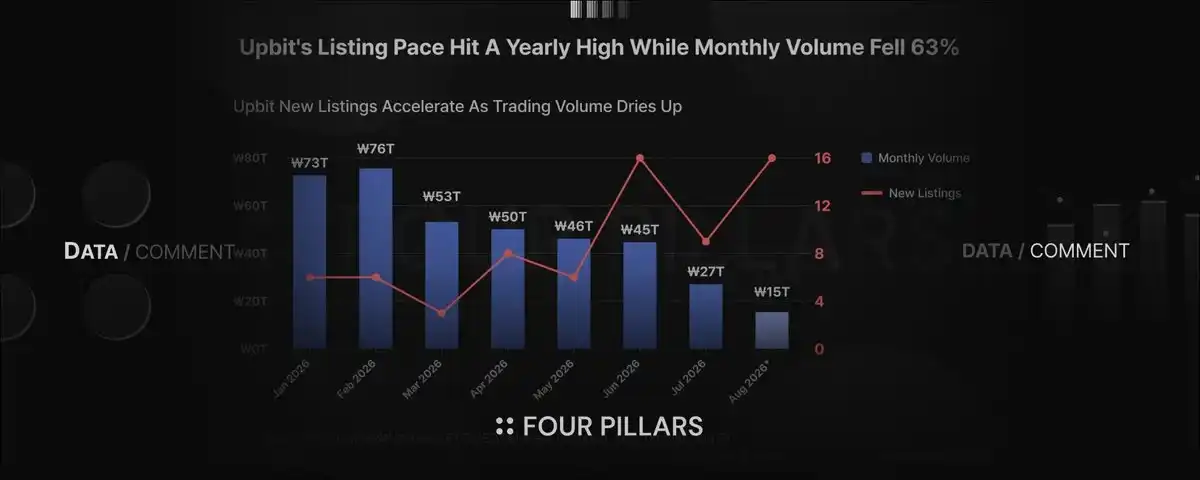
In the second half of 2026, Upbit significantly accelerated its pace of listing new cryptocurrencies, even as the overall Korean won-denominated trading market cooled rapidly. Monthly trading volume on Upbit plunged 63%, from KRW 72.7 trillion in January to KRW 27.1 trillion in July, with Bitcoin prices also falling. Contrary to the conventional logic of listing more during bull markets, Upbit intensified new listings during this downturn. New listings have become a crucial lever for Upbit to sustain trading activity in a bear market. By August, 61 new tokens listed in 2026 were collectively contributing nearly 30% of Upbit's total won trading volume, up from just 5% in January. This means roughly a quarter of the platform's fee revenue now comes from these newly listed assets. Standout performers like CHIP, RE, SLX, and CAP achieved significant individual market share shortly after listing, while new stablecoin listings contributed negligible volume. This strategy highlights a shift: the "Upbit listing premium," once a sought-after event to attract new capital, is increasingly used as a defensive tool to stabilize fee income amid shrinking overall volume. While the premium effect persists, indicating remaining genuine demand, its frequent use risks diluting the long-term strategic value and scarcity of Korean won liquidity access. Upbit's approach reflects a broader challenge for Asian centralized exchanges: relying on short-term listing tools to maintain operations during macro weakness, potentially at the cost of eroding long-term competitive foundations.

marsbitHace 14 min(s)

Upbit Accelerates Token Listings: Total Trading Volume Halved, New Tokens Support Nearly 30% Share

marsbitHace 14 min(s)

Trading

Spot

Artículos destacados

Cómo comprar ONE

¡Bienvenido a HTX.com! Hemos hecho que comprar Harmony (ONE) sea simple y conveniente. Sigue nuestra guía paso a paso para iniciar tu viaje de criptos.Paso 1: crea tu cuenta HTXUtiliza tu correo electrónico o número de teléfono para registrarte y obtener una cuenta gratuita en HTX. Experimenta un proceso de registro sin complicaciones y desbloquea todas las funciones.Obtener mi cuentaPaso 2: ve a Comprar cripto y elige tu método de pagoTarjeta de crédito/débito: usa tu Visa o Mastercard para comprar Harmony (ONE) al instante.Saldo: utiliza fondos del saldo de tu cuenta HTX para tradear sin problemas.Terceros: hemos agregado métodos de pago populares como Google Pay y Apple Pay para mejorar la comodidad.P2P: tradear directamente con otros usuarios en HTX.Over-the-Counter (OTC): ofrecemos servicios personalizados y tipos de cambio competitivos para los traders.Paso 3: guarda tu Harmony (ONE)Después de comprar tu Harmony (ONE), guárdalo en tu cuenta HTX. Alternativamente, puedes enviarlo a otro lugar mediante transferencia blockchain o utilizarlo para tradear otras criptomonedas.Paso 4: tradear Harmony (ONE)Tradear fácilmente con Harmony (ONE) en HTX's mercado spot. Simplemente accede a tu cuenta, selecciona tu par de trading, ejecuta tus trades y monitorea en tiempo real. Ofrecemos una experiencia fácil de usar tanto para principiantes como para traders experimentados.

603 Vistas totalesPublicado en 2024.12.12Actualizado en 2026.06.02

Cómo comprar ONE

Discusiones

Bienvenido a la comunidad de HTX. Aquí puedes mantenerte informado sobre los últimos desarrollos de la plataforma y acceder a análisis profesionales del mercado. A continuación se presentan las opiniones de los usuarios sobre el precio de ONE (ONE).

活动图片