Flowra Launches Open Orderflow Auction For Solana Validators

bitcoinistPublicado a 2026-08-25Actualizado a 2026-08-25

Resumen

Flowra has launched an Open Orderflow Auction framework for Solana validators, introducing a third-party MEV auction and block-building system. Operating as middleware and not a protocol fork, it features 200ms mini-auction cycles where registered searchers compete for transaction inclusion. The system integrates with Honeypot, allowing validators customizable block policies. This aims to bring more transparency and structure to Solana's high-speed transaction ordering market, aligning with broader trends of professionalizing MEV infrastructure. Success depends on adoption by validators and searchers to move meaningful orderflow through the framework.

Flowra has launched its Open Orderflow Auction framework for Solana validators, introducing a third-party block-building and MEV auction system designed around short, competitive ordering windows.

The system, launched on August 21, uses 200ms mini-auction cycles in which registered searchers compete for transaction inclusion. It also integrates with Honeypot, allowing validators to run custom block policies without changing Solana’s core protocol.

That distinction matters.

This is not a Solana hard fork. It is not a native protocol-level upgrade. It is middleware infrastructure for validators and block builders, aimed at changing how orderflow can be organized around the network.

TL;DR

  • Flowra launched an Open Orderflow Auction system for Solana validators.
  • Searchers compete in 200ms mini-auction cycles.
  • The system is third-party validator middleware, not a Solana protocol hard fork.

Why Orderflow Matters

Orderflow is one of the most important hidden parts of crypto trading.

Before transactions land on-chain, they can be sorted, bundled, prioritized, routed, or competed over. That creates value for validators, searchers, users, and infrastructure providers. It also creates risk if orderflow becomes opaque or unfair.

Solana’s speed makes this even more important.

When blocks move quickly, the market around transaction inclusion becomes extremely competitive. Validators need tools to handle that flow, while traders and applications want execution that is efficient and predictable.

Flowra is entering that layer.

What An Open Orderflow Auction Does

An Open Orderflow Auction gives searchers a structured way to compete for inclusion.

Instead of orderflow being handled informally or through closed relationships, a defined auction framework can make the process more transparent and competitive. Registered searchers bid or compete within tight time windows, and validators can use the system to shape block construction.

In Flowra’s case, the 200ms mini-auction cycle is designed for Solana’s high-speed environment.

That kind of timing shows how specialized Solana infrastructure has become.

Validator Policy Control Is The Other Piece

The Honeypot integration is also important because it gives validators more control over block policies.

Validators may want to avoid certain transaction types, comply with specific policies, or optimize how they handle orderflow. Giving them configurable infrastructure may make Solana’s validator economy more flexible.

But it can also raise questions.

If validators adopt different policies, users and applications may need to understand how orderflow changes across the network. The line between customization and fragmentation will matter.

MEV Infrastructure Keeps Professionalizing

This launch fits a broader trend.

MEV and block-building infrastructure are becoming more professional across major chains. Ethereum has already seen years of debate around builders, relays, searchers, and validator incentives. Solana is now developing its own version of that market.

The goal is not to eliminate MEV entirely.

The goal is to manage it in ways that are more transparent, competitive, and less harmful to users. Whether Flowra succeeds will depend on adoption by validators and searchers.

What Comes Next

The key question is whether Solana validators actually use the framework.

A block-building system only matters if meaningful orderflow moves through it. Flowra will need participation from searchers, validator adoption, reliable infrastructure, and clear incentives.

If that happens, Solana’s transaction-ordering market could become more structured.

If adoption is limited, the launch may remain a niche infrastructure experiment.

For now, Flowra’s Open Orderflow Auction shows that Solana’s validator stack is getting more sophisticated — and that the battle over transaction ordering is becoming a serious part of the network’s infrastructure story.

This article is based on Flowra’s public launch materials and related infrastructure documentation.

This article was written by the News Desk and edited by Samuel Rae.

This report is based on information released in disclosures at primary source documentation.

Criptos en tendencia

Preguntas relacionadas

QWhat is Flowra's Open Orderflow Auction for Solana validators, and what is its key technical feature?

AFlowra's Open Orderflow Auction is a third-party block-building and MEV auction system designed for Solana validators. It is middleware infrastructure, not a Solana protocol hard fork. Its key technical feature is the use of 200ms mini-auction cycles where registered searchers compete for transaction inclusion.

QHow does Flowra's system integrate with Honeypot, and what benefit does this provide to validators?

AFlowra's system integrates with Honeypot, which allows validators to run custom block policies without changing Solana's core protocol. This gives validators more control, enabling them to avoid certain transaction types, comply with specific policies, or optimize their handling of orderflow, thus making the validator economy more flexible.

QWhy is orderflow particularly important on a high-speed blockchain like Solana?

AOrderflow is particularly important on Solana due to its speed. When blocks are produced quickly, the market for transaction inclusion becomes extremely competitive. Validators need tools to manage this flow effectively, while traders and applications require efficient and predictable execution, making the organization and management of orderflow a critical infrastructure layer.

QAccording to the article, what is the broader trend in MEV and block-building infrastructure that Flowra's launch represents?

AThe broader trend is the professionalization of MEV and block-building infrastructure across major blockchains. Similar to developments on Ethereum, this involves creating more structured, transparent, and competitive markets around transaction ordering, builders, searchers, and validator incentives, with the goal of managing MEV in less harmful ways rather than eliminating it entirely.

QWhat does the article identify as the key factor that will determine the success or failure of Flowra's Open Orderflow Auction?

AThe key factor is adoption by Solana validators and searchers. The system's success depends on whether meaningful orderflow moves through it, requiring participation from searchers, validator adoption, reliable infrastructure, and clear incentives. Without this, it may remain a niche experiment.

Lecturas Relacionadas

Jackson Hole Becomes a Critical Battle for U.S. Treasuries, BofA Warns: If Warsh Doesn't Signal Rate Hikes, 30-Year Yield May Surge to 5.5%

The Jackson Hole Economic Policy Symposium is shaping up as a crucial battle for the US Treasury market, with the spotlight on Federal Reserve Chair Warsh's upcoming speech. Markets view this as the most critical near-term risk event for bond yields and the US dollar. A key concern is whether Warsh will provide clear signals on the Fed's willingness to resume interest rate hikes should inflation fail to improve. American Bank warns that if he avoids offering such forward guidance, the 30-year Treasury yield could surge toward or above 5.5%, putting further downward pressure on the dollar. This heightened sensitivity stems from fragile market conditions, including the Treasury's recent increased long-end bond buybacks and a string of weaker economic data. Analysts note that Warsh has historically been resistant to providing specific policy guidance, but sustained bond market pressure may force a shift in communication strategy. The market anticipates a framework outlining potential policy responses based on incoming inflation data. Barclays economists assign over a 50% probability to Warsh delivering a hawkish message. Historically, Jackson Hole speeches have had limited lasting market impact, but analysts suggest this year could be an exception due to the unique confluence of pressures, making Warsh's credibility and clarity paramount for stabilizing expectations.

marsbitHace 4 min(s)

Jackson Hole Becomes a Critical Battle for U.S. Treasuries, BofA Warns: If Warsh Doesn't Signal Rate Hikes, 30-Year Yield May Surge to 5.5%

marsbitHace 4 min(s)

“Economic Outcast”: US Treasury Takes Aim at Iran's Cryptocurrency, Technology, and Gold

On August 24, 2026, the U.S. Treasury Department, under Secretary Scott Bessent, launched "Operation Economic Outcast," a major campaign targeting the financial networks of the Islamic Republic of Iran and its affiliates. The primary goal is to cut off revenue streams supporting the Iranian regime, with a specific focus on denying funding to the Islamic Revolutionary Guard Corps (IRGC). The Office of Foreign Assets Control (OFAC) activated authorities to sanction any entities, regardless of location, operating in or servicing five key Iranian economic sectors: digital assets (cryptocurrency), technology, gold, aviation, and shipping. OFAC noted Iran's increasing use of cryptocurrency to evade sanctions, including for operations linked to the IRGC and government officials. Initial measures targeted nearly 60 organizations, individuals, and vessels across multiple jurisdictions involved in procuring nuclear/missile technology, conducting cyber operations, and facilitating illicit oil sales. The U.S. State Department joined the campaign, announcing additional sanctions against Iranian military officials, intelligence entities targeting U.S. forces, and networks moving Iranian oil. Treasury warned foreign partners that they have a specific deadline to halt identified Iran-related activities, or face unilateral U.S. action. Entities facilitating sanctions evasion risk being cut off from the U.S. financial system and the dollar economy. The operation consolidates sanctions against Iran's crypto, tech, and commodity financing into a unified campaign with clear deadlines. It expands OFAC's reach to crypto brokers and payment networks handling Iranian oil. Analysis suggests crypto tools are already embedded in Iran's trade practices, as seen with capital flight from the Nobitex exchange and discussions of Bitcoin payments for Strait of Hormuz transit, indicating new OFAC powers target existing, not hypothetical, evasion channels.

cryptonews.ruHace 19 min(s)

“Economic Outcast”: US Treasury Takes Aim at Iran's Cryptocurrency, Technology, and Gold

cryptonews.ruHace 19 min(s)

Upbit Accelerates Token Listings: Total Trading Volume Halved, New Tokens Support Nearly 30% Share

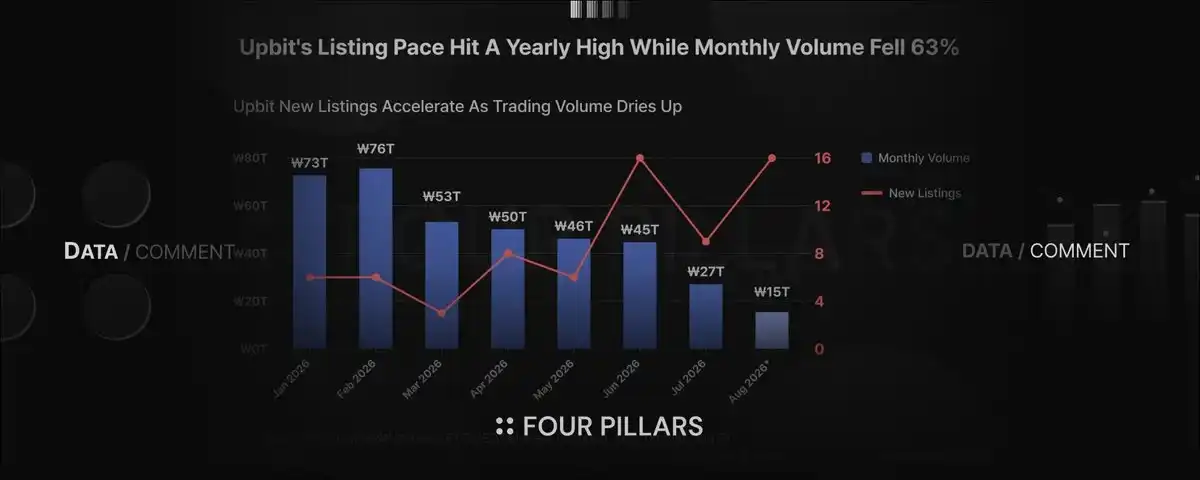
In the second half of 2026, Upbit significantly accelerated its pace of listing new cryptocurrencies, even as the overall Korean won-denominated trading market cooled rapidly. Monthly trading volume on Upbit plunged 63%, from KRW 72.7 trillion in January to KRW 27.1 trillion in July, with Bitcoin prices also falling. Contrary to the conventional logic of listing more during bull markets, Upbit intensified new listings during this downturn. New listings have become a crucial lever for Upbit to sustain trading activity in a bear market. By August, 61 new tokens listed in 2026 were collectively contributing nearly 30% of Upbit's total won trading volume, up from just 5% in January. This means roughly a quarter of the platform's fee revenue now comes from these newly listed assets. Standout performers like CHIP, RE, SLX, and CAP achieved significant individual market share shortly after listing, while new stablecoin listings contributed negligible volume. This strategy highlights a shift: the "Upbit listing premium," once a sought-after event to attract new capital, is increasingly used as a defensive tool to stabilize fee income amid shrinking overall volume. While the premium effect persists, indicating remaining genuine demand, its frequent use risks diluting the long-term strategic value and scarcity of Korean won liquidity access. Upbit's approach reflects a broader challenge for Asian centralized exchanges: relying on short-term listing tools to maintain operations during macro weakness, potentially at the cost of eroding long-term competitive foundations.

marsbitHace 39 min(s)

Upbit Accelerates Token Listings: Total Trading Volume Halved, New Tokens Support Nearly 30% Share

marsbitHace 39 min(s)

Trading

Spot

Artículos destacados

Cómo comprar AUCTION

¡Bienvenido a HTX.com! Hemos hecho que comprar Auction (AUCTION) sea simple y conveniente. Sigue nuestra guía paso a paso para iniciar tu viaje de criptos.Paso 1: crea tu cuenta HTXUtiliza tu correo electrónico o número de teléfono para registrarte y obtener una cuenta gratuita en HTX. Experimenta un proceso de registro sin complicaciones y desbloquea todas las funciones.Obtener mi cuentaPaso 2: ve a Comprar cripto y elige tu método de pagoTarjeta de crédito/débito: usa tu Visa o Mastercard para comprar Auction (AUCTION) al instante.Saldo: utiliza fondos del saldo de tu cuenta HTX para tradear sin problemas.Terceros: hemos agregado métodos de pago populares como Google Pay y Apple Pay para mejorar la comodidad.P2P: tradear directamente con otros usuarios en HTX.Over-the-Counter (OTC): ofrecemos servicios personalizados y tipos de cambio competitivos para los traders.Paso 3: guarda tu Auction (AUCTION)Después de comprar tu Auction (AUCTION), guárdalo en tu cuenta HTX. Alternativamente, puedes enviarlo a otro lugar mediante transferencia blockchain o utilizarlo para tradear otras criptomonedas.Paso 4: tradear Auction (AUCTION)Tradear fácilmente con Auction (AUCTION) en HTX's mercado spot. Simplemente accede a tu cuenta, selecciona tu par de trading, ejecuta tus trades y monitorea en tiempo real. Ofrecemos una experiencia fácil de usar tanto para principiantes como para traders experimentados.

229 Vistas totalesPublicado en 2024.12.12Actualizado en 2026.06.02

Cómo comprar AUCTION

Discusiones

Bienvenido a la comunidad de HTX. Aquí puedes mantenerte informado sobre los últimos desarrollos de la plataforma y acceder a análisis profesionales del mercado. A continuación se presentan las opiniones de los usuarios sobre el precio de AUCTION (AUCTION).

活动图片