Polymarket: 84% of Traders Are Losing Money, 0.033% of People Take the Majority of Profits

marsbitPublicado a 2026-04-08Actualizado a 2026-04-08

Resumen

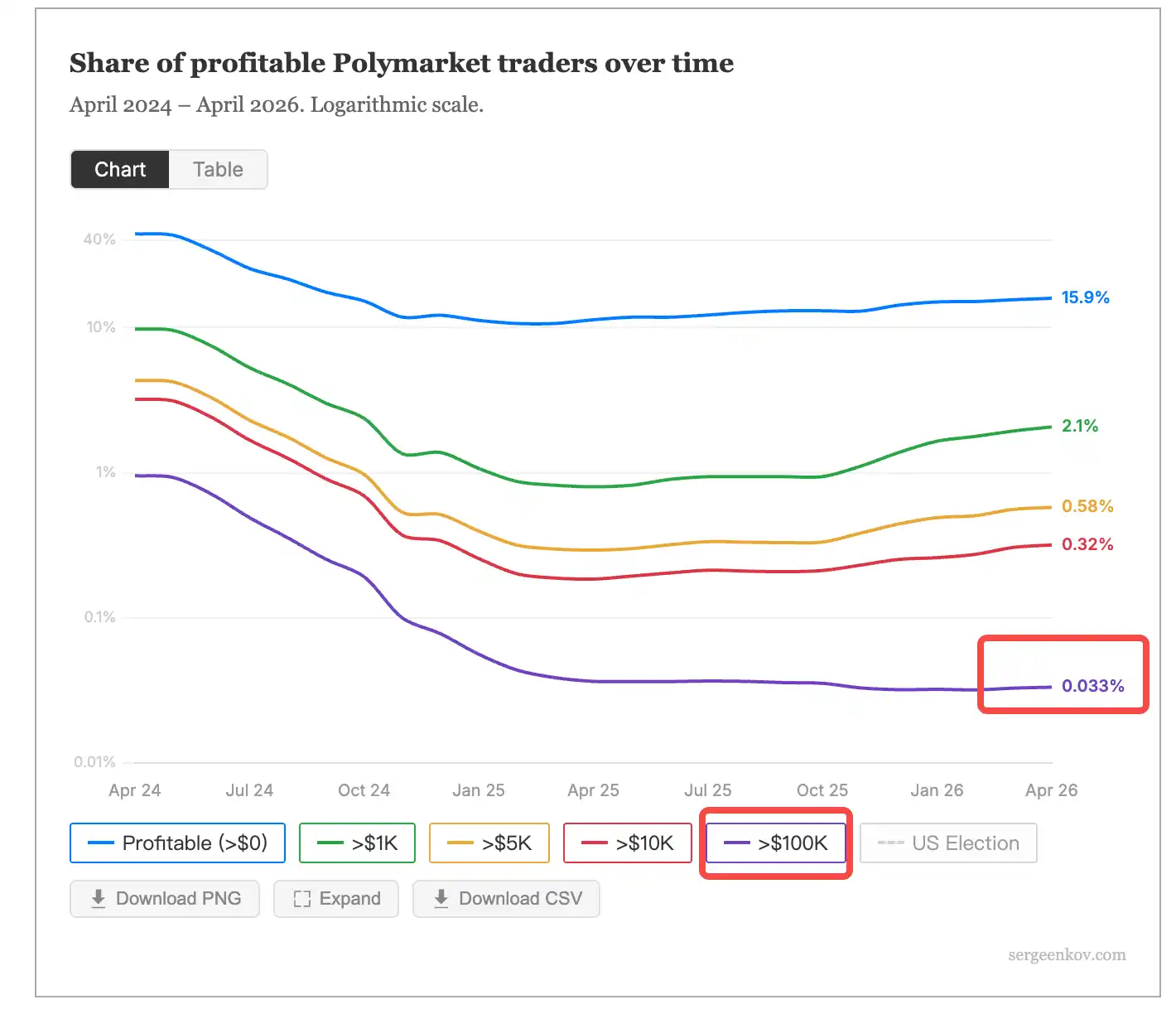
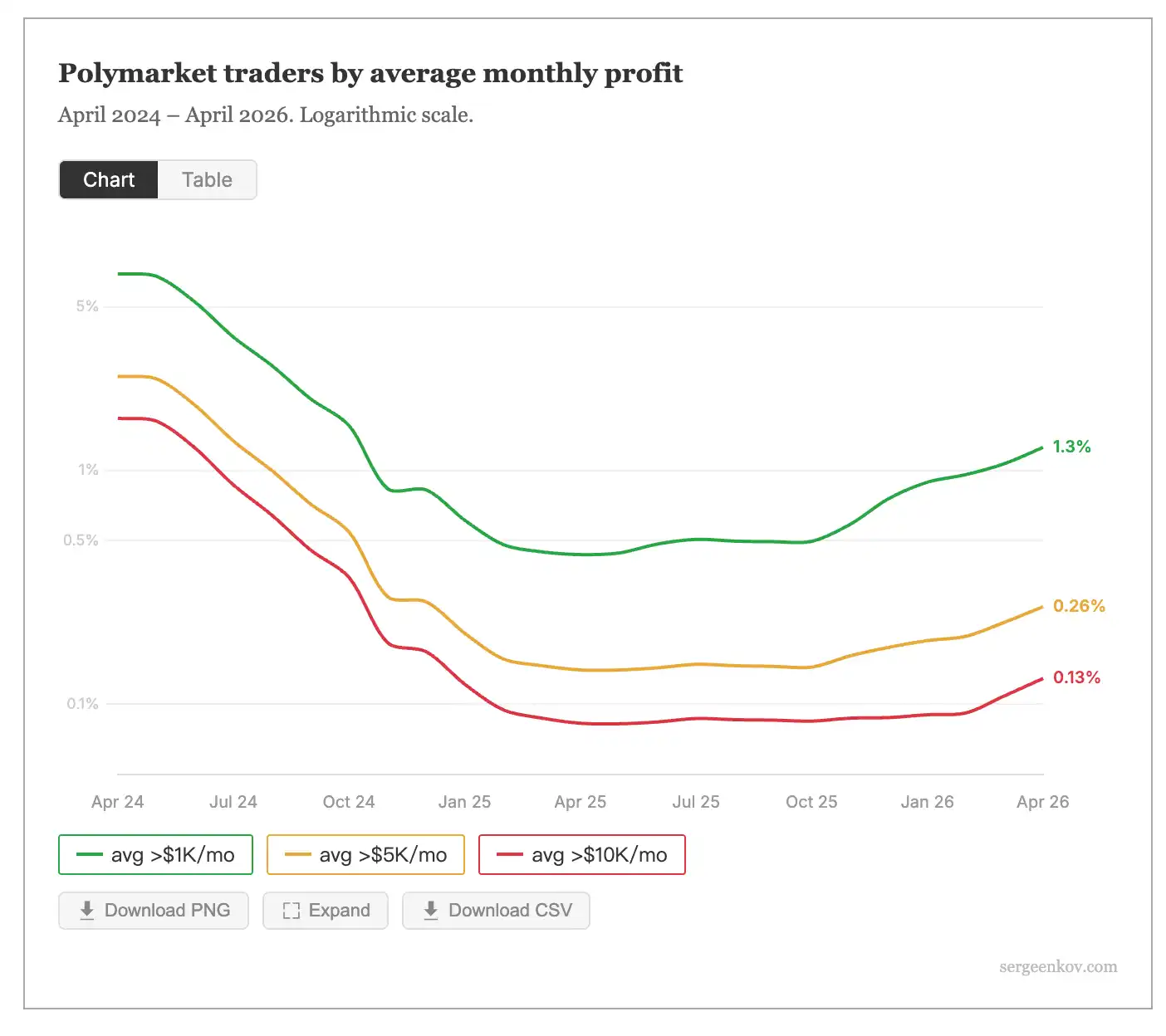
A recent analysis of 2.5 million Polymarket wallet addresses by on-chain researcher Andrey Sergeenkov reveals that 84.1% of traders are losing money, with only 16% achieving any profit. A mere 2% of addresses have accumulated over $1,000 in profits, while just 0.033% (840 addresses) have earned more than $100,000. The study, which improved on prior methodologies by accounting for token splits and mergers, shows a significant increase in unprofitable traders compared to a previous 70% estimate. Profit concentration is extreme: only 1.25% of addresses make over $1,000 monthly, 0.26% earn above $5,000, and just 0.13% surpass $10,000. Most high-earning addresses are short-lived, with 53% of top traders active for only one month. Research indicates that automated strategies—such as arbitrage bots and high-frequency trading systems—dominate profits, exploiting public on-chain data and speed advantages that manual retail traders lack. Despite Polymarket’s accuracy in prediction (94% a month before outcomes), the platform exhibits a stark wealth disparity, raising questions about its function as an information aggregator versus a zero-sum game favoring sophisticated players.

Author: Deep Tide TechFlow

Deep Tide Guide: The latest analysis of 2.5 million wallet addresses on Polymarket by on-chain researcher Andrey Sergeenkov shows that 84.1% of traders are at a loss, with only 2% of addresses accumulating profits exceeding $1,000, and 840 addresses (0.033%) profiting over $100,000. The timing of this report is quite delicate—Polymarket has just secured an exclusive predictive market partnership with MLB for up to $300 million and is pushing hard for retail user growth.

Wealth distribution in on-chain prediction markets is even more brutal than most people imagine.

According to a report by The Defiant on April 6, independent on-chain researcher Andrey Sergeenkov released a profit and loss analysis covering 2.5 million Polymarket wallet addresses, with data as of April 1, 2026. The core conclusion: 84.1% of traders are losing money, and less than 16% of addresses have achieved any level of positive returns.

This is not the first such study. In December 2025, blockchain analyst DeFi Oasis analyzed 1.7 million addresses and 124 million transactions, concluding that 70% of traders were not profitable. Sergeenkov's data sample is larger, and the methodology has been improved (capturing token splits and merges missed in previous research), with the loss ratio jumping from 70% to 84%.

The Top of the Pyramid: Less Than 0.26% Earn Over $5,000 Monthly

Sergeenkov conducted a full analysis of transaction data from two smart contracts, CTF Exchange and NegRisk CTF Exchange, by tracking all USDC fund flows (including buys, sells, redemptions, splits, and merges) on the Polygon chain.

The numbers in the high-profit range are quite stark: addresses with average monthly profits exceeding $1,000 account for 1.25%; those exceeding $5,000 are only 0.26%, about 6,600 addresses; and those exceeding $10,000 drop to 3,250, representing 0.13% of all traders.
More critical is the issue of sustainability. Among those 6,600 addresses with average monthly profits exceeding $5,000, 53% were active for one month and then disappeared, with only 2.6% trading continuously for over a year. Sergeenkov summarized in the report: "Most traders come, trade for a while, and then leave."

In contrast, bottom-feeders consistently harvest profits. An academic paper from Spain's IMDEA Networks Institute analyzed 86 million on-chain transactions between April 2024 and April 2025, finding that arbitrage traders extracted approximately $40 million in profits just from price differences. A single wallet achieved the highest profit of $2 million from 4,049 transactions, averaging $496 per trade.

Retail Manual Trading Can't Beat Bots, Information Advantage Highly Concentrated

The root cause of losses is not complicated. IMDEA's research shows that the largest profits are concentrated in wallets using automated strategies: arbitrage bots, market-making algorithms, and high-frequency trading systems. Manual retail traders typically enter the market only after prices have already adjusted.

This is the fundamental difference between prediction markets and traditional gambling. Polymarket's order book is completely public, and on-chain data is transparent, but this transparency instead makes it easier for professional traders to build systematic advantages. A quantitative wallet equipped with low-latency APIs and probability models is not in the same arena as an ordinary user who opens the app to place a bet after seeing the news.

According to Token Terminal data, Polymarket's nominal trading volume over the past 30 days is approximately $9.8 billion, with about 462,600 monthly active traders. The platform's growth itself is not an issue, but the relationship between user growth and user profitability is inverse—Sergeenkov's data shows that the decline in the proportion of profitable traders is directly related to peaks in user growth, especially the influx after the November 2024 U.S. election.
Information Aggregation Tool or Zero-Sum Game?

This report has reignited an old debate: who exactly do prediction markets serve?

The core argument of supporters is information aggregation. Polymarket's official data claims that its price prediction accuracy exceeds 94% one month before the outcome is determined. In other words, even if 84% of traders are losing money, the market as a whole is still producing valuable probability signals. The losing retail traders are essentially paying for information pricing.

Critics argue that when 84% of a platform's participants are losing money and profits are highly concentrated in the hands of automated traders, the difference between it and a casino is merely a matter of regulatory classification. Especially in the realm of sports contracts, the line between prediction markets and sports betting is being deliberately blurred.

Polymarket's valuation has exceeded $20 billion, and the Intercontinental Exchange (parent company of the NYSE) invested $2 billion in October 2025. Capital markets are clearly betting on the growth story of prediction markets.

But Sergeenkov's report raises a simple question: when the next wave of 2.5 million users floods in, how will their fate differ from the previous wave?


Criptos en tendencia

Preguntas relacionadas

QAccording to the analysis of 2.5 million Polymarket wallet addresses, what percentage of traders are losing money?

A84.1% of traders are losing money.

QWhat is the estimated number of addresses that have profited more than $100,000 on Polymarket, according to the researcher Andrey Sergeenkov?

A840 addresses (0.033% of the total) have profited more than $100,000.

QWhat does the research from the IMDEA Networks Institute identify as the primary reason for散户 (retail traders) losses on prediction markets like Polymarket?

AThe research found that the largest profits are concentrated in wallets using automated strategies (arbitrage bots, market-making algorithms, and high-frequency trading systems), while manual retail traders typically enter the market after prices have already adjusted.

QWhat key statistic does the article mention about the sustainability of high-earning traders (those making over $5,000 monthly)?

AAmong the 6,600 addresses with monthly profits exceeding $5,000, 53% were only active for one month before disappearing, and only 2.6% traded consistently for over a year.

QDespite most traders losing money, what is the core argument of supporters who defend the value of prediction markets like Polymarket?

ASupporters argue that prediction markets serve as valuable information aggregation tools, with Polymarket's prices achieving over 94% accuracy in predicting outcomes one month in advance, meaning the market as a whole produces valuable probabilistic signals even if most individual traders lose money.

Lecturas Relacionadas

The "Impossible Triad" Is Fundamentally a Pseudo-Problem

The article argues that blockchain's fundamental limitation is not the scalability trilemma (decentralization, scalability, security), which has been largely solved, but the lack of **privacy** and, until recently, clear **legitimacy**. Blockchain is described as a slow, expensive, globally shared computer whose core value is censorship resistance and verifiability. While ideal for native digital assets like money (e.g., stablecoins), its default transparency acts as a **tax**, exposing all transactions and enabling MEV extraction, which deters serious institutional capital. Simultaneously, its permissionless nature created regulatory ambiguity. The piece contends that **privacy** is the missing critical feature. It rejects the false choice between total transparency and complete anonymity. Modern cryptography (like zero-knowledge proofs) enables **compliant privacy**: users can prove facts (solvency, KYC status, compliance) without revealing the underlying sensitive data (specific holdings, identities). This preserves auditability for regulators and eliminates the leak of financial information. With recent regulatory progress (e.g., the GENIUS Act) addressing legitimacy, adding default, provably compliant privacy becomes a pure upgrade. It transforms blockchain from a costly, public ledger into a confidential settlement layer, finally bridging the gap to mainstream institutional and individual adoption of on-chain finance.

链捕手Hace 4 hora(s)

The "Impossible Triad" Is Fundamentally a Pseudo-Problem

链捕手Hace 4 hora(s)

Optical Chips: Collective Capacity Expansion

The global optical chip industry is experiencing a massive wave of expansion driven by surging AI data center demand. Major players across the US, Japan, Europe, and China are aggressively investing to ramp up production capacity. In the US, Coherent is expanding its 6-inch Indium Phosphide (InP) semiconductor fab in Texas, supported by CHIPS Act funding and a $2 billion strategic investment from NVIDIA. Lumentum is building a new factory for InP optical devices, and Nokia is scaling its advanced photonic chip packaging and testing capabilities. NVIDIA's investments aim to secure future supply of critical lasers and optical interconnect products for AI infrastructure. Japan's JX Advanced Metals, a leading InP substrate supplier, plans a multi-billion yen investment to increase its capacity 7-10 times, strengthening its grip on the crucial upstream materials market. In Europe, IQE and Tower Semiconductor settled a patent dispute and signed a multi-year InP epitaxial wafer supply agreement, highlighting that next-generation silicon photonics platforms will integrate high-performance InP components. STMicroelectronics and Sivers Semiconductors are also expanding silicon photonics production and partnerships. China is rapidly building out its domestic supply chain. Dongshan Precision's subsidiary, Source Photonics, announced a $12 billion project to expand optical chip and module production. Companies like Sanan Optoelectronics and Yunnan Germanium are scaling up InP chip manufacturing and substrate production, moving towards vertical integration from materials to modules. While debate continues around the exact future architecture—whether CPO (Co-Packaged Optics), NPO, or pluggables will dominate—analysts like Morgan Stanley argue the underlying driver is unchangeable: the explosive growth in bandwidth demand. This will inevitably increase the volume of optical engines, lasers, and related content per GPU, regardless of the final technical path. The competition for "more light" in the AI era has intensified into a global, full-chain capacity race.

marsbitHace 6 hora(s)

Optical Chips: Collective Capacity Expansion

marsbitHace 6 hora(s)

Stablecoins Finally Find Real Yield: An In-Depth Look at On-Chain Reinsurance Re | A Conversation with Re Founder Karan Saroya

Stablecoin Real Yield Found: A Deep Dive into On-Chain Reinsurance with Re's Karan Saroya As stablecoin supply exceeds $170 billion, the search for sustainable, non-speculative yield intensifies. Re, an on-chain reinsurance platform, provides an answer: connecting stablecoin capital to the trillion-dollar traditional reinsurance market. Re operates as a regulated reinsurer, accepting stablecoin deposits as collateral to back US insurance companies. These insurers pay premiums, generating yield that flows back to on-chain depositors. Currently supporting 35 insurers and underwriting $500 million, Re projects scaling to over $1 billion soon. Key insights from a Bankless podcast with founder Karan Saroya and investor Avichal of Electric Capital: 1. **Uncorrelated, Real-World Yield:** Re offers stablecoin holders access to reinsurance returns (targeting 12-14%+), an asset class entirely separate from crypto or equity markets. 2. **Operational Efficiency via Smart Contracts:** Re replaces traditional, labor-intensive capital fundraising with smart contracts, allowing a ~12-person team to compete with industry giants. 3. **Regulatory Leverage:** For every $1 of collateral, regulations allow backing $5-7 in written premiums. This leverage amplifies returns from the underlying risk-free rate. 4. **DeFi Integration:** Depositors receive receipt tokens, which can be used in protocols like Morpho for "looping," potentially pushing yields to 18-20%+. 5. **The "DeFi Mullet" Model:** A compliant front-end (regulated reinsurer) paired with a decentralized back-end (smart contracts, DeFi capital markets). 6. **RE Governance Token:** Modeled on Lloyd's of London, the token governs the central capital pool's allocation, counterparty acceptance, and parameters. 7. **Real Economic Impact:** Capital funds real-world productivity (factories, clinics, businesses) via insurance, moving beyond crypto's internal loops. The discussion highlights a pivotal moment: DeFi's supply-side infrastructure is now met by real demand for productive yield, potentially kickstarting a flywheel where vast on-chain stablecoin capital seeks these real-world returns.

链捕手Hace 8 hora(s)

Stablecoins Finally Find Real Yield: An In-Depth Look at On-Chain Reinsurance Re | A Conversation with Re Founder Karan Saroya

链捕手Hace 8 hora(s)

1996 or 1999? Walsh's First Test is 'How to View AI'

"1996 or 1999? Wall's First Big Test Is 'How to View AI'" Federal Reserve Chairman Wall's initial challenge is not whether to raise or cut rates, but a more fundamental judgment: what kind of boom is the current AI boom? This will determine the Fed's policy path and define his legacy. Economics is split between two opposing views, according to reporter Nick Timiraos. One sees imminent productivity gains that will increase supply and cool inflation, allowing the Fed to hold steady. The other argues that while productivity benefits are distant, demand shocks are here now, and waiting for data confirmation risks missing the intervention window, forcing sharper rate hikes later. Wall has signaled a leaning toward the first view, echoing 1996-era Alan Greenspan, who embraced strong, productivity-driven growth without fear of inflation. However, Wall faces a different macro environment than Greenspan did, with tariff pressures, expanding fiscal deficits, and diminishing globalization benefits, which could force more significant inflation pressures even if AI benefits materialize. Wall's logic, expressed before taking office, is that AI-driven productivity gains won't show in official data for years. If the Fed waits for confirmation, it might mistakenly tighten policy and choke off the very growth that could suppress inflation. This argues for using forward-looking narratives over lagging data. Chicago Fed President Austan Goolsbee presents a key counter-argument. He distinguishes between expected and unexpected productivity booms. A widely anticipated boom, like the current AI wave, can cause people to spend future wealth gains in advance, overheating the economy before productivity actually rises, thus requiring preemptive rate hikes. He cites rising costs for AI data centers as evidence of such overheating. Fed Governor Christopher Waller offers a rebuttal to Goolsbee, noting the "expected spending" mechanism only works if people can borrow against future income, which many households cannot do due to borrowing constraints. Wall also faces a paradox related to his desire to reduce the Fed's use of "forward guidance" (pre-announcing policy moves). This practice was established in 1999 when Greenspan began signaling hikes to avoid market shocks. If the economy follows a less optimistic path, Wall may be forced to choose between using the guidance he wants to abolish or risking market volatility by staying silent. The ultimate question defining Wall's first major test remains: Is this 1996 or 1999?

marsbitHace 9 hora(s)

1996 or 1999? Walsh's First Test is 'How to View AI'

marsbitHace 9 hora(s)

Trading

Spot
Futuros

Artículos destacados

Cómo comprar PEOPLE

¡Bienvenido a HTX.com! Hemos hecho que comprar ConstitutionDAO (PEOPLE) sea simple y conveniente. Sigue nuestra guía paso a paso para iniciar tu viaje de criptos.Paso 1: crea tu cuenta HTXUtiliza tu correo electrónico o número de teléfono para registrarte y obtener una cuenta gratuita en HTX. Experimenta un proceso de registro sin complicaciones y desbloquea todas las funciones.Obtener mi cuentaPaso 2: ve a Comprar cripto y elige tu método de pagoTarjeta de crédito/débito: usa tu Visa o Mastercard para comprar ConstitutionDAO (PEOPLE) al instante.Saldo: utiliza fondos del saldo de tu cuenta HTX para tradear sin problemas.Terceros: hemos agregado métodos de pago populares como Google Pay y Apple Pay para mejorar la comodidad.P2P: tradear directamente con otros usuarios en HTX.Over-the-Counter (OTC): ofrecemos servicios personalizados y tipos de cambio competitivos para los traders.Paso 3: guarda tu ConstitutionDAO (PEOPLE)Después de comprar tu ConstitutionDAO (PEOPLE), guárdalo en tu cuenta HTX. Alternativamente, puedes enviarlo a otro lugar mediante transferencia blockchain o utilizarlo para tradear otras criptomonedas.Paso 4: tradear ConstitutionDAO (PEOPLE)Tradear fácilmente con ConstitutionDAO (PEOPLE) en HTX's mercado spot. Simplemente accede a tu cuenta, selecciona tu par de trading, ejecuta tus trades y monitorea en tiempo real. Ofrecemos una experiencia fácil de usar tanto para principiantes como para traders experimentados.

458 Vistas totalesPublicado en 2024.12.12Actualizado en 2026.06.02

Cómo comprar PEOPLE

Discusiones

Bienvenido a la comunidad de HTX. Aquí puedes mantenerte informado sobre los últimos desarrollos de la plataforma y acceder a análisis profesionales del mercado. A continuación se presentan las opiniones de los usuarios sobre el precio de PEOPLE (PEOPLE).

活动图片