Polygon's $250 Million Acquisition Signals Shift in L2 Competition

marsbitPublicado a 2026-01-14Actualizado a 2026-01-14

Resumen

Polygon Labs has announced the acquisition of cryptocurrency payment infrastructure provider Coinme and blockchain development platform Sequence for a total exceeding $250 million. The strategic move aims to bolster Polygon's stablecoin strategy and its vision for an "Open Money Stack." Coinme, a long-standing compliant crypto business in the U.S., operates a vast network of over 50,000 retail locations and holds a series of money transmitter licenses. This acquisition provides Polygon with critical off-ramp and on-ramp capabilities, enabling seamless conversion between cash, fiat, and on-chain assets like stablecoins. Sequence contributes its modular technology stack, including a smart wallet with account abstraction and a cross-chain orchestration engine called Trails. This simplifies the user experience by allowing seamless interactions across multiple chains without users needing to manage gas fees or underlying complexities. Together, these acquisitions form the foundation of Polygon's Open Money Stack, which integrates layers for fiat ramps, wallet infrastructure, cross-chain interoperability, and blockchain settlement. This reflects a broader shift in the Layer 2 competitive landscape, where success is increasingly determined by full-stack integration—combining compliant entry points with seamless user experiences—rather than just technical performance.

Original Author: Sanqing, Foresight News

On January 13, Polygon Labs announced the completion of its acquisition of cryptocurrency payment infrastructure Coinme and blockchain development platform Sequence, with a total acquisition amount exceeding $250 million. However, Polygon Labs did not disclose the specific acquisition price for each company, nor did it specify whether the transactions were conducted in cash, equity, or a combination of both.

Marc Boiron, CEO of Polygon Labs, and Sandeep Nailwal, founder of the Polygon Foundation, stated that this acquisition aims to support the blockchain network's stablecoin strategy. Coinme holds a series of money transmission licenses in the United States, while Sequence is dedicated to building blockchain infrastructure, including crypto wallets.

Coinme: Complementing the Offline Entry Point for the Stablecoin Ecosystem

On January 9, CoinDesk reported, citing sources, that Polygon was in talks to acquire Bitcoin ATM operator Coinme. Polygon plans to spend between $100 million and $125 million to complete this acquisition.

Founded in 2014, Coinme has long operated in the U.S. compliant crypto business. It launched the first licensed Bitcoin ATM in the United States and has partnered with traditional brands like Coinstar and MoneyGram to establish a cash network of over 50,000 retail points across 48 states.

Coinme is regulated by the Nationwide Multistate Licensing System (NMLS) and state financial regulators, offering online wallet and vending machine transaction services. It supports the exchange and withdrawal of mainstream cryptocurrencies such as Bitcoin, Ethereum, and Litecoin, making it easier for users to trade crypto assets.

As early as 2024, Coinme's transaction volume exceeded $1 billion and achieved profitability for the first time, demonstrating the sustained demand for its compliant payment model.

For Polygon, acquiring Coinme means directly obtaining a series of money transmission licenses across the United States, enabling Polygon to connect cash, debit cards, and on-chain assets within a compliant framework, further advancing the integration of stablecoin payments and off-chain capital inflows.

Sequence: Simplifying Web3 User Experience

While Coinme handles "money," Sequence focuses on "users." Sequence is dedicated to eliminating the complexity of blockchain through a modular stack, including smart wallets, account abstraction, and the Trails cross-chain orchestration engine.

Sequence's core technology includes the Smart Wallet, which uses account abstraction to make wallet behavior more akin to Web2 account experiences, supporting features like social recovery, gas fee abstraction, and automatic transactions.

Its key component for cross-chain execution is Trails, which allows users to automatically find and execute the optimal path for cross-chain or cross-protocol transactions without needing to be aware of cross-chain complexities, gas fees, or token compatibility after expressing their intent.

Combining chain abstraction and account abstraction, Sequence not only enables developers to "build once, run on multiple chains" but also allows end-users to trade, pay, and interact across multiple chains with a single identity, much like using internet services, lowering the barrier for new users entering the on-chain world.

Building the Open Money Stack Strategy

Polygon Labs stated that the core goal of this acquisition is its stablecoin strategy and the Open Money Stack, aiming to reduce system fragmentation through a unified API.
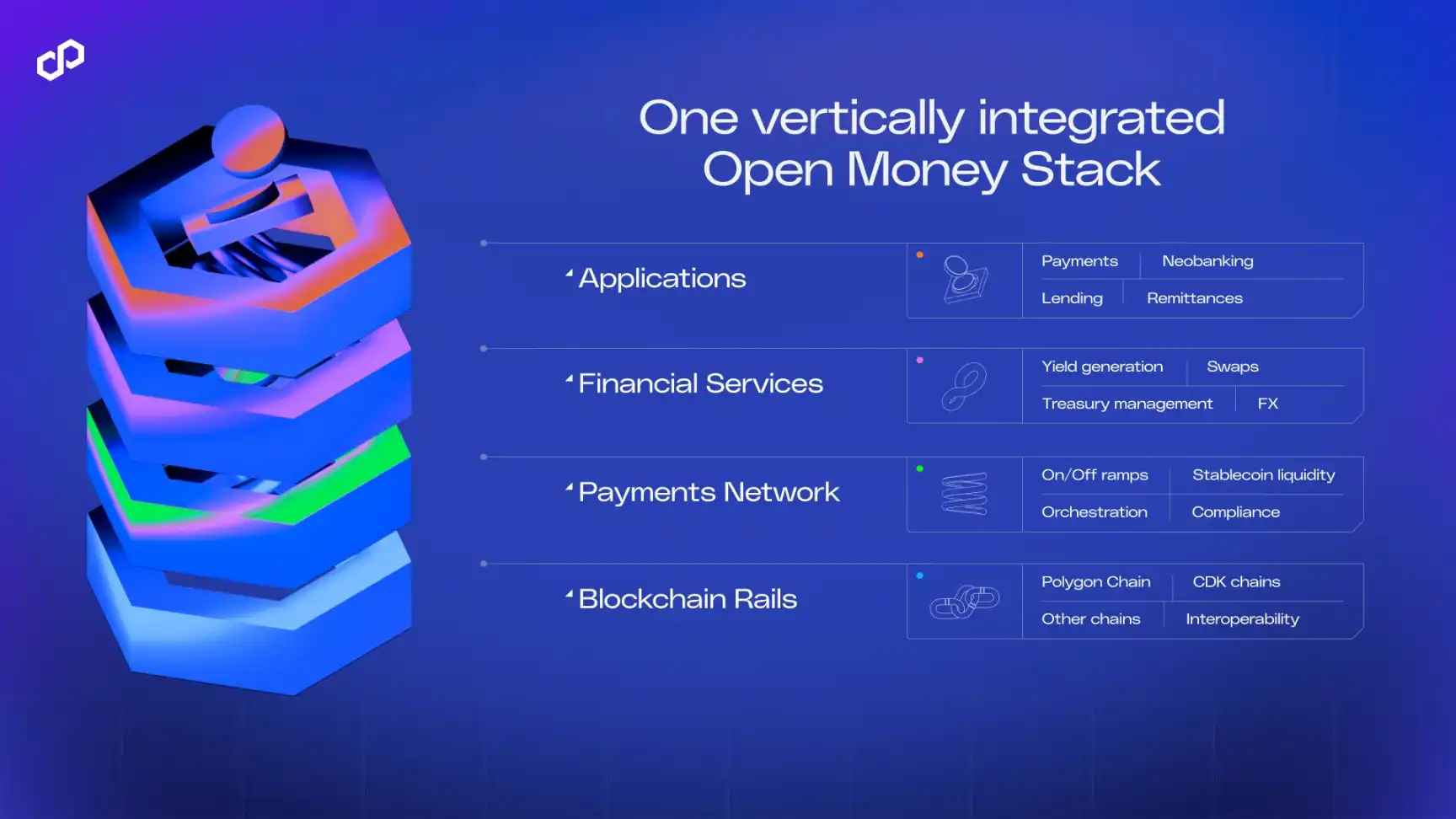
Open Money Stack | Source: Polygon Tweet

On/Off & Cash Ramps Layer: Utilizes Coinme's compliant network and U.S. regulatory licenses to enable instant cash and fiat on-ramps and off-ramps, converting physical cash or electronic fiat into stablecoins or other on-chain assets.

Wallet & Interaction Layer: Leverages Sequence's enterprise-grade smart wallets and account abstraction technology, along with one-click cross-chain transactions and cross-chain interaction capabilities, allowing end-users to receive, send, and make on-chain payments without worrying about underlying chains, gas, or intermediate assets.

Cross-Chain Interoperability Layer: Combines Sequence's Trails cross-chain orchestration engine and Polygon's interoperability protocol to make value flow between different chains completely transparent to users and support cross-chain transactions for any chain and any token.

Settlement Layer (Blockchain Rails): Relies on the Polygon network and its scaling technology to provide high-speed, low-cost, secure on-chain settlement infrastructure, enabling commercial-scale efficiency for stablecoin payments and value transfer.

Additionally, the Open Money Stack plans to integrate stablecoin orchestration with modules for compliance, identity, and yield generation, providing enterprises with payment and treasury management solutions.

L2 Competition Shifts to "Full-Stack Integration"

Polygon's $250 million acquisition reflects that the focus of competition in the L2 space is shifting from underlying technical parameters to full-stack business integration.

This path is highly consistent with the logic behind Coinbase's support for Base. The compliant entry point—acquiring Coinme—is to address the短板 (shortcoming) of fiat on-ramps and off-ramps,对标 (countering) Coinbase's CEX core advantage. For interaction experience, integrating Sequence is to lower the barrier to on-chain entry,对标 (countering) the ease of use of Coinbase Wallet (Base).

Against the backdrop of increasingly converging L2 technologies, ecosystems with compliant channels and low-barrier experiences will more easily attract incremental capital. Through this series of acquisitions, Polygon is attempting to build its own full-link moat in competition with opponents like Base, which possess native centralized advantages.


Preguntas relacionadas

QWhat is the total acquisition amount announced by Polygon Labs, and which two companies were acquired?

APolygon Labs announced a total acquisition amount exceeding $250 million for the cryptocurrency payment infrastructure company Coinme and the blockchain development platform Sequence.

QHow does the acquisition of Coinme benefit Polygon's stablecoin strategy?

AThe acquisition of Coinme provides Polygon with a series of U.S. money transmission licenses and an extensive cash network, enabling compliant integration of cash, debit cards, and on-chain assets to facilitate stablecoin payments and off-chain capital inflows.

QWhat core technologies does Sequence offer to simplify the Web3 user experience?

ASequence offers a modular stack including Smart Wallet with account abstraction for features like social recovery and gas fee abstraction, and the Trails cross-chain orchestration engine to enable seamless cross-chain transactions without user awareness of underlying complexities.

QWhat is the 'Open Money Stack' strategy that Polygon aims to build through these acquisitions?

AThe 'Open Money Stack' strategy aims to create a unified API system comprising layers for on/off ramps (using Coinme's network), wallet infrastructure (via Sequence's technology), cross-chain interoperability, and blockchain settlement, all integrated with stablecoin orchestration and compliance modules.

QHow does Polygon's acquisition approach reflect the shifting competitive focus in the L2 space?

APolygon's acquisitions indicate that L2 competition is moving from underlying technical parameters to full-stack business integration, focusing on compliant entry points and user-friendly experiences to attract incremental capital and build a comprehensive competitive moat.

Lecturas Relacionadas

20 Billion Valuation, Alibaba and Tencent Competing to Invest, Whose Money Will Liang Wenfeng Take?

DeepSeek, an AI startup founded by Liang Wenfeng, is reportedly in talks with Alibaba and Tencent for an external funding round that could value the company at over $20 billion. This marks a significant shift, as DeepSeek had previously relied solely on funding from its parent company,幻方量化 (Huanfang Quantitative), and had resisted external investment. The potential valuation would place DeepSeek among the top-tier AI model companies in China, comparable to competitors like MoonDark (valued at ~$18 billion) and ahead of recently listed firms like MiniMax and Zhipu. The funding—which could range from $600 million (for a 3% stake) to $2 billion (for 10%)—is seen as a move to secure resources for model development, retain talent, and support infrastructure needs, particularly as competition in inference models and AI agents intensifies. Both Alibaba and Tencent are eager to invest, not only for financial returns but also to integrate DeepSeek into their broader AI ecosystems. However, DeepSeek’s leadership is cautious about maintaining independence and may prefer financial investors over strategic ones to avoid being locked into a specific tech ecosystem. Alternative options, such as state-backed funds, offer longer-term capital and policy support but may come with slower decision-making and potential constraints on global expansion. With competing AI firms accelerating their IPO plans, DeepSeek’s window for securing optimal terms may be narrowing. The final decision will reflect a trade-off between capital, resources, and strategic independence.

marsbitHace 17 min(s)

20 Billion Valuation, Alibaba and Tencent Competing to Invest, Whose Money Will Liang Wenfeng Take?

marsbitHace 17 min(s)

After Losing 97% of Its Market Value, iQiyi Attempts to Use AI to Forcefully Extend Its Lifespan

After losing 97% of its market value since its 2018 peak, iQiyi is aggressively pivoting to AI in a desperate attempt to survive. At its 2026 World Conference, CEO Gong Yu announced an "AI Artist Library" with over 100 virtual performers and a new AIGC platform, "NaDou Pro," promising faster production and lower costs. This shift comes as the company faces severe financial distress: its market cap sits near delisting thresholds at $1.36 billion, with significant losses, declining membership revenue, and depleted cash flow. The AI strategy has sparked controversy. Top actors have issued legal threats against unauthorized digital replicas, while in Hengdian, over 134,000 background actors are seeing their already scarce job opportunities vanish as AI replaces them for background roles. iQiyi's move represents a fundamental shift from being a high-cost content buyer to a landlord" to becoming a "platform capitalist" that transfers production risk to creators. This contrasts with competitors like Douyin (TikTok's Chinese counterpart), which is investing heavily in *real* actor-led short dramas, betting that authentic human connection retains users better than AI-generated content. The article draws a parallel to the 1920s transition to "talkies," which made cinema musicians obsolete but ultimately enriched the art form. In contrast, iQiyi's AI drive is framed not as an artistic evolution but as a cost-cutting measure that could degrade storytelling, replacing genuine human emotion with algorithmically calculated stimulation and potentially numbing audiences' capacity for empathy. The core question remains: can a company focused solely on financial survival preserve the art of storytelling?

marsbitHace 21 min(s)

After Losing 97% of Its Market Value, iQiyi Attempts to Use AI to Forcefully Extend Its Lifespan

marsbitHace 21 min(s)

Only a 50% Chance of Passing This Year, Can the CLARITY Bill Succeed Before the Midterm Elections?

The CLARITY Act, which passed the House in July 2025 with strong bipartisan support (294-134), faces a critical juncture in the Senate. The Senate Banking Committee is expected to hold a markup soon, but key issues remain unresolved, including stablecoin yield provisions, DeFi regulations, and securing full Republican committee support. Other contentious points involve the Blockchain Regulatory Certainty Act (BRCA), ethics amendments for government officials, and SEC-related matters. The legislative calendar is tight, with limited time before the midterm elections. If the committee markup is delayed beyond mid-May, the chances of passage in 2026 drop significantly. Senator Cynthia Lummis has warned that failure this year could delay comprehensive crypto market structure legislation until 2030 or later. Galaxy estimates the probability of the CLARITY Act becoming law in 2026 is only about 50%. The bill provides crucial regulatory clarity by defining jurisdictional boundaries between the SEC and CFTC, establishing a path for decentralization, and bringing digital commodity intermediaries under federal regulation. Its passage is seen as vital before potential power shifts in the next Congress, which could bring less favorable leadership to key committees. The timeline is compressed, and the bill must compete for floor time with other priorities like Iran authorization and DHS appropriations. Key hurdles include finalizing the stablecoin yield compromise text, addressing law enforcement concerns about BRCA, and navigating political dynamics around SEC nominations. The outcome of the Banking Committee markup and the level of bipartisan support will be critical indicators of its future success.

marsbitHace 59 min(s)

Only a 50% Chance of Passing This Year, Can the CLARITY Bill Succeed Before the Midterm Elections?

marsbitHace 59 min(s)

Dialogue with Xinhuo Chief Economist Fu Peng: Macro Bear Market Expected to End This Year, Prioritize Allocation to Value Assets

Fu Peng, Chief Economist at New Huo Group, discusses the integration of crypto assets into traditional finance, marking a shift from a speculative phase to institutionalization. He highlights the current era as the second major fusion of finance and technology, driven by AI, data, and computing power, with crypto assets becoming part of the FICC+C (Fixed Income, Currencies, Commodities + Crypto) framework. Regulatory clarity in the U.S., such as the GENIUS and Clarity Acts, has paved the way for institutional adoption by defining digital assets as financial instruments. Fu views RWA (Real World Assets) as a tool for asset tokenization rather than a standalone asset class, noting that financial innovation differs between Eastern and Western markets due to cultural approaches to risk and regulation. He emphasizes that stablecoins are essential for future finance, but Asian markets, including Hong Kong, will adopt them cautiously. Macro liquidity now significantly influences crypto markets, as institutional participation increases correlation with traditional assets. Fu suggests the macro-driven bear market may end by year-end, reducing the relevance of Bitcoin’s four-year cycle. For asset allocation, he recommends value-oriented AI stocks for stability, Bitcoin for moderate certainty, and Ethereum for higher volatility.

marsbitHace 1 hora(s)

Dialogue with Xinhuo Chief Economist Fu Peng: Macro Bear Market Expected to End This Year, Prioritize Allocation to Value Assets

marsbitHace 1 hora(s)

Trading

Spot
Futuros

Artículos destacados

Cómo comprar T

¡Bienvenido a HTX.com! Hemos hecho que comprar Threshold Network Token (T) sea simple y conveniente. Sigue nuestra guía paso a paso para iniciar tu viaje de criptos.Paso 1: crea tu cuenta HTXUtiliza tu correo electrónico o número de teléfono para registrarte y obtener una cuenta gratuita en HTX. Experimenta un proceso de registro sin complicaciones y desbloquea todas las funciones.Obtener mi cuentaPaso 2: ve a Comprar cripto y elige tu método de pagoTarjeta de crédito/débito: usa tu Visa o Mastercard para comprar Threshold Network Token (T) al instante.Saldo: utiliza fondos del saldo de tu cuenta HTX para tradear sin problemas.Terceros: hemos agregado métodos de pago populares como Google Pay y Apple Pay para mejorar la comodidad.P2P: tradear directamente con otros usuarios en HTX.Over-the-Counter (OTC): ofrecemos servicios personalizados y tipos de cambio competitivos para los traders.Paso 3: guarda tu Threshold Network Token (T)Después de comprar tu Threshold Network Token (T), guárdalo en tu cuenta HTX. Alternativamente, puedes enviarlo a otro lugar mediante transferencia blockchain o utilizarlo para tradear otras criptomonedas.Paso 4: tradear Threshold Network Token (T)Tradear fácilmente con Threshold Network Token (T) en HTX's mercado spot. Simplemente accede a tu cuenta, selecciona tu par de trading, ejecuta tus trades y monitorea en tiempo real. Ofrecemos una experiencia fácil de usar tanto para principiantes como para traders experimentados.

541 Vistas totalesPublicado en 2024.12.10Actualizado en 2025.03.21

Cómo comprar T

Discusiones

Bienvenido a la comunidad de HTX. Aquí puedes mantenerte informado sobre los últimos desarrollos de la plataforma y acceder a análisis profesionales del mercado. A continuación se presentan las opiniones de los usuarios sobre el precio de T (T).

活动图片