Planck Retracted? The Father of Quantum Tripped by an Algorithm

marsbitPublicado a 2026-06-30Actualizado a 2026-06-30

Resumen

The recent discovery that two articles (published in 1940 and 1942) by Max Planck, the Nobel laureate and founder of quantum theory, are marked as "retracted" on Springer's digital platform highlights a curious clash between historical publishing practices and modern automated systems. An investigation suggests these retractions are algorithmic errors, not due to fraud or misconduct. The papers, philosophical reflections on science published in *Die Naturwissenschaften*, were likely flagged by the platform's systems. One article, a republished lecture, may have been mistaken for duplicate publication. Another, sharing a title with a prior article by a different author (a common practice for continuing debates at the time), may have triggered a similar automated check. The digital versions have even been replaced with blank pages, contrary to normal practice of preserving retracted texts. This incident underscores how contemporary digital infrastructure, built around concepts like "self-plagiarism" and strict copyright, can misclassify and obscure legitimate historical scholarly communication. It serves as a warning that digital archives are not neutral mirrors of the past but are filtered by platform rules, potentially distorting the scientific record. As AI systems increasingly rely on such databases, such erroneous metadata could propagate, affecting how future tools interpret and access historical knowledge.

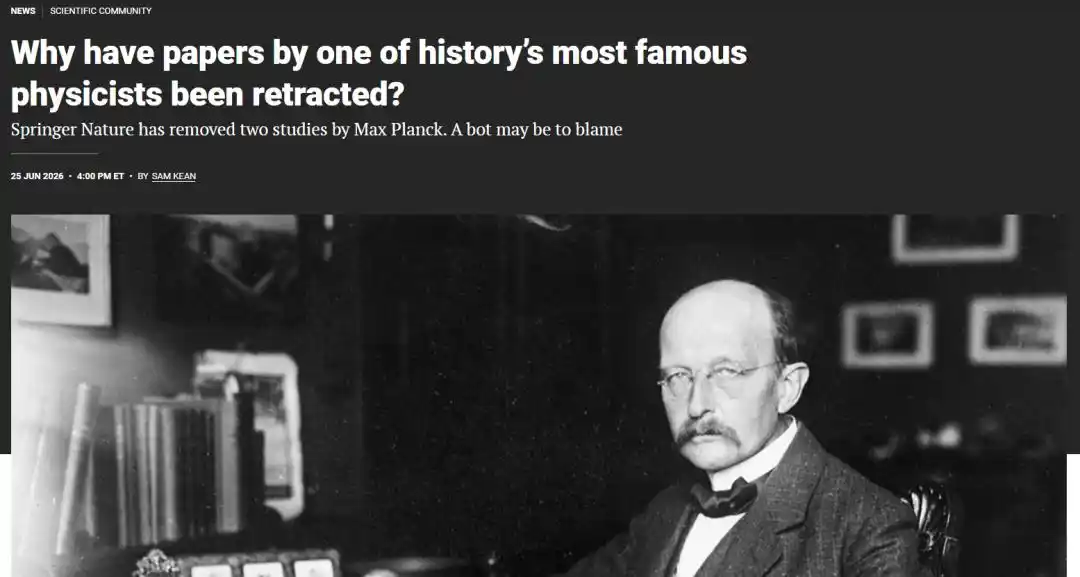
If one day you were to see the name Max Planck on a retraction list, you'd probably think you'd clicked on some academic parody site.

After all, this is no ordinary author. Planck was the founder of quantum theory, the 1918 Nobel Prize winner in Physics, and one of the most important names in 20th-century scientific history.

But a new paper points out that two of Planck's articles, published in 1940 and 1942, are actually marked as "retracted" on Springer's digital platform.
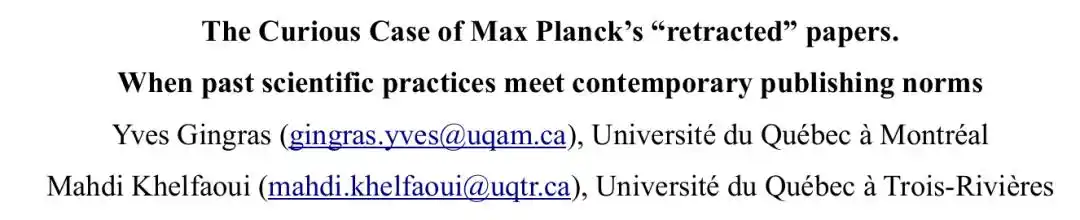
Paper Title: The Curious Case of Max Planck retracted papers. When past scientific practices meet contemporary publishing norms. Paper Address: https://arxiv.org/abs/2605.17534

Amusingly, according to the investigation by the paper's author, these two articles were not retracted due to fabrication, error, or academic misconduct, but were victims of an algorithmic error.

01

The story begins with a "Nobel Laureate Retraction List" from Retraction Watch, a website that tracks issues in academic publishing.

The author, as a researcher in the history of physics, was surprised to see Max Planck on the list because the two articles were published in the German science journal *Die Naturwissenschaften*. By then, Planck was already a world-renowned physicist, and the paper's author found it hard to believe these articles were truly retracted during his lifetime or that there were sufficient grounds for retraction later.
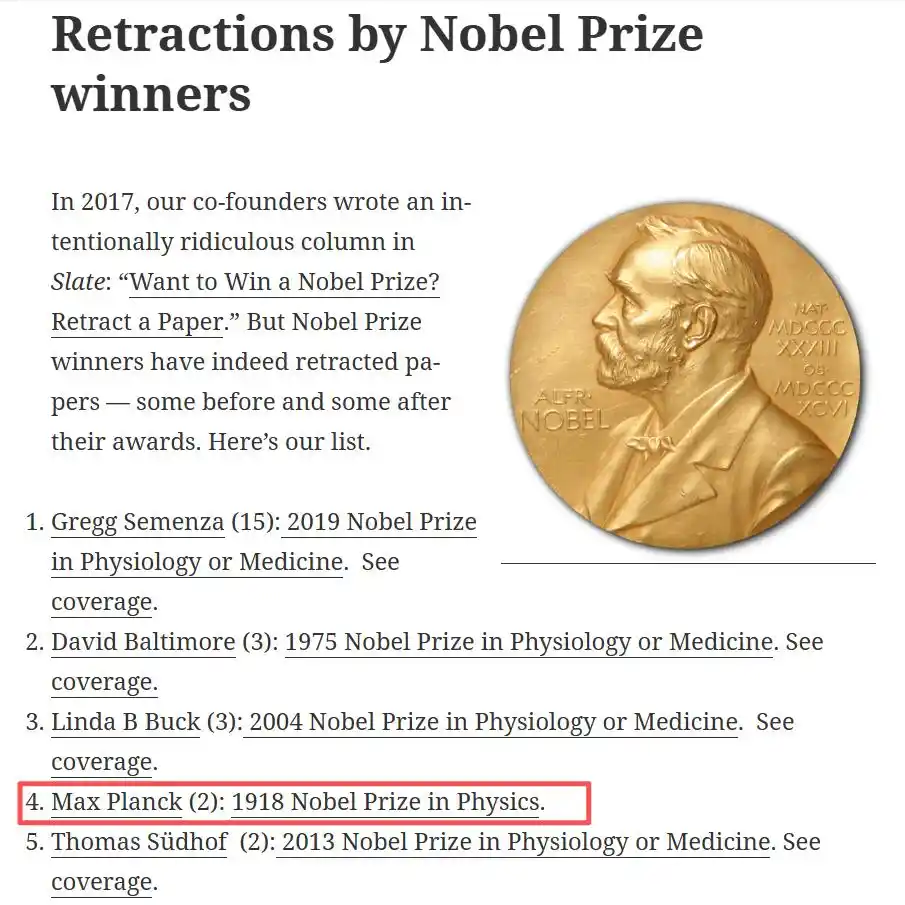
Link: https://retractionwatch.com/retractions-by-nobel-prize-winners/

The explanation given on the Springer platform is rather vague. The page title labels it as a "RETRACTED ARTICLE," but the statement in the PDF says, "This article has been withdrawn due to article violation"; the wording on the webpage is more specific, stating the articles were retracted due to "copyright violation."
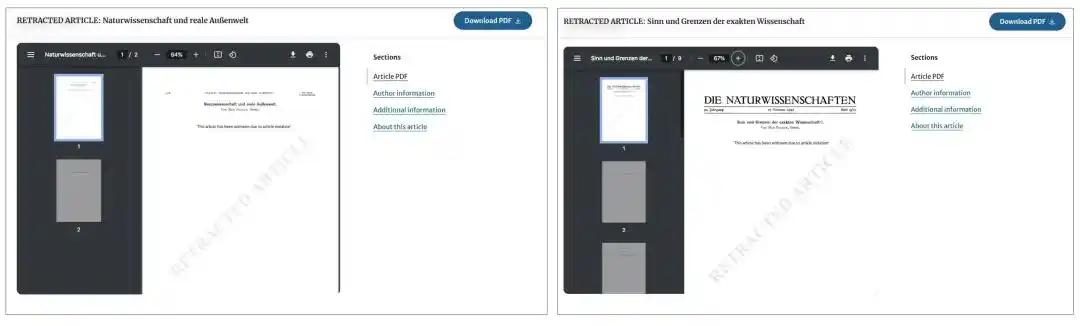
In other words, this is likely an accident manufactured by a combination of copyright, digital archiving, and platform metadata management—these old articles were processed by the system/publisher in modern databases as copyright or duplicate publication issues.

Let's first return to the ecology of scientific publishing in the first half of the 20th century. *Die Naturwissenschaften* was founded in 1913, published by Julius Springer Verlag, and positioned somewhat like the German-language equivalent of *Nature*: it was a comprehensive science weekly covering natural sciences, medicine, and technological advances. It published both technical papers and speeches, conference reports, as well as discussions on the philosophy of science and its cultural significance.

Planck's two articles themselves were not research papers reporting new experiments or theories, but rather philosophical reflections on the nature of scientific knowledge.

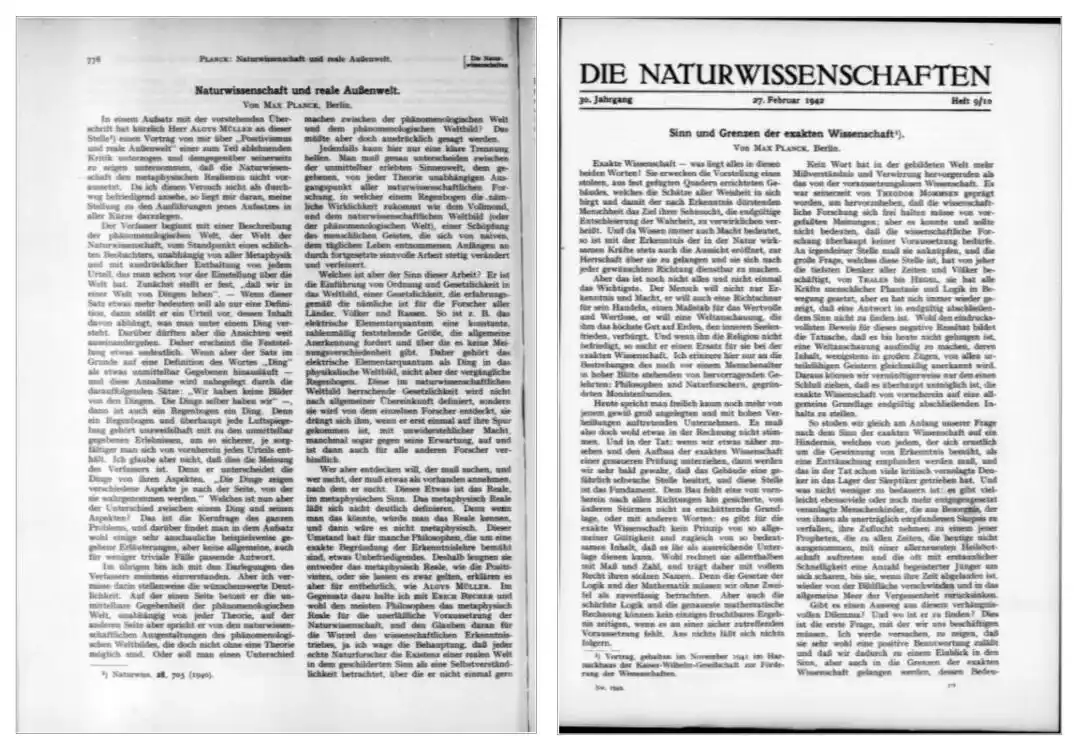
The 1942 article, "The Meaning and Limits of Exact Science," is particularly typical. It was originally a lecture Planck gave in 1941 at the Kaiser-Wilhelm-Gesellschaft in Berlin. It later circulated in multiple forms: published as a pamphlet in 1942, also appearing in *Europäische Revue* and *Die Naturwissenschaften*, and was included in a collection of Planck's speeches and essays in 1943.

Today, such a pathway could easily be identified by platforms or copyright systems as "duplicate publication." But at that time, multi-channel circulation—from lectures to journals, from pamphlets to essay collections—was simply part of how scientific ideas spread.

The case of the 1940 article, "Natural Science and the Real External World," is even more peculiar. The paper's author found no evidence of it being published elsewhere as a duplicate. One possible explanation proposed by the author is that a few months earlier in the same journal, another author, Aloys Müller, had published an article with the same title, discussing Planck's philosophical position. Planck then used the same title for a response, engaging in this intellectual debate.

Within the editorial culture of that era, this was clearly not a problem; it was even an explicit gesture of dialogue. But in later digital indexing, copyright management, and metadata systems, two identical titles might be flagged as a suspicious duplicate.

The paper also points out that these two "retracted" articles have even become blank pages on Springer's platform. Normally, even if a paper is retracted, the original text is preserved with a retraction notice added to maintain the integrity of the scientific record. But here, the two-page article from 1940 and the nine-page article from 1942 have both been erased on the digital platform. To read the original today, you can't find it at the original publisher Springer; you have to go to the non-profit Internet Archive.
02

At this point, the matter is no longer just the amusing story of "Planck being mistakenly retracted"; it's a failure of modern academic publishing infrastructure. When historical literature enters modern digital publishing platforms, who has the right to decide what counts as "duplicate publication," what counts as "copyright violation," and what should continue to be seen?

The paper's author argues that concepts like "duplicate publication" and "self-plagiarism" are not eternal, unchanging standards of academic ethics. They are modern categories bound up with bibliometrics, research evaluation, copyright transfer, and commercial publishing platforms from the late 20th century onwards. The paper explicitly states that "self-plagiarism" is a relatively recent concept that has gained prominence with the evaluation systems that measure academic productivity by paper counts since the 1990s.

This is also a point familiar to today's academic system: the issue isn't just "what the content is," but also "how the content is represented by the system."

Once a historical article enters a database, it is broken down into structured objects like DOI, title, author, copyright status, retraction labels, PDF files, citation records, etc. Once platforms process old literature automatically or semi-automatically according to contemporary rules, they may rewrite past normal publishing practices as today's violations.

This mismatch is particularly alarming in the AI era.

When we talk about training data, data cleaning, literature databases, knowledge graphs, and RAG today, we often assume that digital knowledge is stable, retrievable, and callable. But this incident reminds us that digital archives are not a neutral "mirror of the past"; they are a set of filters imbued with commercial logic, legal assumptions, and platform rules. Data can be renamed, re-categorized by platforms, or even replaced with blank pages.

A modern copyright and metrics system retroactively judged normal pre-digital scientific communication practices as suspicious operations. More seriously, this judgment didn't remain at the label level; it directly affected the accessibility of historical literature.

For the knowledge production systems entering the AI era, a wrong label, a missing PDF, or an opaque copyright handling can all be further amplified by models, search engines, and academic tools. Future AI assistants might not know that Planck's articles were "mistakenly retracted"; they might only see the cold, hard "retracted" marker in the database.

When scientific memory is increasingly entrusted to databases, publishers, platform rules, and commercial infrastructure, can we still accurately see science's past?

Reference Link: https://www.science.org/content/article/why-have-papers-one-history-s-most-famous-physicists-been-retracted

This article is from the WeChat public account "Almost Human" (ID: almosthuman2014), author: Focus on Academia


Criptos en tendencia

Preguntas relacionadas

QWhat is the main reason Max Planck's articles from 1940 and 1942 were marked as 'retracted' on Springer's platform?

AThe primary reason is believed to be an error caused by automated algorithms or digital platform systems. They likely flagged the articles due to issues such as potential 'duplicate publication' or 'copyright violation' based on modern publishing norms, which misinterpreted the historical publication practices of that era.

QWhat was the original publication context of Max Planck's 1942 article 'The Meaning and Limits of Exact Science'?

AThe 1942 article was originally a lecture delivered by Max Planck in 1941 at the Berlin Kaiser-Wilhelm-Gesellschaft. It was subsequently published in multiple formats, including as a pamphlet, in the journals 'Europäische Revue' and 'Die Naturwissenschaften', and later included in a collection of Planck's speeches and essays. This was a normal method of disseminating scientific ideas at the time.

QWhat unusual outcome occurred for Planck's articles on Springer's platform besides the retraction label?

ABeyond being labeled as 'retracted,' the full texts of the articles were replaced with blank pages on Springer's digital platform. This removal of content is unusual, as standard practice for retracted articles is to keep the original text accessible with a retraction notice to preserve scientific record integrity.

QAccording to the article, why is the concept of 'self-plagiarism' considered a modern construct in relation to this incident?

AThe article argues that concepts like 'self-plagiarism' and 'duplicate publication' are relatively recent constructs tied to late-20th-century academic evaluation systems that emphasize paper counts. Planck's multi-format dissemination of his lecture was standard and acceptable scientific communication in his time but is judged by a different, contemporary set of digital platform rules.

QWhat broader concern does this case raise about digital archives and AI-era knowledge systems?

AThis case highlights that digital archives are not neutral mirrors of the past but are filtered through commercial logic, legal assumptions, and platform rules. An erroneous label or removal can distort the historical record. In the AI era, such errors in databases could be amplified by models, search engines, and tools, potentially leading to the loss or misinterpretation of scientific heritage as AI systems may uncritically accept platform metadata.

Lecturas Relacionadas

Ray Dalio's Latest Macro Analysis Full Text: Buy More Gold, Add Some Bitcoin

In his latest macro analysis, Ray Dalio applies his framework from "How Countries Go Broke: The Big Cycle" to the current global debt environment. He highlights recent events like Japan selling U.S. Treasuries and rising U.S. long-term yields as signs of an unsustainable debt dynamic. Dalio explains that excessive government debt leads to either unacceptably high interest rates, severe economic downturns, or significant currency debasement through central bank money printing. He summarizes the U.S. fiscal situation: with $5.5 trillion in revenue, $7.5 trillion in spending, a $2 trillion deficit, and total debt at six times annual revenue, debt servicing costs are immense. Without correction, U.S. debt could reach $55-$60 trillion in a decade. Dalio proposes a "3% Three-Way" solution: reducing the budget deficit to 3% of GDP through balanced spending cuts, tax increases, and interest rate reductions to avoid a traumatic adjustment. In response to FAQs, he argues that the risk of a U.S. debt crisis is high and could materialize within a few years if the current path continues. He dismisses the notion that the dollar's reserve status makes the U.S. immune, citing historical precedents of reserve currency declines. He is also unconvinced by Japan's high-debt stability, noting poor returns for yen-denominated assets. For investors, Dalio recommends diversifying globally, underweighting bonds, and overweighting assets like gold and a small allocation to Bitcoin (around 10-15% to gold) to hedge against currency debasement and poor debt returns.

marsbitHace 42 min(s)

Ray Dalio's Latest Macro Analysis Full Text: Buy More Gold, Add Some Bitcoin

marsbitHace 42 min(s)

Stripe’s 16-Year Chronicle: From 7 Lines of Code to a $100 Billion Valuation

Stripe's 16-year journey began with a simple promise: "7 lines of code to accept payments." Founded by Patrick and John Collison, the company started by hiding the complexity of bank integrations and merchant accounts behind a clean API, initially targeting developers at startups. This early focus on user experience and technical simplicity fueled rapid adoption. A key early milestone was establishing vital bank partnerships, a challenge overcome by hiring Billy Alvarado, who brought crucial institutional relationship skills. From this foundation, Stripe systematically expanded its product boundaries. It launched Connect for platform payments, Atlas for company formation, Radar for fraud prevention, and Billing for subscriptions. This transformed Stripe from a payment processor into a broader financial infrastructure suite for internet businesses. The COVID-19 pandemic accelerated growth but also led to over-hiring. A 14% layoff in 2022 marked a period of organizational correction. Subsequently, Stripe shifted its growth strategy towards strategic acquisitions to enter new domains quickly. It acquired Bridge (stablecoin infrastructure), Privy (wallet infrastructure), Metronome (usage-based billing), and agreed to buy OpenRouter (AI model routing). These moves signal Stripe's ambition to build a "programmable money system" for the emerging AI and agent-based economy, managing not just currency flows but also the measurement and pricing of computational resources like AI tokens. Internally, Stripe leverages AI agents (like "Minions") to boost engineering productivity. Despite scaling to nearly 8,000 employees and processing $1.9 trillion in payment volume annually, the company remains private. A recent employee tender offer valued it at $159 billion. The core question for Stripe's future is whether it can successfully integrate its expanding product matrix—spanning payments, crypto, and AI infrastructure—into a cohesive platform, positioning itself as the foundational economic layer for autonomous software agents.

marsbitHace 1 hora(s)

Stripe’s 16-Year Chronicle: From 7 Lines of Code to a $100 Billion Valuation

marsbitHace 1 hora(s)

Treasury Secretary's Move to Suppress Treasury Yields Ignites 'Currency Debasement Trade'! Gold Hits Three-Month High, Bitcoin Surges Over 25% in a Single Week

US Treasury Secretary Besant's efforts to lower long-term Treasury yields by announcing expanded buybacks had only a brief market impact. However, this move fueled a "currency devaluation trade," weakening the US dollar while boosting both gold (to a three-month high) and Bitcoin (up over 25% for the week). Analysts attribute this reaction to deepening market concerns over the massive US fiscal deficit and structural pressures keeping long-term rates elevated, including fierce competition for capital from global government borrowing and massive AI sector financing. Despite the Treasury's actions, fundamental forces like growth, inflation, and capital demand are seen as limiting its ability to sustainably suppress yields. Bitcoin's strong positive correlation with gold has reinforced its narrative as a hedge against devaluation. While equity markets have shown resilience, some strategists warn that Treasury yields nearing 5% increase pressure on the dollar and high-leverage assets. Figures like Ray Dalio have advised reducing bond exposure in favor of gold and some Bitcoin, citing US debt risks. Market opinions are divided on the sustainability of the devaluation trade, with some noting the lack of a near-term catalyst for its next leg higher. The underlying tension between the Treasury's desire for lower borrowing costs and the Federal Reserve's focus on inflation and reducing market intervention remains a key theme. Upcoming events like Nvidia's earnings and the Jackson Hole symposium will test whether AI profits can continue supporting stocks and if the Fed aligns more with Washington's preference for easier financial conditions.

华尔街日报Hace 3 hora(s)

Treasury Secretary's Move to Suppress Treasury Yields Ignites 'Currency Debasement Trade'! Gold Hits Three-Month High, Bitcoin Surges Over 25% in a Single Week

华尔街日报Hace 3 hora(s)

Alexander Shokhin: Business Needs an Interest Rate Below 10% and the Dollar at 90-95 Rubles

Alexander Shokhin, head of the Russian Union of Industrialists and Entrepreneurs (RSPP), has advocated for potentially using "non-market" tools to keep the ruble within a target exchange rate corridor. This, he argues on August 21, would help avoid excessive volatility, though he called the topic a separate discussion. Shokhin had previously raised the idea of a currency corridor in late May, noting the ruble's current exchange rate is not fully market-driven due to a limited currency segment and reduced foreign currency demand. He stated that many business community colleagues propose fixing a corridor, even through non-market methods, to ensure predictability. The business community's key targets, as outlined by Shokhin in late December 2025, are a Central Bank key rate of 12%, inflation of 4–5%, and a US dollar exchange rate of 90–95 rubles by the end of 2026. A turning point for investment, he said, would be lowering the rate to 12% with 6% inflation, though truly comfortable business conditions would require a rate below 10%. He stressed the critical importance of currency predictability for corporate investment decisions. From a data analysis perspective, the idea of a ruble corridor is not new. A similar mechanism was used in Russia from 1995 to 1998, where the central bank held the dollar within fixed boundaries through regular interventions. This regime lasted three years before ending abruptly during the 1998 default, illustrating the fragility of rigid targets under external shocks. The macro-economic link is clear: stricter corridors require more reserves to defend against currency pressure. The key unresolved technical aspect is the specific sources and volume of such interventions given the current market's limited liquidity. Whether this discussion remains theoretical or leads to concrete corridor parameters will be seen in the coming months.

cryptonews.ruHace 4 hora(s)

Alexander Shokhin: Business Needs an Interest Rate Below 10% and the Dollar at 90-95 Rubles

cryptonews.ruHace 4 hora(s)

Trading

Spot

Artículos destacados

Cómo comprar ONE

¡Bienvenido a HTX.com! Hemos hecho que comprar Harmony (ONE) sea simple y conveniente. Sigue nuestra guía paso a paso para iniciar tu viaje de criptos.Paso 1: crea tu cuenta HTXUtiliza tu correo electrónico o número de teléfono para registrarte y obtener una cuenta gratuita en HTX. Experimenta un proceso de registro sin complicaciones y desbloquea todas las funciones.Obtener mi cuentaPaso 2: ve a Comprar cripto y elige tu método de pagoTarjeta de crédito/débito: usa tu Visa o Mastercard para comprar Harmony (ONE) al instante.Saldo: utiliza fondos del saldo de tu cuenta HTX para tradear sin problemas.Terceros: hemos agregado métodos de pago populares como Google Pay y Apple Pay para mejorar la comodidad.P2P: tradear directamente con otros usuarios en HTX.Over-the-Counter (OTC): ofrecemos servicios personalizados y tipos de cambio competitivos para los traders.Paso 3: guarda tu Harmony (ONE)Después de comprar tu Harmony (ONE), guárdalo en tu cuenta HTX. Alternativamente, puedes enviarlo a otro lugar mediante transferencia blockchain o utilizarlo para tradear otras criptomonedas.Paso 4: tradear Harmony (ONE)Tradear fácilmente con Harmony (ONE) en HTX's mercado spot. Simplemente accede a tu cuenta, selecciona tu par de trading, ejecuta tus trades y monitorea en tiempo real. Ofrecemos una experiencia fácil de usar tanto para principiantes como para traders experimentados.

586 Vistas totalesPublicado en 2024.12.12Actualizado en 2026.06.02

Cómo comprar ONE

Discusiones

Bienvenido a la comunidad de HTX. Aquí puedes mantenerte informado sobre los últimos desarrollos de la plataforma y acceder a análisis profesionales del mercado. A continuación se presentan las opiniones de los usuarios sobre el precio de ONE (ONE).

活动图片











