PIPPIN crashes 33% in a day: What triggered the sell-off?

ambcryptoPublicado a 2026-03-26Actualizado a 2026-03-26

Resumen

PIPPIN's price crashed by 33% in a single day, erasing $37.35 million from its market cap. The sell-off was triggered by a significant buildup of short positions and collapsing perpetual trading volume. Over $2.62 million in futures were liquidated, mostly from long positions. Broader bearish sentiment due to the West Asia crisis also contributed. The token has lost over 92% of its value since late February. However, the price is showing signs of a potential rebound after holding a key support level at $0.0427. If sustained, an 81% surge to $0.107 is possible. The ADX indicator suggests strong directional momentum.

Pippin [PIPPIN] is making waves, having caught the attention of crypto enthusiasts after crashing by over 33%. $37.35 million was wiped out from its market capitalization in a single day, tumbling from $94.15 million to $57.80 million.

Why is PIPPIN’s price falling?

PIPPIN recently recorded a massive buildup of short positions before this crash, as shared by the analytics tool Stalkchain. The post on X also pointed out that the asset’s perpetual volume appeared to be collapsing.
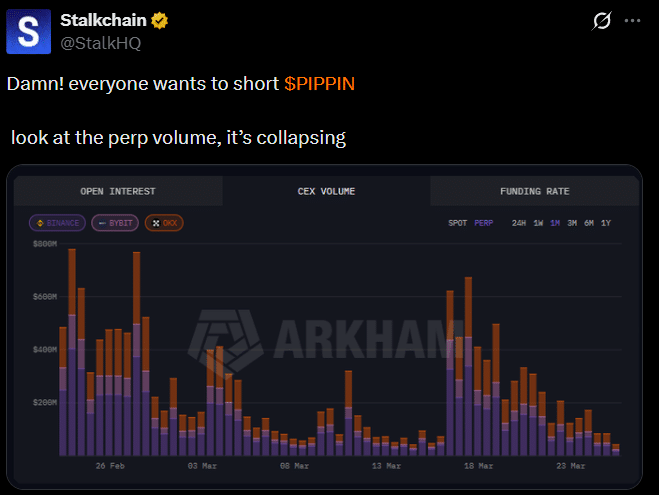
Source: X/StalkHQ

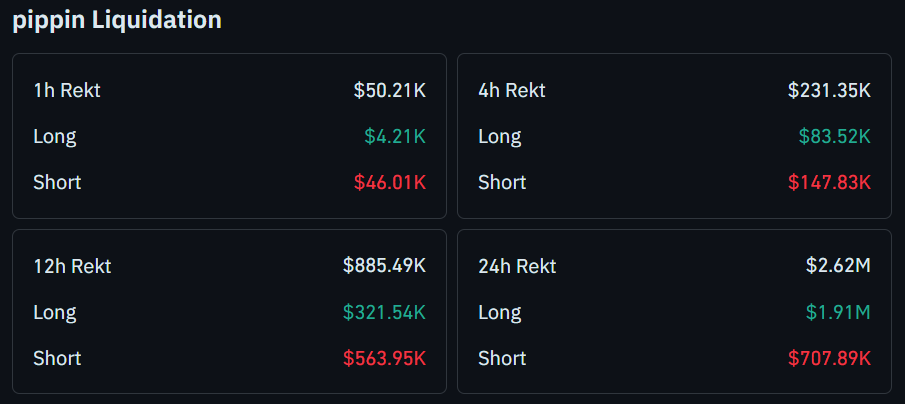
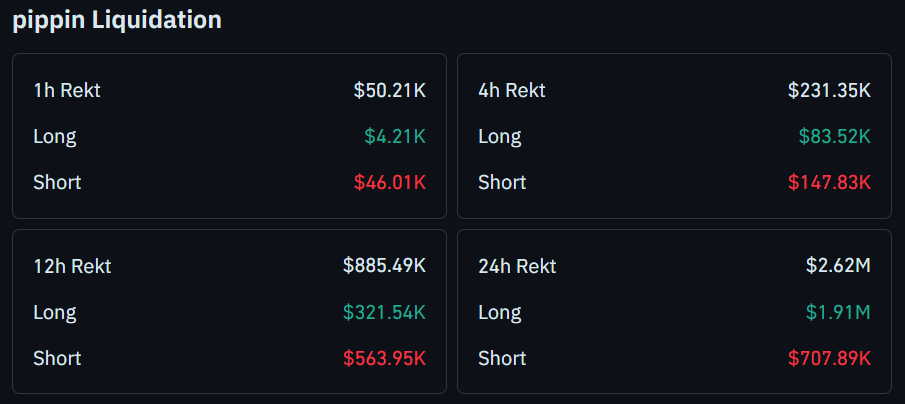
In fact, the derivatives tool CoinGlass revealed that over the past 24 hours, PIPPIN Futures have recorded massive liquidations totaling $2.62 million.

Of this, $1.91 million came from long-leveraged positions, while short positions recorded only $707.89K in liquidations during the same period.

This wave of liquidations has strong potential to influence market participants, and may trigger additional selling pressure.
Source: CoinGlass

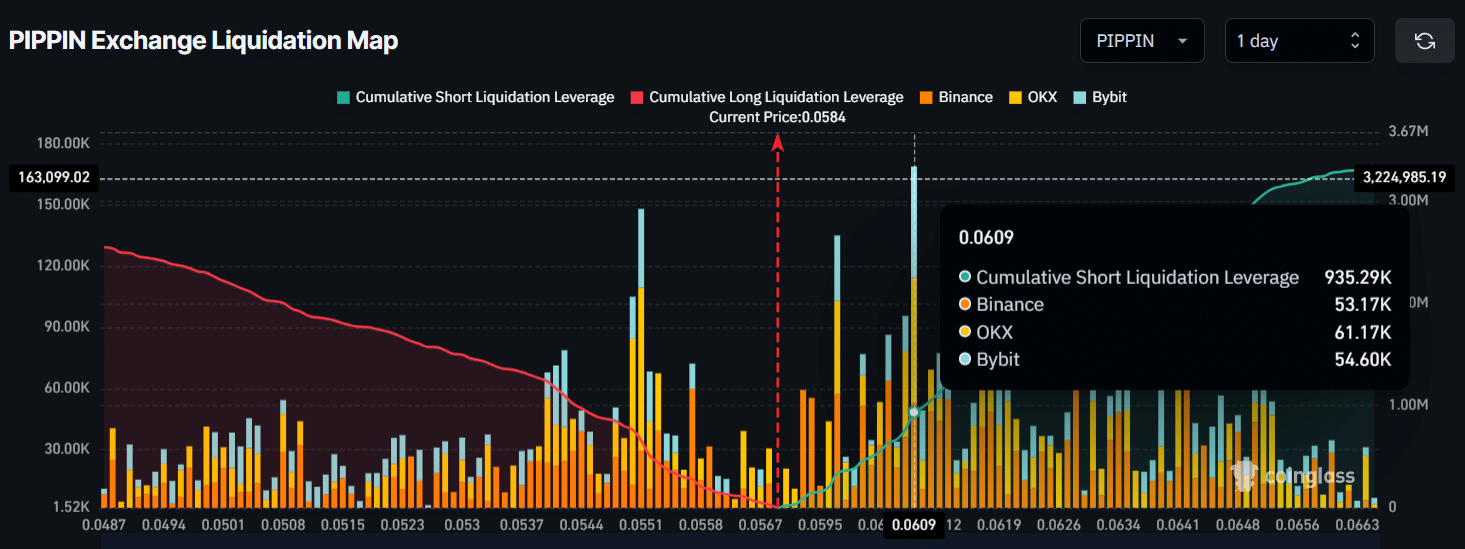
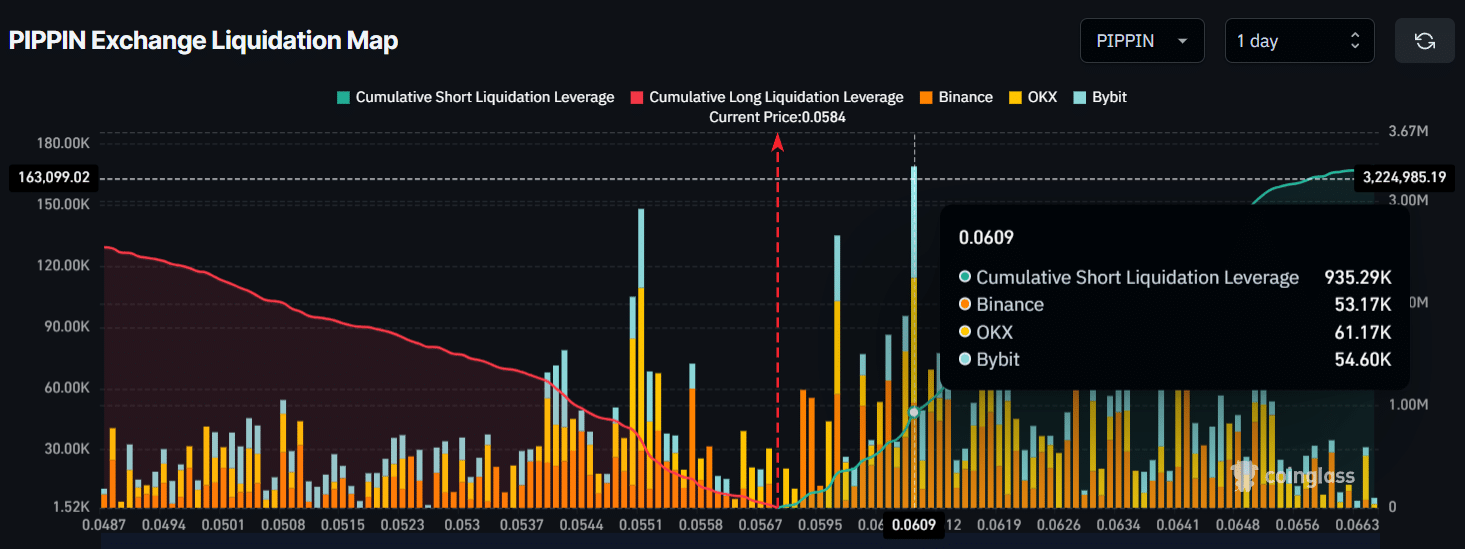
$0.0551 (support) and $0.0609 (resistance) are key levels where traders seem to be heavily overleveraged. At these levels, traders have built $658K in long positions and $935.29K in short positions, indicating that sellers are still in control.
Source: CoinGlass

Another major factor behind the massive price crash appears to be broader market sentiment, which is still bearish due to the ongoing West Asia crisis.

Meanwhile, PIPPIN’s overall trend remained downward at the time of writing, a structure it has maintained since the 26th of February 2026. Currently, it has lost more than 92% of its value, while its market capitalization has plummeted by over $783.12 million.

PIPPIN: Daily chart signals potential reversal

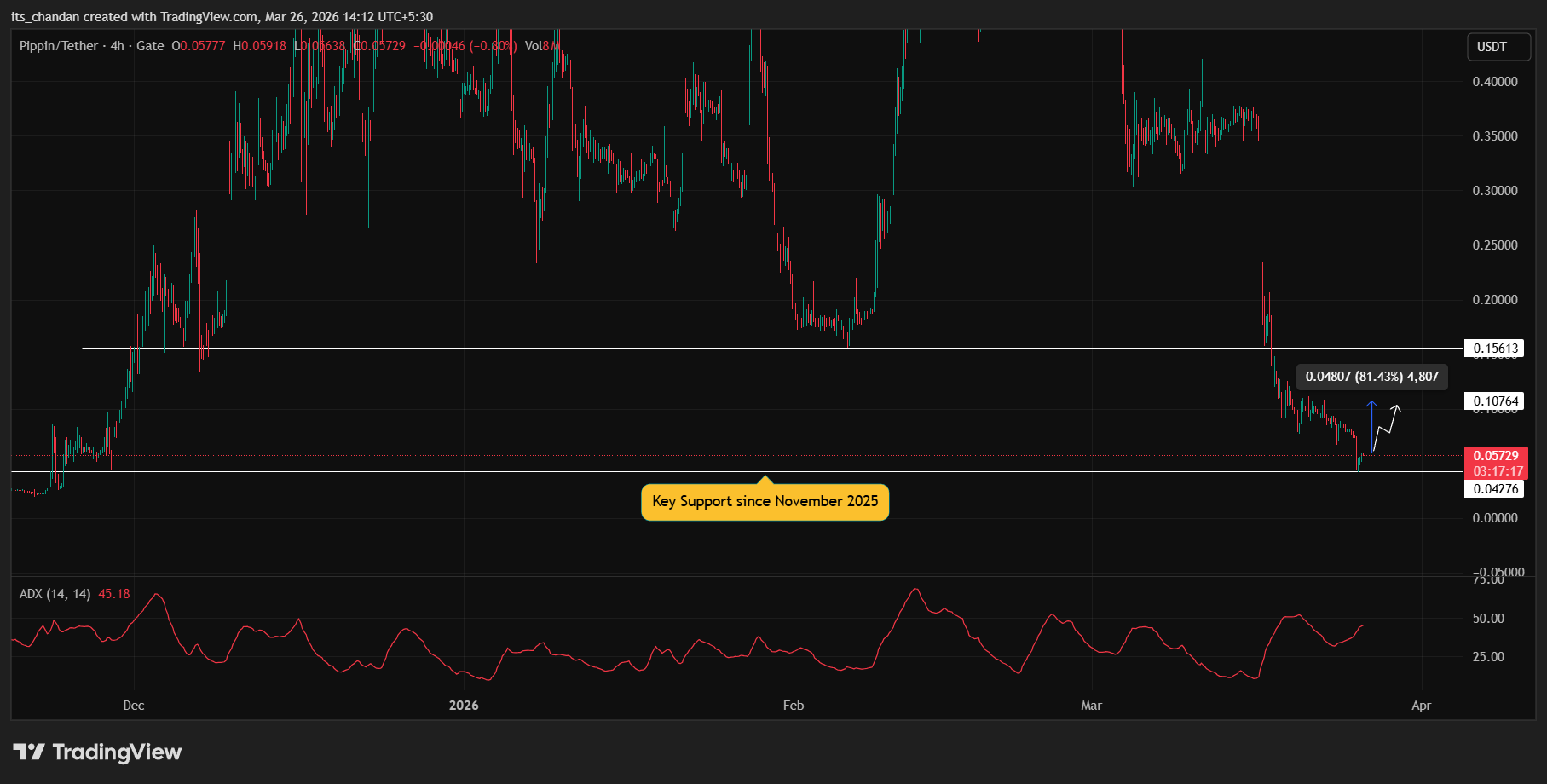
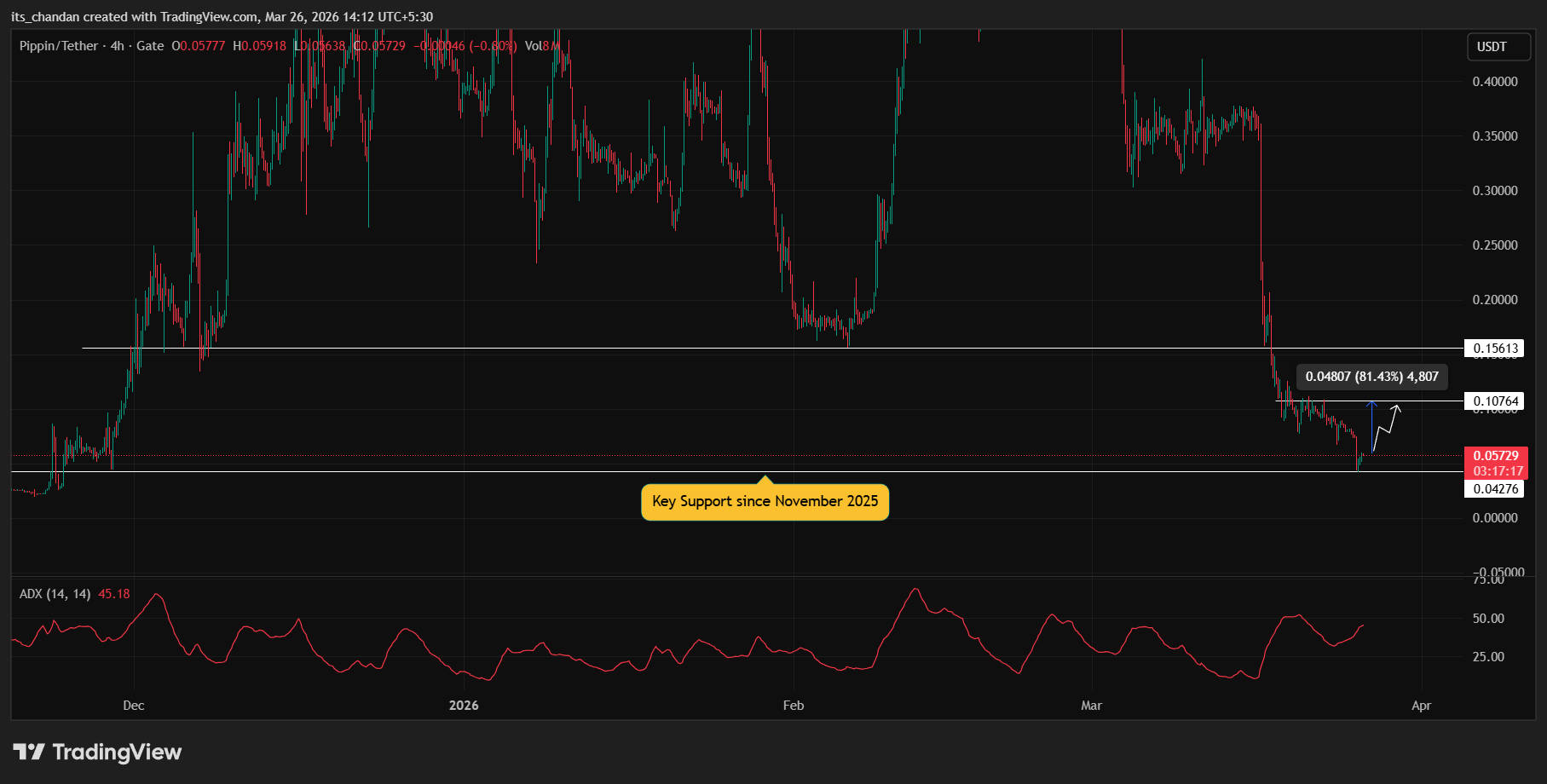
On the four-hour chart, PIPPIN appeared to be rebounding, as the price seemed to be reversing after reaching the key support level of $0.0427, which it has been holding since November 2026.

The 26th of March marks the first time the price has revisited this level since November 2026, when it previously surged significantly from the same zone.
Source: TradingView

If PIPPIN sustains above the $0.0427 level, the chances of a potential market rebound are high. If that happens, the asset could see a strong price surge of over 81% and may reach the $0.107 level.

Notably, the price has already jumped over 36% today from the key support level of $0.0427.

On the other hand, the price decline could continue if PIPPIN fails to hold this key support level.

As of now, the technical indicator Average Directional Index (ADX), which measures trend strength, has reached 45, well above the key threshold of 25, indicating strong directional momentum.


Final Summary

  • With a 33% price crash, PIPPIN has lost a massive 92% of its value over the past month.
  • Price action hints at a potential reversal if PIPPIN remains above the $0.0427 level.

Criptos en tendencia

Preguntas relacionadas

QWhat was the percentage drop in PIPPIN's price and the amount wiped from its market cap in a single day?

APIPPIN's price crashed by over 33% in a single day, wiping out $37.35 million from its market capitalization.

QAccording to analytics tool Stalkchain, what significant activity was recorded in PIPPIN before the crash?

AStalkchain reported a massive buildup of short positions in PIPPIN before the crash occurred.

QWhat are the key support and resistance levels mentioned for PIPPIN, and what do the leveraged positions at these levels indicate?

AThe key levels are $0.0551 (support) and $0.0609 (resistance). At these levels, traders have built $658K in long positions and $935.29K in short positions, indicating that sellers are still in control.

QWhat is the critical support level that, if held, could lead to an 81% price surge for PIPPIN?

AThe critical support level is $0.0427. If PIPPIN sustains above this level, it could see a strong price surge of over 81% to reach the $0.107 level.

QWhat does the high reading of the Average Directional Index (ADX) technical indicator suggest about PIPPIN's trend?

AThe ADX indicator reached a reading of 45, which is well above the key threshold of 25, indicating that there is strong directional momentum in the current trend.

Lecturas Relacionadas

Manus Buyback Plan Emerges: Chinese Investors Plan to Repurchase Equity with $2 Billion, Path to Hong Kong IPO Becomes Clearer

According to a report by The Information, early Chinese investors of Manus, including Tencent, Sequoia Capital China, and ZhenFund, are planning to repurchase the company from Meta for $2 billion—the same price Meta paid in its acquisition last December. This move is a direct response to the Chinese government's prohibition of the foreign acquisition in April. As part of the repurchase plan, Manus is considering establishing a Sino-foreign joint venture within China. This structure is seen as a way to ensure regulatory compliance for its Chinese investors and to pave the way for a future IPO in Hong Kong. Notably, U.S. investor Benchmark will not participate in the buyback, which will concentrate ownership even more among Chinese capital. Since its acquisition by Meta, Manus's business has grown rapidly, with its annualized revenue run rate reportedly increasing four-to-fivefold to $400-$500 million in roughly six months. This strong growth underpins the investors' willingness to repurchase at the original price. Financially, the forced unwinding of the deal may benefit the early investors, allowing them to regain equity at a cost far below the company's current implied valuation, with the added prospect of an independent future listing. However, specific terms of the repurchase, including funding proportions and the joint venture's equity structure, are still under negotiation. This "repurchase-joint venture-Hong Kong IPO" approach could serve as a reference model for other Chinese AI startups navigating cross-border M&A regulations.

marsbitHace 27 min(s)

Manus Buyback Plan Emerges: Chinese Investors Plan to Repurchase Equity with $2 Billion, Path to Hong Kong IPO Becomes Clearer

marsbitHace 27 min(s)

STRC Loses Peg by 11%, Can Strategy's Perpetual Motion Machine Keep Running?

The article discusses the significant and concerning depegging of MicroStrategy's (MSTR) preferred stock, STRC. Designed to trade near its $100 target par value, STRC has recently fallen sharply, reaching a low of $83.26 and closing at $88.59, representing an over 11% discount. STRC is a core component of MicroStrategy's financial strategy. As a perpetual preferred stock, it allows the company to raise capital through an "at-the-market" (ATM) issuance program without diluting common shareholders (MSTR). This capital is primarily used to purchase Bitcoin, creating a "capital flywheel": issuing STRC → raising cash → buying BTC → increasing net assets → supporting STRC's value. The flywheel's operation depends on STRC maintaining its $100 price. To enforce this, MicroStrategy employs a dynamic dividend mechanism, recently raising the rate to 11.5% and increasing payout frequency. However, this has failed to halt the depegging, indicating market concerns extend beyond yield. Analysts cite two main reasons. First, technical factors like forced liquidations from leveraged arbitrage trades may have exacerbated the sell-off. Second, and more fundamentally, is waning confidence in MicroStrategy's financial resilience. A JPMorgan report highlighted the company's limited cash relative to its ~$1.7 billion annual dividend obligation, raising liquidity concerns. While MicroStrategy counters that its massive Bitcoin holdings provide decades of coverage, this argument relies on the potential need to sell BTC—a departure from its long-standing "never sell" narrative. The company's recent sale of a small amount of Bitcoin for "testing," despite being framed as minor, has intensified these fears. The persistent depegging threatens to cripple MicroStrategy's primary funding channel. If STRC remains discounted, the company's ability to fund further Bitcoin purchases weakens. Should cash reserves dwindle while financing is constrained, the market may increasingly price in the risk of MicroStrategy becoming a forced seller of Bitcoin to meet obligations. This shift from a major marginal buyer to a potential seller could pose significant downside risk to the broader Bitcoin market.

链捕手Hace 35 min(s)

STRC Loses Peg by 11%, Can Strategy's Perpetual Motion Machine Keep Running?

链捕手Hace 35 min(s)

Behind the AI Scorecards Lies a Chinese 'Question Setter'

Behind the AI scorecards that dominate industry discussions—benchmarks like MMLU-Pro, MMMU, and MMMU-Pro—stands a Chinese-Canadian researcher: Wenhu Chen. As an assistant professor at the University of Waterloo and founder of the TIGER Lab, Chen has become a key "exam-setter" for evaluating large language and multimodal models. Chen first gained broader recognition with MMLU-Pro, a more challenging and stable update to the popular MMLU benchmark. As top models like OpenAI’s o3 began achieving near-perfect scores on the original MMLU, it became difficult to distinguish their true capabilities. MMLU-Pro introduced more complex reasoning questions, expanded answer choices, and filtered out ambiguous or simple items, effectively reintroducing differentiation among state-of-the-art models. His work on MMMU addressed the evaluation of multimodal models, requiring them to integrate visual information (like charts, diagrams, or tables) with textual knowledge across diverse academic subjects. Even the strongest models initially scored only around 56-59%, highlighting significant room for improvement in genuine multimodal reasoning. MMMU-Pro further refined this by preventing models from bypassing visual cues. Chen’s research focus has long been on complex information understanding and reasoning. His background—including a PhD at UC Santa Barbara, research at Google/DeepMind on Gemini, and now a role in Meta’s superintelligence lab—provides deep insight into model development and their potential weaknesses. His TIGER Lab also builds models (e.g., for video understanding and generation), ensuring his evaluation benchmarks are grounded in practical challenges. While AI headlines often spotlight company leaders and product launches, Chen’s work exemplifies the critical, behind-the-scenes contributions of researchers crafting the rigorous standards that define and drive progress in AI capabilities.

marsbitHace 1 hora(s)

Behind the AI Scorecards Lies a Chinese 'Question Setter'

marsbitHace 1 hora(s)

Trading

Spot
Futuros

Artículos destacados

Cómo comprar PIPPIN

¡Bienvenido a HTX.com! Hemos hecho que comprar pippin (PIPPIN) sea simple y conveniente. Sigue nuestra guía paso a paso para iniciar tu viaje de criptos.Paso 1: crea tu cuenta HTXUtiliza tu correo electrónico o número de teléfono para registrarte y obtener una cuenta gratuita en HTX. Experimenta un proceso de registro sin complicaciones y desbloquea todas las funciones.Obtener mi cuentaPaso 2: ve a Comprar cripto y elige tu método de pagoTarjeta de crédito/débito: usa tu Visa o Mastercard para comprar pippin (PIPPIN) al instante.Saldo: utiliza fondos del saldo de tu cuenta HTX para tradear sin problemas.Terceros: hemos agregado métodos de pago populares como Google Pay y Apple Pay para mejorar la comodidad.P2P: tradear directamente con otros usuarios en HTX.Over-the-Counter (OTC): ofrecemos servicios personalizados y tipos de cambio competitivos para los traders.Paso 3: guarda tu pippin (PIPPIN)Después de comprar tu pippin (PIPPIN), guárdalo en tu cuenta HTX. Alternativamente, puedes enviarlo a otro lugar mediante transferencia blockchain o utilizarlo para tradear otras criptomonedas.Paso 4: tradear pippin (PIPPIN)Tradear fácilmente con pippin (PIPPIN) en HTX's mercado spot. Simplemente accede a tu cuenta, selecciona tu par de trading, ejecuta tus trades y monitorea en tiempo real. Ofrecemos una experiencia fácil de usar tanto para principiantes como para traders experimentados.

665 Vistas totalesPublicado en 2025.01.11Actualizado en 2026.06.02

Cómo comprar PIPPIN

Discusiones

Bienvenido a la comunidad de HTX. Aquí puedes mantenerte informado sobre los últimos desarrollos de la plataforma y acceder a análisis profesionales del mercado. A continuación se presentan las opiniones de los usuarios sobre el precio de PIPPIN (PIPPIN).

活动图片