Pacific 'Fever': How Extreme Weather Becomes Wall Street's ATM?

链捕手Publicado a 2026-07-08Actualizado a 2026-07-08

Resumen

"Pacific 'Fever': How Extreme Weather Becomes Wall Street's Piggy Bank" The article examines how the 2026-2027 El Niño, potentially the strongest since 1950, is not only disrupting global weather but also creating major financial opportunities. It links recent extreme events in China and worldwide to this climate phenomenon, which alters atmospheric patterns, increasing risks of floods, droughts, and heatwaves. The core narrative explores how financial markets capitalize on these disruptions. A hedge fund is raising $500 million specifically to bet on El Niño-affected crops like South African corn and Malaysian palm oil. Historically, such strategies have yielded massive profits. Examples include Richard Dennis ("Turtle Trader") making his first fortune in the 1970s soy boom triggered by El Niño's impact on Peruvian anchovies (a key fishmeal source), and Anthony Ward's cocoa empire built on superior weather intelligence. The 2024 cocoa price surge, driven by West African drought, enriched quantitative trend-following funds. Currently, markets are preemptively bidding up palm oil, rubber, and sugar futures based on anticipated future supply shocks, despite high current inventories. The article details El Niño's asymmetric global impacts: causing drought in Southeast Asia (hurting palm oil/rubber) and India (affecting sugar/cotton), but bringing beneficial rains to South American soy and sugarcane. Key metrics to watch include the Niño3.4 index, Indian monsoon data, and Mal...

Author: Jia Liu, Zhangsheng Beatz

It rained heavily and unexpectedly for several days in Tianjin. You'd leave home in sunshine only to get soaked halfway. A friend's flight to Shenzhen in the evening was canceled due to a typhoon, and all high-speed train tickets to Zhejiang direction were suspended.

Checking the news on the phone: rainfall exceeded 329 mm in just a few hours in Fushun, Liaoning. Residents in Fangchenggang, Guangxi, said it was the most severe flood in 20 years. Daily precipitation records were broken at seven national meteorological stations. The largest high-temperature warning in northern China was issued, with ground temperatures approaching 50°C in some places. In the first week of July, two to three typhoons were queuing up to form in the Western Pacific, with super typhoon 'Bavi' approaching the southeast coast.

Since the start of summer in 2026, the weather in China has clearly become more restless.

And it's not just us. Sea temperatures off the coast of Peru remain persistently warm, limiting anchovy catches, with fishmeal prices rising about 80% over the past year. As Southeast Asia enters the dry season, drought signals are strengthening, putting palm oil producing regions in Malaysia and Indonesia on edge. The crucial window for the Indian monsoon hasn't arrived yet, but markets are already betting it will be weak. Analysts have flagged Australian wheat planting area as potentially shrinking significantly.

These extreme weather changes are scattered across different continents, seemingly unrelated. But in fact, beyond the direct trigger mechanisms like monsoon moisture, tropical storm peripheral circulation, location, and topography, they most likely have all been influenced by the same storm:

ENSO, El Niño.

El Niño: The Pacific is Running a Fever

ENSO, translated in Chinese as El Niño–Southern Oscillation, is the largest interannual signal in Earth's climate system. Simply put, it describes the periodic changes between Pacific sea temperatures and atmospheric circulation.

Under normal conditions, the eastern equatorial Pacific is relatively cool, and the western part is relatively warm. Trade winds push warm water toward the western Pacific. But if the trade winds weaken, warm water flows back eastward, abnormally raising sea temperatures in the central and eastern Pacific, resulting in an El Niño.

Meteorological agencies judge whether an El Niño is occurring mainly by looking at a key region: the Niño3.4 region (a critical area in the equatorial central Pacific, understood as the "thermometer" for judging El Niño strength). If this region's temperature remains 0.5°C above the normal for several consecutive months, it's considered an El Niño state; if it's 2°C above, it's a super-strong level. 1997 and 2015 were two typical super-strong El Niño events.

This year's El Niño could become the strongest one since 1950.

On June 11, the U.S. National Oceanic and Atmospheric Administration (NOAA) officially issued an El Niño watch, confirming that El Niño conditions have emerged and are expected to strengthen through late 2026 to early 2027. They estimate a 63% probability of a super-strong El Niño occurring from November this year to January next year. The judgment from the Chinese Academy of Sciences' Institute of Atmospheric Physics is slightly more conservative, with a probability of over 70% for a moderate event and about 10% for a super-strong one.
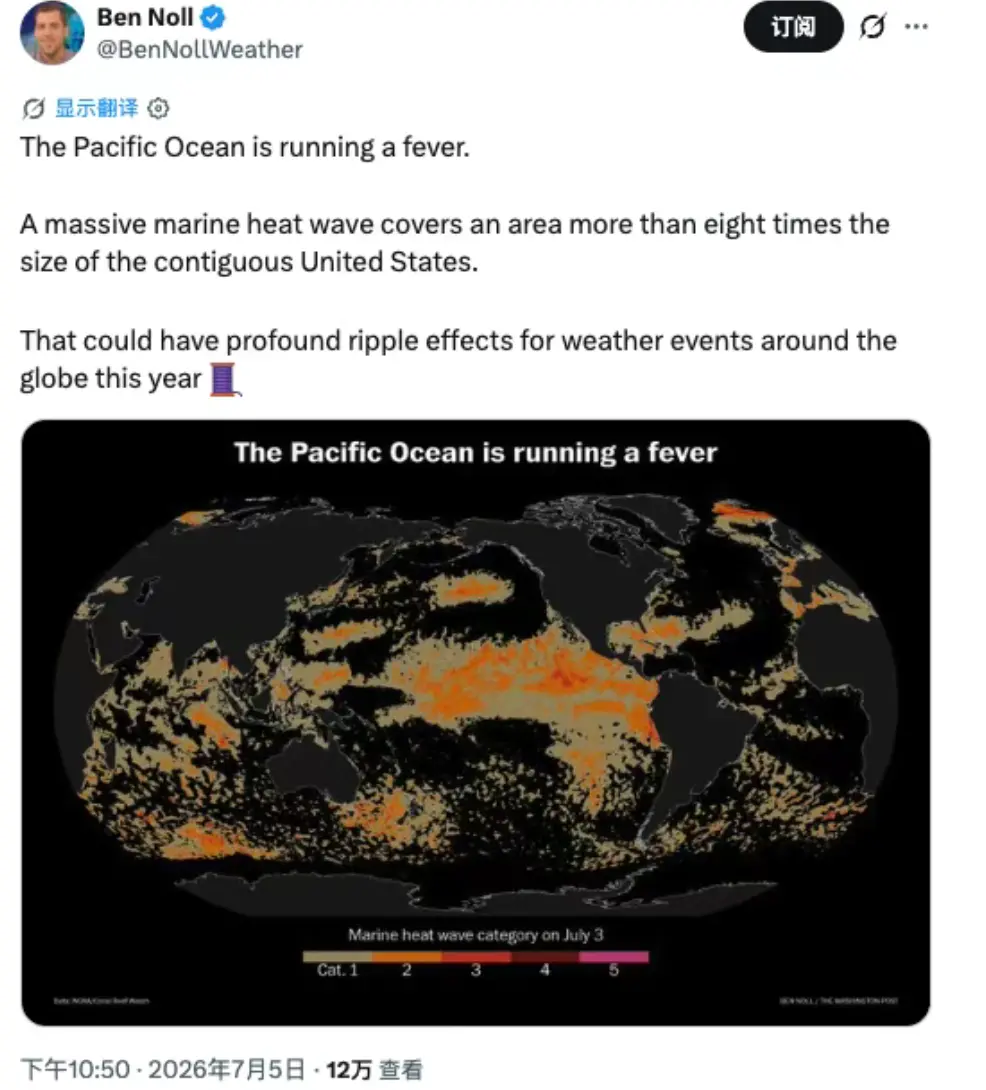
Meteorologist Ben Noll posted a Pacific sea temperature map on X with the caption "Pacific fever." Deep orange and red cover most of the Pacific on the map, showing the area of this marine heatwave exceeds 8 times the size of the contiguous United States.

For us, its impact is not "directly creating a specific rainstorm," but rather altering the underlying tone of atmospheric circulation. It influences the position of the Western Pacific Subtropical High, changes the path of water vapor transported by the East Asian Summer Monsoon, making rain belts more likely to deviate from their normal positions, and increasing the risk of high temperatures, droughts, and severe convection.

Compounded with global warming, for every 1°C increase in atmospheric temperature, its capacity to hold water vapor increases by about 7%. So today's El Niño isn't happening in a normal climate but against a backdrop that is already hotter, wetter, and more prone to extremes.

Here we have monsoons and typhoons, but over there in financial markets, some have already caught the scent, and funds are stirring.

On June 24, Bloomberg reported that hedge fund Moreton Capital Partners is raising $500 million for a dedicated vehicle. The assets targeted are agricultural products affected by El Niño, such as South African corn, Malaysian palm oil, and Australian wheat. Co-founder Les Finemore's rationale was simply: the market is vastly underestimating the risks brought by this year's El Niño.

Weather is no longer just background noise in a commodity portfolio; to some extent, it can stand alone as a separate theme for capital raising.

How can Finemore raise $500 million? Because profiting from extreme weather like El Niño isn't theoretical; people have been making big money from it for decades.

The First Fortune of the 'Turtle Trading' Founder

In 1972, the anchovies off the coast of Peru suddenly disappeared.

This tiny fish, about a dozen centimeters long, is something most people in the world will never eat, but when ground into fishmeal, it's one of the most important protein sources in global animal feed.

The disappearance of the anchovies was precisely because the equatorial Pacific waters suddenly warmed up. Cold water no longer upwelled, breaking the plankton chain. Meteorologists later named this phenomenon: El Niño.

With no fishmeal, feed manufacturers had to find substitutes, pushing up the price of soybean meal, which in turn drove up the price of soybeans.

At the Chicago Mercantile Exchange, a young trader not yet 26, Richard Dennis, saw prices hitting new highs and kept buying soybeans. In 1974, he made about $500,000 on soybeans and became a millionaire by year-end.
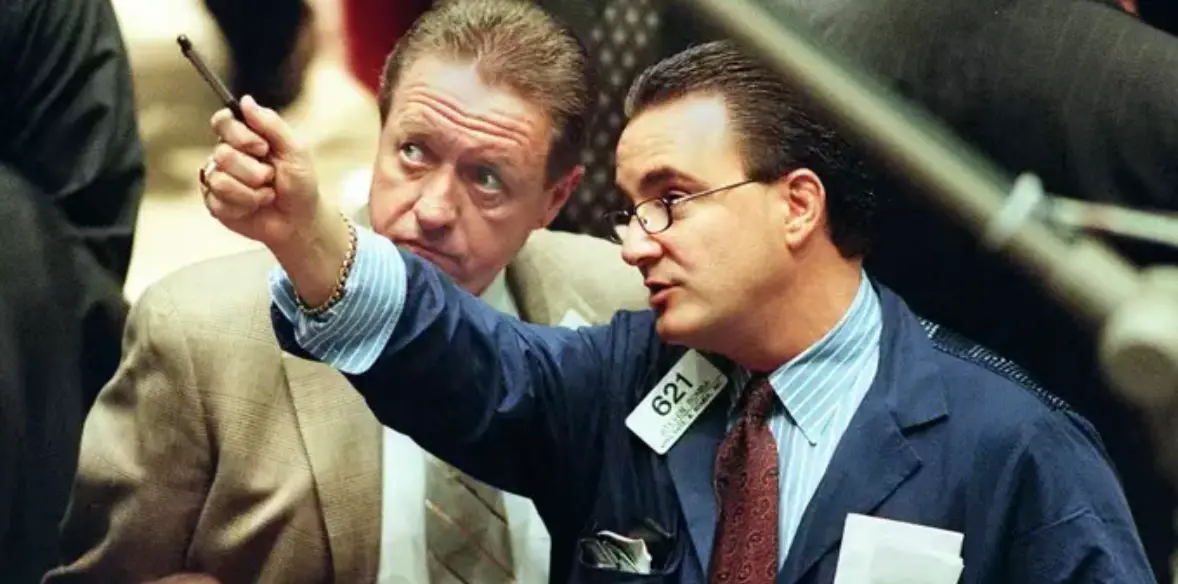
Richard Dennis in his youth

And this young trader, Richard Dennis, who made his first fortune, would later become the famous founder of the "Turtle Traders," his name enshrined as one of the patriarchs of trend trading.

Another classic story is that of Anthony Ward, nicknamed Chocfinger. He founded Armajaro in London in 1998, specializing in cocoa and coffee. What set this company apart was not its trading desk but its meteorology department: a proprietary weather station network, employing full-time meteorologists, and a research team of over 20 people in West African producing regions.

His logic: small weather changes could cause crop yields to fluctuate by 10%; whoever knows the weather first knows the price first. In 2002, he took three-quarters of the London exchange's cocoa delivery for the month, with a pre-tax profit of £10.4 million. On July 17, 2010, he received 240,100 tonnes of physical cocoa in one go, valued at £658 million, about 7% of global annual production, essentially all visible inventory in Europe at the time, pushing cocoa prices to their highest since 1977.

Let's look at some more recent examples.

In 2024, cocoa was the craziest commodity globally. West Africa's Côte d'Ivoire and Ghana, producers of 70% of the world's cocoa, suffered from abnormally high temperatures and dry Harmattan winds (a dry, hot wind blowing from the Sahara to the West African coast). Cocoa pods rotted on a large scale, compounded by disease, old trees, and low inventories. Cocoa futures rose over 400% in two years, briefly surpassing $10,000 per tonne.

Those who captured the bulk of this move weren't just cocoa industry players, but a group of quantitative trend funds. Razvan Remsing of Aspect Capital said it was their best first quarter in 25 years. AQR's managed futures strategy rose about 17.4% in Q1. Capital Fund Management's trend fund rose about 17.5%. Aspect's flagship fund was up 21.4% by late April. Winton, founded by David Harding, saw its diversified macro fund rise about 13% in Q1.

During the same period, besides making significant money on cocoa, Winton also made a lot on another front: El Niño typically brings warmer winters to parts of the U.S. A less cold winter means weaker heating demand for natural gas, inventories build up, and the U.S. natural gas benchmark price, Henry Hub (equivalent to Brent in the oil market), fell to near 30-year lows.

Bottom-Fishing Cocoa, or Sugar?

Back to 2026. This round of El Niño hasn't peaked yet, but the market has already front-run one wave.

Palm oil futures surged from 9400 yuan in late April to 9993 yuan before retreating. Rubber rose from its April low, briefly breaking 18300 yuan in mid-May. Sugar fluctuated repeatedly between 5200 and 5450 yuan. Peanuts rallied for seven consecutive sessions, supported by drought conditions and cost factors.

The strange thing is, the actual fundamentals of these commodities don't support the rise. Malaysian palm oil inventories were still increasing month-on-month by the end of May. Domestic sugar inventories in China were 1.83 million tonnes higher year-on-year. Domestic palm oil inventories were up 25.68% year-on-year. Production hasn't started falling yet, but prices rose first. The only reason for the rise is the anticipation of reduced yields 6 to 12 months later due to El Niño.

Over the past fifty years, every round of moderate or stronger El Niño has left its mark on commodity markets. In the 1982 round, palm oil rose 169%. From 2009 to 2010, Indonesian rubber production fell 11.3%, and spot prices rose 157.79% over two years. From 2015 to 2016, sugar rose 65%.
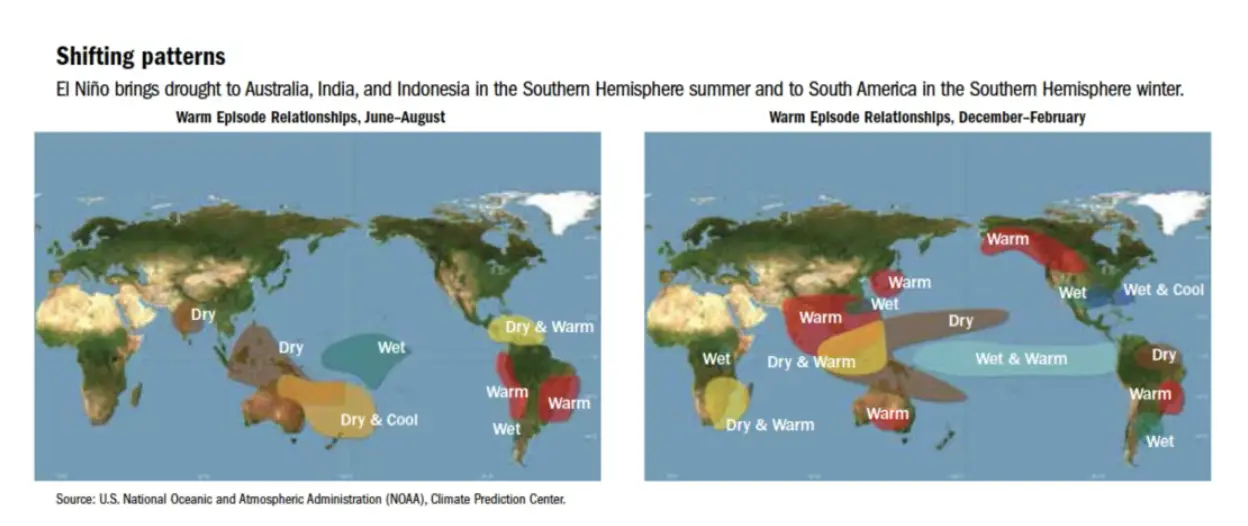
In Southeast Asia, it brings drought, suppressing palm oil and rubber yields. In India, it weakens the monsoon, affecting sugar and cotton. In Peru, it makes anchovies disappear, pushing up fishmeal prices. But at the other end of South America, it brings more rain, potentially improving soybean and sugarcane conditions in Brazil and Argentina. In the mining regions of Chile and Peru, heavy rainfall impacts not farmland but copper mines. In the U.S., a warm winter suppresses natural gas demand.

Overseas community discussions about this El Niño are still fermenting.
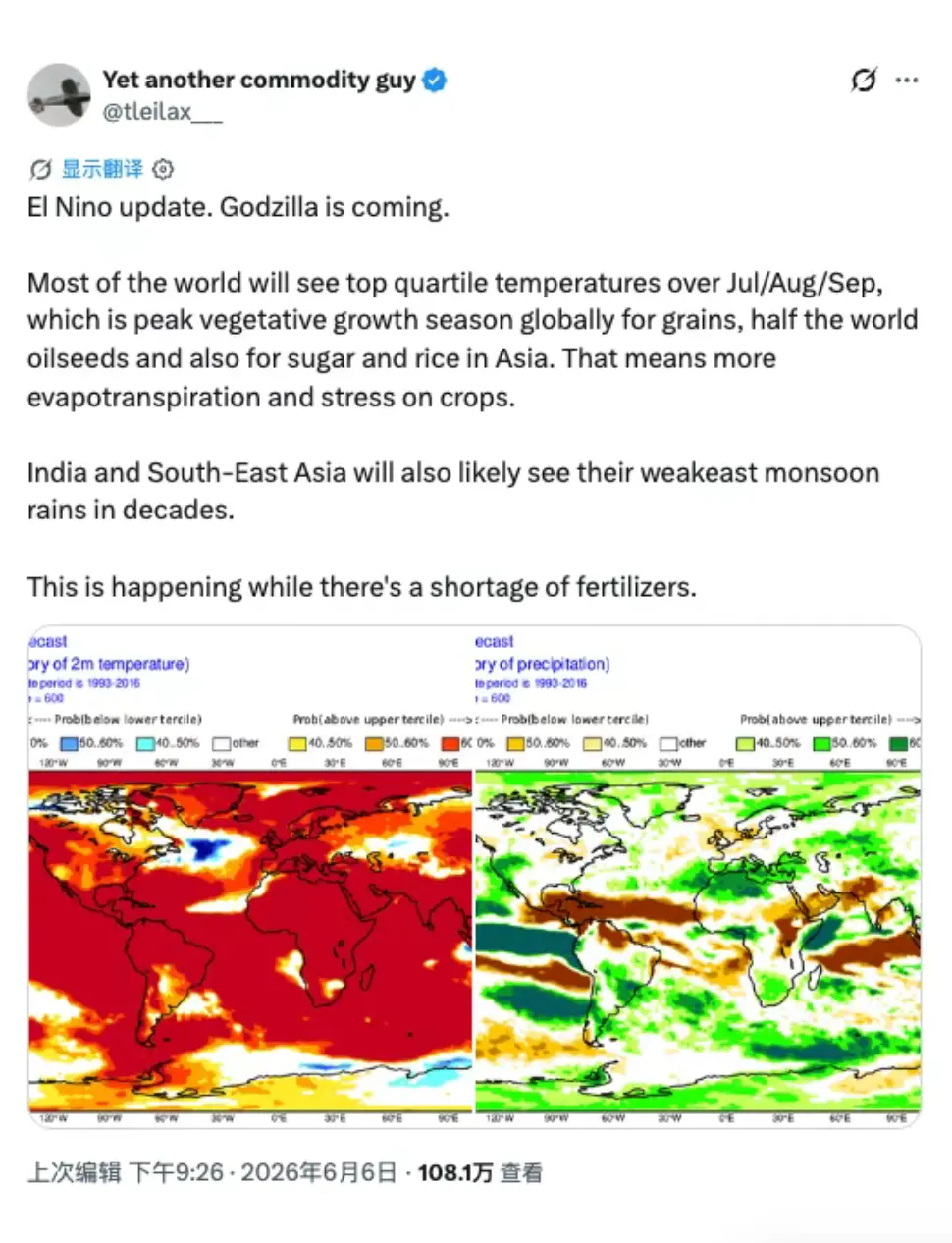
Commodities blogger @tleilax__ posted with two forecast maps. One map shows how much higher global temperatures from July to September this year are expected to be compared to the same period in previous years. The map is almost entirely red, and this timeframe coincides with the crucial growing period for grains, oilseeds, Asian rice, and sugar.

The other map shows whether rainfall will be higher or lower than the historical average for the same period. It shows large swathes of India and Southeast Asia as drier than usual, precisely matching the market's biggest fear: a weak monsoon.

His conclusion: India and Southeast Asia could experience the weakest monsoon rainfall in decades, and this is happening against a backdrop of a global fertilizer shortage. This post has garnered over 1.08 million views so far.

A commodities column on Substack listed palm oil, cotton, and cocoa as the cluster with the clearest risk-reward profile for the next 6 to 12 months. The Singapore investment community is scrutinizing Malaysian plantation stocks one by one, concluding that pure upstream planters capture the full elasticity, while companies like Wilmar International, focused on midstream and downstream processing, get their margins squeezed by rising palm oil prices. The U.S. stock community is circulating an even more nuanced argument: Adecoagro, an agricultural company in Brazil and Argentina, is a "weather hedge for tech-heavy portfolios" because El Niño brings rain, not drought, to South America; its output expands while Asia's production declines, pushing up prices.

The script for this round's market move is still largely unwritten, so it's not necessarily better to buy earlier. There aren't many hard indicators that can change position direction, but each is crucial:

  • Whether the Niño3.4 index breaks above 2.0°C in autumn/winter. This is the dividing line between moderate and super-strong, and the switch for overall agricultural volatility to step up.

  • Indian monsoon rainfall data from June to September. The steering wheel for the sugar, cotton, and rice group of commodities.

  • Monthly inventory reports from the Malaysian Palm Oil Board. The speed at which high inventories are drawn down determines when the expected market move connects with the actual market move.

  • Rainfall in Guangxi, China, in July and the consecutive days of high temperatures in North China. The former governs sugar, the latter electricity.

  • The subsequent fundraising scale of weather-focused funds like Moreton. The volume of institutional capital determines whether weather trading is a short-lived pulse or a year-long theme.

The experiences of 1972 and 2024 point to the same time lag: the real price effects of El Niño mostly occur after the event's peak. Dennis made his money two years after the anchovy collapse. Cocoa truly exploded after ENSO turned neutral. In the second half of 2026, the market is trading on expectations; in 2027, it will trade on the actual production shortfall itself.

At First, No One Cared About This Storm

Beyond these trading opportunities, what's more thought-provoking are two highly shared posts on X by finance blogger @FinanceLancelot.
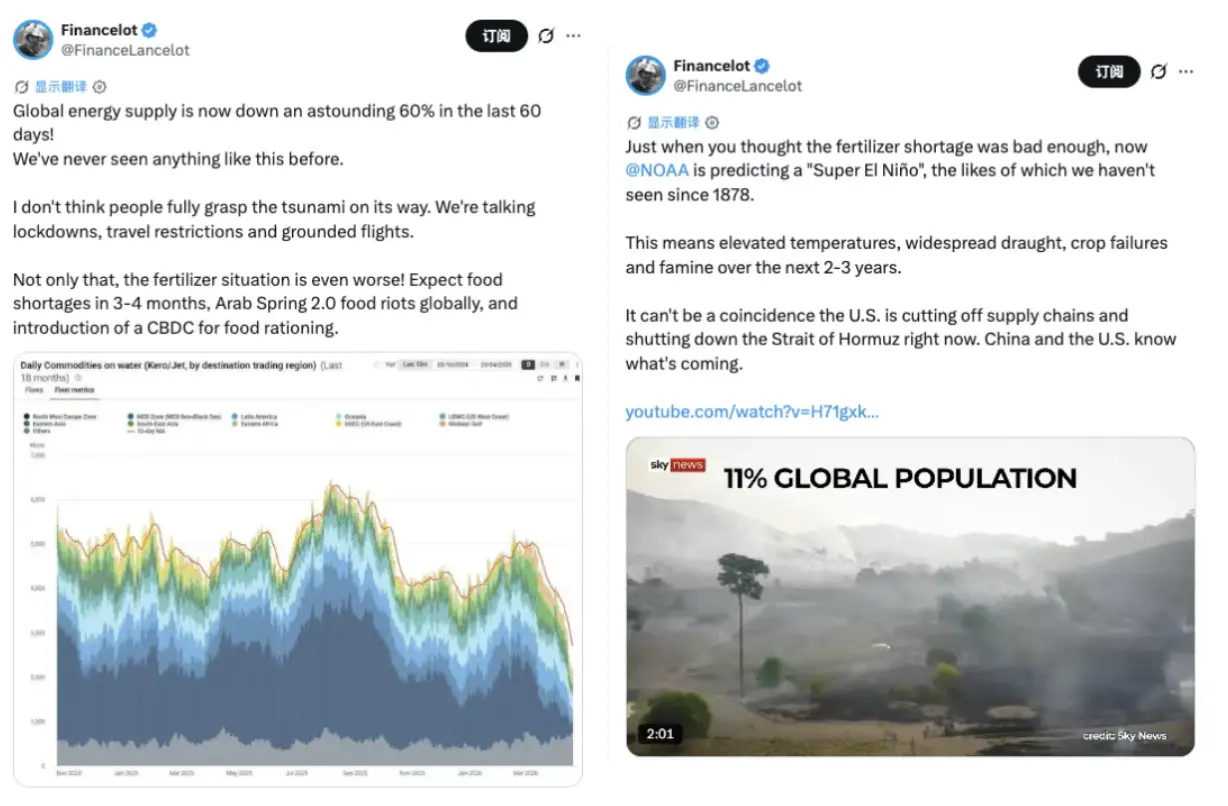
One said NOAA (the U.S. National Oceanic and Atmospheric Administration, one of the world's most frequently cited climate monitoring agencies) is predicting a "super El Niño" unseen since 1878, implying warming, widespread drought, crop failures, and famine risks over the next two to three years. It was accompanied by a Sky News video titled "11% of the global population."

Another post expressed a similar view: global energy and maritime supply has fallen 60% in the past 60 days, accompanied by a shipping oil product flow chart showing a cliff-like drop from the start of the year. His conclusion: fertilizer shortages coupled with El Niño could lead to food shortages globally within 3 to 4 months.

The wording of these posts carries obvious doomsday overtones and shouldn't be taken at face value.

But they reflect one thing: a group of people in the market are already weaving a narrative connecting El Niño, energy supply disruptions, fertilizer shortages, and tensions in the Strait of Hormuz. And this narrative is gaining traction and attention.

More importantly, this narrative points not just to gains and losses in futures accounts, but to potential impacts on the lives of ordinary people, adding to everyone's cost of living.

At first, no one cared about this storm. It was just a typhoon, a downpour, a slight rise in sea temperature.

But the storm doesn't stop just because no one cares. The heavy rains around the world, the canceled flights, the disappearing anchovies in Peru, the rotting cocoa pods in Ghana, the sugar shortages—these are already part of the storm, destined to land in the lives of different people.


Criptos en tendencia

Preguntas relacionadas

QWhat is ENSO (El Niño-Southern Oscillation) and how does it act as a 'fever' for the Pacific, according to the article?

AENSO describes the periodic variation in sea surface temperatures and atmospheric circulation in the Pacific Ocean. During an El Niño event, weakened trade winds allow warm water to flow back east, causing abnormally high sea temperatures in the central-eastern Pacific. The article metaphorically calls this a 'fever' for the Pacific, referencing a scientist's post showing a vast area of deep orange and red on a sea temperature map, indicating a massive oceanic heatwave.

QWho was Richard Dennis and how did his first major profit relate to an El Niño event?

ARichard Dennis was a young trader who later became famous as a founder of the 'Turtle Traders.' His first major profit came in the 1970s by trading soybeans. The price surge was indirectly caused by an El Niño event off Peru, which devastated the anchovy population. As fishmeal (made from anchovies) became scarce and expensive, feed manufacturers switched to soybean meal, driving up soybean prices. Dennis capitalized on this trend, making around $500,000 and becoming a millionaire by the end of 1974.

QWhat are some of the key financial indicators or data points that traders are watching to gauge the impact of the 2026 El Niño on commodity markets?

ATraders are monitoring several key indicators: 1) Whether the Niño3.4 index exceeds 2.0°C in autumn/winter, marking a shift to a strong El Niño. 2) India's monsoon rainfall data from June to September, crucial for sugar, cotton, and rice. 3) Monthly stock reports from the Malaysian Palm Oil Board to see if high inventories are decreasing. 4) Rainfall in Guangxi, China, and the duration of heatwaves in North China, affecting sugar and electricity demand. 5) The fundraising scale of weather-focused funds like Moreton Capital Partners, indicating institutional interest.

QHow does the article illustrate the time lag between an El Niño event and its full impact on commodity prices?

AThe article highlights that the most significant price effects often occur after the El Niño peaks, not during its initial development. For example, Richard Dennis profited from the 1972-73 El Niño's impact on soybeans in 1974. Similarly, the 2024 cocoa price explosion happened after the ENSO cycle had turned neutral. The article suggests that for the 2026 event, the market in late 2026 is trading on anticipation, while 2027 will likely trade on the actual supply shortages and减产 (yield reduction) itself.

QBeyond specific trades, what broader, more alarming narrative is emerging in some financial communities regarding the 2026 El Niño, according to the article's conclusion?

AA broader, more alarming narrative is forming that connects several crises: the potential 'super El Niño,' a reported 60% drop in global energy and maritime shipping supplies, fertilizer shortages, and geopolitical tensions like those around the Strait of Hormuz. This narrative, promoted by some financial commentators, warns of widespread drought, crop failures, and the risk of global food shortages impacting '11% of the global population' within a few months, ultimately affecting the cost of living for ordinary people worldwide.

Lecturas Relacionadas

Bitcoin’s path to $80K may hinge on THIS hidden trend

Bitcoin's potential path toward $80,000 is influenced by conflicting market signals. Data shows the Coinbase Bitcoin Premium Index has recorded its longest-ever streak of consecutive negative premiums, indicating muted institutional demand or net selling from U.S. institutions. While such a trend often signals short-term weakness, it doesn't necessarily forecast a long-term bear market. Additionally, a bearish crossover occurred in Bitcoin's Net Unrealized Profit/Loss (NUPL), with its short-term average falling below the longer-term average, suggesting declining investor profitability and waning market momentum. Historically, major bear market bottoms saw the 100-day NUPL drop below zero, but this cycle it remains positive, implying either an unprecedented bottom or a further decline is needed. Currently trading around $63,148, Bitcoin has seen weekly gains but remains below its May peak. Technical indicators present a mixed picture: the MACD shows bullish momentum, while the RSI signals bearish pressure. A positive development is the return of inflows to Bitcoin ETFs after eight weeks of outflows. Analysts hold divergent views; some highlight a key liquidity zone between $48,000-$50,000 where a market bottom could form, while others maintain a more optimistic long-term outlook. Ultimately, while some bullish signs exist, a strong push from institutional investors appears crucial for Bitcoin to challenge the $80,000 level.

ambcryptoHace 14 min(s)

Bitcoin’s path to $80K may hinge on THIS hidden trend

ambcryptoHace 14 min(s)

Unexpected Weak Non-Farm Payrolls Data Pushes BTC to Rebound 11%, FOMC Minutes to Test the Narrative of This Rally

Bitcoin has rebounded 11% from its 21-month low, but the sustainability of this rally hinges entirely on the Federal Reserve's release of the June FOMC meeting minutes. The bounce was triggered by a weaker-than-expected US jobs report, which showed only 57,000 jobs added in June—about half of economists' forecasts. This data prompted traders to scale back bets on further Fed rate hikes, fueling a rally in Bitcoin alongside gold and stocks. The upcoming minutes are critical. They will reveal whether Fed officials, in their mid-June meeting, were already expressing concerns about a weakening labor market, tight credit conditions, or the risks of overtightening—factors that would support the market's recent dovish shift. Conversely, if the discussion focused on persistent inflation and the conditions for more rate hikes, the rally's foundational narrative would crumble. Market indicators show the rebound's fragility. While US spot Bitcoin ETFs saw a significant single-day inflow, it followed a prolonged period of outflows. On-chain data indicates a substantial increase in Bitcoin being moved to exchanges, creating potential sell pressure. Options market positioning suggests key price levels around $60,000 and $62,000 that could either stabilize or accelerate price movement. In essence, Bitcoin's 11% gain is built on speculation about the Fed's private deliberations three weeks ago. The FOMC minutes will replace that speculation with concrete details, and the discrepancy between market expectations and the actual record will determine whether Bitcoin holds above $64,000 or falls back toward $58,000.

marsbitHace 24 min(s)

Unexpected Weak Non-Farm Payrolls Data Pushes BTC to Rebound 11%, FOMC Minutes to Test the Narrative of This Rally

marsbitHace 24 min(s)

Just Now, The World's First Ultra-High-Frame World Model Was Born, Nvidia Content 0, Racing to 50 FPS

Just Now, Global First Ultra-High-Frame World Model Born, 0% NVIDIA, Speeds to 50 FPS A Chinese team has developed MoWorld, the world's first Flash World Model, achieving real-time interactive inference exceeding 50 FPS. Crucially, it is entirely built on domestic NPUs (National Processing Units), bypassing NVIDIA GPUs. Developed by Moxin Technology in collaboration with Zhejiang University's Pan Yunhe academician team, MoWorld represents a complete, closed-loop system from training and distillation to deployment on domestic computing power. The model tackles the critical industry bottleneck of real-time performance, essential for applications like robotics, gaming, and digital worlds. MoWorld achieves this through a full-stack redesign for NPUs, including a proprietary 3D-annotated data pipeline, system-level optimizations for long-sequence training (up to 2000 frames), and inference optimizations like dynamic mixed-precision quantization. On a Huawei Ascend 910C platform, a 14B MoE parameter model achieves over 50 FPS, reducing typical inference costs by 70% compared to equivalent GPU solutions. This breakthrough lowers the deployment barrier, potentially accelerating the industrialization of world models. Key application areas include gaming/entertainment (offering 6-DoF camera control for immersive exploration), embodied AI/autonomous driving (providing a high-fidelity digital training ground), film pre-visualization, and 3D reconstruction/digital twins due to its strong geometric consistency. MoWorld demonstrates that a full-stack domestic compute ecosystem can support cutting-edge, real-time world models, positioning China at a competitive starting line in defining next-generation spatial intelligence standards. The project underscores a shift in competition from model scale to real-world usability and cost-effective deployment.

marsbitHace 1 hora(s)

Just Now, The World's First Ultra-High-Frame World Model Was Born, Nvidia Content 0, Racing to 50 FPS

marsbitHace 1 hora(s)

Pacific 'Fever': How Extreme Weather Becomes Wall Street's Cash Machine?

"Pacific Fever": How Extreme Weather Becomes Wall Street's ATM? The summer of 2026 sees unusually fierce weather across China and globally. The common driver behind this global pattern is a powerful El Niño event, potentially the strongest since 1950, as declared by NOAA. This phenomenon, characterized by warming central/eastern Pacific waters, disrupts global atmospheric circulation, raising risks of floods, droughts, and heatwaves, further intensified by climate change. For financial markets, especially commodities, El Niño is not just weather but a major trading theme. History shows its price impact is profound. In the 1970s, El Niño-driven anchovy collapse in Peru fueled a soybean boom, giving Richard Dennis his first million. Anthony Ward's cocoa empire was built on superior weather intelligence. Most recently in 2024, West African droughts caused cocoa prices to soar over 400%, delivering huge gains for trend-following hedge funds. In 2026, markets are again pricing in future El Niño-induced supply shocks. Despite high current inventories, prices for palm oil, rubber, and sugar have rallied on anticipation of upcoming Southeast Asian droughts and weak Indian monsoons. Analysts identify key indicators to watch: the Niño3.4 index, Indian monsoon rainfall, Malaysian palm oil stocks, and the fundraising scale of specialized weather funds like Moreton Capital. Beyond trading opportunities, a concerning narrative is gaining traction online, linking El Niño with fertilizer shortages and energy supply disruptions to warn of potential global food crises within months. While alarmist, it highlights a deeper truth: the cascading effects of climate-driven weather extremes ultimately translate into higher costs of living for everyone, far beyond the trading floor.

marsbitHace 1 hora(s)

Pacific 'Fever': How Extreme Weather Becomes Wall Street's Cash Machine?

marsbitHace 1 hora(s)

Just Now, OpenAI's Chief Futurist Departed, Once Called a Jackass by Musk

Just now, OpenAI's Chief Futurist, Joshua Achiam, announced his departure from the company via X. Having joined as a 25-year-old intern in 2017, he spent nine years at OpenAI, evolving from an AI safety research scientist to leading the Mission Alignment team. Earlier this year, that team was dissolved, and Achiam transitioned to the newly created role of Chief Futurist, positioned at the intersection of AI safety and policy to study AGI's long-term risks and opportunities. In his departure statement, Achiam called his time a "graduation," reflecting on the immense progress from AI that couldn't converse to systems solving scientific problems. He expressed optimism about a future of peace, prosperity, and possibility, closing with "To safe AGI." His tenure was notably marked by a 2018 incident where he publicly challenged Elon Musk—then still with OpenAI—on safety compromises if Musk pursued AGI at Tesla, leading Musk to call him a "jackass." This became an internal legend, with colleagues later giving him a trophy inscribed, "To safety, never stop being that jackass." Achiam's exit follows a pattern of prominent safety and alignment experts leaving OpenAI, including Jan Leike and others who joined rivals like Anthropic or started non-profits. His departure coincides with OpenAI's internal efforts to more tightly integrate its research and policy teams, and the recent hiring of former White House AI advisor Dean Ball. Achiam did not cite a specific reason for leaving but indicated it was a long-considered decision, stating the mission to ensure AGI benefits humanity can now be advanced beyond the "frontier lab's" walls.

marsbitHace 1 hora(s)

Just Now, OpenAI's Chief Futurist Departed, Once Called a Jackass by Musk

marsbitHace 1 hora(s)

Trading

Spot

Artículos destacados

Qué es $S$

Entendiendo SPERO: Una Visión General Completa Introducción a SPERO A medida que el panorama de la innovación continúa evolucionando, la aparición de tecnologías web3 y proyectos de criptomonedas juega un papel fundamental en la configuración del futuro digital. Un proyecto que ha atraído la atención en este campo dinámico es SPERO, denotado como SPERO,$$s$. Este artículo tiene como objetivo reunir y presentar información detallada sobre SPERO, para ayudar a entusiastas e inversores a comprender sus fundamentos, objetivos e innovaciones dentro de los dominios web3 y cripto. ¿Qué es SPERO,$$s$? SPERO,$$s$ es un proyecto único dentro del espacio cripto que busca aprovechar los principios de descentralización y tecnología blockchain para crear un ecosistema que promueva la participación, la utilidad y la inclusión financiera. El proyecto está diseñado para facilitar interacciones de igual a igual de nuevas maneras, proporcionando a los usuarios soluciones y servicios financieros innovadores. En su esencia, SPERO,$$s$ tiene como objetivo empoderar a los individuos al proporcionar herramientas y plataformas que mejoren la experiencia del usuario en el espacio de las criptomonedas. Esto incluye habilitar métodos de transacción más flexibles, fomentar iniciativas impulsadas por la comunidad y crear caminos para oportunidades financieras a través de aplicaciones descentralizadas (dApps). La visión subyacente de SPERO,$$s$ gira en torno a la inclusividad, buscando cerrar brechas dentro de las finanzas tradicionales mientras aprovecha los beneficios de la tecnología blockchain. ¿Quién es el Creador de SPERO,$$s$? La identidad del creador de SPERO,$$s$ sigue siendo algo oscura, ya que hay recursos públicos limitados que proporcionan información de fondo detallada sobre su(s) fundador(es). Esta falta de transparencia puede derivarse del compromiso del proyecto con la descentralización, una ética que muchos proyectos web3 comparten, priorizando las contribuciones colectivas sobre el reconocimiento individual. Al centrar las discusiones en torno a la comunidad y sus objetivos colectivos, SPERO,$$s$ encarna la esencia del empoderamiento sin señalar a individuos específicos. Como tal, comprender la ética y la misión de SPERO sigue siendo más importante que identificar a un creador singular. ¿Quiénes son los Inversores de SPERO,$$s$? SPERO,$$s$ cuenta con el apoyo de una diversa gama de inversores que van desde capitalistas de riesgo hasta inversores ángeles dedicados a fomentar la innovación en el sector cripto. El enfoque de estos inversores generalmente se alinea con la misión de SPERO, priorizando proyectos que prometen avances tecnológicos sociales, inclusión financiera y gobernanza descentralizada. Estas fundaciones de inversores suelen estar interesadas en proyectos que no solo ofrecen productos innovadores, sino que también contribuyen positivamente a la comunidad blockchain y sus ecosistemas. El respaldo de estos inversores refuerza a SPERO,$$s$ como un contendiente notable en el dominio de proyectos cripto que evoluciona rápidamente. ¿Cómo Funciona SPERO,$$s$? SPERO,$$s$ emplea un marco multifacético que lo distingue de los proyectos de criptomonedas convencionales. Aquí hay algunas de las características clave que subrayan su singularidad e innovación: Gobernanza Descentralizada: SPERO,$$s$ integra modelos de gobernanza descentralizada, empoderando a los usuarios para participar activamente en los procesos de toma de decisiones sobre el futuro del proyecto. Este enfoque fomenta un sentido de propiedad y responsabilidad entre los miembros de la comunidad. Utilidad del Token: SPERO,$$s$ utiliza su propio token de criptomoneda, diseñado para servir diversas funciones dentro del ecosistema. Estos tokens permiten transacciones, recompensas y la facilitación de servicios ofrecidos en la plataforma, mejorando la participación y la utilidad general. Arquitectura en Capas: La arquitectura técnica de SPERO,$$s$ apoya la modularidad y escalabilidad, permitiendo la integración fluida de características y aplicaciones adicionales a medida que el proyecto evoluciona. Esta adaptabilidad es fundamental para mantener la relevancia en el cambiante paisaje cripto. Participación de la Comunidad: El proyecto enfatiza iniciativas impulsadas por la comunidad, empleando mecanismos que incentivan la colaboración y la retroalimentación. Al nutrir una comunidad sólida, SPERO,$$s$ puede abordar mejor las necesidades de los usuarios y adaptarse a las tendencias del mercado. Enfoque en la Inclusión: Al ofrecer tarifas de transacción bajas e interfaces amigables para el usuario, SPERO,$$s$ busca atraer a una base de usuarios diversa, incluyendo a individuos que anteriormente pueden no haber participado en el espacio cripto. Este compromiso con la inclusión se alinea con su misión general de empoderamiento a través de la accesibilidad. Cronología de SPERO,$$s$ Entender la historia de un proyecto proporciona información crucial sobre su trayectoria de desarrollo y hitos. A continuación se presenta una cronología sugerida que mapea eventos significativos en la evolución de SPERO,$$s$: Fase de Conceptualización e Ideación: Las ideas iniciales que forman la base de SPERO,$$s$ fueron concebidas, alineándose estrechamente con los principios de descentralización y enfoque comunitario dentro de la industria blockchain. Lanzamiento del Whitepaper del Proyecto: Tras la fase conceptual, se lanzó un whitepaper completo que detalla la visión, los objetivos y la infraestructura tecnológica de SPERO,$$s$ para generar interés y retroalimentación de la comunidad. Construcción de Comunidad y Primeras Interacciones: Se realizaron esfuerzos de divulgación activa para construir una comunidad de primeros adoptantes y posibles inversores, facilitando discusiones en torno a los objetivos del proyecto y obteniendo apoyo. Evento de Generación de Tokens: SPERO,$$s$ llevó a cabo un evento de generación de tokens (TGE) para distribuir sus tokens nativos a los primeros seguidores y establecer liquidez inicial dentro del ecosistema. Lanzamiento de la dApp Inicial: La primera aplicación descentralizada (dApp) asociada con SPERO,$$s$ se puso en marcha, permitiendo a los usuarios interactuar con las funcionalidades centrales de la plataforma. Desarrollo Continuo y Alianzas: Actualizaciones y mejoras continuas a las ofertas del proyecto, incluyendo alianzas estratégicas con otros actores en el espacio blockchain, han moldeado a SPERO,$$s$ en un jugador competitivo y en evolución en el mercado cripto. Conclusión SPERO,$$s$ se erige como un testimonio del potencial de web3 y las criptomonedas para revolucionar los sistemas financieros y empoderar a los individuos. Con un compromiso con la gobernanza descentralizada, la participación comunitaria y funcionalidades diseñadas de manera innovadora, allana el camino hacia un paisaje financiero más inclusivo. Como con cualquier inversión en el espacio cripto que evoluciona rápidamente, se anima a los posibles inversores y usuarios a investigar a fondo y participar de manera reflexiva con los desarrollos en curso dentro de SPERO,$$s$. El proyecto muestra el espíritu innovador de la industria cripto, invitando a una mayor exploración de sus innumerables posibilidades. Mientras el viaje de SPERO,$$s$ aún se desarrolla, sus principios fundamentales pueden, de hecho, influir en el futuro de cómo interactuamos con la tecnología, las finanzas y entre nosotros en ecosistemas digitales interconectados.

118 Vistas totalesPublicado en 2024.12.17Actualizado en 2024.12.17

Qué es $S$

Qué es AGENT S

Agent S: El Futuro de la Interacción Autónoma en Web3 Introducción En el paisaje en constante evolución de Web3 y las criptomonedas, las innovaciones están redefiniendo constantemente cómo los individuos interactúan con las plataformas digitales. Uno de estos proyectos pioneros, Agent S, promete revolucionar la interacción humano-computadora a través de su marco agente abierto. Al allanar el camino para interacciones autónomas, Agent S busca simplificar tareas complejas, ofreciendo aplicaciones transformadoras en inteligencia artificial (IA). Esta exploración detallada profundizará en las complejidades del proyecto, sus características únicas y las implicaciones para el dominio de las criptomonedas. ¿Qué es Agent S? Agent S se presenta como un marco agente abierto innovador, diseñado específicamente para abordar tres desafíos fundamentales en la automatización de tareas informáticas: Adquisición de Conocimiento Específico del Dominio: El marco aprende inteligentemente de diversas fuentes de conocimiento externas y experiencias internas. Este enfoque dual le permite construir un rico repositorio de conocimiento específico del dominio, mejorando su rendimiento en la ejecución de tareas. Planificación a Largo Plazo de Tareas: Agent S emplea planificación jerárquica aumentada por la experiencia, un enfoque estratégico que facilita la descomposición y ejecución eficiente de tareas complejas. Esta característica mejora significativamente su capacidad para gestionar múltiples subtareas de manera eficiente y efectiva. Manejo de Interfaces Dinámicas y No Uniformes: El proyecto introduce la Interfaz Agente-Computadora (ACI), una solución innovadora que mejora la interacción entre agentes y usuarios. Utilizando Modelos de Lenguaje Multimodal de Gran Escala (MLLMs), Agent S puede navegar y manipular diversas interfaces gráficas de usuario sin problemas. A través de estas características pioneras, Agent S proporciona un marco robusto que aborda las complejidades involucradas en la automatización de la interacción humana con las máquinas, preparando el terreno para una multitud de aplicaciones en IA y más allá. ¿Quién es el Creador de Agent S? Si bien el concepto de Agent S es fundamentalmente innovador, la información específica sobre su creador sigue siendo elusiva. El creador es actualmente desconocido, lo que resalta ya sea la etapa incipiente del proyecto o la elección estratégica de mantener a los miembros fundadores en el anonimato. Independientemente de la anonimidad, el enfoque sigue siendo en las capacidades y el potencial del marco. ¿Quiénes son los Inversores de Agent S? Dado que Agent S es relativamente nuevo en el ecosistema criptográfico, la información detallada sobre sus inversores y patrocinadores financieros no está documentada explícitamente. La falta de información disponible públicamente sobre las bases de inversión u organizaciones que apoyan el proyecto plantea preguntas sobre su estructura de financiamiento y hoja de ruta de desarrollo. Comprender el respaldo es crucial para evaluar la sostenibilidad del proyecto y su posible impacto en el mercado. ¿Cómo Funciona Agent S? En el núcleo de Agent S se encuentra una tecnología de vanguardia que le permite funcionar de manera efectiva en diversos entornos. Su modelo operativo se basa en varias características clave: Interacción Humano-Computadora Similar a la Humana: El marco ofrece planificación avanzada de IA, esforzándose por hacer que las interacciones con las computadoras sean más intuitivas. Al imitar el comportamiento humano en la ejecución de tareas, promete elevar las experiencias de los usuarios. Memoria Narrativa: Empleada para aprovechar experiencias de alto nivel, Agent S utiliza memoria narrativa para hacer un seguimiento de las historias de tareas, mejorando así sus procesos de toma de decisiones. Memoria Episódica: Esta característica proporciona a los usuarios una guía paso a paso, permitiendo que el marco ofrezca apoyo contextual a medida que se desarrollan las tareas. Soporte para OpenACI: Con la capacidad de ejecutarse localmente, Agent S permite a los usuarios mantener el control sobre sus interacciones y flujos de trabajo, alineándose con la ética descentralizada de Web3. Fácil Integración con APIs Externas: Su versatilidad y compatibilidad con varias plataformas de IA aseguran que Agent S pueda encajar sin problemas en ecosistemas tecnológicos existentes, convirtiéndolo en una opción atractiva para desarrolladores y organizaciones. Estas funcionalidades contribuyen colectivamente a la posición única de Agent S dentro del espacio cripto, ya que automatiza tareas complejas y de múltiples pasos con una intervención humana mínima. A medida que el proyecto evoluciona, sus posibles aplicaciones en Web3 podrían redefinir cómo se desarrollan las interacciones digitales. Cronología de Agent S El desarrollo y los hitos de Agent S pueden encapsularse en una cronología que resalta sus eventos significativos: 27 de septiembre de 2024: El concepto de Agent S fue lanzado en un documento de investigación integral titulado “Un Marco Agente Abierto que Usa Computadoras Como un Humano”, mostrando las bases del proyecto. 10 de octubre de 2024: El documento de investigación fue puesto a disposición del público en arXiv, ofreciendo una exploración profunda del marco y su evaluación de rendimiento basada en el benchmark OSWorld. 12 de octubre de 2024: Se lanzó una presentación en video, proporcionando una visión visual de las capacidades y características de Agent S, involucrando aún más a posibles usuarios e inversores. Estos marcadores en la cronología no solo ilustran el progreso de Agent S, sino que también indican su compromiso con la transparencia y la participación comunitaria. Puntos Clave Sobre Agent S A medida que el marco Agent S continúa evolucionando, varios atributos clave destacan, subrayando su naturaleza innovadora y potencial: Marco Innovador: Diseñado para proporcionar un uso intuitivo de las computadoras similar a la interacción humana, Agent S aporta un enfoque novedoso a la automatización de tareas. Interacción Autónoma: La capacidad de interactuar de manera autónoma con las computadoras a través de GUI significa un salto hacia soluciones informáticas más inteligentes y eficientes. Automatización de Tareas Complejas: Con su metodología robusta, puede automatizar tareas complejas y de múltiples pasos, haciendo que los procesos sean más rápidos y menos propensos a errores. Mejora Continua: Los mecanismos de aprendizaje permiten a Agent S mejorar a partir de experiencias pasadas, mejorando continuamente su rendimiento y eficacia. Versatilidad: Su adaptabilidad en diferentes entornos operativos como OSWorld y WindowsAgentArena asegura que pueda servir a una amplia gama de aplicaciones. A medida que Agent S se posiciona en el paisaje de Web3 y criptomonedas, su potencial para mejorar las capacidades de interacción y automatizar procesos significa un avance significativo en las tecnologías de IA. A través de su marco innovador, Agent S ejemplifica el futuro de las interacciones digitales, prometiendo una experiencia más fluida y eficiente para los usuarios en diversas industrias. Conclusión Agent S representa un audaz avance en la unión de la IA y Web3, con la capacidad de redefinir cómo interactuamos con la tecnología. Aunque aún se encuentra en sus primeras etapas, las posibilidades para su aplicación son vastas y atractivas. A través de su marco integral que aborda desafíos críticos, Agent S busca llevar las interacciones autónomas al primer plano de la experiencia digital. A medida que nos adentramos más en los reinos de las criptomonedas y la descentralización, proyectos como Agent S sin duda desempeñarán un papel crucial en la configuración del futuro de la tecnología y la colaboración humano-computadora.

520 Vistas totalesPublicado en 2025.01.14Actualizado en 2025.01.14

Qué es AGENT S

Cómo comprar S

¡Bienvenido a HTX.com! Hemos hecho que comprar Sonic (S) sea simple y conveniente. Sigue nuestra guía paso a paso para iniciar tu viaje de criptos.Paso 1: crea tu cuenta HTXUtiliza tu correo electrónico o número de teléfono para registrarte y obtener una cuenta gratuita en HTX. Experimenta un proceso de registro sin complicaciones y desbloquea todas las funciones.Obtener mi cuentaPaso 2: ve a Comprar cripto y elige tu método de pagoTarjeta de crédito/débito: usa tu Visa o Mastercard para comprar Sonic (S) al instante.Saldo: utiliza fondos del saldo de tu cuenta HTX para tradear sin problemas.Terceros: hemos agregado métodos de pago populares como Google Pay y Apple Pay para mejorar la comodidad.P2P: tradear directamente con otros usuarios en HTX.Over-the-Counter (OTC): ofrecemos servicios personalizados y tipos de cambio competitivos para los traders.Paso 3: guarda tu Sonic (S)Después de comprar tu Sonic (S), guárdalo en tu cuenta HTX. Alternativamente, puedes enviarlo a otro lugar mediante transferencia blockchain o utilizarlo para tradear otras criptomonedas.Paso 4: tradear Sonic (S)Tradear fácilmente con Sonic (S) en HTX's mercado spot. Simplemente accede a tu cuenta, selecciona tu par de trading, ejecuta tus trades y monitorea en tiempo real. Ofrecemos una experiencia fácil de usar tanto para principiantes como para traders experimentados.

1.1k Vistas totalesPublicado en 2025.01.15Actualizado en 2026.06.02

Cómo comprar S

Discusiones

Bienvenido a la comunidad de HTX. Aquí puedes mantenerte informado sobre los últimos desarrollos de la plataforma y acceder a análisis profesionales del mercado. A continuación se presentan las opiniones de los usuarios sobre el precio de S (S).

活动图片