ECB's Schnabel says central bank money 'should move to blockchain'

cryptonews.ruPublicado a 2026-08-30Actualizado a 2026-08-30

Resumen

ECB Executive Board member Isabel Schnabel stated that central bank money "must move onto the blockchain." She argued that stablecoins lack the independent ability to scale liquidity during financial stress—a gap only a central bank can fill. Her proposed solution involves tokenization, which she says can make transactions faster, safer, and more programmable, but only if the safest asset (central bank money) is on the same "rails" as other tokenized assets. This marks a notable shift for the Eurosystem, which had previously viewed Distributed Ledger Technology (DLT) mainly as a tool for regulating stablecoins and crypto, not as infrastructure to adopt directly. The first step is Project Pontes, launching in September. It will initially synchronize the ECB’s existing TARGET services with private DLT platforms. Eventually, it aims to enable settlement finality on a Eurosystem-managed DLT platform with smart contract functionality and 24/7 operation. The long-term strategy is Project Appia, tasked with developing the architecture, standards, and legal framework for a genuine European tokenized asset market by 2028. Trials have already processed around €1.6 billion, and since March 2026, the ECB accepts DLT-based assets as collateral. While not directly impacting Bitcoin's price, these developments signal that a major G7 central bank is preparing to settle transactions on-chain, lending legitimacy to the underlying infrastructure of crypto markets. The ECB's move to avoid "d...

Isabel Schnabel did not mince her words, clearly stating that stablecoins lack the "independent ability to rapidly increase liquidity in times of financial stress" — a gap that only a central bank can fill.

Her solution appears to be based on tokenization; she added that this technology could make financial transactions faster, safer, and more programmable, but only if the safest asset in the system (e.g., central bank money) is actually on the same "rails" as everything else that is to be tokenized.

This is a notable admission from a Eurosystem official, as for many years, European Central Bank officials have viewed distributed ledger technology (DLT) as a tool for regulating the stablecoin and cryptocurrency market, not as infrastructure to be adopted directly.

Project Pontes — the first step

The most immediate part of this plan is Project Pontes, which the ECB plans to launch in September. Initially, Pontes will synchronize the ECB's existing TARGET services (the payment infrastructure that eurozone banks already use to settle euro transactions) with DLT platforms managed by market participants.
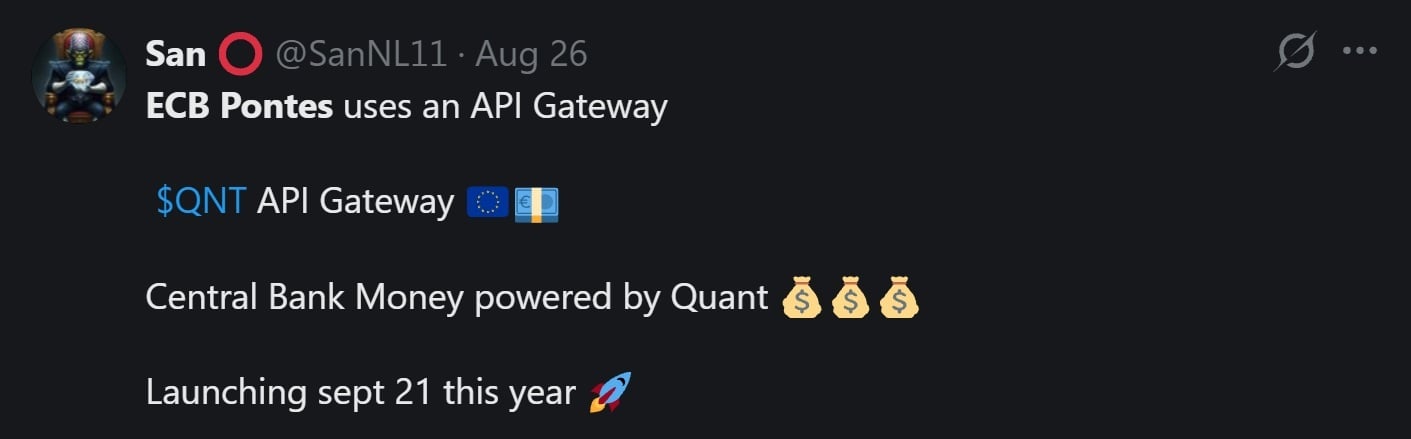
According to Schnabel, over time, "Pontes" will support settlement finality directly on a DLT platform managed by the Eurosystem, with smart contract functionality and, ultimately, round-the-clock operation.

In March, News.bitcoin.com reported that the European Central Bank had already outlined an extensive roadmap, and Pontes executive board member Piero Cipollone articulated the goal as creating a "single digital financial market that would exist alongside" the euro itself.

Appia is the long-term strategy

If Pontes is the bridge, then Project Appia is the final destination. Appia is tasked with developing the long-term architecture, technical standards, and legal framework needed for a genuine European market for tokenized assets; the full plan is expected by 2028. The two-year timeline reflects how many underlying questions remain unresolved.

Nevertheless, trials aimed at testing interoperability between DLT platforms and existing settlement systems processed approximately 1.6 billion euros with 64 participants across nine jurisdictions, and European issuers have placed nearly 4 billion euros worth of DLT-based instruments since 2021. Since March 2026, the ECB has also been accepting DLT-based assets as eligible collateral for its lending operations.

Why this extends beyond Europe

None of this directly dictates the price of Bitcoin, but it is all happening in a market where institutional investors are already using blockchain mechanisms to move trillions in tokenized value, and where every signal that a G7 country's central bank is willing to settle with its own money on-chain lends legitimacy to the infrastructure that cryptocurrency markets have operated on for over a decade.

If the ECB (an institution built on the principles of a conservative approach to monetary infrastructure) is rushing to avoid "disintermediation" by private tokenization, it serves as a reminder that the debate, which crypto traders follow through the price of Bitcoin and stablecoin volumes, is the same one now unfolding in central bank boardrooms.


Criptos en tendencia

Preguntas relacionadas

QWhat is the main criticism that Isabel Schnabel of the ECB makes about stablecoins, and what does she propose as the solution?

AIsabel Schnabel criticizes stablecoins for lacking an 'independent capacity to rapidly scale up liquidity in periods of financial stress.' She argues that only a central bank can fill this gap. Her proposed solution is based on tokenization, stating that money itself must be placed on the blockchain rails to make transactions faster, safer, and more programmable.

QWhat is the purpose of the ECB's Project Pontes, and what is its initial phase?

AProject Pontes is designed to be a bridge. Its initial phase, launching in September, will synchronize the ECB's existing TARGET payment infrastructure with market participants' DLT platforms, connecting traditional bank settlement systems with blockchain-based systems.

QWhat is the long-term goal of the ECB's Project Appia, and what is its expected timeline?

AProject Appia is the ECB's long-term strategy to develop the full architecture, technical standards, and legal framework for a genuine European market for tokenized assets. The full plan is expected by 2028.

QAccording to the article, how has the ECB's view on Distributed Ledger Technology (DLT) shifted?

AThe ECB's view has shifted from seeing DLT primarily as a tool for regulating stablecoins and cryptocurrency markets to now considering it as a core infrastructure that should be adopted directly by central banks for their own monetary operations.

QWhy does the article suggest the ECB's initiatives have significance beyond Europe, even though they don't directly set Bitcoin's price?

AThe ECB's moves lend legitimacy to the blockchain infrastructure that has underpinned crypto markets for over a decade. By signaling a major G7 central bank's willingness to conduct settlements with its own money on-chain, it validates the technology in the institutional financial world where trillions in tokenized value already move.

Lecturas Relacionadas

Ripple Labs Warns of a New Challenge for Blockchains

Ripple Labs is preparing the XRP Ledger for quantum threats but now emphasizes a broader challenge: ensuring financial infrastructure can adapt simultaneously to quantum computing and artificial intelligence. Senior Director of Engineering Ayo Akinyele states the goal is not merely anticipating a "Q-Day" but building infrastructure capable of preemptively adopting new security mechanisms without network disruption. The shift to post-quantum cryptography involves more than swapping algorithms; it requires flexible infrastructure, improved key management, and clear upgrade paths. Financial systems were not designed with quantum computers in mind, necessitating a rethink of transaction, identity, asset, and data protection. This is underscored by significant investments, such as the $2 billion U.S.-IBM quantum factory initiative and a 2030 U.S. government mandate for post-quantum cryptography adoption. AI introduces distinct risks by driving automation and autonomous economic activity, increasing demand for an always-on, internet-oriented payment infrastructure. AI agents could soon conduct transactions independently, creating new security requirements. Ripple Labs advocates for proactive, orderly preparation rather than a crisis-driven transition, having outlined a four-phase strategy aiming for a full XRP Ledger transition by 2028, now expanded to address both quantum and AI-driven challenges.

cryptonews.ruHace 50 min(s)

Ripple Labs Warns of a New Challenge for Blockchains

cryptonews.ruHace 50 min(s)

"We're Back": Michael Saylor Hints Company May Resume Bitcoin Purchases

Speculation that MicroStrategy (MSTR) may resume buying Bitcoin surged after executive chairman Michael Saylor posted a cryptic message on X on August 30. The post consisted of the phrase "We're ₿ack" and an accompanying chart showing the company's holdings of 840,447 BTC, valued at approximately $65.72 billion. This came after two consecutive weeks with no Bitcoin transactions reported by the company. MicroStrategy's last SEC filing, dated August 24, confirmed its holdings of 840,447 BTC were acquired for $63.36 billion at an average price of $75,385 per Bitcoin. The company reported no purchases or sales between August 17 and 23. Instead, it raised capital by selling MSTR shares for about $2.01 billion, boosting its total US dollar liquidity to $6.69 billion. This capital reorganization had paused Bitcoin acquisitions. Saylor's post followed a significant Bitcoin price recovery from around $65,000 on August 19 to over $79,000 by August 30. As the largest publicly traded corporate Bitcoin holder, controlling roughly 4% of the total 21 million supply, MicroStrategy's potential return to the buyer's market is closely watched. The company has $1.59 billion in flexible cash reserves that the board could allocate for further Bitcoin purchases, dividends, debt repayment, or other treasury purposes. The next corporate report will clarify if the "We're ₿ack" message signaled an actual new acquisition.

cryptonews.ruHace 53 min(s)

"We're Back": Michael Saylor Hints Company May Resume Bitcoin Purchases

cryptonews.ruHace 53 min(s)

Trading

Spot

Artículos destacados

Qué es $BANK

Banco AI: Un Paso Revolucionario en el Futuro de la Banca Introducción En una era marcada por avances rápidos en tecnología, Banco AI se sitúa en la intersección de la inteligencia artificial (IA) y los servicios bancarios. Este proyecto innovador busca redefinir el panorama financiero, mejorando la eficiencia operativa, las medidas de seguridad y las experiencias del cliente a través del poder de la IA. Al embarcarnos en esta exploración de Banco AI, profundizaremos en lo que implica el proyecto, sus dinámicas operativas, su contexto histórico y hitos significativos. ¿Qué es Banco AI? En su esencia, Banco AI representa una iniciativa transformadora destinada a integrar la inteligencia artificial en varias operaciones bancarias. Este proyecto aprovecha las capacidades de la IA para automatizar procesos, mejorar los protocolos de gestión de riesgos y mejorar la interacción con los clientes a través de servicios personalizados. Los objetivos principales de Banco AI incluyen: Automatización de Funciones Bancarias: Al aprovechar las tecnologías de IA, Banco AI tiene como objetivo automatizar tareas rutinarias, reduciendo la carga sobre los recursos humanos y mejorando la eficiencia. Mejora en la Gestión de Riesgos: El proyecto utiliza algoritmos de IA para predecir e identificar riesgos, fortaleciendo así las medidas de seguridad contra fraudes y otras amenazas. Personalización de Servicios Bancarios: Banco AI se centra en ofrecer productos y servicios financieros a medida al analizar datos y comportamientos de los clientes. Mejoramiento de la Experiencia del Cliente: La implementación de soluciones impulsadas por IA, como chatbots y asistentes virtuales, tiene como objetivo proporcionar a los usuarios interacciones más humanas, revolucionando la forma en que los clientes se relacionan con los bancos. Con estos objetivos, Banco AI se posiciona como un jugador crucial para hacer que la banca sea más eficiente, segura y centrada en el usuario. ¿Quién es el Creador de Banco AI? Los detalles sobre el creador de Banco AI siguen siendo desconocidos. Como tal, no se ha identificado a ninguna persona u organización específica en la información disponible. El anonimato que rodea el inicio del proyecto plantea preguntas, pero no resta valor a su ambiciosa visión y objetivos. ¿Quiénes Son los Inversores de Banco AI? Al igual que con el creador del proyecto, no se ha divulgado información específica sobre los inversores u organizaciones que apoyan a Banco AI. Sin esta información, es un desafío delinear el respaldo financiero y el apoyo institucional que podrían estar impulsando el proyecto hacia adelante. No obstante, la importancia de contar con una sólida base de inversión es fundamental para sostener el desarrollo en un campo tan innovador. ¿Cómo Funciona Banco AI? Banco AI opera en múltiples frentes innovadores, centrándose en factores únicos que lo diferencian de los marcos bancarios tradicionales. A continuación, se presentan las características operativas clave: Automatización: Al aplicar algoritmos de aprendizaje automático, Banco AI automatiza varios procesos manuales dentro de los bancos. Esto resulta en la reducción de costos operativos y permite que los trabajadores humanos redirijan sus esfuerzos hacia actividades más estratégicas. Gestión Avanzada de Riesgos: La integración de la IA en las prácticas de gestión de riesgos equipa a los bancos con herramientas para predecir con precisión amenazas potenciales como el fraude, garantizando que la información y los activos de los clientes permanezcan seguros. Recomendaciones Financieras Personalizadas: A través del aprendizaje continuo a partir de las interacciones con los clientes, los sistemas de IA desarrollan una comprensión matizada de las necesidades del usuario, lo que les permite ofrecer consejos adaptados sobre decisiones financieras. Interacciones Mejoradas con los Clientes: Al utilizar chatbots y asistentes virtuales impulsados por IA, Banco AI permite una experiencia más atractiva para el cliente, permitiendo a los usuarios resolver sus consultas rápidamente, reduciendo así los tiempos de espera y mejorando los niveles de satisfacción. En conjunto, estas características operativas posicionan a Banco AI como un pionero en el sector bancario, estableciendo nuevos parámetros para la entrega de servicios y la excelencia operativa. Línea de Tiempo de Banco AI Entender la trayectoria de Banco AI requiere mirar su contexto histórico. A continuación, se presenta una línea de tiempo que destaca hitos y desarrollos importantes: Inicios de 2010: La conceptualización de la integración de la IA en los servicios bancarios comenzó a ganar atención a medida que las instituciones bancarias reconocieron los posibles beneficios. 2018: Se produjo un aumento notable en la implementación de tecnologías de IA cuando los bancos comenzaron a utilizar herramientas de IA como chatbots para el servicio al cliente básico y sistemas de gestión de riesgos para mejorar la seguridad. 2023: La sofisticación de la IA continuó avanzando, con la introducción de IA generativa para tareas más complejas como el procesamiento de documentos y análisis de inversiones en tiempo real. Este año marcó un salto significativo en las capacidades que la tecnología de IA otorgó a los bancos. 2024-Estatus Actual: A partir de este año, Banco AI se encuentra en una trayectoria ascendente, con investigaciones y desarrollos en curso que pronto mejorarán las capacidades en las operaciones bancarias. La continua exploración de las aplicaciones de IA sugiere emocionantes desarrollos aún por venir. Puntos Clave Sobre Banco AI Integración de la IA en la Banca: Banco AI se centra en adoptar inteligencia artificial para optimizar los procesos bancarios y mejorar la experiencia del usuario. Enfoque en Automatización y Gestión de Riesgos: El proyecto enfatiza fuertemente estas áreas, con el objetivo de desplazar la carga de tareas rutinarias mientras mejora los marcos de seguridad a través de análisis predictivos. Soluciones Bancarias Personalizadas: Al aprovechar los datos de los clientes, Banco AI permite servicios bancarios adaptados a las necesidades individuales de los usuarios. Compromiso con el Desarrollo: Banco AI se mantiene comprometido con esfuerzos de investigación y desarrollo continuos, asegurando su adaptabilidad y relevancia continua a medida que la tecnología sigue evolucionando. Conclusión En resumen, Banco AI ejemplifica un paso crucial hacia adelante en la industria bancaria, aprovechando la inteligencia artificial para redefinir los paradigmas operativos, mejorar la seguridad y promover la satisfacción del cliente. A pesar de las lagunas en la información sobre el creador y los inversores, los objetivos claros y los mecanismos funcionales de Banco AI proporcionan una sólida base para su evolución continua. A medida que la tecnología de IA sigue avanzando y fusionándose con el sector bancario, Banco AI está bien posicionado para impactar significativamente el futuro de los servicios financieros, mejorando la forma en que entendemos e interactuamos con la banca.

325 Vistas totalesPublicado en 2024.04.06Actualizado en 2024.12.03

Qué es $BANK

Cómo comprar BANK

¡Bienvenido a HTX.com! Hemos hecho que comprar Lorenzo Protocol (BANK) sea simple y conveniente. Sigue nuestra guía paso a paso para iniciar tu viaje de criptos.Paso 1: crea tu cuenta HTXUtiliza tu correo electrónico o número de teléfono para registrarte y obtener una cuenta gratuita en HTX. Experimenta un proceso de registro sin complicaciones y desbloquea todas las funciones.Obtener mi cuentaPaso 2: ve a Comprar cripto y elige tu método de pagoTarjeta de crédito/débito: usa tu Visa o Mastercard para comprar Lorenzo Protocol (BANK) al instante.Saldo: utiliza fondos del saldo de tu cuenta HTX para tradear sin problemas.Terceros: hemos agregado métodos de pago populares como Google Pay y Apple Pay para mejorar la comodidad.P2P: tradear directamente con otros usuarios en HTX.Over-the-Counter (OTC): ofrecemos servicios personalizados y tipos de cambio competitivos para los traders.Paso 3: guarda tu Lorenzo Protocol (BANK)Después de comprar tu Lorenzo Protocol (BANK), guárdalo en tu cuenta HTX. Alternativamente, puedes enviarlo a otro lugar mediante transferencia blockchain o utilizarlo para tradear otras criptomonedas.Paso 4: tradear Lorenzo Protocol (BANK)Tradear fácilmente con Lorenzo Protocol (BANK) en HTX's mercado spot. Simplemente accede a tu cuenta, selecciona tu par de trading, ejecuta tus trades y monitorea en tiempo real. Ofrecemos una experiencia fácil de usar tanto para principiantes como para traders experimentados.

1.1k Vistas totalesPublicado en 2025.05.09Actualizado en 2026.06.02

Cómo comprar BANK

Discusiones

Bienvenido a la comunidad de HTX. Aquí puedes mantenerte informado sobre los últimos desarrollos de la plataforma y acceder a análisis profesionales del mercado. A continuación se presentan las opiniones de los usuarios sobre el precio de BANK (BANK).

活动图片