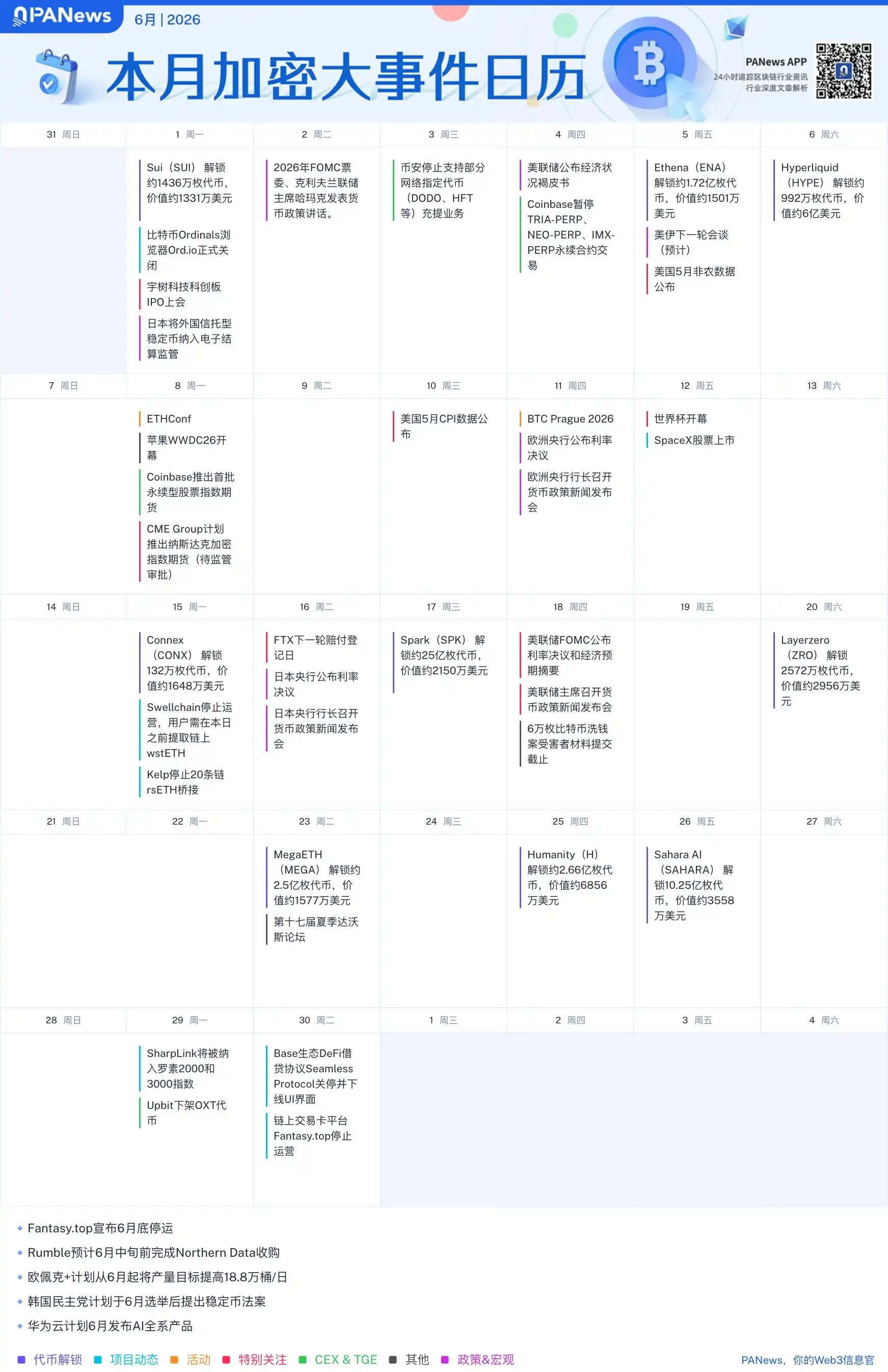
PA Graphic | One Picture to Understand Major Web3 Events Worth Watching in June

marsbitPublicado a 2026-06-01Actualizado a 2026-06-01

Resumen

June's crypto market is dominated by key macro events, token unlocks, and project developments. The major focus is on US economic data releases, including May's Nonfarm Payrolls and CPI figures, alongside the Federal Reserve's policy meeting and press conference. These will heavily influence market risk appetite. The European Central Bank and Bank of Japan will also announce interest rate decisions, keeping global liquidity and rate paths in focus. Significant token unlocks are scheduled for assets like SUI and ENA, posing potential market risks. Notable project updates include Coinbase launching its first perpetual stock index futures and CME Group planning a Nasdaq Crypto Index. SharpLink will be added to Russell indexes. Conversely, project consolidation continues, with services like the Bitcoin Ordinals browser Ord.io shutting down, requiring users to manage asset transfers. Other key events span technology and sports, such as the start of the World Cup, Apple's WWDC26, SpaceX's stock market debut, and Yushu Technology's IPO review. Overall, June's market direction will be shaped by evolving liquidity expectations, regulatory shifts, and ecosystem rotation amidst these converging events.

More comprehensive coverage, flexible filtering, and convenient export. Welcome to experience the new PANews crypto calendar👇

Click to View Calendar

In June, the crypto market sees a dense mix of macro interest rate decisions, key economic data, token unlocks, and traditional tech events. The core highlights are:

📌 The US releases May Non-Farm Payrolls and CPI data; the Fed publishes the Beige Book and holds a monetary policy press conference, as market risk appetite continues to be influenced by macro expectations.

🏦 The European Central Bank and the Bank of Japan will announce interest rate decisions, with global liquidity and interest rate paths remaining one of the main market themes for June.

🪙 Tokens such as SUI and ENA will undergo unlocks; be mindful of the risks.

🚀 Project Updates: Coinbase will launch its first perpetual stock index futures; CME Group plans to launch Nasdaq crypto index futures; SharpLink will be included in the Russell 2000 and 3000 indices.

⚠️ Project Shutdowns Continue: Services like the Bitcoin Ordinals browser Ord.io are gradually ceasing operations; attention should be paid to asset withdrawal and migration arrangements.

🌐 Other Key Events: World Cup opening, Apple WWDC26 opening, SpaceX stock listing, Unitree Robotics' IPO hearing on the STAR Market, etc.

Macro factors, unlocks, regulation, project shutdowns, and tech events are advancing simultaneously. The market in June may continue to seek new directions amid liquidity expectations, policy shifts, and ecosystem rotations.

Global focal events converge. Lock onto the core threads of Web3 in June 2026 with just this one graphic!
Preguntas relacionadas

QWhat are the key categories of events to watch in the Web3 space for June according to the article?

AThe key categories are macro events (like US non-farm payrolls, CPI data, and Fed meetings), central bank interest rate decisions (from the ECB and Bank of Japan), token unlocks (for projects like SUI and ENA), major project dynamics (e.g., new futures products from Coinbase and CME), project shutdowns, and other significant tech/global events.

QWhich two major central banks are expected to announce interest rate decisions in June?

AThe European Central Bank (ECB) and the Bank of Japan are expected to announce their interest rate decisions in June.

QWhat specific risks related to project tokens are mentioned for June?

AThe article warns of risks associated with token unlocks for projects like SUI and ENA in June.

QName two traditional financial institutions planning to launch new crypto-related products in June.

ACoinbase is planning to launch its first perpetual stock index futures, and CME Group plans to launch Nasdaq crypto index futures.

QWhat is one example given of a project or service that is shutting down in June?

AThe Bitcoin Ordinals browser Ord.io is mentioned as one of the projects whose services are being discontinued in June.

Lecturas Relacionadas

The Value Distribution of Stablecoins

**Summary: The Value Distribution of Stablecoins** The article argues that stablecoins are evolving from mere trading tools into broader channels for dollar access. It divides the stablecoin ecosystem into four layers to analyze how value is distributed: 1. **Issuance Layer:** Mints stablecoins, holds reserve assets, and captures the spread between reserve yield and user costs (e.g., Tether, Circle). This layer currently earns the largest profit margin. 2. **Infrastructure Layer:** Connects stablecoins to the traditional financial system, handling fiat on/off-ramps, banking integration, compliance (KYC/AML), and asset management (e.g., Bridge, BVNK). This is the "unglamorous" but critical work, building the essential bridges between crypto and real-world finance. 3. **Acquiring/Distribution Layer:** Integrates stablecoins into merchant systems, manages payment flows, and provides enterprise financial software (e.g., Stripe, Coinbase). They act as the access point for businesses. 4. **Application Layer:** The end-users and businesses that ultimately use stablecoins for payments, settlements, or as a store of value. They benefit from convenience but have little pricing power. The core thesis is that while the issuance layer currently dominates profits, the often-overlooked **infrastructure layer holds significant long-term potential**. The real challenge and barrier to mass adoption is not the on-chain transfer of stablecoins (which is simple), but the complex "last mile" integration into existing business workflows, banking systems, and regulatory frameworks across different countries. Companies in this layer are currently in a "land grab" phase, investing heavily to build networks, secure bank partnerships, and establish compliance pathways. While their position is currently pressured by the profitable issuers above and distribution platforms below, the article suggests that if stablecoins become a default financial rail for businesses, the infrastructure providers who have done the hard work of integration will ultimately gain strong pricing power and become entrenched, essential players.

marsbitHace 4 hora(s)

The Value Distribution of Stablecoins

marsbitHace 4 hora(s)

The Value Distribution of Stablecoins

The Value Distribution of Stablecoins The article argues that stablecoins are evolving from a mere trading tool into a broad "dollar channel." It analyzes the industry's value chain through four layers: 1. **Issuance Layer (e.g., Tether, Circle):** The top layer that mints stablecoins, holds reserve assets, and captures the thickest interest rate spread. 2. **Infrastructure Layer (e.g., Bridge, BVNK):** Connects stablecoins to the traditional financial system, handling critical but complex "dirty work" like fiat on/off-ramps, banking integration, compliance (KYC/AML), and cross-border settlement. 3. **Acquiring/Distribution Layer (e.g., Stripe, Coinbase):** Embeds stablecoins into merchant systems, manages payment flows, and integrates with enterprise software. 4. **Application Layer:** End-users and businesses that ultimately use stablecoins for payments, settlement, or storing value. The author posits that while the issuance layer currently captures the most profit, the most overlooked and potentially critical layer is infrastructure. The core challenge for stablecoin adoption isn't the on-chain transfer (which is simple), but bridging the gap between blockchain and the real-world financial system. This involves solving practical problems for businesses: fiat conversion, reconciliation, tax handling, and user onboarding. Infrastructure companies are currently in a difficult "land-grab" phase—building networks, securing banking relationships, and achieving compliance country-by-country. They face pressure from both the profitable issuance layer above and distribution platforms below. However, the author suggests this layer is building a crucial moat. Once stablecoins become a default business rail, the infrastructure players who have done the hard work of integration may gain significant, durable value and pricing power.

链捕手Hace 4 hora(s)

The Value Distribution of Stablecoins

链捕手Hace 4 hora(s)

How to Do Research Well: Deliberately Practice the Real Skills That Matter

No one truly teaches you how to do research. You're often given a desk, a pre-selected problem, and vague instructions to "create something new." Consequently, many people reverse-engineer the job based on visible outputs—papers, posts, announcements—learning only how to *appear* like a researcher rather than how to *become* one. True research capability is built from stacking small, trainable skills, nearly all of which can be developed through deliberate practice. **Pick Your Own Problem:** Most researchers absorb problems from advisors or trends, lacking the underlying reasoning. Choosing a problem you genuinely care about, as John Schulman advises, leads to original work. Develop "taste" like a muscle: predict experiment outcomes, guess paper results from methods, and track which findings remain important over time. **Upgrade Your Inputs:** Relying on shared reading lists (arXiv hot lists, filtered group chats) leads to unoriginal conclusions. Undervalued old literature often holds crucial insights (e.g., MoE, LSTM, backpropagation). Richard Sutton's "The Bitter Lesson" or Claude Shannon's 1952 talk on creative thinking are more predictive than lengthy modern surveys. Breadth matters as much as depth: draw from neuroscience, mechanism design, hardware knowledge, and honest statistics. Read papers directly, especially appendices and limitations sections. **Write Everything Down:** As Paul Graham noted, writing exposes flaws in seemingly mature ideas. Writing is the cheapest defense against self-deception. Following Feynman's principle, Darwin programmatically wrote down facts contradicting his theory to combat memory bias. Maintain a detailed log of hypotheses, setups, predictions, results, and updated understandings. Reviewing past logs fosters essential humility.

marsbitHace 6 hora(s)

How to Do Research Well: Deliberately Practice the Real Skills That Matter

marsbitHace 6 hora(s)

Trading

Spot
Futuros

Artículos destacados

Cómo comprar ONE

¡Bienvenido a HTX.com! Hemos hecho que comprar Harmony (ONE) sea simple y conveniente. Sigue nuestra guía paso a paso para iniciar tu viaje de criptos.Paso 1: crea tu cuenta HTXUtiliza tu correo electrónico o número de teléfono para registrarte y obtener una cuenta gratuita en HTX. Experimenta un proceso de registro sin complicaciones y desbloquea todas las funciones.Obtener mi cuentaPaso 2: ve a Comprar cripto y elige tu método de pagoTarjeta de crédito/débito: usa tu Visa o Mastercard para comprar Harmony (ONE) al instante.Saldo: utiliza fondos del saldo de tu cuenta HTX para tradear sin problemas.Terceros: hemos agregado métodos de pago populares como Google Pay y Apple Pay para mejorar la comodidad.P2P: tradear directamente con otros usuarios en HTX.Over-the-Counter (OTC): ofrecemos servicios personalizados y tipos de cambio competitivos para los traders.Paso 3: guarda tu Harmony (ONE)Después de comprar tu Harmony (ONE), guárdalo en tu cuenta HTX. Alternativamente, puedes enviarlo a otro lugar mediante transferencia blockchain o utilizarlo para tradear otras criptomonedas.Paso 4: tradear Harmony (ONE)Tradear fácilmente con Harmony (ONE) en HTX's mercado spot. Simplemente accede a tu cuenta, selecciona tu par de trading, ejecuta tus trades y monitorea en tiempo real. Ofrecemos una experiencia fácil de usar tanto para principiantes como para traders experimentados.

290 Vistas totalesPublicado en 2024.12.12Actualizado en 2026.06.02

Cómo comprar ONE

Discusiones

Bienvenido a la comunidad de HTX. Aquí puedes mantenerte informado sobre los últimos desarrollos de la plataforma y acceder a análisis profesionales del mercado. A continuación se presentan las opiniones de los usuarios sobre el precio de ONE (ONE).

活动图片