Author: Li Jia, Wall Street Insights
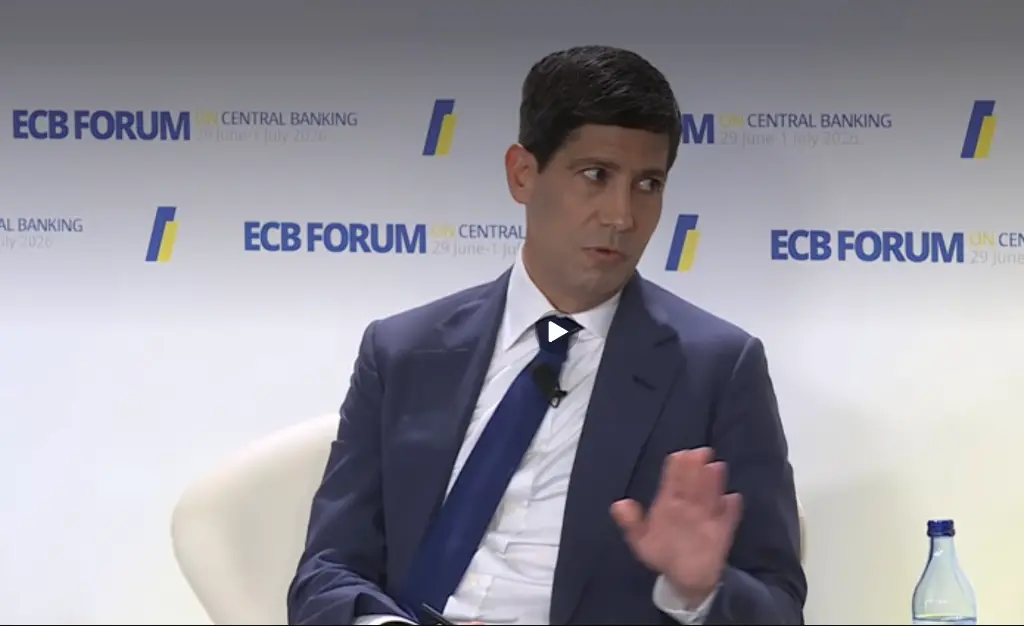
On July 1, at the annual Central Banking Forum held by the European Central Bank in Sintra, Portugal, Wall reiterated that the Federal Reserve will not provide forward guidance on the future path of interest rates. He hopes that policymakers can engage in full discussions based on the latest data at each meeting, rather than signaling policy direction to the market in advance.
He stated that U.S. inflation risks have eased somewhat over the past four weeks, and the supply expansion brought by AI could profoundly change the way the economy operates, with the U.S. at the center of this transformation. However, whether AI will ultimately bring inflation or deflation should be judged by the central bank based on data.
Will Not Provide Any Interest Rate Forward Guidance
Wall stated that the Federal Reserve is "charting a new course" and will not signal interest rate moves in advance as it did in the past. He said:
"We will hold our next meeting in four weeks, and I hope we can have a real family-style debate then."
He emphasized again that forward guidance is not the right policy for the current economic situation. In the future, the Fed will continue to make decisions based on the latest economic data, not by committing to a policy path in advance.
This means the Federal Reserve will rely more on real-time economic data rather than signaling policy to the market in advance.
At the June meeting, the Federal Reserve unanimously decided to keep the federal funds rate unchanged in the 3.5%-3.75% range. However, the latest dot plot showed that nine out of 18 officials still expect at least one rate hike this year, and the market has largely priced in the possibility of at least one 25-basis-point hike by the end of the year.
However, Wall himself declined to reveal his own policy inclination, only emphasizing that future policy decisions will depend on data performance.
AI is Changing the Economy at an Unprecedented Pace
Wall discussed the macroeconomic impact of artificial intelligence at the forum. He said the speed at which AI model capabilities are improving shows a clear exponential growth trend.
He pointed out that the supply capacity expansion driven by AI will become a new variable that future monetary policy must focus on, as productivity improvements mean the economy can achieve faster growth with lower inflationary pressure.
However, he also acknowledged that there is still great uncertainty about how AI will affect the job market.
"There is still a serious question about when AI will truly begin to affect employment."
He emphasized that the Federal Reserve must continue to achieve its dual statutory goals of maximum employment and price stability, and any policy adjustments must balance both.
Inflation Risk Down, but Whether AI Has an Inflationary Effect Remains to Be Seen
Wall stated that U.S. inflation risk has declined over the past four weeks, meaning price pressures have eased to some extent recently.
However, regarding the market's widespread discussion on whether AI is a deflationary force or a new source of inflation, Wall did not give a clear answer. He said:
"Whether AI has an inflationary effect should be decided by the central bank."
In his view, AI can both improve production efficiency and expand supply on one hand, and stimulate new investment and demand on the other. Therefore, the final effect needs to be judged based on data, not preset conclusions.
In addition, Wall pointed out that Fed policy not only affects the U.S. but also has significant spillover effects through global financial markets.
Reiterating Fed Independence: Policy Will Not Be Affected by External Pressure
Responding to ongoing external concerns about Federal Reserve independence, Wall once again made a clear statement. He said:
"The Federal Reserve has long been independent, and it will remain independent. You won't see any change."
This statement is also seen by the market as a response to President Trump's recent repeated calls for the Fed to cut rates. Wall emphasized that the Fed will independently decide the appropriate policy path and will not change decisions due to external political pressure.
U.S. Faces Great Opportunity for Productivity Enhancement
Beyond monetary policy, Wall also focused on the long-term growth prospects of the U.S. economy that day.
He said he has been focused on monetary policy work for the past four weeks, and the current era is one of great opportunity for the United States. Wall believes that the supply side of the U.S. economy remains strong, and potential growth rates appear to be trending upward. Therefore, there is ample reason to be optimistic about future productivity.
He said if the economic performance of the past four quarters can serve as a reference for the future, then the U.S. economic outlook deserves optimism. He stated:
"The United States is not afraid of productivity-driven economic growth."
However, he also acknowledged that it is not yet clear whether productivity improvements will have a direct impact on short-term monetary policy, but the continuous expansion of supply capacity will undoubtedly profoundly influence future policymaking.
Unchanged Stance on Balance Sheet Reduction
Besides interest rate policy, Wall also discussed the Fed's balance sheet.
He said, his view on the balance sheet has not changed over the past four weeks. "It's no secret that I want the Fed's balance sheet to be smaller."
However, he also said that the Fed remains open about the final appropriate size of the balance sheet. Wall noted that balance sheet policy mainly works through asset prices, so any major decisions regarding the balance sheet will be subject to public discussion and decided collectively by the FOMC.
He also stated that the current balance sheet size of about $6.7 trillion is still far above pre-pandemic levels, and even if reduction continues, it cannot be completed in a short time. "Eighteen weeks is far from enough."
Five Reform Working Groups to See New Progress
In fact, abandoning forward guidance is only part of Wall's push for Fed reform.
Last month, Wall announced the establishment of five internal special working groups, responsible for studying communication mechanisms, the balance sheet, data usage, productivity & employment, and the inflation framework, among other issues. He recently revealed that the list of special working group members will be announced as early as next week.
Wall stated that these working groups will not only involve internal Fed officials but also invite external experts, including some international figures from outside the United States. He hopes that through these reforms, the Fed's policy framework and communication mechanisms will be re-examined, making monetary policy more suitable for the rapidly changing economic environment.