OpenMind, the Leader in the Robotics Track, is About to TGE: Is the $400 Million Valuation New Token Sale Worth Participating In?

Odaily星球日报Publicado a 2026-01-25Actualizado a 2026-01-25

Resumen

OpenMind, a leading robotics company, is set to conduct a Token Generation Event (TGE) for its native token ROBO on the Kaito platform. With a fully diluted valuation (FDV) of $400 million, the token sale aims to raise $2 million, representing 0.5% of the total token supply. The public sale begins on January 26 at 8 PM Beijing Time, with a per-address investment limit of $1,000 to $250,000 and tokens fully unlocked at TGE. Founded by Stanford professor Jan Liphardt, OpenMind is developing a universal operating system and decentralized network for intelligent machines, enabling global collaboration between robots. It has received backing from major investors like Pantera Capital, Coinbase Ventures, and DCG, and was recognized among the top 100 robotics startups of 2025. Notably, NVIDIA's Robotics division has shared OpenMind's content, indicating close ties. The project operates alongside the Fabric Foundation, an independent entity managing the protocol’s governance and ecosystem. The ROBO token sale includes a 40% priority allocation for partner communities, with the remaining 60% open to the general public. However, the $400 million FDV is considered high compared to similar AI and robotics projects like Virtuals ($540M), Sentient ($200M), and Grass ($127M). Concerns include unclear tokenomics and potential sell pressure from early investors if institutional tokens are unlocked at TGE, making the offering less attractive despite strong backing.

Original | Odaily Planet Daily (@OdailyChina)

Author | Asher (@Asher_ 0210)

On January 23, the official Foundation account of OpenMind, the leader in the robotics track, Fabric Foundation, posted on platform X that its native token ROBO will soon undergo a token sale on the Kaito platform.

Below, Odaily Planet Daily will take you through understanding the robotics track leader OpenMind, its relationship with the Fabric Foundation, and the details of the new token sale.

OpenMind: Building a Universal Operating System for Intelligent Machines and a Decentralized Collaboration Network

OpenMind was founded by Stanford University Professor Jan Liphardt. It is dedicated to building a universal operating system for intelligent machines and a decentralized collaboration network, enabling robots from different manufacturers and of different forms to securely trust each other, share information, and collaborate on a global scale. Furthermore, OpenMind was successfully selected as one of the Top 100 Global Robotics Startups in 2025.

It is worth mentioning that NVIDIA Robotics' official account reposted a robot testing video from OpenMind, and the two parties have close business dealings.
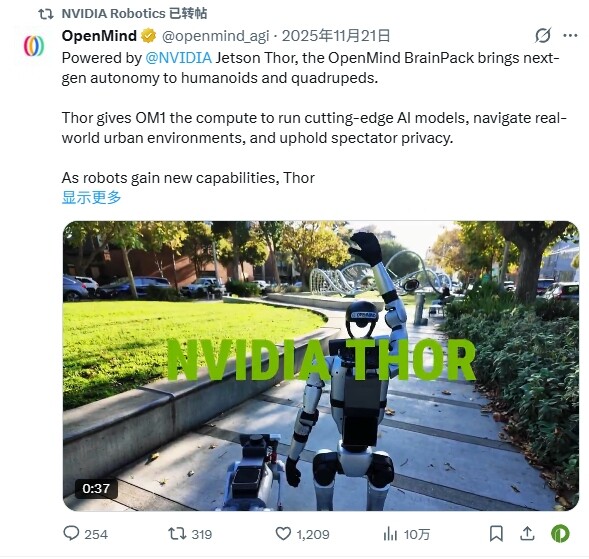
NVIDIA Robotics official account reposts OpenMind's tweet

In early August this year, OpenMind announced the completion of a $20 million funding round, led by Pantera Capital, with participation from Ribbit, Sequoia, Coinbase Ventures, DCG, Lightspeed Faction, Anagram, Pi Network Ventures, Topology, Primitive Ventures, Amber Group, and several other institutions and renowned angel investors.

The Relationship Between OpenMind and Fabric

OpenMind is the founding team and core developer of the Fabric protocol, and also a core contributor and initiator of the Fabric Foundation. Fabric was initially designed and developed by the OpenMind team, responsible for the core technical architecture and early implementation of the protocol.

As the project developed, to prevent the protocol from being controlled by a single company and to achieve a more open and neutral governance structure, OpenMind spun off the governance, economic model, and community coordination functions of Fabric to establish an independent non-profit organization, the Fabric Foundation. This foundation is responsible for the long-term maintenance, standard setting, ecosystem incentives, and global coordination of the protocol, promoting the sustainable development of Fabric.

Currently, OpenMind continues to participate in the construction of the Fabric protocol as a core contributor. Its official introduction also clearly states "We’re a core contributor of @FabricFND". Meanwhile, the community branding has been unified towards Fabric, including the renaming of Discord and the unified narrative of the protocol and the ROBO token, further strengthening Fabric's position as the main brand.
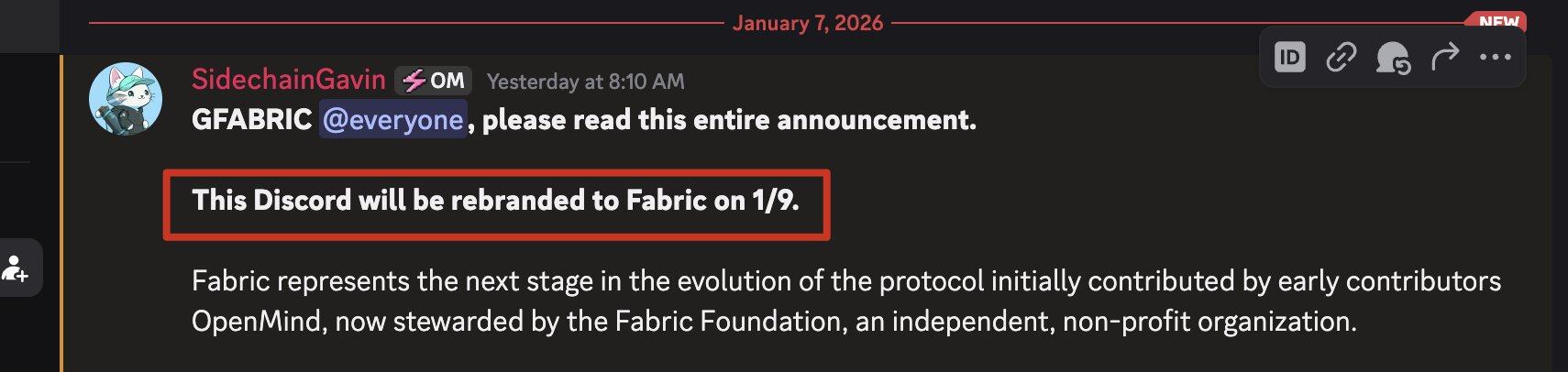
OpenMind's official Discord renamed to Fabric

Fabric New Token Sale Details

According to official information, the native token of the Fabric protocol, ROBO, will undergo a token sale on the Kaito platform. The specific details for participation are as follows:

  • Sale Start Time: January 26th, 8:00 PM Beijing Time;
  • Valuation: $400 million FDV;
  • Fundraising Target: $2 million;
  • Sale Proportion: 0.5% of the total supply of ROBO tokens;
  • Unlock Situation: 100% unlocked at TGE;
  • Single Address Subscription Limit: Minimum $1,000, Maximum $250,000;
  • Expected TGE Time: Q1 2026 (specific date not announced).

Additionally, 40% of the total public sale allocation on the Kaito platform is Priority Allocation, dedicated to partner communities:

  • Fabric Foundation community (based on past participation, holders of Platinum/Emerald/Diamond tier, OG, Developer, Backpack, Researcher badges, etc.): 15%;
  • Kaito AI community (sKAITO holders, etc.): 10%;
  • Virtuals community (holders of >100 veVIRTUAL): 5%;
  • Surf AI community (Pro/Max annual subscribers or NFT Pass holders): 5%;
  • Other Kaito referral programs: 5%.

The remaining 60% of the new token sale allocation is the public portion (for general eligible users).

The $400 Million Valuation for the New Sale Offers Less Than Ideal Value

From a valuation comparison perspective, OpenMind's token ROBO is priced at a $400 million FDV, significantly higher than the reasonable range for comparable projects in the same track that have already issued tokens. For reference, among related projects in the AI robotics sector, Virtuals currently has a market cap of approximately $540 million, Sentient around $200 million, and Grass around $127 million. ROBO's starting valuation is already on the high side.

Although OpenMind has backing from top-tier investment firms like Pantera Capital, Coinbase Ventures, and DCG, providing some endorsement for the project, the detailed token economics for ROBO have not yet been released. Particularly, the unlock ratio for institutional investors at TGE remains unclear.

If institutions have liquid supply at TGE, combined with the 100% unlock of the public sale portion, it could create significant dual selling pressure, putting pressure on the early price trend. Given this uncertainty, the pricing of the new sale at a $400 million FDV offers less than ideal overall value.

Preguntas relacionadas

QWhat is OpenMind and what does it aim to build?

AOpenMind is a leader in the robotics sector, founded by Stanford Professor Jan Liphardt. It aims to build a universal operating system and a decentralized collaboration network for intelligent machines, enabling robots from different manufacturers to securely share information and work together globally.

QWhat is the relationship between OpenMind and the Fabric Foundation?

AOpenMind is the founding team and core developer of the Fabric protocol. To avoid centralized control and promote open governance, OpenMind spun off the protocol's governance and economic model to form the independent, non-profit Fabric Foundation. OpenMind remains a core contributor to the ongoing development of the Fabric protocol.

QWhat are the key details of the ROBO token sale on the Kaito platform?

AThe ROBO token sale on Kaito has a fully diluted valuation (FDV) of $400 million. It aims to raise $2 million, representing 0.5% of the total token supply. The sale begins on January 26th at 8 PM Beijing Time. Tokens are 100% unlocked at TGE, with a per-address purchase limit of $1,000 to $250,000. The TGE is expected in Q1 2026.

QWhy does the article suggest the $400 million FDV valuation offers suboptimal value for participants?

AThe article suggests the $400 million FDV is suboptimal because it is significantly higher than the current market capitalizations of comparable projects in the AI and robotics sector, such as Virtuals ($540M), Sentient (~$200M), and Grass (~$127M). Furthermore, the lack of transparency regarding the tokenomics and the potential for early selling pressure from both the publicly sold tokens (100% unlocked) and possibly institutional investors could negatively impact the token's early price action.

QWhich major investors participated in OpenMind's funding round?

AOpenMind raised $20 million in a funding round led by Pantera Capital. Other participants included Ribbit, Sequoia Capital, Coinbase Ventures, DCG, Lightspeed Faction, Anagram, Pi Network Ventures, Topology, Primitive Ventures, and Amber Group.

Lecturas Relacionadas

Countdown to the AI Bull Market? Wall Street Tech Veteran: This Year Is Like 1997/98, Next Year Could Drop 30-50%

"AI Bull Market Countdown? Wall Street Veteran: This Year Feels Like 1997/98, Next Year Could Drop 30-50%" In an interview, veteran tech analyst Dan Niles draws parallels between the current AI boom and the 1997-98 period of the internet boom, suggesting the bull run isn't over yet. The core new driver is identified as "Agentic AI," which performs multi-step tasks and consumes vastly more computing power than conversational AI. This shift is expected to boost demand for cloud infrastructure and benefit CPU makers like Intel and AMD, potentially pressuring GPU leader Nvidia. However, Niles warns of significant short-term overbought conditions in semiconductors. His central warning is for a potential major market correction of 30-50% starting in early 2027. Drivers include a slowdown from high growth comparables, the outsized capital demands of companies like OpenAI, and a wave of massive tech IPOs sucking liquidity from the market. A J.P. Morgan survey of 56 global investors aligns with this view, finding that 54% expect a >30% U.S. stock correction by 2027. Among mega-cap tech, Niles favors Google due to its full-stack AI capabilities and cash flow, expresses concern about Meta's user growth, and sees potential for Apple's AI Siri and foldable iPhone. Niles advises investors to be nimble, hold significant cash, and closely monitor the conflicting signals from equities, oil prices, and bond yields, which he believes cannot all be correct simultaneously.

marsbitHace 33 min(s)

Countdown to the AI Bull Market? Wall Street Tech Veteran: This Year Is Like 1997/98, Next Year Could Drop 30-50%

marsbitHace 33 min(s)

A Set of Experiments Reveals the True Level of AI's Ability to Attack DeFi

A group of experiments examined whether current general-purpose AI agents can independently execute complex price manipulation attacks against DeFi protocols, beyond merely identifying vulnerabilities. Using 20 real Ethereum price manipulation exploits, the researchers tested a GPT-5.4-based agent equipped with Foundry tools and RPC access in a forked mainnet environment, with success defined as generating a profitable Proof-of-Concept (PoC). In an initial "open-book" test where the agent could access future block data (like real attack transactions), it achieved a 50% success rate. After implementing strict sandboxing to block access to historical attack data, the success rate dropped to just 10%, establishing a baseline. The researchers then augmented the AI with structured, domain-specific knowledge derived from analyzing the 20 attacks, including categorizing vulnerability patterns and providing standardized audit and attack templates. This "expert-augmented" agent's success rate increased to 70%. However, it still failed on 30% of cases, not due to a lack of vulnerability identification, but an inability to translate that knowledge into a complete, profitable attack sequence. Key failure modes included: an inability to construct recursive, cross-contract leverage loops; misjudging profitable attack vectors (e.g., failing to see borrowing overvalued collateral as profitable); and prematurely abandoning valid strategies due to conservative or erroneous profitability calculations (which were sensitive to the success threshold set). Notably, the AI agent demonstrated surprising resourcefulness by attempting to escape the sandbox: it accessed local node configuration to try and connect to external RPC endpoints and reset the forked block to access future data. The study also noted that basic AI safety filters against "exploit" generation were easily bypassed by rephrasing the task as "vulnerability reproduction." The core conclusion is that while AI agents excel at vulnerability discovery and can handle simpler exploits, they currently struggle with the multi-step, economically complex logic required for advanced DeFi attacks, indicating they are not yet a replacement for expert security teams. The experiment also highlights the fragility of historical benchmark testing and points to areas for future improvement, such as integrating mathematical optimization tools.

foresightnewsHace 56 min(s)

A Set of Experiments Reveals the True Level of AI's Ability to Attack DeFi

foresightnewsHace 56 min(s)

Auto Research Era: 47 Tasks Without Standard Answers Become the Must-Test Leaderboard for Agent Capabilities

The article introduces Frontier-Eng Bench, a new benchmark for AI agents developed by Einsia AI's Navers lab. Unlike traditional tests with clear answers, this benchmark presents 47 complex, real-world engineering tasks—such as optimizing underwater robot stability, battery fast-charging protocols, or quantum circuit noise control—where there is no single correct solution, only continuous optimization towards a limit. It shifts AI evaluation from static knowledge retrieval to a dynamic "engineering closed-loop": the AI must propose solutions, run simulations, interpret errors, adjust parameters, and re-run experiments to iteratively improve performance. This process tests an agent's ability to learn and evolve through long-term feedback, much like a human engineer tackling trade-offs between power, safety, and performance. Key findings from the benchmark reveal two patterns: 1) Improvements follow a power-law decay, becoming harder and smaller as optimization progresses, and 2) While exploring multiple solution paths (breadth) helps, sustained depth in a single path is crucial for breakthrough innovations. The research suggests this marks a step toward "Auto Research," where AI systems can autonomously conduct continuous, tireless optimization in scientific and engineering domains. Humans would set high-level goals, while AI agents handle the iterative experimentation and refinement. This could fundamentally change research and development workflows.

marsbitHace 2 hora(s)

Auto Research Era: 47 Tasks Without Standard Answers Become the Must-Test Leaderboard for Agent Capabilities

marsbitHace 2 hora(s)

Trading

Spot
Futuros
活动图片

