Auto Research Era: 47 Tasks Without Standard Answers Become the Must-Test Leaderboard for Agent Capabilities

marsbitPublicado a 2026-05-13Actualizado a 2026-05-13

Resumen

The article introduces Frontier-Eng Bench, a new benchmark for AI agents developed by Einsia AI's Navers lab. Unlike traditional tests with clear answers, this benchmark presents 47 complex, real-world engineering tasks—such as optimizing underwater robot stability, battery fast-charging protocols, or quantum circuit noise control—where there is no single correct solution, only continuous optimization towards a limit. It shifts AI evaluation from static knowledge retrieval to a dynamic "engineering closed-loop": the AI must propose solutions, run simulations, interpret errors, adjust parameters, and re-run experiments to iteratively improve performance. This process tests an agent's ability to learn and evolve through long-term feedback, much like a human engineer tackling trade-offs between power, safety, and performance. Key findings from the benchmark reveal two patterns: 1) Improvements follow a power-law decay, becoming harder and smaller as optimization progresses, and 2) While exploring multiple solution paths (breadth) helps, sustained depth in a single path is crucial for breakthrough innovations. The research suggests this marks a step toward "Auto Research," where AI systems can autonomously conduct continuous, tireless optimization in scientific and engineering domains. Humans would set high-level goals, while AI agents handle the iterative experimentation and refinement. This could fundamentally change research and development workflows.

If we throw AI into an engineering site with no standard answers, can it still survive?

For a long time, AI Agents have appeared omnipotent, but in reality, most are just 'flipping through memories' within known knowledge bases.

Yet the real engineering world is harsh: the stability of underwater robots, the lithium plating boundary of power batteries, the noise control of quantum circuits... These problems have no 'perfect score', only 'optimizations that inch closer to the limit'.

Recently, the Agent Benchmark released by Navers lab under Einsia AIFrontier-Eng Bench—officially tore off the label of AI being an 'exam-crammer'.

The research team didn't have AI grind through outdated coding problems. Instead, they gave it a complete 'engineering closed loop': propose a solution, connect to the simulator, digest errors, adjust parameters, and re-run.

Faced with 47 hardcore tasks spanning multiple disciplines, AI must behave like a senior engineer, seeking the optimal solution within the 'impossible triangle' of power consumption, safety, and performance.

This is not just a test suite; it's more like a rehearsal for Agent 'evolution'.

When AI begins to learn self-correction from feedback, the Auto Research era, where 'humans set goals and AI iterates non-stop 24/7', might be closer than we imagine.

AI Starts Tackling 'Hard Work'

Past large language models were more like super straight-A students.

You pose a question, it 'flips through memory' from massive training data, then pieces together an answer that seems plausible.

In this mode, the large model is essentially playing 'word chain', not solving real-world problems.

But the emergence of Frontier-Eng Bench has AI doing the work of 'engineering optimization'.

The process has shifted to letting AI first propose a solution, then connect to a simulator to run experiments, subsequently obtain feedback and errors, modify parameters and code, and continue re-running until performance improves further.

In this closed-loop system, AI's identity undergoes a qualitative change.

Want to make the underwater robot more stable? AI must start automatically tuning the controller.

Want to increase the speed of the robotic arm a bit more? AI has to run simulations itself.

To some extent, AIs have shed their purely semantic understanding role and begun to act like professional engineers, continuously optimizing based on real-world environmental feedback.
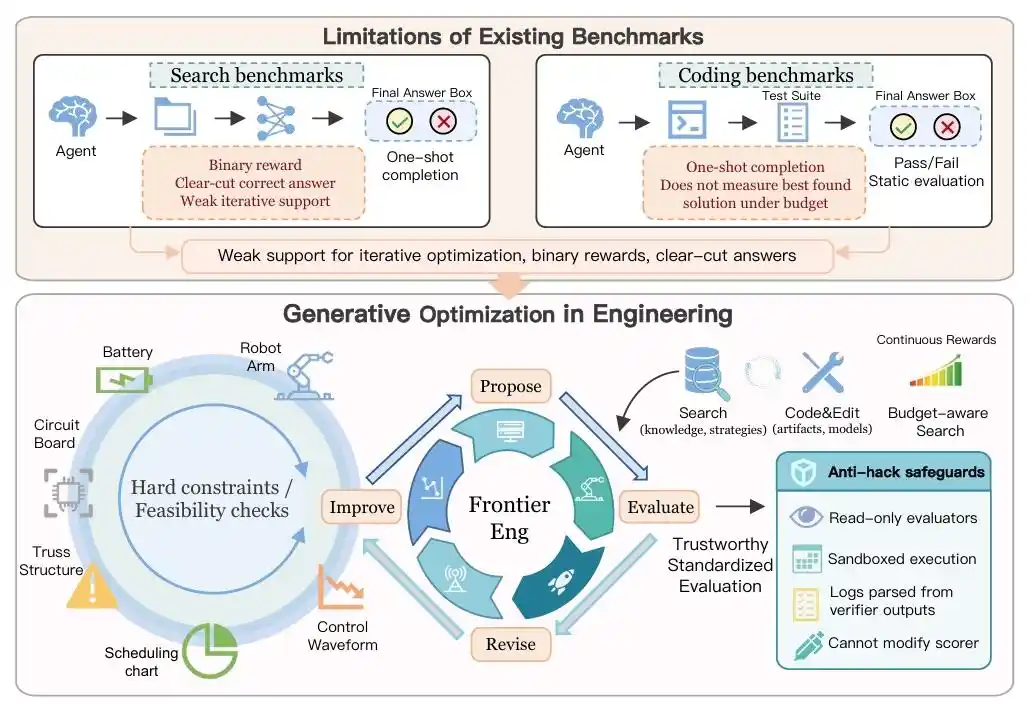
The most interesting aspect of Frontier-Eng Bench is: it doesn't test whether AI 'answered correctly', but rather whether AI can continuously become stronger.

Because real engineering optimization is never about multiple-choice questions; there is no single standard answer.

Take fast-charging batteries as an example: the goal sounds simple—charge as fast as possible, but reality isn't so easy.

Under strict constraints like temperature mustn't spike, voltage can't overspeed, battery life can't drop too fast, and lithium plating must be avoided, AI must precisely hit the balance point of performance.

This means AI cannot pass through by any clever 'test-cramming' tricks; it must demonstrate endurance for continuous evolution through long-term feedback.

Can AI perform long-term optimization in real environments?

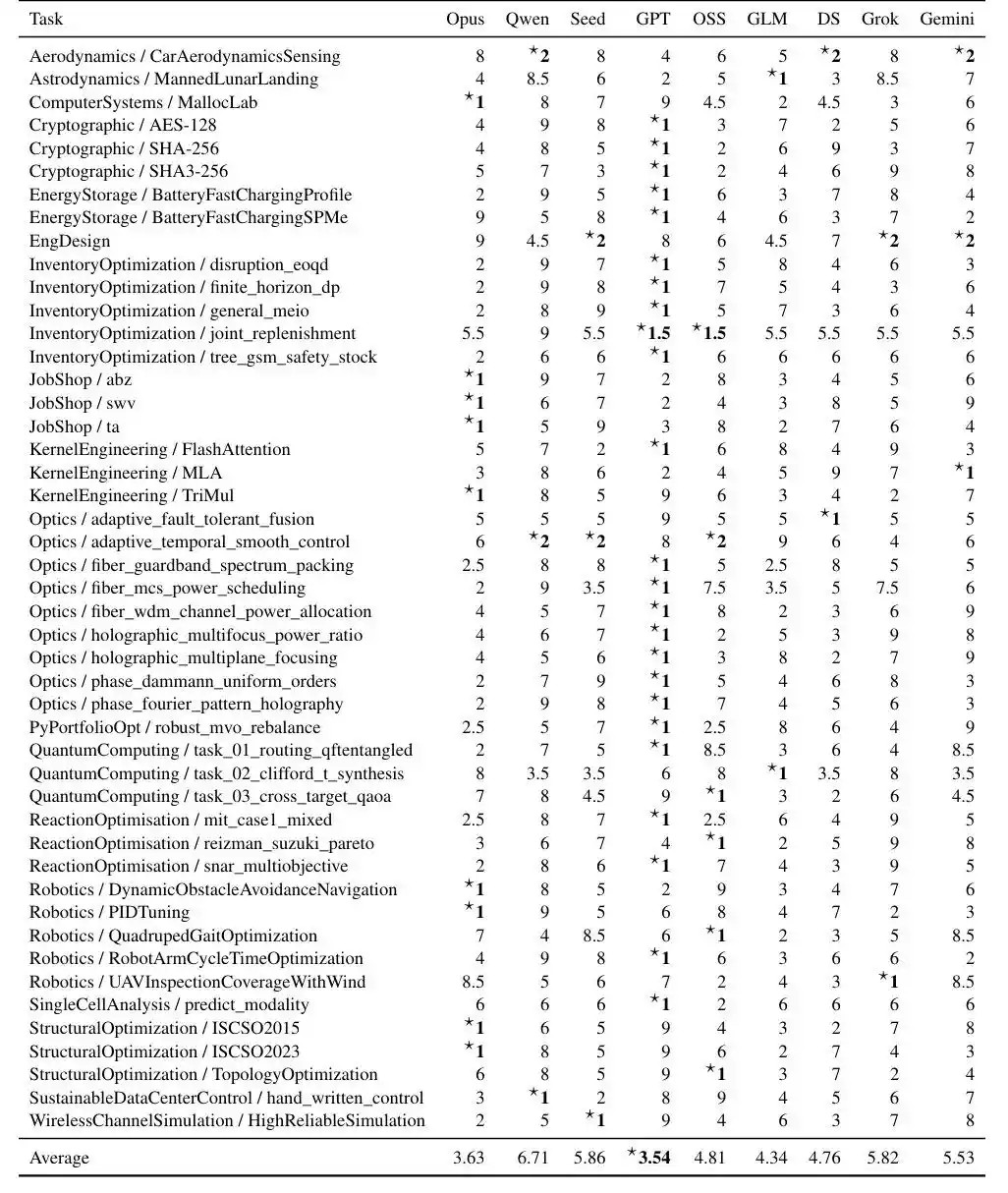
Looking at the results, GPT5.4 showed the most stable overall performance, but AIs still have a long way to go before 'solving' the Benchmark.
Auto Research Enters the 'Iterative Optimization' Era

The research team raised a very interesting point in their paper:

Truly advanced intelligence essentially relies on long-term feedback loops.

Just as AlphaGo could defeat Lee Sedol, it lay in the vast number of simulations and immediate feedback behind each decision, not the rote memorization of established game records.

True scientific research is the same: top labs don't rely on a single burst of inspiration, but continuously propose hypotheses, run experiments, examine results, modify plans, and try again.

Engineering optimization follows the same principle: anyone can create the first version; what's truly difficult is that final 1% performance leap.

The significance of Frontier-Eng Bench lies here: For the first time, it systematically begins testing AI's 'iterative optimization capability', and has summarized two nearly brutal laws of AI evolution.
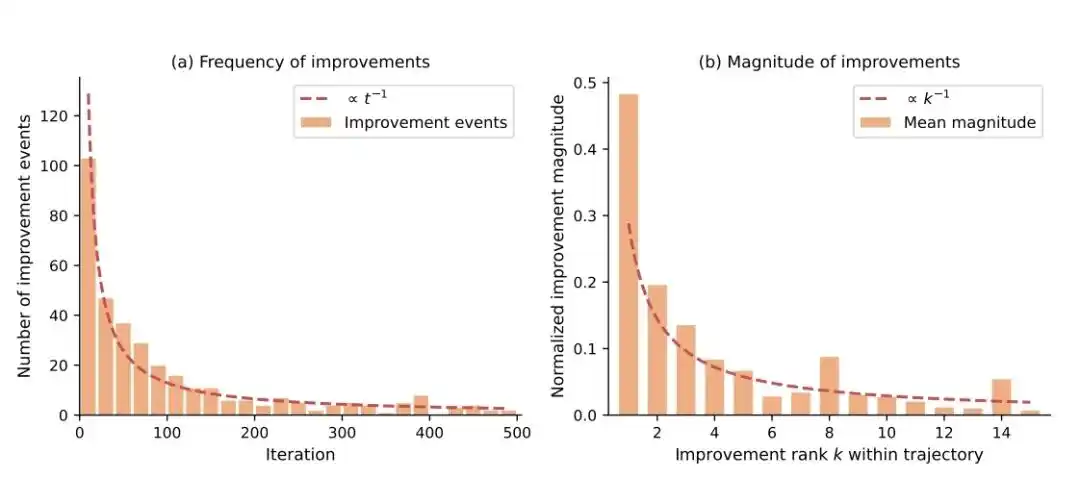
The first law is: The further you go, the harder the improvement.

This paper found that the frequency and magnitude of Agent improvements follow a power-law decay:

  • Improvement frequency ∝ 1 / iteration count
  • Improvement magnitude ∝ 1 / improvement count

Simply put: the fastest gains come in the first few rounds, and it gets progressively harder and smaller later on.

This closely resembles the real R&D process: the first version of AI can quickly eliminate many 'low-hanging fruits', but the closer it gets to the bottleneck, the more effort is required to squeeze out even a bit more performance.

Would it be more cost-effective to explore multiple paths in parallel for trial and error? The answer lies in the second law.
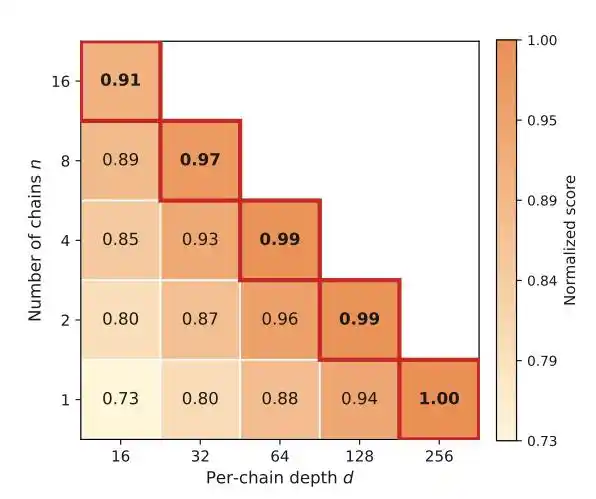
The second law: Breadth is useful, but depth is even more indispensable.

Running multiple parallel paths can avoid getting stuck, but with a fixed budget, each additional chain opened shallows the depth of exploration.

Many engineering breakthroughs require continuous accumulation and constant correction before structural leaps emerge; they can't be achieved simply by 'trying a few more times'.

This actually points towards the development direction of next-generation Agents: not models that 'output an answer once', but systems that can continuously iterate and self-evolve within long-term feedback loops.

AI Engineers Might Really Be Coming

The true far-reaching significance of this research lies in its preliminary outline of an AI system beginning to approach the real engineering cycle.
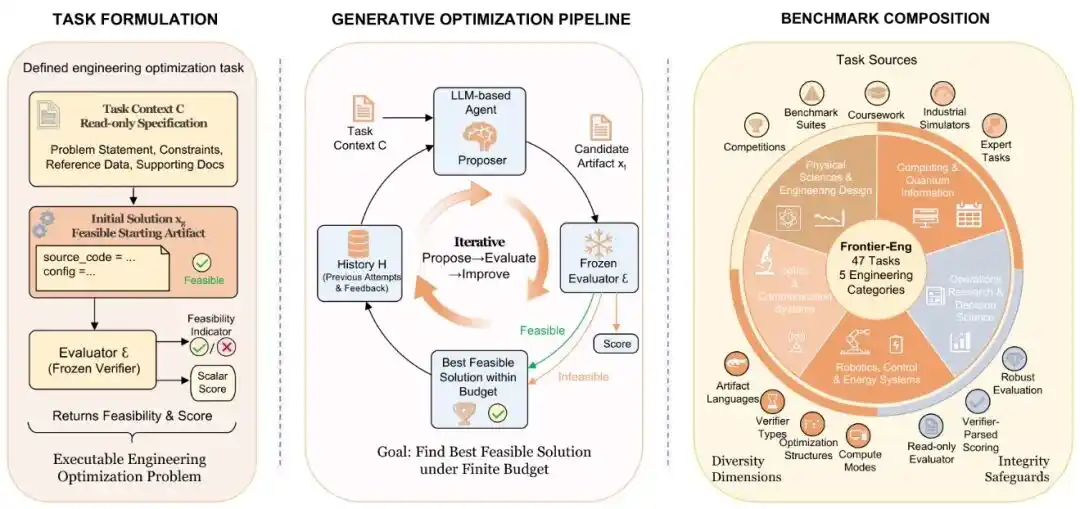
Imagine when AI connects to industrial software, simulation environments, CAD systems, chip design tools, scientific computing platforms...

A dramatic transformation in the modality of productivity is on the verge of emerging.

In future labs, a division of labor like this might appear:

Human researchers are responsible for proposing directions and goals.

For example, 'reduce this component's energy consumption by 30%', 'compress this model's forward pass GPU usage even lower', 'increase the stability of robot control a bit more', 'push the fidelity of this quantum circuit closer to the limit', etc.

And AI is responsible for 'grinding the path'. They focus on these goals, continuously optimizing.

For example, automatically running simulations and experiments, automatically reading feedback from verifiers and simulators, then continuing to modify and optimize, iterating non-stop 24/7.

This evolutionary logic frees AI from the identity of an 'assistive tool', allowing it to begin solving complex system problems like a real engineering team—and tirelessly at that.

And the issues revealed by the Frontier-Eng Benchmark are actually very direct:

When AI begins to learn 'long-term optimization', how far is it from true engineering intelligence?

Paper Title: Frontier-Eng: Benchmarking Self-Evolving Agents on Real-World Engineering Tasks with Generative Optimization

Project Homepage: https://lab.einsia.ai/frontier-eng/

Arxiv: https://arxiv.org/abs/2604.12290

GitHub repo: https://github.com/EinsiaLab/Frontier-Engineering

This article is from the WeChat public account "Quantum Bit", author: Yun Zhong

Criptos en tendencia

Preguntas relacionadas

QWhat is the main purpose of the Frontier-Eng Benchmark released by Einsteina AI's Navers lab?

AThe main purpose of the Frontier-Eng Benchmark is to move beyond testing AI's ability to recall known information. It systematically tests AI agents' capability for 'iterative optimization' on 47 real-world, open-ended engineering tasks without standard answers, evaluating if they can continuously improve performance through a feedback loop involving simulation, error analysis, and parameter adjustment.

QHow does the AI's role change in the Frontier-Eng Benchmark testing process compared to traditional language models?

AIn the Frontier-Eng Benchmark, the AI transitions from acting as a 'super student' that retrieves and assembles answers from training data to performing 'engineering optimization.' Its role becomes akin to a professional engineer: it proposes solutions, runs simulations, analyzes feedback and errors, modifies parameters/code, and reruns experiments in a continuous loop to seek optimal performance under complex constraints.

QWhat are the two key 'AI evolution laws' discovered through the Frontier-Eng Benchmark regarding iterative optimization?

AThe two key laws are: 1) Improvements become progressively harder and smaller (showing a power-law decay: Improvement frequency ∝ 1/iteration count, Improvement magnitude ∝ 1/improvement count). 2) While exploring multiple parallel paths (breadth) is useful, sustained depth in a single optimization path is more critical for achieving structural breakthroughs, as fixed budgets force a trade-off between breadth and depth.

QWhat future work paradigm does the article suggest might emerge from the development of self-evolving AI agents?

AThe article suggests a future 'Auto Research' paradigm where human researchers define the goals and direction (e.g., 'reduce component energy consumption by 30%'), and AI agents take on the role of 'grinding the path.' They would work autonomously and tirelessly—running simulations, interpreting feedback from verifiers and simulators, and iteratively optimizing—24/7 to approach performance limits.

QAccording to the article, what fundamental shift in AI capability does the Frontier-Eng Benchmark represent?

AThe Frontier-Eng Benchmark represents a fundamental shift from evaluating AI's ability to find predetermined 'correct answers' to testing its capacity for 'self-evolution' through long-term feedback loops. It moves the focus to whether AI can demonstrate sustained learning and improvement in complex, real-world scenarios with no single correct answer, pushing AI closer to genuine engineering intelligence.

Lecturas Relacionadas

Interview with Robinhood CEO: Memecoin Boom was Unplanned, My Portfolio is Quite Diversified

In an interview with The Iced Coffee Hour podcast, Robinhood CEO Vlad Tenev discussed the company's initiatives, market views, and personal insights. He highlighted the unexpected success of meme coins on the newly launched Robinhood Chain, which he described as a key part of the financial future. The chain supports tokenized stocks tradable globally and enables innovative DeFi activities not initially anticipated by the team. Regarding market concerns, Tenev noted signs of potential bubbles, specifically in AI and semiconductor stocks, but expressed confidence in Robinhood's younger user base, who often view market downturns as opportunities. He identified optimizing the unified user experience across Robinhood's expanding product lines as the company's current major challenge. Addressing criticism over the prediction markets feature, which some equate to gambling, Tenev emphasized the company's focus on personalization, allowing users to hide the feature or access it more easily. On a personal note, Tenev shared that he enjoys cryptocurrency trading and holds a diversified portfolio. He is optimistic about Bitcoin's long-term prospects due to its unique status as the first crypto asset. Outside work, he focuses on teaching his children math and has adopted wellness routines like sauna, cold baths, and a pre-sleep journaling habit to curb screen time.

marsbitHace 13 min(s)

Interview with Robinhood CEO: Memecoin Boom was Unplanned, My Portfolio is Quite Diversified

marsbitHace 13 min(s)

Illegal Mining in Russia: Why Home Farms Are Easy to Detect

Illegal cryptocurrency mining in Russia is becoming increasingly risky, especially in regions where such activity is banned. Energy supply companies detect atypical, sustained electricity consumption in residential areas, triggering checks. They monitor anomalous usage, report data to tax authorities, and forward information to prosecutors. Home mining farms give themselves away through a characteristic load pattern: an apartment consumes electricity evenly and almost around-the-clock, making such deviations obvious in statistics. Mining remains legal only where not prohibited and when electricity is consumed under a proper contract, metered, and paid for. Income from mining is subject to taxation. To operate legally, registration or notification is required as per regulations. Current consequences for illegal mining involve applying existing rules: penalties for illegal grid connections, unmetered consumption, causing damage to energy companies, and tax evasion. Equipment may be confiscated. While specific administrative and criminal liability for mining itself is still being finalized, offenders face fines, damage claims, and potential criminal charges. Key illegal schemes include mining in prohibited regions, using illegal grid connections or unmetered power, and not paying taxes on mining income. The main damages involve losses for energy companies, grid overload, and unpaid taxes. As of now, bans on crypto mining are in effect in Moscow, the Moscow region, parts of the Kursk region, and several other territories (including parts of the North Caucasus, certain Ukrainian territories under Russian control, and areas in Southern Siberia and the Far East) until at least March 15, 2031, primarily to mitigate electricity deficit risks. The primary reason home mining is easily detectable is its non-typical power consumption pattern: equipment runs almost constantly, creating a stable load that significantly differs from normal household usage, making concealment difficult.

cryptonews.ruHace 16 min(s)

Illegal Mining in Russia: Why Home Farms Are Easy to Detect

cryptonews.ruHace 16 min(s)

Moscow Institute of Physics and Technology (MIPT): Testing Cryptocurrency Trading Strategies under Real Market Conditions

Moscow Institute of Physics and Technology (MIPT) has introduced a system for backtesting cryptocurrency trading strategies under realistic market conditions rather than relying on idealized historical price data. The system simulates real-world trading factors like fees, slippage, liquidity, and perpetual contract funding costs—factors that can cause a paper-profitable strategy to perform poorly in live trading. The system rigorously evaluates strategies by processing market data step-by-step, using only information available at each decision point and incorporating real trading costs. MIPT researchers tested 132 variants of momentum-based strategies. The key finding was not maximum profitability, but the strategies' ability to limit losses during market crashes, with maximum drawdowns reduced from 67% to 29% in realistic tests. The research concluded that forming a portfolio of multiple strategy variants yields more stable returns than relying on a single, historically best-performing variant. This realistic testing framework is seen as a potential foundation for developing and assessing new cryptocurrency investment products, especially as Russia establishes its regulatory framework for digital financial assets. Future work will test other strategy classes and expand to different types of crypto assets.

cryptonews.ruHace 16 min(s)

Moscow Institute of Physics and Technology (MIPT): Testing Cryptocurrency Trading Strategies under Real Market Conditions

cryptonews.ruHace 16 min(s)

Robinhood CEO Interview: Meme Coin Boom Was Unexpected, My Investment Portfolio Is Quite Diverse

Interview with Robinhood CEO Vlad Tenev on The Iced Coffee Hour podcast. Tenev discussed Robinhood Chain, calling it the future of finance. He highlighted its recent launch, rapid growth in TVL, and support for tokenized stocks tradable globally. He noted the unexpected popularity of meme coins on the chain and unique product combinations created by developers. Tenev addressed concerns about AI and stock market bubbles, stating his young user base often views market dips as opportunities. He acknowledged the complexity of balancing investments in chips and energy sectors. He identified optimizing the unified user experience across Robinhood's expanding product lines as the company's biggest current challenge. Responding to criticism, Tenev explained Robinhood's focus on three areas: improving core infrastructure, adding standard financial products it currently lacks, and pioneering innovations like prediction markets and AI-agent trading. He emphasized user personalization, allowing features like prediction markets to be hidden. On personal investment, Tenev stated his portfolio is diversified and he enjoys cryptocurrency trading. He expressed long-term optimism about Bitcoin's unique first-mover status and brand strength, while avoiding specific price predictions. In his personal life, Tenev focuses on teaching his children math, maintaining his health through sauna and cold therapy routines, and building better sleep habits by journaling and reading physical books before bed.

Odaily星球日报Hace 22 min(s)

Robinhood CEO Interview: Meme Coin Boom Was Unexpected, My Investment Portfolio Is Quite Diverse

Odaily星球日报Hace 22 min(s)

Trading

Spot

Artículos destacados

Cómo comprar ERA

¡Bienvenido a HTX.com! Hemos hecho que comprar Caldera (ERA) sea simple y conveniente. Sigue nuestra guía paso a paso para iniciar tu viaje de criptos.Paso 1: crea tu cuenta HTXUtiliza tu correo electrónico o número de teléfono para registrarte y obtener una cuenta gratuita en HTX. Experimenta un proceso de registro sin complicaciones y desbloquea todas las funciones.Obtener mi cuentaPaso 2: ve a Comprar cripto y elige tu método de pagoTarjeta de crédito/débito: usa tu Visa o Mastercard para comprar Caldera (ERA) al instante.Saldo: utiliza fondos del saldo de tu cuenta HTX para tradear sin problemas.Terceros: hemos agregado métodos de pago populares como Google Pay y Apple Pay para mejorar la comodidad.P2P: tradear directamente con otros usuarios en HTX.Over-the-Counter (OTC): ofrecemos servicios personalizados y tipos de cambio competitivos para los traders.Paso 3: guarda tu Caldera (ERA)Después de comprar tu Caldera (ERA), guárdalo en tu cuenta HTX. Alternativamente, puedes enviarlo a otro lugar mediante transferencia blockchain o utilizarlo para tradear otras criptomonedas.Paso 4: tradear Caldera (ERA)Tradear fácilmente con Caldera (ERA) en HTX's mercado spot. Simplemente accede a tu cuenta, selecciona tu par de trading, ejecuta tus trades y monitorea en tiempo real. Ofrecemos una experiencia fácil de usar tanto para principiantes como para traders experimentados.

683 Vistas totalesPublicado en 2025.07.17Actualizado en 2026.06.02

Cómo comprar ERA

Discusiones

Bienvenido a la comunidad de HTX. Aquí puedes mantenerte informado sobre los últimos desarrollos de la plataforma y acceder a análisis profesionales del mercado. A continuación se presentan las opiniones de los usuarios sobre el precio de ERA (ERA).

活动图片