Only 3 Points for the Public Chain Moat? Alliance DAO Founder's Remarks Ignite Crypto Community Debate

Odaily星球日报Publicado a 2025-12-11Actualizado a 2025-12-11

Resumen

In a recent debate sparked by Alliance DAO founder qw (@QwQiao), the crypto community is divided over the "moat" of blockchain technology. Qw controversially rated the moat of L1 public chains at just 3/10, arguing that their defensibility is limited compared to traditional tech and financial giants like Microsoft (10/10), Apple (10/10), or Visa (10/10). He suggested that even top crypto projects only score around 5/10, with Bitcoin being an exception at 9/10 due to its unique founding narrative and Lindy effect. The discussion originated from a Paradigm researcher’s critique that "liquidity is not a moat," which drew mixed reactions. Some, like Dragonfly Capital’s Haseeb, strongly disagreed with qw, pointing to Ethereum’s decade-long dominance despite numerous challengers as proof of a significant moat. Others argued that network effects, trust, and ecosystem maturity are critical moats in crypto. The article explores seven potential components of a public chain’s moat: technical vision, founder influence, developer/user networks, application ecosystems, token market cap, external connectivity, and long-term roadmaps. It concludes that the crypto industry is still too small and nascent to focus heavily on moat analysis—instead, it should prioritize scaling users, capital, and real-world utility.

Original / Odaily Planet Daily (@OdailyChina)

Author / Wenser(@wenser2010)
Recently, Alliance DAO founder qw(@QwQiao) dropped a bombshell opinion: "Blockchain moats are limited," rating the moat of L1 public chains at a mere 3/10.

This statement quickly ignited the overseas crypto circle, sparking heated discussions among crypto VCs, public chain builders, and KOLs. Dragonfly partner Haseeb angrily retorted that rating the "blockchain moat at 3/10" was utterly ridiculous, noting that even Aave founder Santi, who dislikes the industry's gambling tendencies, never believed blockchain "has no moat."

Debates about the meaning, value, and business models of blockchain & cryptocurrency consistently resurface throughout market cycles. The crypto industry constantly oscillates between idealism and reality: people nostalgically yearn for the original decentralized ideals while simultaneously craving the status and recognition of the traditional financial industry, all while being deeply mired in self-doubt about whether it's "just a repackaged casino." The root of all these contradictions perhaps lies in scale—the total market capitalization of the crypto industry has hovered around $3-4 trillion, still appearing minuscule compared to traditional financial giants often worth hundreds of billions or even trillions of dollars.

As practitioners in the industry, everyone harbors a contradictory psychology of both arrogance and inferiority—arrogant about blockchain's birth embodying Satoshi Nakamoto's ideal of de-monetization and decentralized spirit, and about the crypto industry indeed becoming an emerging financial sector that is gradually gaining attention, acceptance, and participation from mainstream forces; the point of inferiority, however, is probably like a poor kid always feeling that what they are doing isn't quite honorable, filled with blood, tears, bitterness, and pain from a zero-sum game where people prey on each other. In short, the limitations of the industry's scale have bred this cyclical identity anxiety, self-doubt, and self-denial.

Today, let's use the topic of "moat business ratings" raised by qw to discuss the existing chronic problems and core advantages of the crypto industry.

Origin of the Debate: Is Liquidity the Moat of the Crypto Industry?

This major industry discussion about "whether the crypto industry has a moat" originally stemmed from a statement by Paradigm team researcher frankie—"The greatest trick the devil ever pulled was convincing crypto people that liquidity is a moat."(Odaily Planet Daily Note: Original quote: the greatest trick the devil ever pulled was convincing crypto people that liquidity is a moat.)

It's clear that frankie, a "purebred" VC, somewhat scoffs at the current industry trend of highly推崇 "liquidity is everything." After all, for an investment manager or research expert who holds advantages in capital and information, they often hope their managed funds are spent on projects and businesses with real operational support, capable of generating genuine cash flow and continuously providing financial returns.

This view also gained agreement from many in the comments:

  • Multicoin partner Kyle Samani directly said "+1";
  • Ethereum Foundation member binji believed that "trust is the real moat; even if trust might flow opportunistically in the short term, liquidity will always reside where trust is placed."
  • Chris Reis from Circle's Arc blockchain team also pointed out: "TVL always seems to be the wrong North Star metric (business guiding goal)."
  • Justin Alick from the Aura foundation remarked somewhat jokingly: "Liquidity is like a fickle woman; she might leave you at any time."
  • DeFi researcher Defi peniel stated bluntly: "Relying solely on liquidity is not a moat; hype can disappear overnight."

Of course, many also refuted this—

  • DFDV COO & CIO Parker commented: "What are you talking about? USDT is the worst stablecoin but holds absolute dominance. Bitcoin is the (performance/experience) worst blockchain but holds dominant地位 absolutely."
  • Former Sequoia investor, now Folius Ventures investor KD, simply asked: "Isn't it?"
  • Fabric VC investor Thomas Crow pointed out: "In exchanges, liquidity *is* a moat—the deeper the liquidity, the better the user experience; this is the most important characteristic in this vertical industry, without exception. This is why major innovations in crypto asset trading focus on solving insufficient liquidity (which leads to worse user experience). Examples include Uniswap acquiring liquidity for long-tail assets through LPs, and Pump.Fun attracting pre-token launch liquidity through standardized contracts and bonding curves."
  • Pantera investor Mason Nystrom retweeted and commented: "Liquidity is absolutely a moat." He then provided various examples: Among public chains, Ethereum leads today because of DeFi liquidity (and developers); among CEXs, Binance, Coinbase, etc.; among lending platforms, Aave, MakerDAO; among stablecoins, USDT; among DEXs, Uniswap, Pancakeswap.

Then came the "moat rating" tweet from Alliance DAO founder qw:
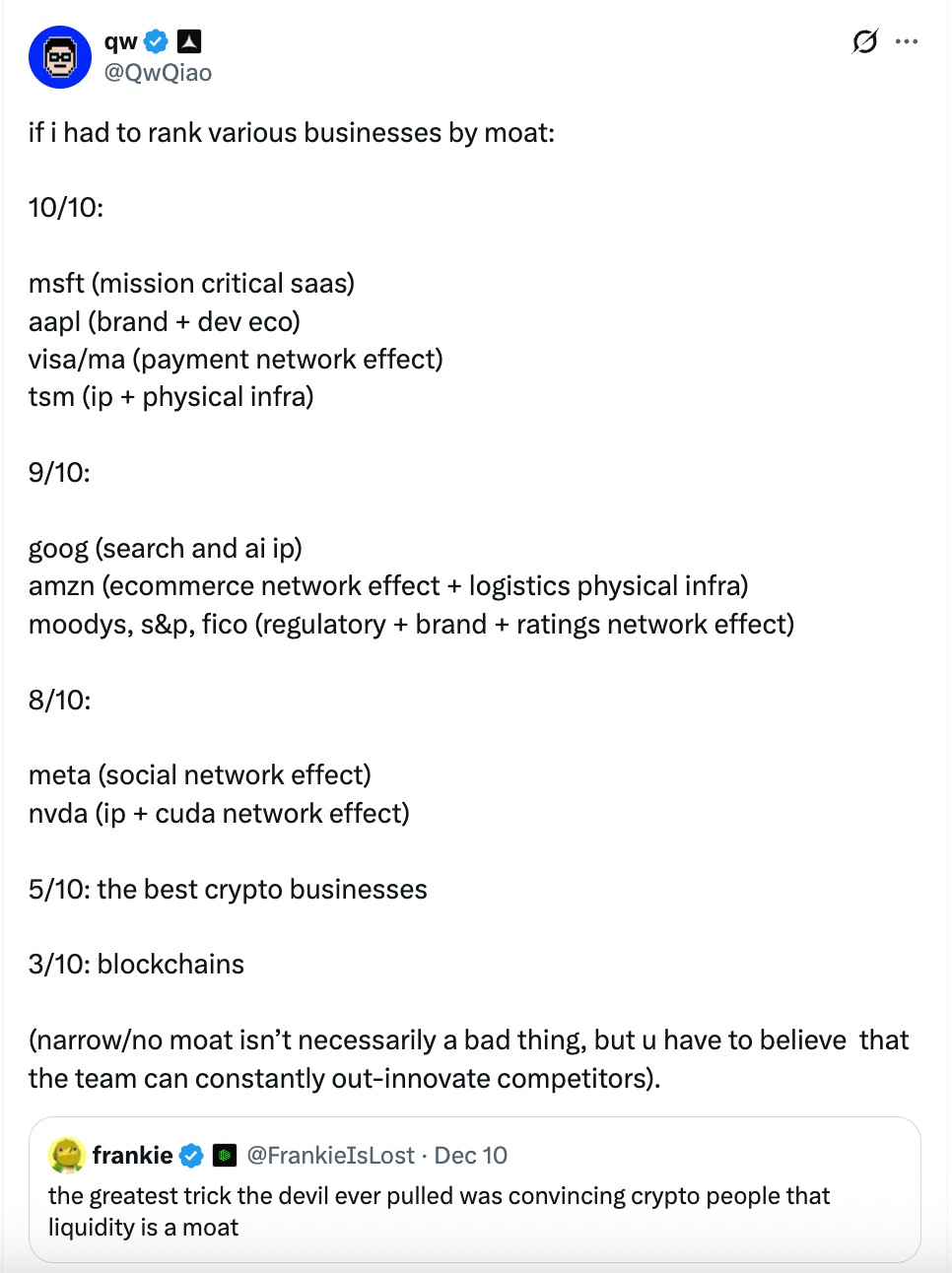
In his view, the moat of the blockchain (public chain) itself is very limited, rated only 3/10.

  • He believes Microsoft (key SaaS), Apple (brand + developer ecosystem), Visa/Mastercard (payment network effects), TSMC (IP + physical infrastructure) can score 10/10 (strongest moat);
  • Google (search and AI IP), Amazon (e-commerce network effects + logistics infrastructure), rating agencies like Moody's, S&P, FICO (regulation-driven + brand + rating network effects), large-scale cloud computing (AWS/Azure/GCP etc.) can score 9/10;
  • Meta (social network effects), NVIDIA (IP + CUDA network effects) score 8/10;
  • The best crypto businesses in the crypto industry score 5/10;
  • Public chains (blockchains) score only 3/10 (narrow moat).

qw further stated that a low moat score isn't necessarily bad, but it means teams must continuously lead innovation, otherwise they will be quickly replaced. Later, perhaps feeling the initial rating was too hasty, he added some supplementary ratings in the comments:

  • The 3 major cloud service infrastructure providers score 9/10;
  • BTC's moat scores 9/10 (Odaily Planet Daily Note: qw pointed out that no one can replicate BTC's founding story and the "Lindy Effect," but deducted 1 point because it's unclear if it can handle security budget and quantum threats);
  • Tesla 7/10 (Odaily Planet Daily Note: qw believes automated IP like self-driving is insane, but the car industry is commoditized, and humanoid robots might be similar)
  • Lithography machine manufacturer ASML 10/10.
  • AAVE's moat score might be higher than 5/10, qw's reason: "As a user, you must trust their smart contract security testing is thorough enough not to lose your funds".

Of course, seeing qw so grandly play the "sharp critic," besides debates about the "moat system," some in the comments made unrelated sarcastic remarks, even mentioning: "What about those terrible launch platforms you invested in?" (Odaily Planet Daily Note: After investing in pump.fun, Alliance DAO's subsequent investments in one-click token issuance platforms (like Believe) performed poorly, even he himself didn't want to rate them)

With such a火药味十足 (fireworks-filled) focal topic, Dragonfly partner Haseeb's subsequent angry retort followed.

Dragonfly Partner's Inner OS: Nonsense, I've Never Seen Someone So Shameless

Responding to qw's "moat rating system," Dragonfly partner Haseeb posted angrily: "What? 'Blockchain moat: 3/10'? That's kinda absurd. Even Santi doesn't think public chains 'have no moat'.

Ethereum has held a dominant position for *10 consecutive years*, hundreds of challengers have raised over $10 billion trying to grab market share. After a decade of competitors trying to defeat it, Ethereum has successfully defended its throne every time. If that doesn't indicate Ethereum has a moat, I don't know what a moat is!"

In the comments of this tweet, qw gave his perspective: "You're talking about looking back ('the past ten years') and it's factually incorrect (on multiple metrics Ethereum no longer holds the throne)."

Subsequently, the two exchanged several rounds on "what exactly is a moat?" and "does Ethereum really have a moat", with qw even pulling out a post he made in November, pointing out that the "moat" in his mind is actually revenue/profit. But Haseeb immediately counterargued with examples—once-popular crypto projects like OpenSea, Axie, BitMEX, although they had high revenues, actually had no moat; the real moat should focus on—"can it be replaced by competitors".

Abra Global management director Marissa also joined the discussion: "Agree (with Haseeb). qw's statement is a bit strange—switching costs and network effects can be strong moats—Solana and Ethereum both have these, I think they will be stronger than other public chains over time. They both have strong brands and developer ecosystems, clearly also part of the moat. Maybe he's referring to other public chains that don't have the above advantages."

Haseeb continued, full of sarcasm: "qw is just splitting hairs, asking for trouble."

Based on the above discussion, perhaps we should break down the "real moat" of public chains in the cryptocurrency industry and what aspects it comprises.

The 7 Components of a Public Chain Moat: From People to Business, From Origin to Network

In my opinion, the main reasons why qw's "moat rating system" seems somewhat unable to justify itself are:

First, its rating标准 only looks at current industry status and revenue while ignoring multi-dimensional evaluation. Whether it's infrastructure like Microsoft, Apple, Amazon Web Services, or payment giants like Visa, Mastercard, the main reason qw gives high scores is their strong revenue models, which obviously oversimplifies and superficializes the business moat of a giant company. Moreover, Apple's global market share is not dominant, and payment giants like Visa also face challenges like market shrinkage and regional business decline.

Second, it overlooks the complexity and uniqueness of public chains and crypto projects区别于 (differentiating them from) traditional internet businesses. As challengers to the fiat system, cryptocurrency, blockchain technology, and subsequent public chains and crypto projects立足点 (base themselves) on the inherent "anonymity," "nodality" of decentralized networks, which is often something traditional revenue-driven businesses cannot achieve.

Based on this, I believe the moat of public chain businesses mainly lies in the following 7 aspects, including:

1. Technical Philosophy. This is also the biggest advantage and differentiating feature of the Bitcoin network, Ethereum network, Solana network, and countless public chain projects. As long as humanity remains wary of centralized systems, authoritarian governments, and the fiat system, and accepts the concepts of sovereign individuals and related viewpoints, the real demand for decentralized networks will always exist;

2. Founder Charisma. Satoshi Nakamoto disappeared after inventing Bitcoin and ensuring the Bitcoin network ran smoothly, sitting on tens of billions of dollars in assets but unmoved; from a World of Warcraft enthusiast abused by the game company to Ethereum co-founder, Vitalik resolutely embarked on his decentralized spiritual journey; Solana founder Toly and others were originally elite engineers at US big tech companies but were unwilling to stop there, thus starting their own "capital internet" construction journey, not to mention the various public chains built inheriting the ambition of Meta's Libra network with the Move language. The personal charm and appeal of founders are particularly important in the crypto industry. This is also why countless crypto projects receive VC favor, community追捧 (praise), and capital influx because of their founders, but also fade into obscurity due to founder resignation or accidents. A good founder is the true soul of a public chain乃至 (and even) a crypto project;

3. Developer and User Network. On this point,正如 (just as) the Metcalfe effect and Lindy effect emphasize, the stronger the network effect of something and the longer it exists, the more likely it is to persist. The developer and user network is the cornerstone of public chains and many crypto projects, because developers can be said to be the first and most enduring users of a crypto public chain or project;

4. Application Ecosystem. A tree with roots but no branches and leaves can hardly survive, and the same goes for crypto projects. Therefore, a rich application ecosystem capable of self-closure and synergistic effects is crucial. The reason why public chains like Ethereum and Solana can survive the winter and still exist is inseparable from the various application projects that are always building. Furthermore, the richer the application ecosystem, the more it can continuously generate造血 (blood-making), feeding back to the public chain;

5. Token Market Cap. If the aforementioned are the inner part and foundation of a "moat," then the token market cap is the external form and brand image of a public chain and a crypto project. Only when you "look expensive" will more people believe you "have a lot of money," that you are a "gold mining ground." This is true for individuals, and likewise for projects;

6. Openness to the Outside. Besides building their own internal循环 (circulation) ecosystems, public chains and other crypto projects also need to maintain openness and operability and exchange value with the external environment. Therefore, openness to the outside is also crucial. Taking public chains like Ethereum and Solana as examples, this refers to the convenience and scale of their bridging with traditional finance, user fund inflows/outflows, and various industries through windows like payments and lending;

7. Long-Term Roadmap. A truly solid moat must not only provide support in the short term but also constantly update, iterate, and innovate, maintaining its own vitality and longevity in the long term. For public chains, the long-term roadmap is both a North Star metric and a powerful抓手 (lever) to激励 (incentivize) continuous development and innovation inside and outside the ecosystem. Ethereum's success is closely related to the planning of its long-term roadmap.

Based on the above elements, a public chain can grow from zero to one, from nothing to something, gradually moving through the野蛮生长 (wild growth) period into the mature iteration period. Corresponding liquidity and user stickiness will naturally follow.

Conclusion: The Crypto Industry Has Not Yet Reached the Stage of "Competing on Talent"

Recently, Moore Threads, known as the "Chinese version of NVIDIA," successfully listed on the Hong Kong stock market, achieving a milestone of 300 billion CNY on its first day of trading; then, within just a few days, its stock price soared all the way, reaching another astonishing breakthrough with a market cap exceeding 400 billion CNY today.

Compared to Ethereum, which took 10 years of operation to finally reach a $300 billion market cap, Moore Threads covered 1/7 of that journey in just a few days. And compared to US stock giants often worth trillions, the crypto industry is even more insignificant.

This makes us sigh again that today, with the scale of capital and user involvement far smaller than the financial and internet industries, we are far from the stage of "competing on talent." The only pain point of the crypto industry today is that we don't have enough people, we don't attract enough capital, and the industries involved are not broad enough. Rather than worrying about those grand, all-encompassing "moats," perhaps what we should think about is how cryptocurrency can更快 (faster), lower cost, and more conveniently meet the real needs of more market users.

Preguntas relacionadas

QWhat controversial rating did Alliance DAO founder qw assign to L1 public blockchains' moat, and why did it spark debate?

Aqw assigned a moat rating of only 3/10 to L1 public blockchains, arguing their moat is very limited. This sparked intense debate because many industry leaders, such as Dragonfly's Haseeb, found it absurd, citing Ethereum's decade-long dominance despite numerous well-funded challengers.

QAccording to the article, what did Paradigm researcher frankie criticize as a false belief in crypto, and how did the community respond?

Afrankie criticized the belief that 'liquidity is a moat' as a deceptive notion. The community was divided: some agreed, like Multicoin's Kyle Samani and others emphasizing trust or better metrics, while defenders like DFDV's Parker argued liquidity is crucial, citing examples like USDT and Bitcoin's dominance.

QHow did Dragonfly partner Haseeb counter qw's low moat rating for blockchains?

AHaseeb strongly countered by pointing to Ethereum's sustained dominance for over a decade despite hundreds of competitors raising over $10 billion to challenge it. He argued that if this doesn't constitute a moat, nothing does, emphasizing that a true moat is about being hard to replace.

QWhat are the seven components of a public blockchain's moat as outlined in the article?

AThe seven components are: 1. Technical philosophy, 2. Founder charisma, 3. Developer and user network, 4. Application ecosystem, 5. Token market capitalization, 6. Openness to the outside world, and 7. Long-term roadmap.

QWhat does the article conclude is the crypto industry's main challenge regarding its 'moat' and future growth?

AThe article concludes that the crypto industry's main challenge is its relatively small scale in terms of user adoption and capital compared to traditional finance and internet giants. It argues the focus should be on attracting more users and capital by meeting real market needs quickly, cheaply, and conveniently, rather than worrying about abstract moats.

Lecturas Relacionadas

Trading

Spot
Futuros

Artículos destacados

Qué es $S$

Entendiendo SPERO: Una Visión General Completa Introducción a SPERO A medida que el panorama de la innovación continúa evolucionando, la aparición de tecnologías web3 y proyectos de criptomonedas juega un papel fundamental en la configuración del futuro digital. Un proyecto que ha atraído la atención en este campo dinámico es SPERO, denotado como SPERO,$$s$. Este artículo tiene como objetivo reunir y presentar información detallada sobre SPERO, para ayudar a entusiastas e inversores a comprender sus fundamentos, objetivos e innovaciones dentro de los dominios web3 y cripto. ¿Qué es SPERO,$$s$? SPERO,$$s$ es un proyecto único dentro del espacio cripto que busca aprovechar los principios de descentralización y tecnología blockchain para crear un ecosistema que promueva la participación, la utilidad y la inclusión financiera. El proyecto está diseñado para facilitar interacciones de igual a igual de nuevas maneras, proporcionando a los usuarios soluciones y servicios financieros innovadores. En su esencia, SPERO,$$s$ tiene como objetivo empoderar a los individuos al proporcionar herramientas y plataformas que mejoren la experiencia del usuario en el espacio de las criptomonedas. Esto incluye habilitar métodos de transacción más flexibles, fomentar iniciativas impulsadas por la comunidad y crear caminos para oportunidades financieras a través de aplicaciones descentralizadas (dApps). La visión subyacente de SPERO,$$s$ gira en torno a la inclusividad, buscando cerrar brechas dentro de las finanzas tradicionales mientras aprovecha los beneficios de la tecnología blockchain. ¿Quién es el Creador de SPERO,$$s$? La identidad del creador de SPERO,$$s$ sigue siendo algo oscura, ya que hay recursos públicos limitados que proporcionan información de fondo detallada sobre su(s) fundador(es). Esta falta de transparencia puede derivarse del compromiso del proyecto con la descentralización, una ética que muchos proyectos web3 comparten, priorizando las contribuciones colectivas sobre el reconocimiento individual. Al centrar las discusiones en torno a la comunidad y sus objetivos colectivos, SPERO,$$s$ encarna la esencia del empoderamiento sin señalar a individuos específicos. Como tal, comprender la ética y la misión de SPERO sigue siendo más importante que identificar a un creador singular. ¿Quiénes son los Inversores de SPERO,$$s$? SPERO,$$s$ cuenta con el apoyo de una diversa gama de inversores que van desde capitalistas de riesgo hasta inversores ángeles dedicados a fomentar la innovación en el sector cripto. El enfoque de estos inversores generalmente se alinea con la misión de SPERO, priorizando proyectos que prometen avances tecnológicos sociales, inclusión financiera y gobernanza descentralizada. Estas fundaciones de inversores suelen estar interesadas en proyectos que no solo ofrecen productos innovadores, sino que también contribuyen positivamente a la comunidad blockchain y sus ecosistemas. El respaldo de estos inversores refuerza a SPERO,$$s$ como un contendiente notable en el dominio de proyectos cripto que evoluciona rápidamente. ¿Cómo Funciona SPERO,$$s$? SPERO,$$s$ emplea un marco multifacético que lo distingue de los proyectos de criptomonedas convencionales. Aquí hay algunas de las características clave que subrayan su singularidad e innovación: Gobernanza Descentralizada: SPERO,$$s$ integra modelos de gobernanza descentralizada, empoderando a los usuarios para participar activamente en los procesos de toma de decisiones sobre el futuro del proyecto. Este enfoque fomenta un sentido de propiedad y responsabilidad entre los miembros de la comunidad. Utilidad del Token: SPERO,$$s$ utiliza su propio token de criptomoneda, diseñado para servir diversas funciones dentro del ecosistema. Estos tokens permiten transacciones, recompensas y la facilitación de servicios ofrecidos en la plataforma, mejorando la participación y la utilidad general. Arquitectura en Capas: La arquitectura técnica de SPERO,$$s$ apoya la modularidad y escalabilidad, permitiendo la integración fluida de características y aplicaciones adicionales a medida que el proyecto evoluciona. Esta adaptabilidad es fundamental para mantener la relevancia en el cambiante paisaje cripto. Participación de la Comunidad: El proyecto enfatiza iniciativas impulsadas por la comunidad, empleando mecanismos que incentivan la colaboración y la retroalimentación. Al nutrir una comunidad sólida, SPERO,$$s$ puede abordar mejor las necesidades de los usuarios y adaptarse a las tendencias del mercado. Enfoque en la Inclusión: Al ofrecer tarifas de transacción bajas e interfaces amigables para el usuario, SPERO,$$s$ busca atraer a una base de usuarios diversa, incluyendo a individuos que anteriormente pueden no haber participado en el espacio cripto. Este compromiso con la inclusión se alinea con su misión general de empoderamiento a través de la accesibilidad. Cronología de SPERO,$$s$ Entender la historia de un proyecto proporciona información crucial sobre su trayectoria de desarrollo y hitos. A continuación se presenta una cronología sugerida que mapea eventos significativos en la evolución de SPERO,$$s$: Fase de Conceptualización e Ideación: Las ideas iniciales que forman la base de SPERO,$$s$ fueron concebidas, alineándose estrechamente con los principios de descentralización y enfoque comunitario dentro de la industria blockchain. Lanzamiento del Whitepaper del Proyecto: Tras la fase conceptual, se lanzó un whitepaper completo que detalla la visión, los objetivos y la infraestructura tecnológica de SPERO,$$s$ para generar interés y retroalimentación de la comunidad. Construcción de Comunidad y Primeras Interacciones: Se realizaron esfuerzos de divulgación activa para construir una comunidad de primeros adoptantes y posibles inversores, facilitando discusiones en torno a los objetivos del proyecto y obteniendo apoyo. Evento de Generación de Tokens: SPERO,$$s$ llevó a cabo un evento de generación de tokens (TGE) para distribuir sus tokens nativos a los primeros seguidores y establecer liquidez inicial dentro del ecosistema. Lanzamiento de la dApp Inicial: La primera aplicación descentralizada (dApp) asociada con SPERO,$$s$ se puso en marcha, permitiendo a los usuarios interactuar con las funcionalidades centrales de la plataforma. Desarrollo Continuo y Alianzas: Actualizaciones y mejoras continuas a las ofertas del proyecto, incluyendo alianzas estratégicas con otros actores en el espacio blockchain, han moldeado a SPERO,$$s$ en un jugador competitivo y en evolución en el mercado cripto. Conclusión SPERO,$$s$ se erige como un testimonio del potencial de web3 y las criptomonedas para revolucionar los sistemas financieros y empoderar a los individuos. Con un compromiso con la gobernanza descentralizada, la participación comunitaria y funcionalidades diseñadas de manera innovadora, allana el camino hacia un paisaje financiero más inclusivo. Como con cualquier inversión en el espacio cripto que evoluciona rápidamente, se anima a los posibles inversores y usuarios a investigar a fondo y participar de manera reflexiva con los desarrollos en curso dentro de SPERO,$$s$. El proyecto muestra el espíritu innovador de la industria cripto, invitando a una mayor exploración de sus innumerables posibilidades. Mientras el viaje de SPERO,$$s$ aún se desarrolla, sus principios fundamentales pueden, de hecho, influir en el futuro de cómo interactuamos con la tecnología, las finanzas y entre nosotros en ecosistemas digitales interconectados.

72 Vistas totalesPublicado en 2024.12.17Actualizado en 2024.12.17

Qué es $S$

Qué es AGENT S

Agent S: El Futuro de la Interacción Autónoma en Web3 Introducción En el paisaje en constante evolución de Web3 y las criptomonedas, las innovaciones están redefiniendo constantemente cómo los individuos interactúan con las plataformas digitales. Uno de estos proyectos pioneros, Agent S, promete revolucionar la interacción humano-computadora a través de su marco agente abierto. Al allanar el camino para interacciones autónomas, Agent S busca simplificar tareas complejas, ofreciendo aplicaciones transformadoras en inteligencia artificial (IA). Esta exploración detallada profundizará en las complejidades del proyecto, sus características únicas y las implicaciones para el dominio de las criptomonedas. ¿Qué es Agent S? Agent S se presenta como un marco agente abierto innovador, diseñado específicamente para abordar tres desafíos fundamentales en la automatización de tareas informáticas: Adquisición de Conocimiento Específico del Dominio: El marco aprende inteligentemente de diversas fuentes de conocimiento externas y experiencias internas. Este enfoque dual le permite construir un rico repositorio de conocimiento específico del dominio, mejorando su rendimiento en la ejecución de tareas. Planificación a Largo Plazo de Tareas: Agent S emplea planificación jerárquica aumentada por la experiencia, un enfoque estratégico que facilita la descomposición y ejecución eficiente de tareas complejas. Esta característica mejora significativamente su capacidad para gestionar múltiples subtareas de manera eficiente y efectiva. Manejo de Interfaces Dinámicas y No Uniformes: El proyecto introduce la Interfaz Agente-Computadora (ACI), una solución innovadora que mejora la interacción entre agentes y usuarios. Utilizando Modelos de Lenguaje Multimodal de Gran Escala (MLLMs), Agent S puede navegar y manipular diversas interfaces gráficas de usuario sin problemas. A través de estas características pioneras, Agent S proporciona un marco robusto que aborda las complejidades involucradas en la automatización de la interacción humana con las máquinas, preparando el terreno para una multitud de aplicaciones en IA y más allá. ¿Quién es el Creador de Agent S? Si bien el concepto de Agent S es fundamentalmente innovador, la información específica sobre su creador sigue siendo elusiva. El creador es actualmente desconocido, lo que resalta ya sea la etapa incipiente del proyecto o la elección estratégica de mantener a los miembros fundadores en el anonimato. Independientemente de la anonimidad, el enfoque sigue siendo en las capacidades y el potencial del marco. ¿Quiénes son los Inversores de Agent S? Dado que Agent S es relativamente nuevo en el ecosistema criptográfico, la información detallada sobre sus inversores y patrocinadores financieros no está documentada explícitamente. La falta de información disponible públicamente sobre las bases de inversión u organizaciones que apoyan el proyecto plantea preguntas sobre su estructura de financiamiento y hoja de ruta de desarrollo. Comprender el respaldo es crucial para evaluar la sostenibilidad del proyecto y su posible impacto en el mercado. ¿Cómo Funciona Agent S? En el núcleo de Agent S se encuentra una tecnología de vanguardia que le permite funcionar de manera efectiva en diversos entornos. Su modelo operativo se basa en varias características clave: Interacción Humano-Computadora Similar a la Humana: El marco ofrece planificación avanzada de IA, esforzándose por hacer que las interacciones con las computadoras sean más intuitivas. Al imitar el comportamiento humano en la ejecución de tareas, promete elevar las experiencias de los usuarios. Memoria Narrativa: Empleada para aprovechar experiencias de alto nivel, Agent S utiliza memoria narrativa para hacer un seguimiento de las historias de tareas, mejorando así sus procesos de toma de decisiones. Memoria Episódica: Esta característica proporciona a los usuarios una guía paso a paso, permitiendo que el marco ofrezca apoyo contextual a medida que se desarrollan las tareas. Soporte para OpenACI: Con la capacidad de ejecutarse localmente, Agent S permite a los usuarios mantener el control sobre sus interacciones y flujos de trabajo, alineándose con la ética descentralizada de Web3. Fácil Integración con APIs Externas: Su versatilidad y compatibilidad con varias plataformas de IA aseguran que Agent S pueda encajar sin problemas en ecosistemas tecnológicos existentes, convirtiéndolo en una opción atractiva para desarrolladores y organizaciones. Estas funcionalidades contribuyen colectivamente a la posición única de Agent S dentro del espacio cripto, ya que automatiza tareas complejas y de múltiples pasos con una intervención humana mínima. A medida que el proyecto evoluciona, sus posibles aplicaciones en Web3 podrían redefinir cómo se desarrollan las interacciones digitales. Cronología de Agent S El desarrollo y los hitos de Agent S pueden encapsularse en una cronología que resalta sus eventos significativos: 27 de septiembre de 2024: El concepto de Agent S fue lanzado en un documento de investigación integral titulado “Un Marco Agente Abierto que Usa Computadoras Como un Humano”, mostrando las bases del proyecto. 10 de octubre de 2024: El documento de investigación fue puesto a disposición del público en arXiv, ofreciendo una exploración profunda del marco y su evaluación de rendimiento basada en el benchmark OSWorld. 12 de octubre de 2024: Se lanzó una presentación en video, proporcionando una visión visual de las capacidades y características de Agent S, involucrando aún más a posibles usuarios e inversores. Estos marcadores en la cronología no solo ilustran el progreso de Agent S, sino que también indican su compromiso con la transparencia y la participación comunitaria. Puntos Clave Sobre Agent S A medida que el marco Agent S continúa evolucionando, varios atributos clave destacan, subrayando su naturaleza innovadora y potencial: Marco Innovador: Diseñado para proporcionar un uso intuitivo de las computadoras similar a la interacción humana, Agent S aporta un enfoque novedoso a la automatización de tareas. Interacción Autónoma: La capacidad de interactuar de manera autónoma con las computadoras a través de GUI significa un salto hacia soluciones informáticas más inteligentes y eficientes. Automatización de Tareas Complejas: Con su metodología robusta, puede automatizar tareas complejas y de múltiples pasos, haciendo que los procesos sean más rápidos y menos propensos a errores. Mejora Continua: Los mecanismos de aprendizaje permiten a Agent S mejorar a partir de experiencias pasadas, mejorando continuamente su rendimiento y eficacia. Versatilidad: Su adaptabilidad en diferentes entornos operativos como OSWorld y WindowsAgentArena asegura que pueda servir a una amplia gama de aplicaciones. A medida que Agent S se posiciona en el paisaje de Web3 y criptomonedas, su potencial para mejorar las capacidades de interacción y automatizar procesos significa un avance significativo en las tecnologías de IA. A través de su marco innovador, Agent S ejemplifica el futuro de las interacciones digitales, prometiendo una experiencia más fluida y eficiente para los usuarios en diversas industrias. Conclusión Agent S representa un audaz avance en la unión de la IA y Web3, con la capacidad de redefinir cómo interactuamos con la tecnología. Aunque aún se encuentra en sus primeras etapas, las posibilidades para su aplicación son vastas y atractivas. A través de su marco integral que aborda desafíos críticos, Agent S busca llevar las interacciones autónomas al primer plano de la experiencia digital. A medida que nos adentramos más en los reinos de las criptomonedas y la descentralización, proyectos como Agent S sin duda desempeñarán un papel crucial en la configuración del futuro de la tecnología y la colaboración humano-computadora.

367 Vistas totalesPublicado en 2025.01.14Actualizado en 2025.01.14

Qué es AGENT S

Cómo comprar S

¡Bienvenido a HTX.com! Hemos hecho que comprar Sonic (S) sea simple y conveniente. Sigue nuestra guía paso a paso para iniciar tu viaje de criptos.Paso 1: crea tu cuenta HTXUtiliza tu correo electrónico o número de teléfono para registrarte y obtener una cuenta gratuita en HTX. Experimenta un proceso de registro sin complicaciones y desbloquea todas las funciones.Obtener mi cuentaPaso 2: ve a Comprar cripto y elige tu método de pagoTarjeta de crédito/débito: usa tu Visa o Mastercard para comprar Sonic (S) al instante.Saldo: utiliza fondos del saldo de tu cuenta HTX para tradear sin problemas.Terceros: hemos agregado métodos de pago populares como Google Pay y Apple Pay para mejorar la comodidad.P2P: tradear directamente con otros usuarios en HTX.Over-the-Counter (OTC): ofrecemos servicios personalizados y tipos de cambio competitivos para los traders.Paso 3: guarda tu Sonic (S)Después de comprar tu Sonic (S), guárdalo en tu cuenta HTX. Alternativamente, puedes enviarlo a otro lugar mediante transferencia blockchain o utilizarlo para tradear otras criptomonedas.Paso 4: tradear Sonic (S)Tradear fácilmente con Sonic (S) en HTX's mercado spot. Simplemente accede a tu cuenta, selecciona tu par de trading, ejecuta tus trades y monitorea en tiempo real. Ofrecemos una experiencia fácil de usar tanto para principiantes como para traders experimentados.

783 Vistas totalesPublicado en 2025.01.15Actualizado en 2025.03.21

Cómo comprar S

Discusiones

Bienvenido a la comunidad de HTX. Aquí puedes mantenerte informado sobre los últimos desarrollos de la plataforma y acceder a análisis profesionales del mercado. A continuación se presentan las opiniones de los usuarios sobre el precio de S (S).

活动图片