Odds Of Crypto Market Structure Bill Passing This Year Fall To 40% On Polymarket

bitcoinistPublicado a 2026-02-25Actualizado a 2026-02-25

Resumen

According to prediction market Polymarket, the odds of the crypto market structure bill, the CLARITY Act, passing this year have fallen sharply to 42%. This drop reflects growing skepticism that ongoing high-level negotiations between the crypto industry and banking representatives will reach a breakthrough in time, despite months of discussions at the White House. A key sticking point is draft legislation addressing bank concerns, particularly around crypto rewards programs. A major outcome is that paying yield on idle stablecoin balances is now off the table. The debate has shifted to whether rewards can be tied to specific user activities instead of simple account balances. Market experts suggest that if passed, the bill could significantly impact Bitcoin derivatives markets. It would likely cement the CFTC's authority, potentially leading to more regulated US trading venues and the emergence of CFTC-registered perpetual futures platforms. This clarity could encourage greater institutional participation and reduce discrepancies between spot and futures markets. Furthermore, Bitcoin options markets might see new regulated venues and potentially lower volatility, making strategies like hedging more accessible.

The likelihood that the long‐awaited crypto market structure legislation, known as the CLARITY Act, will become law this year has fallen sharply over the past 24 hours, according to data from prediction platform Polymarket.

Traders now assign the bill a 42% chance of passing in 2026, reflecting growing skepticism that ongoing negotiations between the crypto industry and the banking sector will produce a breakthrough in time.

Crypto And Banks Remain Divided

The drop in confidence comes despite months of high-level discussions at the White House. Lawmakers and industry representatives have been attempting to build consensus around a broader market structure framework.

However, three key White House meetings between crypto firms and banking representatives have yet to yield a final agreement. Even so, public messaging from officials has remained upbeat.
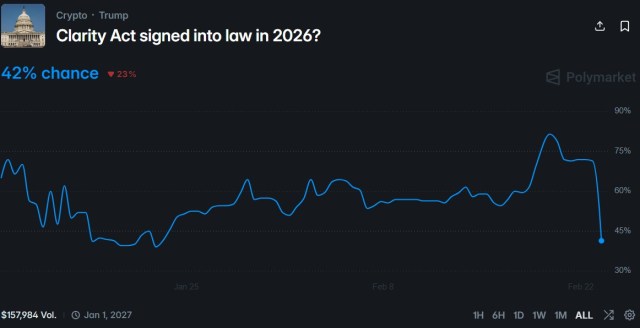
Crypto market structure bill odds of passing drop to 42%. Source: Polymarket

As Bitcoinist reported last week, Patrick Witt, Executive Director of the President’s Council of Advisors for Digital Assets, described the latest round of talks as “a big step forward.” “We’re close,” Witt wrote, adding that if both sides continue negotiating in good faith, he expects the administration’s March 1 deadline to be met.

At the center of the discussions is draft legislative language designed to address concerns raised by banks in a document titled “Yield and Interest Prohibition Principles.”

While the proposed text acknowledges the banking sector’s objections, it also makes clear that any restrictions on crypto rewards programs would be narrowly tailored.

One significant outcome of the negotiations is that paying yield on idle stablecoin balances — a major objective for many crypto firms — is effectively off the table.

Instead, the debate has shifted toward whether companies should be permitted to offer rewards tied to specific user activities rather than simple account balances.

How New Rules Could Change Bitcoin Derivatives Markets

Beyond the political back‐and‐forth, market expert MartyParty recently highlighted potential structural shifts that could follow the bill’s passage, arguing that the changes may be more significant than many investors realize.

In the Bitcoin (BTC) futures market, clearer jurisdictional boundaries would likely cement the Commodity Futures Trading Commission’s (CFTC) authority over digital asset commodities.

The expert believes that could accelerate the growth of regulated US trading venues, similar to CME, and potentially open the door to CFTC‐registered perpetual futures platforms.

According to MartyParty’s analysis, clear commodity classification may also encourage greater institutional participation, particularly from funds that are restricted from investing in assets deemed securities.

Perpetual futures contracts — a crypto‐native product widely used outside the United States — could also evolve. With CFTC registration, US‐based perpetual products might emerge with stronger consumer protections, greater transparency around funding rates, and tighter safeguards against manipulation.

Greater regulatory clarity could also reduce discrepancies between spot and futures markets, narrowing price gaps and stabilizing funding dynamics. At the same time, stricter leverage caps or margin requirements imposed under CFTC rules could limit the extreme levels of retail speculation currently seen on offshore platforms.

Bitcoin options markets would likely experience parallel shifts. The expert asserts that a clearer regulatory framework could encourage the development of additional US‐regulated options venues offering both physically settled and cash‐settled contracts tied to Bitcoin futures.

Reduced enforcement uncertainty may also lower implied volatility premiums, potentially making options more affordable for hedging and speculative strategies.

Institutional investors, in particular, could more confidently deploy advanced strategies — including collars and straddles — if Bitcoin’s commodity status is firmly established.

The 1D chart shows BTC’s price consolidation, currently at around $66,000. Source: BTCUSDT on TradingView.com

Featured image from OpenArt, chart from TradingView.com

Preguntas relacionadas

QAccording to Polymarket, what are the current odds that the CLARITY Act will pass this year?

AThe current odds that the CLARITY Act will pass this year are 42%.

QWhat is the major sticking point in the negotiations between the crypto industry and banks, as mentioned in the article?

AA major sticking point is the debate over whether companies should be permitted to offer rewards tied to specific user activities rather than simple account balances, with paying yield on idle stablecoin balances effectively being off the table.

QWhich US regulatory body is expected to gain clearer authority over digital asset commodities if the bill passes?

AThe Commodity Futures Trading Commission (CFTC) is expected to have its authority over digital asset commodities cemented.

QWhat potential benefit for institutional investors does the expert MartyParty highlight regarding Bitcoin's classification?

AMartyParty highlights that if Bitcoin's commodity status is firmly established, institutional investors could more confidently deploy advanced options strategies like collars and straddles.

QWhat was the public messaging from officials like, despite the lack of a final agreement from the White House meetings?

ADespite the lack of a final agreement, public messaging from officials remained upbeat, with one executive director describing the latest talks as 'a big step forward' and expressing that they are 'close' to a deal.

Lecturas Relacionadas

In Jinjiang, Fujian, a Storage Super Unicorn Lies Quiet

In Fujian's Jinjiang, a city known for sportswear, lies a quiet semiconductor giant: Fujian Jinhua Integrated Circuit Co. (JHICC). Once a promising domestic DRAM manufacturer alongside Yangtze Memory and ChangXin Memory Technologies (CXMT), its journey was derailed in 2018 when the U.S. placed it on an Entity List and filed criminal charges for alleged trade secret theft. This halted production for years. A turning point came in February 2024 when a U.S. federal court found JHICC not guilty. However, it had lost crucial time. While CXMT soared to become a top-valued A-share company in 2024, JHICC, with an estimated valuation of 80 billion RMB, was just restarting. Its current output is primarily customized DDR4 chips, not the advanced DDR5/HBM demanded for AI, but it still benefits from the broader memory chip upcycle. JHICC's story is tied to Chen Zhengkun, a veteran engineer who left Micron to lead the venture. Founded in 2016 with state-backed funding, JHICC partnered with Taiwan's UMC to develop DRAM technology. Rapid progress was cut short by the U.S. actions, which Micron initiated, partly due to its heavy reliance on the Chinese market. Post-sanctions, Chen's team worked to rebuild the production line with reduced reliance on U.S. technology. According to its records, JHICC achieved small-scale production and revenue growth under immense pressure. It now focuses on the stable "niche" DRAM market (e.g., TVs, routers) with a monthly capacity of ~40,000 wafers, aiming for 60,000 by 2026. It holds over 1,000 patents but remains on the Entity List. For Jinjiang, investing in JHICC was a bold industrial leap. The local government provided unwavering financial and logistical support during the crisis, helping the company survive. JHICC has become the anchor for a growing local semiconductor cluster. Though its scale lags behind domestic peers, JHICC's persistence symbolizes a hard-won foothold in a global market long dominated by Samsung, SK Hynix, and Micron. Having missed one boom, it seeks a place in the new AI-driven memory supercycle.

marsbitHace 7 min(s)

In Jinjiang, Fujian, a Storage Super Unicorn Lies Quiet

marsbitHace 7 min(s)

Must-Watch Events Next Week|CLARITY Act Could Face Senate Vote; SpaceX, Circle to Report Earnings (8.3-8.9)

**Summary: Key Events and Developments to Watch (August 3-9)** The upcoming week is marked by significant financial disclosures, key legislative deadlines, and notable product updates. **Major Financial Events:** Several companies are scheduled to release their Q2 2026 earnings. American Bitcoin (ABTC) will report on August 3, followed by SpaceX and Hut 8 Mining Corp. on August 4, and Circle on August 5. Notably, a significant portion of SpaceX shares (up to 12% of total shares) will be unlocked on August 6 following their earnings release. **Key Legislative Deadline:** The U.S. Senate faces an August 7 deadline to secure 60 votes for the CLARITY Act, a bipartisan bill aiming to establish a federal regulatory framework for cryptocurrencies. The Senate may hold a full vote on the bill during the week. **Economic Data:** The U.S. July Non-Farm Payrolls report will be released on August 7, providing crucial labor market data. **Technology & Product Updates:** * **Shutdowns:** DeFi portfolio tracker Zapper and wallet app Ctrl Wallet will cease operations on August 3. * **Upgrades:** LayerZero will deprecate its v1 relayers on August 3. XRP Ledger's new version 3.3.0, featuring five new functions, is expected next week. * **AI:** Elon Musk announced that the advanced Grok 4.6 AI model is set for release around August 7. * **Bitcoin:** The BIP-110 forced signaling for a potential Bitcoin network change is scheduled to begin around August 8. **Other Notable Events:** Chinese robotics firm Unitree Tech has set its preliminary price inquiry for its IPO for August 5. South Korean exchange Upbit will delist AQT and AERGO tokens on August 3.

marsbitHace 2 hora(s)

Must-Watch Events Next Week|CLARITY Act Could Face Senate Vote; SpaceX, Circle to Report Earnings (8.3-8.9)

marsbitHace 2 hora(s)

Trading

Spot
活动图片





