Now is the Best Time to Interact with Polymarket (Exclusive Tutorial Included)

Odaily星球日报Publicado a 2026-03-18Actualizado a 2026-03-18

Resumen

Polymarket, a prediction market platform, is currently offering an exceptional opportunity for users to earn liquidity provider (LP) rewards, particularly due to a massive $2 million subsidy program for NCAA's "March Madness" basketball tournament events. The core strategy for effective interaction is to focus on accumulating these LP rewards instead of solely trading, as a significant majority of users have never received any. To qualify, users must provide liquidity on specific, subsidized events by placing orders within a maximum spread (e.g., ±1¢) and a minimum share amount (e.g., 1000 shares). Rewards are distributed daily, but only if they exceed $1. The article provides a step-by-step guide: First, select an event with high subsidies from the Rewards page, preferably one starting later to minimize price volatility and inventory risk. For example, a game starting days later showed almost no price movement. Next, use the Split function to create equal buy and sell shares from a minimum of $1000, then place limit sell orders on both sides. It's advised to place orders slightly away from the market price (e.g., the second position) to reduce the risk of orders being filled, which would require rebalancing. Users should monitor their positions and consider withdrawing orders about one day before the event starts to avoid last-minute volatility, then potentially move funds to a later event. The author reports earning $4.31 in rewards over a few hours with minimal effort,...

Original | Odaily Planet Daily (@OdailyChina)

Author | Azuma (@azuma_eth)
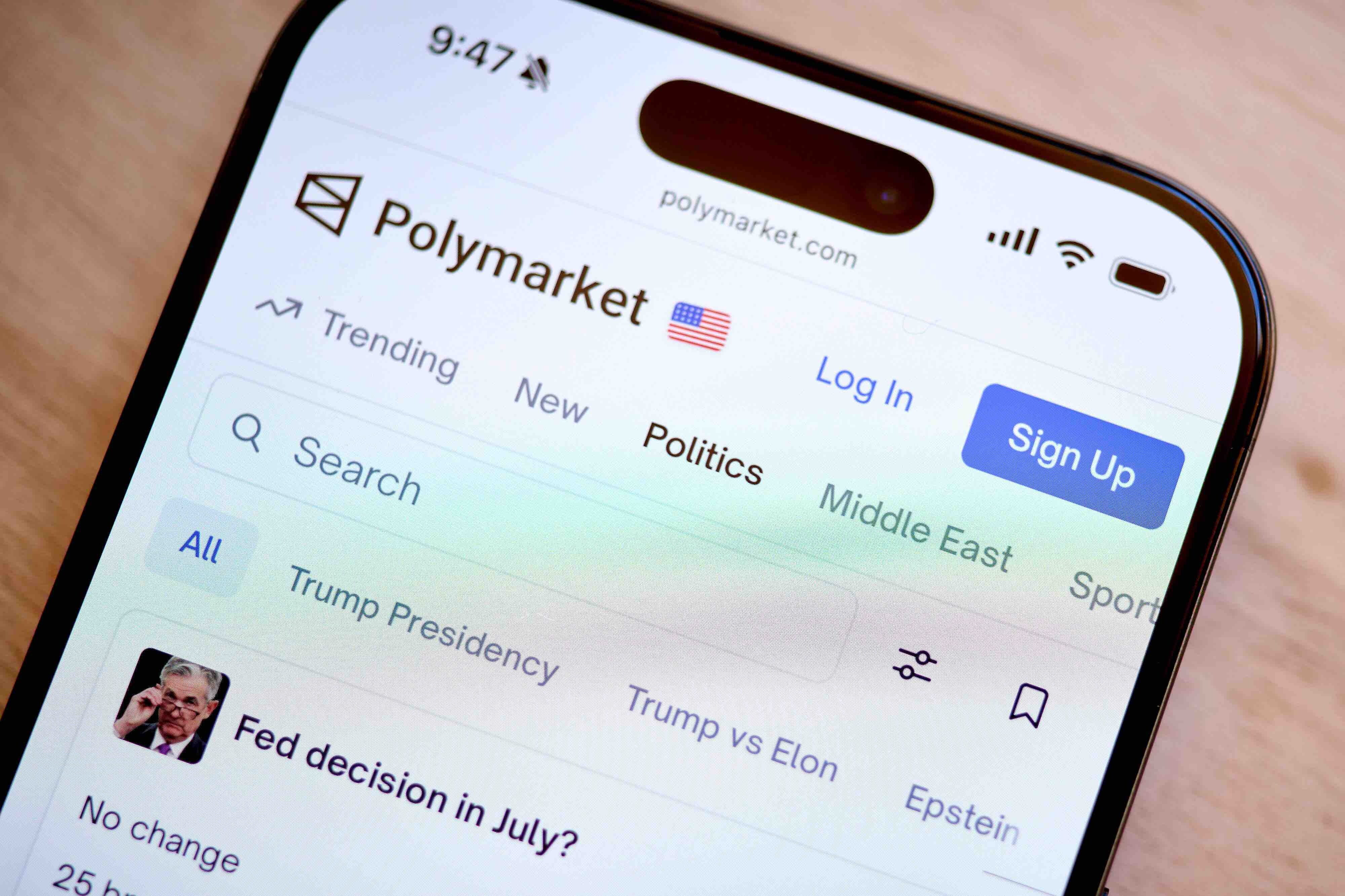
Earlier this year, Odaily Planet Daily compiled an article by data analyst arise titled "Data Modeling: How to Improve the Quality of Polymarket Interactions?".

The core logic of the article is that, considering about 80% of users have never received even $1 in Polymarket liquidity (LP) subsidies, while everyone is frantically competing for trading volume, a more efficient interaction strategy is actually to do everything possible to accumulate LP rewards.

So-called "LP rewards" are real cash subsidies issued by Polymarket to improve the liquidity conditions of its platform for specific prediction markets. All reward details can be viewed in real-time on the official Rewards page (https://polymarket.com/rewards).
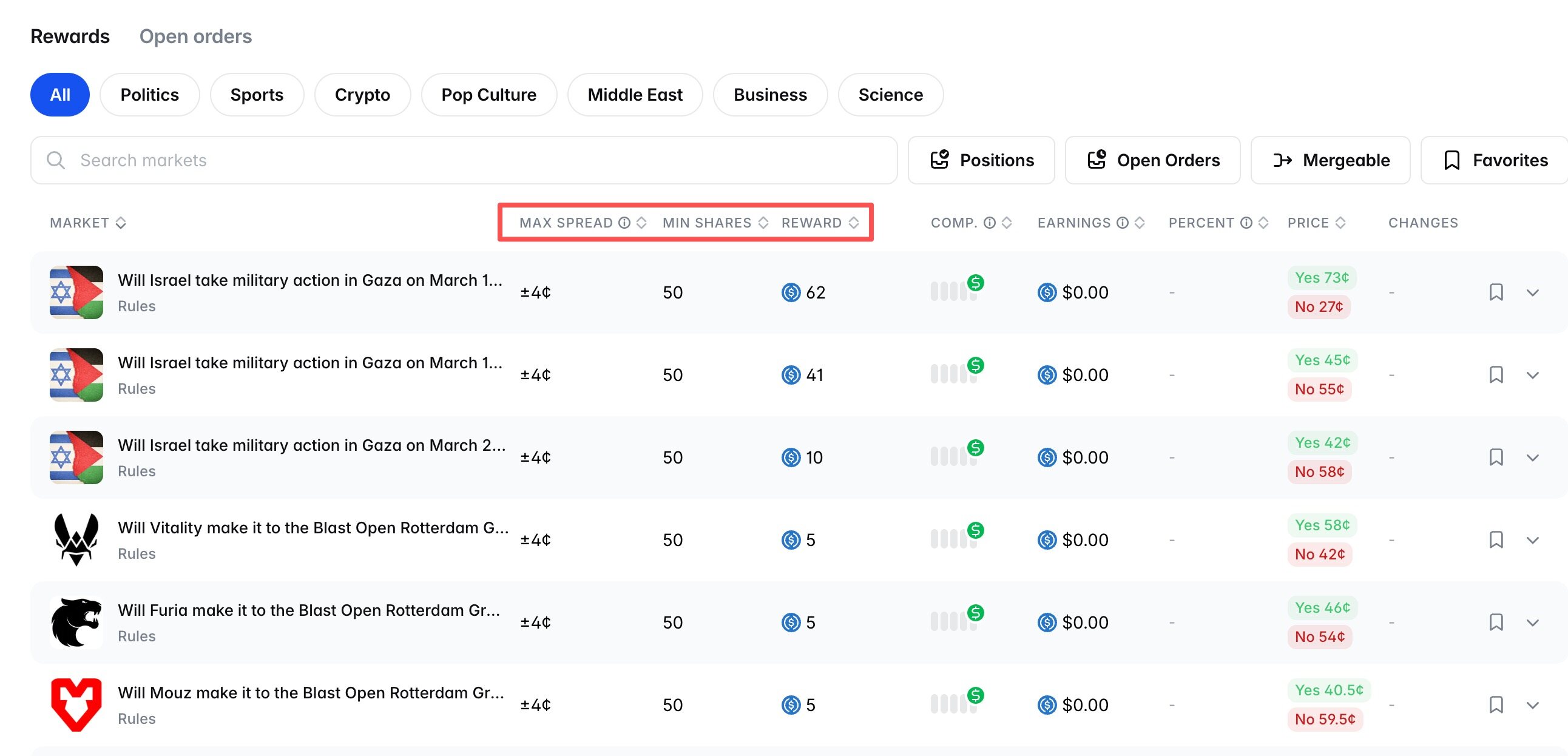
Users first need to select an event that has subsidies, then place orders for at least the specified amount (Min Shares) within the specified spread range (Max Spread) to automatically accumulate LP rewards. The closer the order price is to the market price, the higher the efficiency of earning rewards. LP rewards are distributed daily at 8:00 UTC, but only rewards of $1 or more are distributed.

Although the rules for obtaining LP rewards are not complicated, the difficulty of market making in prediction markets is inherently higher (refer to "Only One in Ten Prediction Markets Will Survive Until the End of the Year, Not an Exaggeration"). Coupled with the minimum $1 threshold for daily reward distribution, many ordinary users with limited funds find it difficult to accumulate rewards when trying to operate, and may even suffer capital losses due to inventory risk.

However, right now, Polymarket is providing an excellent opportunity window — with the arrival of the NCAA "March Madness", Polymarket has announced that it will provide $2 million in LP subsidies for related events.
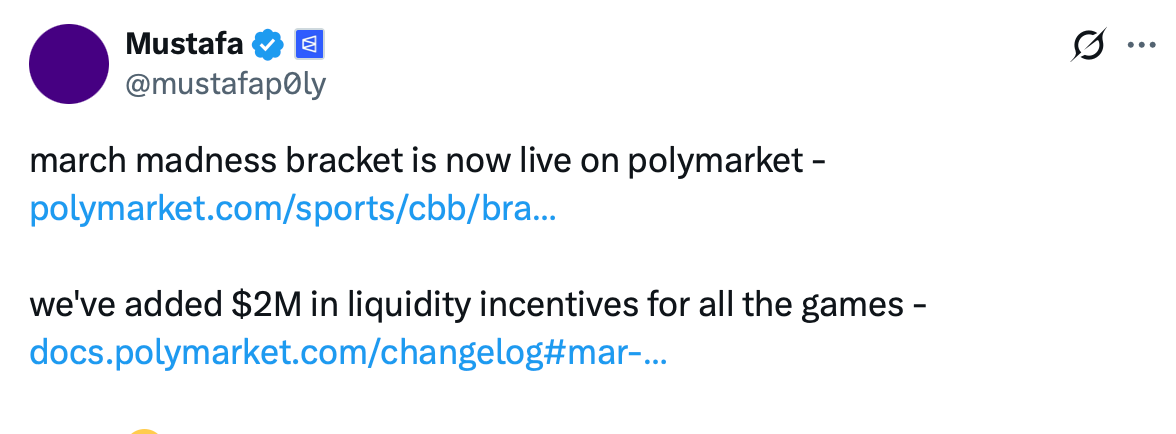
It is important to note that the total amount of LP subsidies Polymarket has distributed for all subsidized events so far is only $13 million. This $2 million+ subsidy will be concentratedly distributed for specific 63 games in less than a month — this directly means an expansion of the subsidy intensity per event, and also represents an excellent opportunity for ordinary users.

Next, Odaily Planet Daily will walk you through the process of market making for NCAA-related events step by step, and briefly mention a few points I think are worth noting.

First, open the Polymarket Rewards page, click on Reward, and you can sort all events by subsidy intensity. It's easy to see that the events with the highest subsidy intensity on Polymarket currently are all NCAA "March Madness" games. (I have been providing liquidity on Polymarket for the past few months and have never seen such a level of subsidy intensity.)
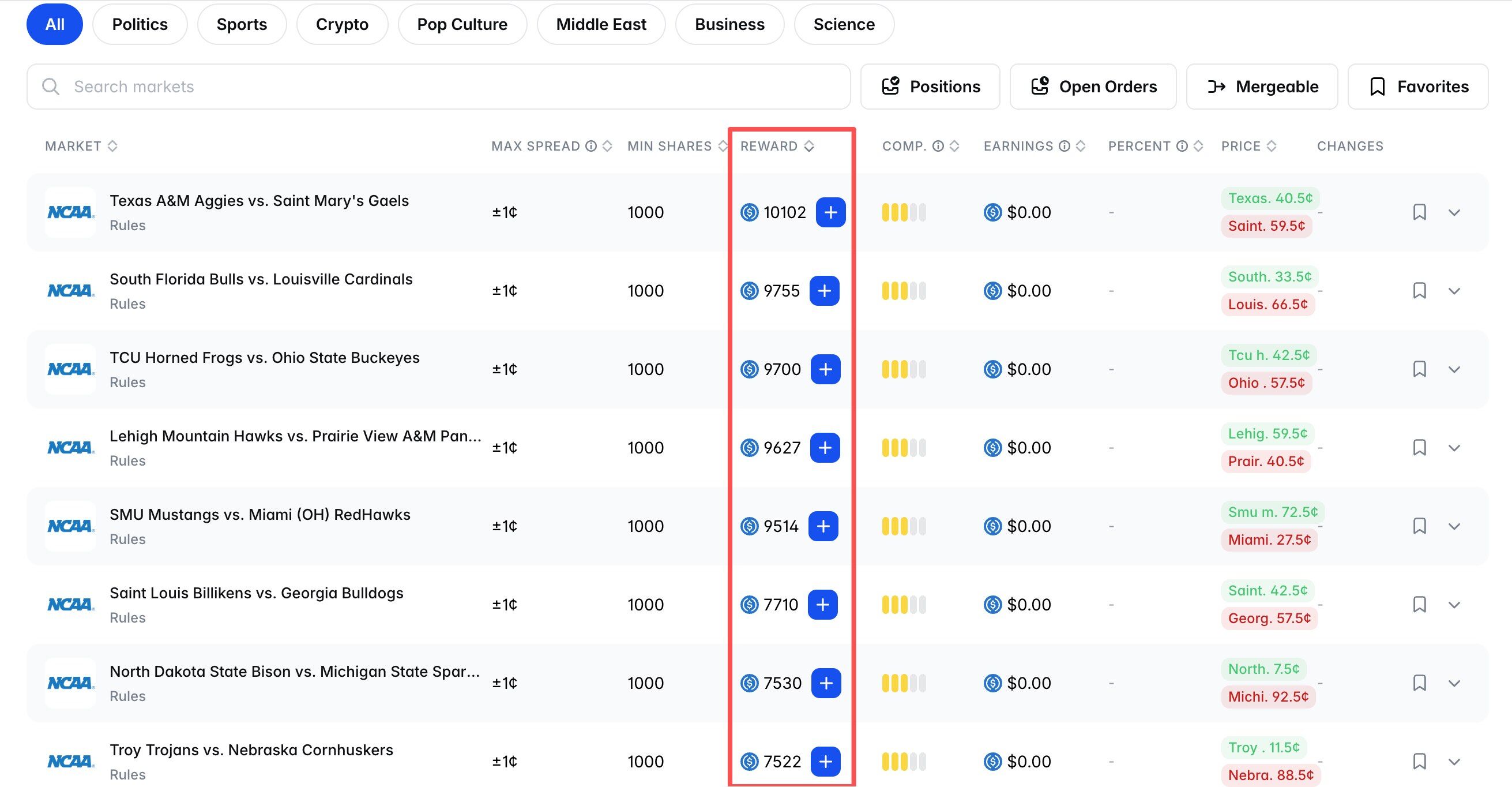
The next most important thing is choosing a pool. It should be added that there is a column called COMP (Competitive) on the right side of Rewards, which indicates the current competition status for providing liquidity in that event. Theoretically, greener is better (representing less competition), but in practice, the competition gap has basically been leveled by professional market making funds, so what you basically see is "three yellow bars", meaning the current competition status is "medium".

Here, it is more recommended to choose games that start later. For example, I chose to put funds into this game between the University of Iowa and the University of Houston on March 19th EST (March 20th Beijing time).
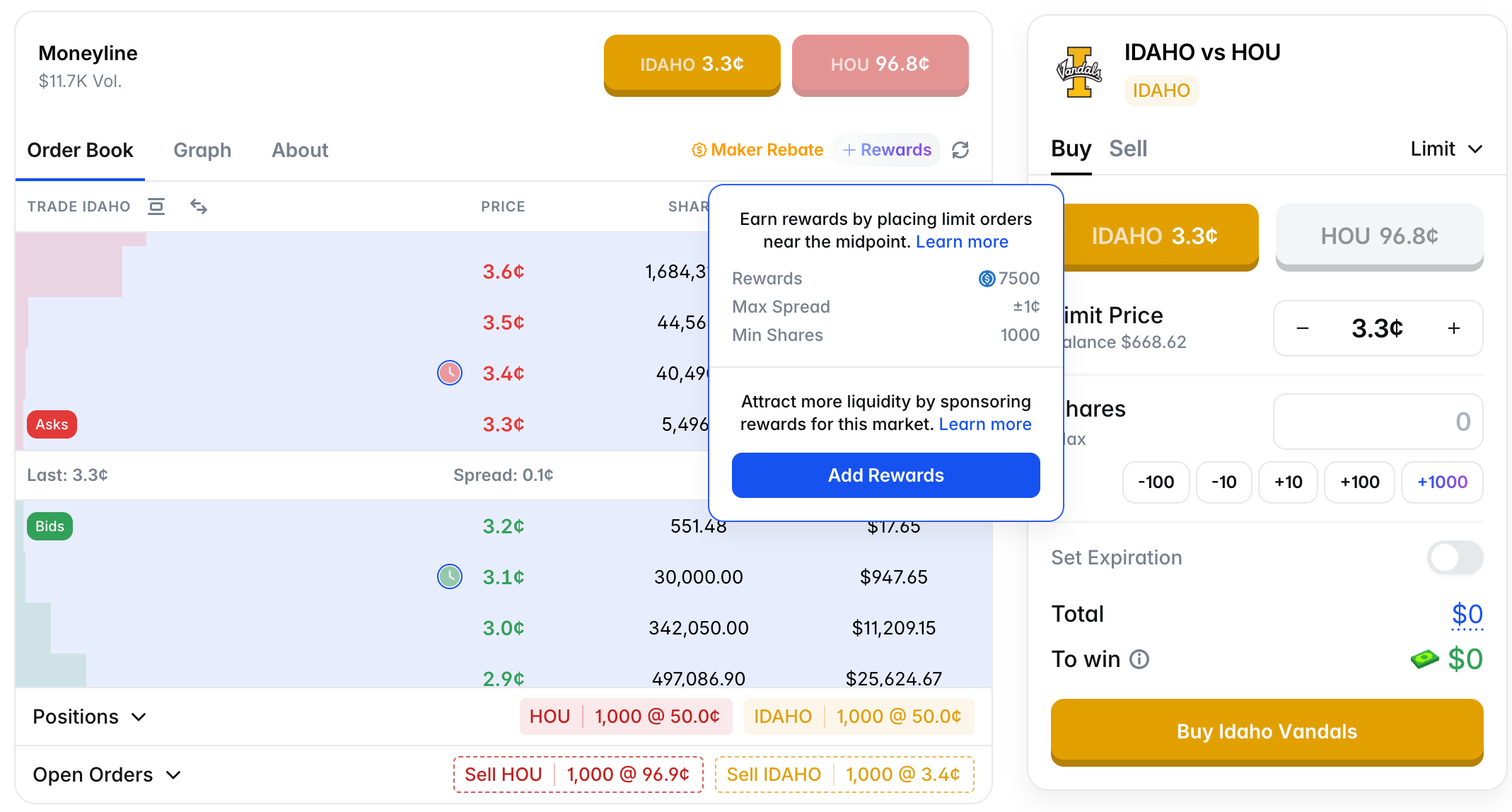
The reason later start times are better is that the trading volume peak for a single sports event on Polymarket often only arrives shortly before the game starts, and Polymarket has already started injecting subsidies. Taking this "University of Iowa vs. University of Houston" game starting the day after tomorrow as an example, the current total trading volume is only $12,000. With a certain liquidity base, lower trading volume often means smaller fluctuations — the chart below clearly shows the probability fluctuation status since Polymarket listed this game. You saw it right, it's a straight line!
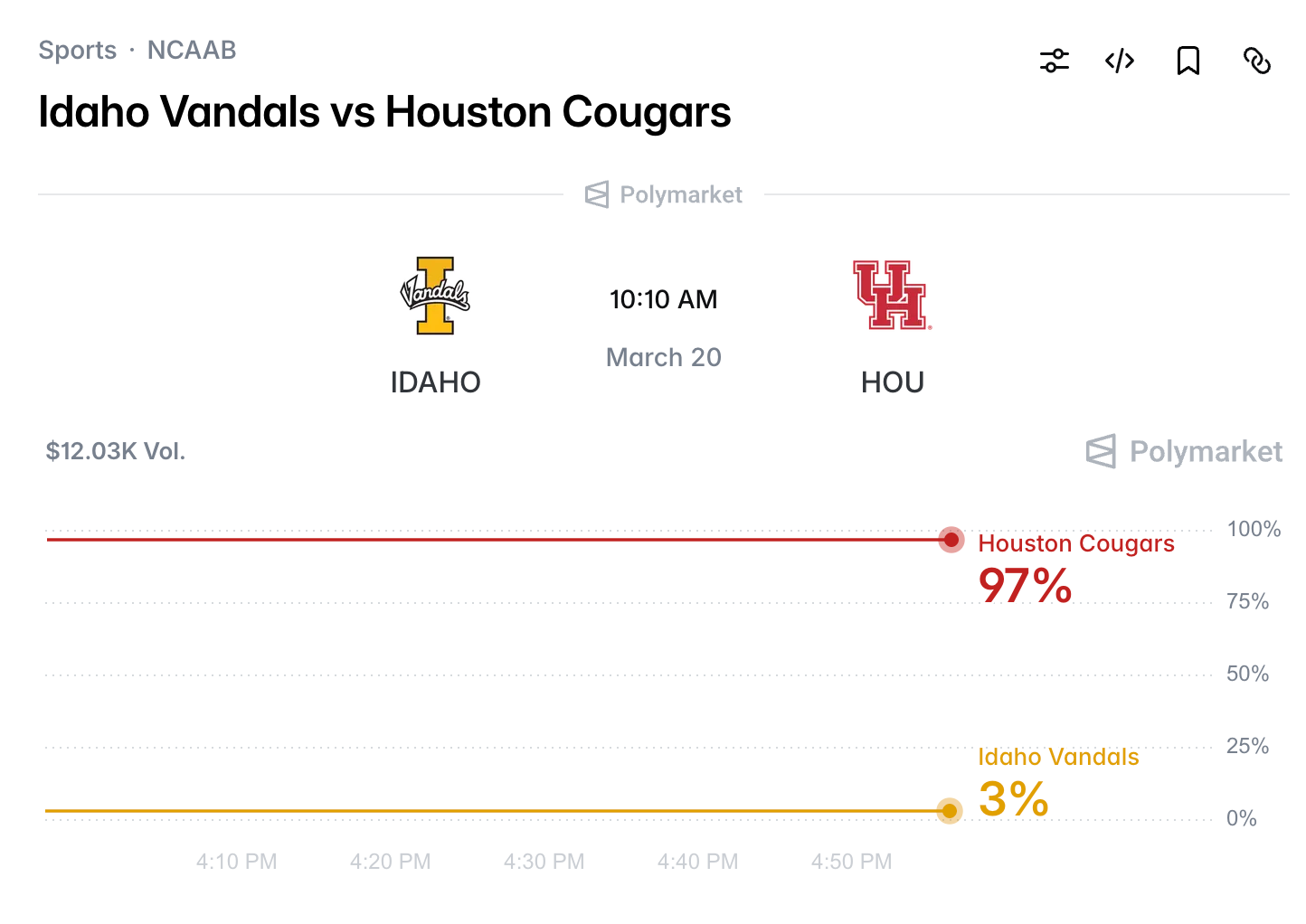
Extremely small fluctuations mean users can temporarily avoid "inventory risk", the biggest risk source in market making. Simply put, you don't have to worry too much about the price suddenly moving unilaterally, causing your one-sided orders to be filled while the market price has moved to an unfavorable direction.

After finding a suitable pool (not necessarily this one; I put funds into this one in the morning, you can look for later times), it's time to provide liquidity. Polymarket's liquidity requirements for all NCAA games are a minimum of 1000 shares, with a maximum spread not exceeding ±1¢.

Compared to placing buy orders, it is more recommended to use Polymarket's Split function to split $1000 (the minimum requirement) into equal bilateral shares (which can be reversely minted into $1000 through the Merge function), and then place sell orders on both sides.

As for the specific price points for placing orders, it depends on your own risk appetite. The closer to the market price, the higher the efficiency of earning LP rewards. But still considering inventory risk, I prefer to place orders at the "second best" price level, and then pay attention to price fluctuations, trying to ensure the orders don't get filled — if they are filled, the order amount will no longer meet the requirements, and you will need to consider how to handle the shares on the other side.

Finally, regarding the order cancellation time, it is recommended to cancel the orders about 1 day before the game starts, and then look for later games. If you are interested in continuing, you can repeat the above operation.
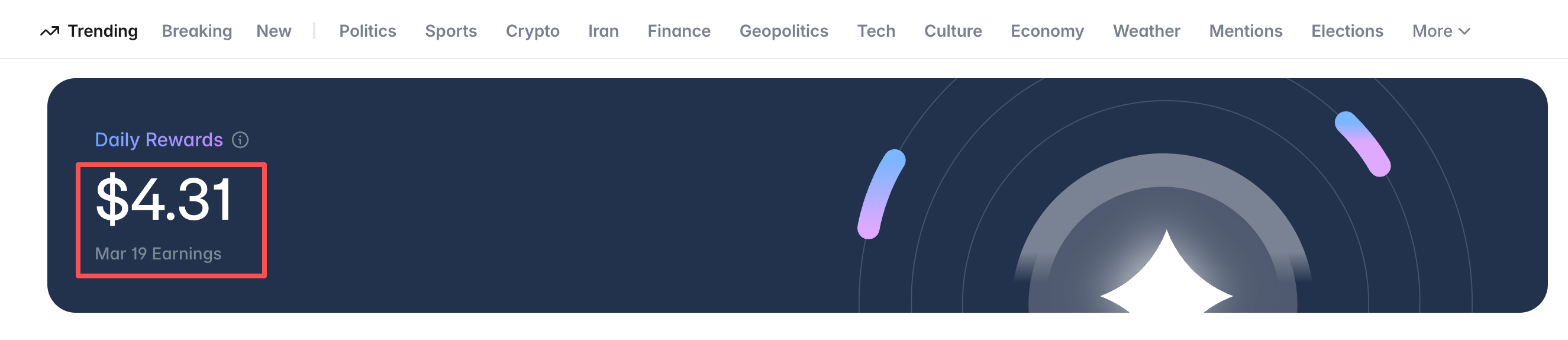
Finally, here are the data: I placed the orders around 10:00 in the morning. The probability for this game did not fluctuate at all during this period. Although I said I needed to monitor it, I didn't really do much. As of 17:00, the LP reward I have earned is $4.31 (which will be distributed tomorrow).

The profit is small change, but the key point is to enrich the interaction behavior on Polymarket. Compared to a few days ago, you might have needed to博弈 with the market in relatively low subsidy conditions. Under the current subsidy intensity and event fluctuation conditions, this operation can basically be considered brainless now.

Finally, a quick advertisement: Friends interested in prediction markets are welcome to join our TG chat group for casual discussion anytime: https://t.me/OdailySeer


Preguntas relacionadas

QWhat is the core strategy recommended for interacting with Polymarket to maximize rewards?

AThe core strategy is to focus on accumulating Liquidity Provider (LP) rewards rather than just trading volume, as approximately 80% of users have never received even $1 in LP subsidies.

QWhat specific event has created a prime opportunity for users to earn LP rewards on Polymarket recently?

AThe NCAA 'March Madness' tournament has created a prime opportunity, as Polymarket is providing over $2 million in LP subsidies concentrated across 63 specific games within a month.

QWhat are the two main requirements for users to start accumulating LP rewards on a subsidized event?

AUsers must place orders of at least the 'Min Shares' amount (e.g., 1000 shares for NCAA games) within the specified 'Max Spread' (e.g., ±1¢ for NCAA games) on a subsidized event.

QWhy does the article suggest choosing markets for games that start later?

AGames that start later have lower current trading volume, which often results in minimal price volatility (a nearly flat line on the chart), significantly reducing the inventory risk for liquidity providers.

QWhat specific Polymarket feature does the article recommend using to provide liquidity easily and what is the suggested action regarding order placement?

AThe article recommends using the 'Split' function to divide $1000 into equal opposing shares, then placing sell orders on both sides. It also advises placing orders at the 'second price level' from the market price to balance reward efficiency and risk, and to cancel orders about one day before the game starts.

Lecturas Relacionadas

Understanding Hash in One Article: The "Browser Miner" on Ethereum

Hash is an Ethereum-based ERC-20 token described as a "browser-minable post-quantum token." Its key features include enabling browser-based GPU mining without specialized hardware, a fixed supply cap of 21 million tokens, immutable and permissionless smart contracts with no team allocation or pre-mining, and an emphasis on post-quantum security using Keccak256 hashing. The mining mechanism is a simplified on-chain proof-of-work where miners solve unique challenges tied to their wallet address. Key design elements prevent answer theft, with epochs resetting every 100 blocks (~20 minutes) and a per-block minting limit. Emission follows a Bitcoin-like halving schedule every 100,000 mints, starting at 100 tokens per mint. Projections suggest all tokens could be mined within approximately 294 days if a target rate of one mint per minute is sustained. Hash emphasizes "post-quantum" security by leveraging hash-based primitives like Keccak256, which are considered more resistant to quantum attacks compared to elliptic-curve cryptography. While not a fully post-quantum asset, it aligns with Ethereum's broader post-quantum research narrative. The project completed its Genesis sale at $0.03 and began trading on Uniswap, with its price reaching around $0.19. The initial circulating supply is small, with 5% sold in Genesis and 5% allocated to liquidity. The majority (47.6% of total supply) is allocated to early-stage mining, leading to a front-loaded emission schedule. This structure, combined with low initial liquidity, makes Hash a high-volatility, high-risk project dependent on sustained miner participation and market demand to absorb new supply.

marsbitHace 1 min(s)

Understanding Hash in One Article: The "Browser Miner" on Ethereum

marsbitHace 1 min(s)

OpenAI's Largest Internal Wealth Creation: 600 People Cash Out a Total of $6.6 Billion, 75 Take Home the Maximum $30 Million Each

A Wall Street Journal report reveals OpenAI's unprecedented pre-IPO wealth creation. In a single employee stock sale last October, over 600 current and former employees sold shares, collectively cashing out approximately $6.6 billion. Due to high investor demand, the company tripled the individual sale cap to $30 million, with about 75 employees selling the maximum amount. This event represents the largest such transaction in tech industry history for a private company. OpenAI's valuation was $500 billion for this tender offer. Employees with over two years of tenure were eligible, allowing many post-ChatGPT hires their first liquidity event. The company's stock has reportedly grown over 100-fold in seven years. Following a restructuring, employees collectively hold about 26% of OpenAI. The scale of executive wealth is also staggering. In court testimony related to Elon Musk's lawsuit, President and co-founder Greg Brockman confirmed his OpenAI stake is worth around $30 billion. Analysis indicates about 165 current and former employees hold a combined ~$164.9 billion in equity, averaging nearly $1 billion per person in paper wealth. OpenAI's per-employee stock-based compensation is estimated to be 34 times the average of major tech firms before their IPOs. OpenAI continues its rapid ascent, closing a $122 billion funding round at an $852 billion valuation in March. With monthly revenue hitting $2 billion, over 900 million weekly ChatGPT users, and plans for a potential trillion-dollar IPO in late 2026, this wealth-creation engine shows no signs of stopping.

链捕手Hace 23 min(s)

OpenAI's Largest Internal Wealth Creation: 600 People Cash Out a Total of $6.6 Billion, 75 Take Home the Maximum $30 Million Each

链捕手Hace 23 min(s)

Understanding CPO (Co-Packaged Optics) in One Article: Why Nvidia Is Willing to Spend $3.2 Billion on a Fiber?

NVIDIA and Corning announced a multi-year strategic partnership on May 6, 2026, with NVIDIA committing up to $3.2 billion to support Corning's U.S. expansion. This investment will triple Corning's manufacturing plants and significantly boost its optical fiber and communications production capacity. The core driver behind this massive investment is the fundamental shift from copper to optical interconnect technology within AI data centers. As GPU clusters scale, copper wires face critical limitations: severe signal attenuation over distance, high energy consumption for signal integrity, and excessive heat generation. Optical fiber, transmitting light instead of electrical signals, solves these issues with minimal loss, near-light speed, and lower power needs. The article outlines a three-stage evolution of data center interconnect: 1. **Traditional Copper Interconnects:** The mainstream solution of the 2010s, now being phased out due to scaling bottlenecks. 2. **Pluggable Optical Modules:** The current mainstream, where modules convert electrical signals to light externally. This process still introduces energy loss and latency. 3. **CPO (Co-Packaged Optics):** The next-generation technology where the optical engine is integrated directly with the GPU chip package. This drastically reduces the electrical signal travel distance to mere millimeters, slashing power consumption and latency while boosting data density. NVIDIA CEO Jensen Huang has identified CPO as an essential core technology for AI infrastructure. NVIDIA's investment signifies a strategic shift from being a buyer to actively controlling its supply chain for critical components. With demand for specialized optical fiber far outstripping supply—evidenced by soaring prices—securing long-term manufacturing capacity has become a competitive necessity. While Corning's expansion may pressure some suppliers, a projected global fiber supply gap of 5-15% over the next few years creates a significant opportunity window, particularly for Chinese manufacturers competitive in optical preforms, chips, and modules. Ultimately, NVIDIA's move is not about chasing a trend but an engineering imperative. The transition to light-based interconnects like CPO is driven by the physical limits of copper, marking a definitive step in the ongoing AI computing revolution.

marsbitHace 48 min(s)

Understanding CPO (Co-Packaged Optics) in One Article: Why Nvidia Is Willing to Spend $3.2 Billion on a Fiber?

marsbitHace 48 min(s)

Trading

Spot
Futuros
活动图片




