NodeStrategy: The First Ordinals DAT Project, Bringing the Strategy Treasury Narrative to NFTs

marsbitPublicado a 2026-05-25Actualizado a 2026-05-25

Resumen

**Summary: The Fundamental Flaws of NodeStrategy, the 'First Ordinals DAT'** NodeStrategy presents itself as the first Ordinals Digital Asset Treasury (DAT) on Bitcoin. Its model mirrors MicroStrategy's treasury narrative but for NFTs, specifically targeting the NodeMonkes collection (not officially affiliated). The project's core mechanism is a four-step flywheel: a 10% fee on all trades (90% to treasury, 10% to radFi/Bound marketplace) is used to buy NodeMonkes. These NFTs are then listed for sale on Satflow, with 100% of the sale proceeds used to buy back and burn the project's token, NODESTRAT, aiming to create a perpetual value cycle. However, the design contains critical, self-defeating flaws: 1. **Platform Lock-In:** As a Bitcoin Rune, NODESTRAT lacks smart contract functionality and cannot natively enforce the 10% fee. The fee can only be collected on the radFi/Bound marketplace itself. This makes the entire flywheel dependent on a single platform. If liquidity moves elsewhere, fee revenue drops to zero, halting the mechanism. 2. **Self-Suffocating Economics:** The 10% fee acts both as the flywheel's fuel and a major drag on demand. A buy/sell roundtrip incurs a 20% cost, creating a massive hurdle for traders. This strangles the very trading volume needed to generate fees. 3. **Ineffective Value Support:** The flywheel is starved. Low daily volume (~$9K) generates minimal fees for NFT purchases. The NFT "ladder" sales are slow and unpredictable (only 39 total ...

Author: 798.eth

NodeStrategy claims to be the first Ordinals DAT project on Bitcoin. It transplants MicroStrategy's treasury narrative onto NFTs: treasury buys monkeys, buys back and burns, number go up—it sounds smooth. But it's currently at a 0.46x depth discount, and the price is stagnant. The problem lies in the design itself. The fuel that feeds this machine and the cage that locks it are the same thing: that 10% transaction fee. Let's break it down step by step.

First, what is NodeStrategy? It's a Bitcoin Rune token called NODESTRAT, with a total supply of 1 billion. It calls itself The Perpetual Monke Machine, the first Ordinals digital asset treasury on Bitcoin L1. The treasury's underlying assets are NodeMonkes, a blue-chip Ordinals NFT series. Note that it is not affiliated with the official NodeMonkes. The trading venue is radFi, which is now Bound.

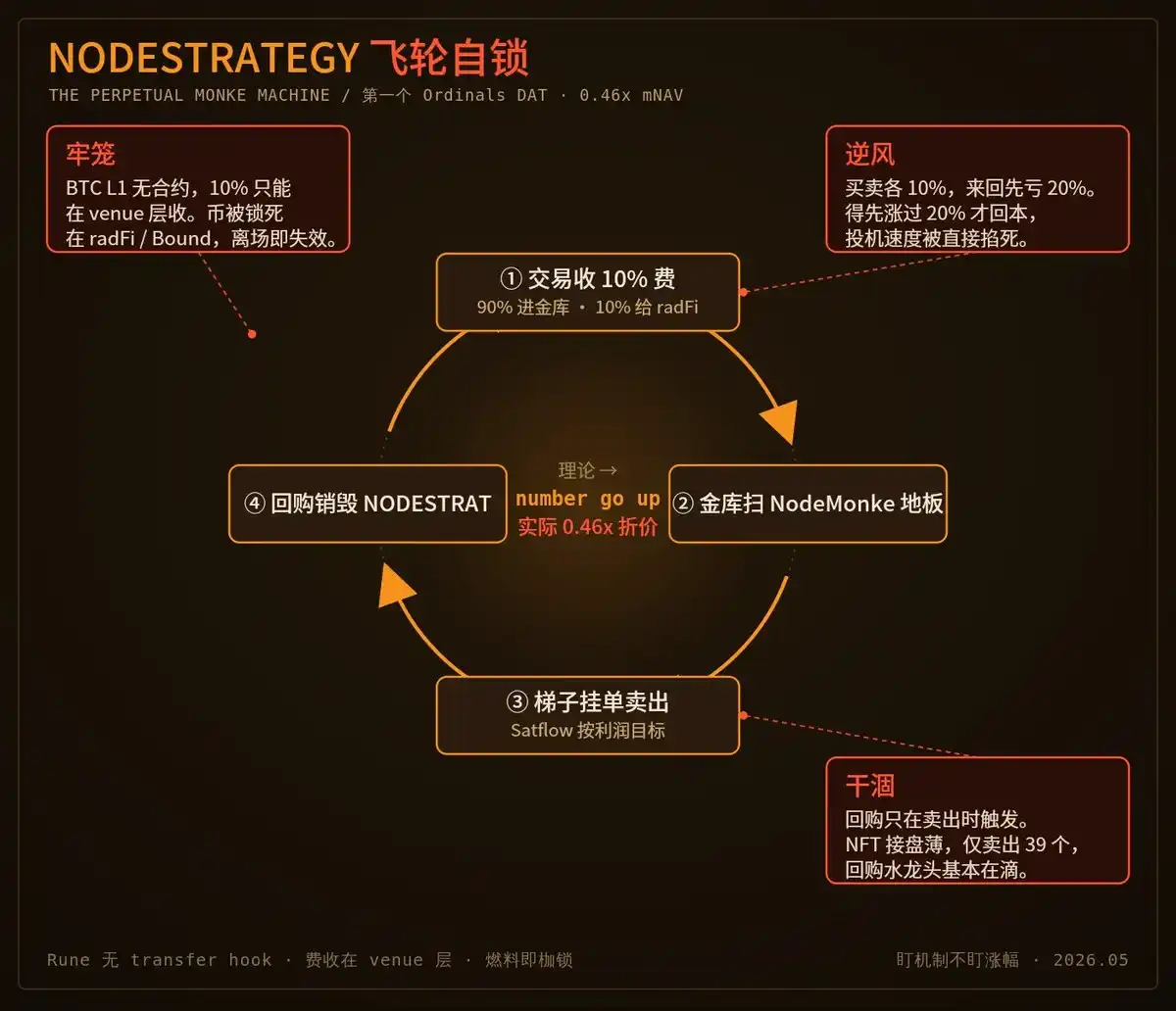
Next, how does the flywheel turn? The story it paints is a four-step closed loop. A 10% fee is charged on each transaction, with 90% going to the treasury and 10% to radFi. The treasury uses this fee to sweep the floor of NodeMonkes. The purchased monkeys are listed in a ladder on Satflow, for sale at different profit targets. The BTC from sold monkeys is 100% used to buy back and burn NODESTRAT. Reduced supply leads to price increases, attracting more traders, which in turn generates more fees. It claims to become more valuable the more it spins. There's only one script, and it sounds self-consistent. But it's not spinning. Here's why.

Point one: Why NODESTRAT can only be traded on radFi / Bound.

First, recognize its lifeline. The entire flywheel—sweeping, selling, buyback and burn—relies entirely on that 10% fee for sustenance. Without this fee, the treasury has no money, and the machine stops instantly.

So who collects this 10%, and at which layer? On Ethereum or Solana, this is simple; the token's contract itself can collect it. ERC20 can implement fee-on-transfer, and Solana's Token-2022 has TransferFee. With each transfer, the token's own code deducts the tax; you can trade it anywhere, and the tax follows the token.

But NODESTRAT is a Rune on Bitcoin. Bitcoin L1 does not have smart contracts. A Rune is just a balance entry on the Runes protocol ledger, etched as a number. It has no code, no transfer hooks, no executable logic whatsoever. You cannot create a Rune that automatically collects taxes. Transferring a Rune is simply a regular Bitcoin transaction moving a balance from one place to another; nothing in between can intercept it and take 10%.

Therefore, this 10% cannot be attached to the token itself; it can only be attached to the trading venue. It's radFi / Bound's liquidity pool that deducts the 10% at the moment you trade NODESTRAT, when constructing the transaction. The tax is collected at the platform layer; the token itself cannot deduct a single satoshi.

The corollary is clear. This 10% fee only exists when trading on radFi / Bound. If you transfer NODESTRAT as a regular Rune peer-to-peer to a friend, or sell it on another Ordinals marketplace, there is no 10% fee, because no place outside of Bound knows about this rule, let alone can enforce it.

Thus, the project is left with only one path to survive: locking all trading strictly within radFi / Bound. This is the only place in the world where this toll fee can be collected. If liquidity flows elsewhere, fee income drops to zero, the treasury stops sweeping, and the flywheel dies immediately.

This also explains that portion of the 10% allocated to radFi. radFi is the toll booth, and NodeStrategy is responsible for directing all traffic onto this road. This token is almost literally Bound by its name; it's honest naming. Its entire value mechanism is held hostage, like a pawn, on a single platform. This fragility is written into its design.

Point two: Why the price isn't rising, and where the root cause lies.

Its script is number go up, so why is it flat? The real issue is that the very fuel for this machine is poisoning its own demand.

First, the machine is out of gas. The flywheel burns on trading volume, and the volume is basically dead—$9K per day. A 10% cut is $900; 90% goes to the treasury, $810, which buys less than 0.01 BTC per day. No volume means no fees, no fees mean no sweeping, no sweeping means no monkeys on the ladder to sell, no sales mean no buybacks, no buybacks mean no burns—resulting in nothing happening to the price. The entire chain is spinning idly.

An even more critical point. That 10% is not just fuel; it is simultaneously a headwind pressing down on its own price. Buying incurs a 10% fee, selling incurs another 10%—a round trip loses 20% upfront. This token needs to rise over 20% just for a trader to break even. You're essentially inviting people to buy something that charges 10% on entry and another 10% on exit, directly strangling speculative velocity. On one side is the tailwind from buybacks and burns, and on the other side is the 20% round-trip tax acting as a headwind—both blowing on the same token. It's fighting itself.

The buyback pipe itself is already tightly screwed. Buybacks only trigger when a NodeMonke is actually sold from the ladder; only the money from sold monkeys goes towards buybacks. But the NFT market has thin order books, sells slowly, and is uncertain. It has only sold 39 monkeys in total, with 15 in the short bucket, and 0 in the medium and long buckets. The buyback faucet is basically dripping. The 30.77% that has been burned so far...

Burning itself does not create demand. Reducing supply can push up the price, but only if demand still exists. There's no volume, and entering the market gets hit with a 10% fee. Burning 30% of the supply results in a smaller, yet equally illiquid, market with no one bidding. Price is about supply and demand at the margin; it's aggressively attacking the denominator while the demand on the numerator side is locked down by the tax and dead volume.

That 0.46x discount is a self-locking trap. The token price is only half of NAV. A normal DAT, when at a premium, can issue more tokens to buy more assets, compounding and growing thicker—that's the real leverage for number go up. The only remaining lever to push the price is buybacks, which are starved by the earlier point. The path to premium is blocked, the path via buybacks is sluggish, and the discount just hangs there, with no mechanism to close it.

Finally, NAV is double the market cap; why isn't the price converging towards NAV?

Holding NODESTRAT offers no redemption channel; you cannot exchange the token for its implied 0.46x worth of NodeMonkes. Your only exit is to sell it to the next bidder on radFi, paying another 10%. That NAV is a marketing number, not a floor price. The market naturally doesn't recognize it, pricing it solely based on cash flow.

That 10% fee was meant to feed the flywheel. Instead, on one hand, it tax-strangles the very demand and volume the flywheel needs most; on the other hand, it can only collect it by locking the token onto a single platform, thereby limiting liquidity. Add to that the fact that the backing is non-redeemable and non-realizable, so NAV cannot anchor the price. This machine's design lets its own fuel source restrict its own demand.

This is not an assessment of price movements, just the mechanism.

Are there any good solutions to get this otherwise well-conceived flywheel spinning again?
Preguntas relacionadas

QWhat is NodeStrategy and what is its primary function as described in the article?

ANodeStrategy is the first Ordinals DAT (Digital Asset Treasury) project on Bitcoin. Its primary function is to serve as a 'Perpetual Monke Machine'—a digital asset treasury for NodeMonkes NFTs on Bitcoin L1. The project aims to mirror the MicroStrategy treasury model on the Ordinals/NFT ecosystem.

QWhat is the four-step flywheel mechanism designed for NodeStrategy, and why does it fail to operate as intended?

AThe four-step flywheel is: 1) Collect a 10% fee on every NODESTRAT trade. 2) Use 90% of that fee to buy NodeMonkes NFTs from the floor. 3) List the purchased NFTs on Satflow at different profit targets. 4) Use 100% of the proceeds from NFT sales to repurchase and burn NODESTRAT. It fails because the 10% fee, which is its fuel, simultaneously chokes the trading volume and liquidity it needs to function, and the tax is only enforceable on the Bound (radFi) platform.

QWhy is the NODESTRAT token effectively locked to trading on the radFi/Bound platform?

ANODESTRAT is a Rune token on Bitcoin, which lacks smart contract functionality. Therefore, the 10% trading fee cannot be programmed into the token itself and can only be enforced by the trading platform (Bound) when constructing transactions on its order book. If the token trades elsewhere, no fee is collected, starving the treasury and stopping the flywheel.

QWhat are the two main contradictions or self-defeating aspects of the 10% trading fee mechanism?

AFirst, the fee suppresses the very trading volume it relies on for fuel. A round-trip trade incurs a 20% cost, killing speculative demand. Second, the mechanism relies on locking all liquidity to a single platform (Bound) to enforce the fee, creating fragility and limiting market access.

QWhy does the NODESTRAT token trade at a significant discount to its Net Asset Value (NAV) according to the article?

AThe NAV is not actionable for holders. There is no redemption mechanism to exchange NODESTRAT for its underlying NodeMonkes NFTs. The only exit is to sell on the open market (with another 10% fee), so the price is set purely by trading demand and liquidity, which are weak. The NAV is thus a marketing metric, not a functional price floor.

Lecturas Relacionadas

Near Returns to the AI Stage: Transformation into a Public Chain Due to 'Payroll Difficulties,' Agent and Privacy Emerge as New Growth Narratives

NEAR Returns to AI Origins: From Payroll Struggles to Blockchain, Now Focusing on AI Agents and Privacy NEAR Protocol's journey began not with grand blockchain ambitions, but from a practical hurdle: its AI startup founders, including Transformer paper co-author Illia Polosukhin, couldn't efficiently pay international developers in 2017. This led them to pivot and build a high-performance, scalable blockchain. After years navigating various crypto narratives like sharding and cross-chain interoperability, NEAR is now leveraging its AI roots to re-enter the AI arena. A key driver is its "NEAR Intents" layer, which abstracts complex cross-chain transactions. Users simply state their goal (e.g., swap BTC for ETH), and a solver network finds the optimal route. This system has processed over $20B in cross-chain volume, generating significant fee revenue. A major growth area is private transactions via "Confidential Intents/Swaps," which hide trade details until settlement to protect against MEV and front-running. Remarkably, private swaps recently accounted for over 40% of NEAR's transaction volume, highlighting strong demand but also potential regulatory scrutiny. With its AI-founder pedigree, NEAR is positioning itself at the intersection of blockchain, AI agents, and privacy, aiming to become infrastructure for the emerging agent economy while navigating the challenges of its rapid adoption.

marsbitHace 1 hora(s)

Near Returns to the AI Stage: Transformation into a Public Chain Due to 'Payroll Difficulties,' Agent and Privacy Emerge as New Growth Narratives

marsbitHace 1 hora(s)

From Ethereum to AI's 'CROPS': What Exactly is This Set of 'Slow Variables' That Vitalik Repeatedly Emphasizes?

In recent discussions, Vitalik Buterin has frequently emphasized the concept of "CROPS," a framework defining core values for Ethereum's development. CROPS stands for Censorship Resistance, Capture Resistance, Open Source, Privacy, and Security. Initially outlined in the Ethereum Foundation's "EF Mandate," it represents a commitment to user sovereignty, ensuring that the network resists external control, remains open, protects privacy, and prioritizes security. The relevance of CROPS extends beyond Ethereum's foundational principles, becoming crucial in the context of AI integration. As AI agents begin handling wallet operations and automated transactions, the risk increases that users may cede control over their digital assets, privacy, and intentions to centralized AI service providers. A "CROPS AI" would therefore emphasize local execution where possible, privacy-preserving remote model calls (e.g., using zero-knowledge proofs), and transparent, verifiable processes to maintain user agency. Vitalik highlights a significant convergence between "CROPS Ethereum access layer" and "CROPS AI." Both address the same fundamental challenge: how users can access powerful services—be it blockchain data via RPCs or AI models—without exposing sensitive information or relinquishing ultimate control. This intersection points toward a future digital entry point that is more private, secure, and user-controlled. Ultimately, CROPS is not merely an abstract ideal but a practical guidepost. It steers development—from protocol resilience and wallet design to AI agent safety—towards a future where users retain self-sovereignty even as digital systems grow more complex and powerful. In an era of accelerating AI adoption, these "slow variables" of censorship resistance, openness, privacy, and security may define Ethereum's enduring value.

marsbitHace 1 hora(s)

From Ethereum to AI's 'CROPS': What Exactly is This Set of 'Slow Variables' That Vitalik Repeatedly Emphasizes?

marsbitHace 1 hora(s)

Silicon Valley 'Startup Guru' Steve Hoffman: Web3 + AI Could Be a Trap

Silicon Valley investor and "Godfather of Startups" Steve Hoffman warns that combining Web3 with AI is likely a trap, not a promising venture. In an interview, Hoffman argues that while AI is a foundational technology touching all industries, Web3 adds complexity, friction, and regulatory risk without solving mainstream consumer or business needs. He advises founders to focus on deep, specialized applications where startups can out-iterate giants, rather than on generic features easily replicated by large tech companies. Hoffman observes that Silicon Valley will lead foundational AI research, while China excels at rapid, large-scale application and commercialization, particularly in robotics. He stresses that AI-driven autonomous agents capable of collaborative, multi-step tasks are 2-4 years away, which will cause significant job displacement. The solution is not to slow AI but to redesign business models around human-AI collaboration and reform social systems like education and retraining. For startups, Hoffman recommends focusing on vertical, expertise-heavy domains to build defensibility. He sees major opportunities in AI fraud detection and cybersecurity. Key founder mindsets include systemic thinking over feature-focus, relentless customer centricity, building adaptive teams, and deeply understanding AI's capabilities and limits. Hoffman is also leading a non-profit initiative to establish university centers aimed at training future leaders in responsible, human-value-aligned AI innovation.

marsbitHace 3 hora(s)

Silicon Valley 'Startup Guru' Steve Hoffman: Web3 + AI Could Be a Trap

marsbitHace 3 hora(s)

Token Inefficient, Economy Tokenless

The article "Tokens Aren't Economical, Economics Aren't Tokenized" analyzes a pivotal shift in the AI industry from a technology-driven narrative to one dominated by capital efficiency. It highlights two concurrent trends: a severe capital shortage due to the exorbitant and recurring costs of compute (e.g., OpenAI's high burn rate) and a wave of corporate spin-offs where major tech companies are separating their AI units (like Kuaishou's Kling and Baidu's Kunlunxin). The core argument is that AI's "anti-internet" business model, where user growth increases costs rather than profits, has created a disconnect between high valuations and actual cash flow. Spin-offs address this by allowing AI assets to be valued independently. Within a parent company, they are seen as cost centers, but as standalone entities, they are priced based on their growth potential and scarcity in the primary market, leading to massive valuation premiums (e.g., Kling's estimated value tripling post-spin-off). The industry is at an inflection point, moving from "model worship" to "value realization." The competition is evolving from a pure compute (GPU) race to a broader focus on systemic efficiency and full-stack engineering (involving CPUs and orchestration) to achieve viable commercialization. The year 2026 is framed as a critical moment where the industry must definitively answer how to economically translate AI capability into tangible business value, reshaping the sector's future power structure.

marsbitHace 3 hora(s)

Token Inefficient, Economy Tokenless

marsbitHace 3 hora(s)

Trading

Spot
Futuros
活动图片





