New Crypto Buyer Enters the Market: Kazakhstan Plans to Invest Up to $350 Million

marsbitPublicado a 2026-03-09Actualizado a 2026-03-09

Resumen

Kazakhstan's central bank, under Governor Timur Suleimanov, plans to invest up to $350 million from its gold and foreign exchange reserves into the crypto asset sector, with investments set to begin between April and May. The move, which represents a cautious 0.5% of the country's total reserves, will include not only cryptocurrencies but also stocks of high-tech companies, index funds, and other crypto-related financial instruments. The National Investment Corporation (NIC) will also incorporate confiscated crypto assets from law enforcement operations into the national crypto fund. This decision follows eased regulations in January, which recognized digital financial assets as a new asset class and allowed licensed crypto exchanges. Kazakhstan currently holds 3,544 bitcoins, ranking eighth globally in government crypto holdings.

By: Felix, PANews

On March 6, Timur Suleimanov, the Governor of the National Bank of Kazakhstan, stated that the central bank plans to use part of its gold and foreign exchange reserves to invest in the crypto asset sector, with an amount of up to $350 million.

Although the specific asset categories and timeline for the investment have not yet been disclosed, according to Aliya Moldabekova, Deputy Governor of the National Bank of Kazakhstan, the investment will begin between April and May.

Pilot Phase Allocation Accounts for 0.5% of Reserves

Despite the high-profile announcement of the purchase, Kazakhstan has demonstrated a cautious approach in every aspect of its national reserve plan for crypto assets.

The consideration phase alone took six months. As early as last July, Governor Timur Suleimenov indicated that the central bank was considering investing part of its foreign exchange reserves and national fund assets into crypto assets, emphasizing that this is a complex issue requiring careful handling due to the high volatility of such assets, despite their potential for high returns.

It was not until January of this year that Timur Suleimenov announced that an initial fund of $350 million had been allocated for this special purpose. This fund will be deployed using part of the foreign exchange and gold reserves.

Additionally, the investment approach is relatively diversified. Suleimanov stated during an interest rate briefing: "We are currently compiling a list of investments, which includes not only cryptocurrencies themselves but also high-tech company stocks related to cryptocurrencies and digital financial assets, index funds, and other instruments with dynamics similar to crypto assets."

Deputy Governor Aliya Moldabekova emphasized, "We are not making large-scale investments in cryptocurrencies. We are currently screening companies engaged in the digital asset business, such as those involved in building cryptocurrency infrastructure. We are in the process of selecting such companies."

Furthermore, the scale of the investment reflects a "cautious" approach, with the $350 million allocation accounting for only 0.5% of the country's total reserves. As of February 1, the National Bank of Kazakhstan's gold and foreign exchange reserves stood at $69.4 billion, while the assets of the national fund totaled $65.23 billion.

Easing Crypto Regulations and Incorporating Seized Assets into Crypto Fund

It is worth noting that not all of the reserved crypto assets will come from purchases; proceeds from law enforcement actions will also be a source.

In January of this year, the National Investment Corporation (NIC), the investment arm of the National Bank of Kazakhstan, announced plans to use cryptocurrencies seized by law enforcement agencies, along with foreign exchange and gold reserves, to enhance the national crypto reserve.

Kassym-Jomart Tokayev, President of Kazakhstan, revealed that during operations to "crack down on illegal mining farms," law enforcement agencies have shut down 130 illegal exchanges and seized assets worth over $5 million. These seized crypto assets, such as Bitcoin, will no longer serve merely as evidence but will be fully incorporated into the national crypto fund.

According to data from Bitcoin Treasuries, Kazakhstan currently ranks eighth in the global ranking of national crypto reserves (including law enforcement seizures), holding 3,544 BTC.
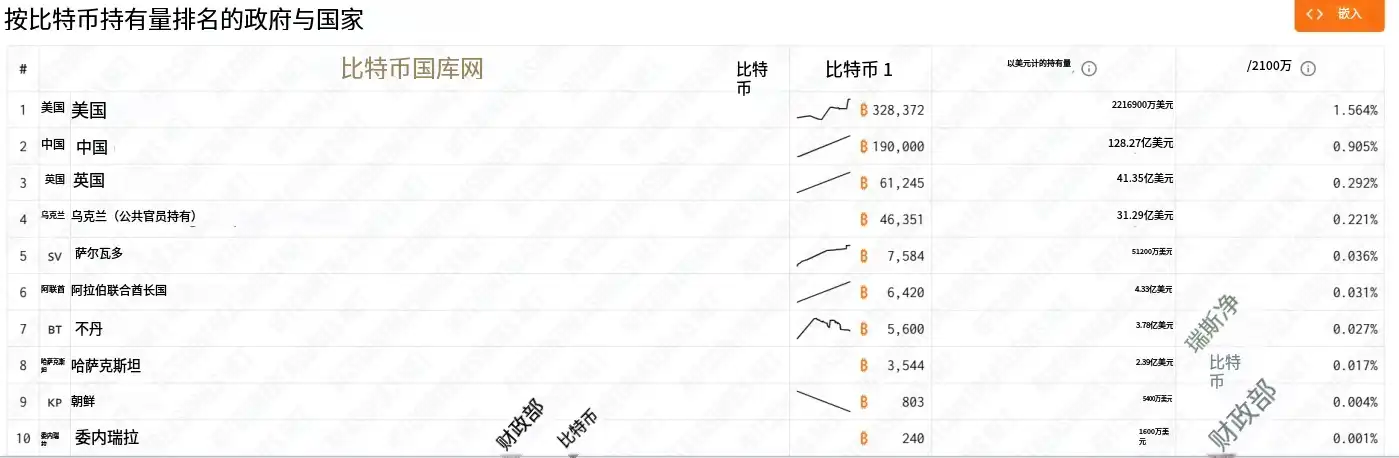
Governments and Countries Ranked by Bitcoin Holdings

Kazakhstan eased cryptocurrency regulations in January of this year, explicitly classifying digital financial assets (DFA) as a new asset category under regulation and allowing their circulation within the country. It also permitted the establishment of crypto exchanges licensed by the central bank. Additionally, the central bank will formulate a list of approved cryptocurrencies for circulation and impose certain restrictions on cryptocurrency trading activities.

Against the current macroeconomic backdrop of a crypto bear market, Kazakhstan's use of up to $350 million in reserve funds to invest in crypto assets not only reflects further recognition of cryptocurrencies by sovereign states but also provides a certain boost to the market. PANews will continue to monitor the specific allocation of subsequent funds.

Related reading: Is Venezuela's $60 Billion Bitcoin Shadow Reserve Real or Fake?

Preguntas relacionadas

QWhat is the maximum amount Kazakhstan's central bank plans to invest in crypto assets from its reserves?

AKazakhstan's central bank plans to invest up to $350 million from its gold and foreign exchange reserves into the crypto asset sector.

QWhen is the investment in crypto assets scheduled to begin, according to the Deputy Governor of the National Bank of Kazakhstan?

AAccording to Deputy Governor Aliya Moldabekova, the investment is scheduled to begin between April and May.

QWhat percentage of Kazakhstan's total reserves does the initial $350 million crypto investment represent?

AThe initial $350 million allocation represents 0.5% of Kazakhstan's total reserves.

QBesides purchasing crypto directly, what is another source of crypto assets for Kazakhstan's national fund?

AAnother source of crypto assets for the national fund is from assets seized by law enforcement agencies during operations against illegal mining and exchanges.

QWhat regulatory change did Kazakhstan implement regarding digital financial assets in January?

AIn January, Kazakhstan relaxed its cryptocurrency regulations by officially recognizing digital financial assets (DFA) as a new asset class, allowing their circulation within the country, and permitting the establishment of licensed crypto exchanges.

Lecturas Relacionadas

Breaking: OpenAI Undergoes Major Reorganization, President Brockman Assumes Command

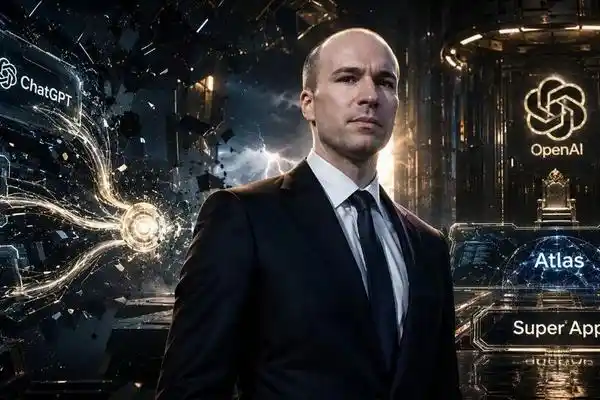
OpenAI has announced a major internal reorganization just months before its anticipated IPO. The company is merging its three flagship product lines—ChatGPT, Codex, and the API platform—into a single, unified product organization. The most significant leadership change involves co-founder and President Greg Brockman moving from a background technical role to take full, permanent control over all product strategy. This follows the indefinite medical leave of AGI Deployment CEO Fidji Simo. Additionally, ChatGPT's longtime lead, Nick Turley, has been reassigned to enterprise products, with former Instagram executive Ashley Alexander taking over consumer offerings. The consolidation, internally framed as a strategic move towards an "Agentic Future," aims to break down internal silos and create a cohesive "Super App." This planned desktop application would integrate ChatGPT's conversational abilities, Codex's coding power, and a rumored internal web browser named "Atlas" to autonomously perform complex user tasks. The reorganization occurs amid significant internal and external pressures. OpenAI has recently seen a wave of high-profile departures, including Sora co-lead Bill Peebles and other senior technical leaders, leading to concerns about a thinning executive bench. Externally, rival Anthropic recently secured funding at a staggering $900 billion valuation, surpassing OpenAI's own. Google's upcoming I/O developer conference also poses a competitive threat. Analysts suggest the dramatic restructure is a pre-IPO move to present a clearer, more focused narrative to Wall Street—streamlining operations and demonstrating decisive leadership under Brockman to counter internal turbulence and intense market competition.

marsbitHace 3 hora(s)

Breaking: OpenAI Undergoes Major Reorganization, President Brockman Assumes Command

marsbitHace 3 hora(s)

Two Survival Structures of Market Makers and Arbitrageurs

Market makers and arbitrageurs represent two distinct survival structures in high-frequency trading. Market makers primarily use limit orders (makers) to profit from the bid-ask spread, enjoying high capital efficiency (nominally 100%) but bearing inventory risk. This "inventory risk" arises from passive, fragmented, and discontinuous order fills in the limit order book (LOB). This risk, while a potential cost, can also contribute to excess profit if managed within control boundaries, allowing for mean reversion. Market makers essentially sell "time" (uncertainty over execution timing) to the market for price control and low fees. In contrast, cross-exchange arbitrageurs typically use market orders (takers) to exploit price differences or funding rates, resulting in lower nominal capital efficiency (requiring capital on both exchanges) and higher transaction costs. Their risk exposure stems from asymmetries in exchange rules (e.g., minimum order sizes), execution latency, and infrastructure risks (e.g., ADL, oracle drift). These exposures are active, exogenous gaps that primarily erode profits rather than contribute to them. Arbitrageurs essentially sell "space" (capital sunk across venues) for localized, immediate certainty. Both strategies engage in a trade-off between execution friction and residual risk. Optimal systems allow for temporary, controlled risk exposure rather than enforcing zero exposure at all costs. Their evolution converges towards hybrid models: arbitrageurs may use maker orders to reduce costs, while market makers may use taker orders or hedges for risk management. Ultimately, both use different forms of risk exposure—market makers exposing inventory, arbitrageurs immobilizing capital—to extract marginal, hard-won certainty from the market.

链捕手Hace 3 hora(s)

Two Survival Structures of Market Makers and Arbitrageurs

链捕手Hace 3 hora(s)

Who Will Define the Rules of the AI Era? Anthropic Discusses the 2028 US-China AI Landscape

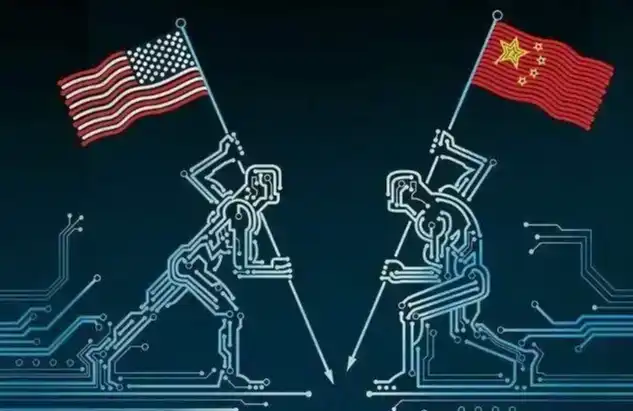
This article, based on Anthropic's analysis, outlines the intensifying systemic competition between the U.S./allies and China for AI leadership by 2028. It argues that access to advanced computing power ("compute") is the critical bottleneck, where the U.S. currently holds a significant advantage through chip export controls and allied innovation. However, China's AI labs remain competitive by exploiting policy loopholes—via chip smuggling, overseas data center access, and "model distillation" attacks to copy U.S. model capabilities—keeping them close to the frontier. The piece presents two contrasting scenarios for 2028. In the first, decisive U.S. action to tighten compute controls and curb distillation locks in a 12-24 month AI capability lead, cementing democratic influence over global AI norms, security, and economic infrastructure. In the second, policy inaction allows China to achieve near-parity through continued access to U.S. technology, enabling Beijing to promote its AI stack globally and integrate advanced AI into its military and governance systems, altering the strategic balance. Anthropic contends that maintaining a decisive U.S. lead is essential for shaping safe AI development and governance. The core recommendation is for U.S. policymakers to urgently close compute and model access loopholes while promoting global adoption of the U.S. AI technology stack to secure a lasting strategic advantage.

marsbitHace 5 hora(s)

Who Will Define the Rules of the AI Era? Anthropic Discusses the 2028 US-China AI Landscape

marsbitHace 5 hora(s)

Trading

Spot
Futuros

Artículos destacados

Cómo comprar BAN

¡Bienvenido a HTX.com! Hemos hecho que comprar Comedian (BAN) sea simple y conveniente. Sigue nuestra guía paso a paso para iniciar tu viaje de criptos.Paso 1: crea tu cuenta HTXUtiliza tu correo electrónico o número de teléfono para registrarte y obtener una cuenta gratuita en HTX. Experimenta un proceso de registro sin complicaciones y desbloquea todas las funciones.Obtener mi cuentaPaso 2: ve a Comprar cripto y elige tu método de pagoTarjeta de crédito/débito: usa tu Visa o Mastercard para comprar Comedian (BAN) al instante.Saldo: utiliza fondos del saldo de tu cuenta HTX para tradear sin problemas.Terceros: hemos agregado métodos de pago populares como Google Pay y Apple Pay para mejorar la comodidad.P2P: tradear directamente con otros usuarios en HTX.Over-the-Counter (OTC): ofrecemos servicios personalizados y tipos de cambio competitivos para los traders.Paso 3: guarda tu Comedian (BAN)Después de comprar tu Comedian (BAN), guárdalo en tu cuenta HTX. Alternativamente, puedes enviarlo a otro lugar mediante transferencia blockchain o utilizarlo para tradear otras criptomonedas.Paso 4: tradear Comedian (BAN)Tradear fácilmente con Comedian (BAN) en HTX's mercado spot. Simplemente accede a tu cuenta, selecciona tu par de trading, ejecuta tus trades y monitorea en tiempo real. Ofrecemos una experiencia fácil de usar tanto para principiantes como para traders experimentados.

547 Vistas totalesPublicado en 2024.12.11Actualizado en 2025.03.21

Cómo comprar BAN

Discusiones

Bienvenido a la comunidad de HTX. Aquí puedes mantenerte informado sobre los últimos desarrollos de la plataforma y acceder a análisis profesionales del mercado. A continuación se presentan las opiniones de los usuarios sobre el precio de BAN (BAN).

活动图片