National-Level Players Enter the Game: The 2025 Revelation of Cryptocurrency Crime Spiraling Out of Control

marsbitPublicado a 2026-01-10Actualizado a 2026-01-10

Resumen

Summary: In 2025, state-level cryptocurrency activity surged, marking a new phase in the maturation of illicit on-chain ecosystems. Illicit addresses received at least $154 billion, a 162% year-over-year increase, largely driven by a 694% spike in transactions involving sanctioned entities. Stablecoins dominated these flows, accounting for 84% of all illicit transaction volume. Key trends include North Korean hackers stealing a record $2 billion, including the largest crypto theft in history from Bybit. Russia launched the ruble-backed A7A5 token, which saw $93.3 billion in transaction volume within a year, facilitating large-scale evasion. Chinese money laundering networks emerged as dominant, sophisticated operators offering full-service criminal enterprises. Iran-linked proxy networks moved over $2 billion for activities including oil sales and weapons procurement. Illicit actors and nations increasingly rely on full-stack infrastructure providers resistant to takedowns and sanctions. Furthermore, the connection between crypto and real-world violent crime is growing, with increased use in human trafficking and a rise in violent coercion attacks to seize crypto assets during price peaks. Collaboration between law enforcement, regulators, and crypto firms is crucial to counter these evolving, interconnected threats.

Original Author: Chainalysis

Original Compilation: Chopper, Foresight News

In 2025, we observed a significant increase in cryptocurrency-related activities at the national level, marking a new mature stage in the development of the illegal on-chain ecosystem. Over the past few years, the professionalization of the cryptocurrency crime sector has deepened; illegal organizations have now established large-scale on-chain infrastructure to support transnational criminal networks in procuring goods and services and laundering proceeds from crypto crimes. Against this backdrop, governments have also begun to enter this field, leveraging these mature professional service providers on one hand, while building their own customized infrastructure on the other to evade sanctions on a large scale. As governments connect to this cryptocurrency supply chain originally built for cybercriminals and organized crime groups, government agencies, compliance, and security teams now face severe challenges in terms of consumer rights protection and national security.
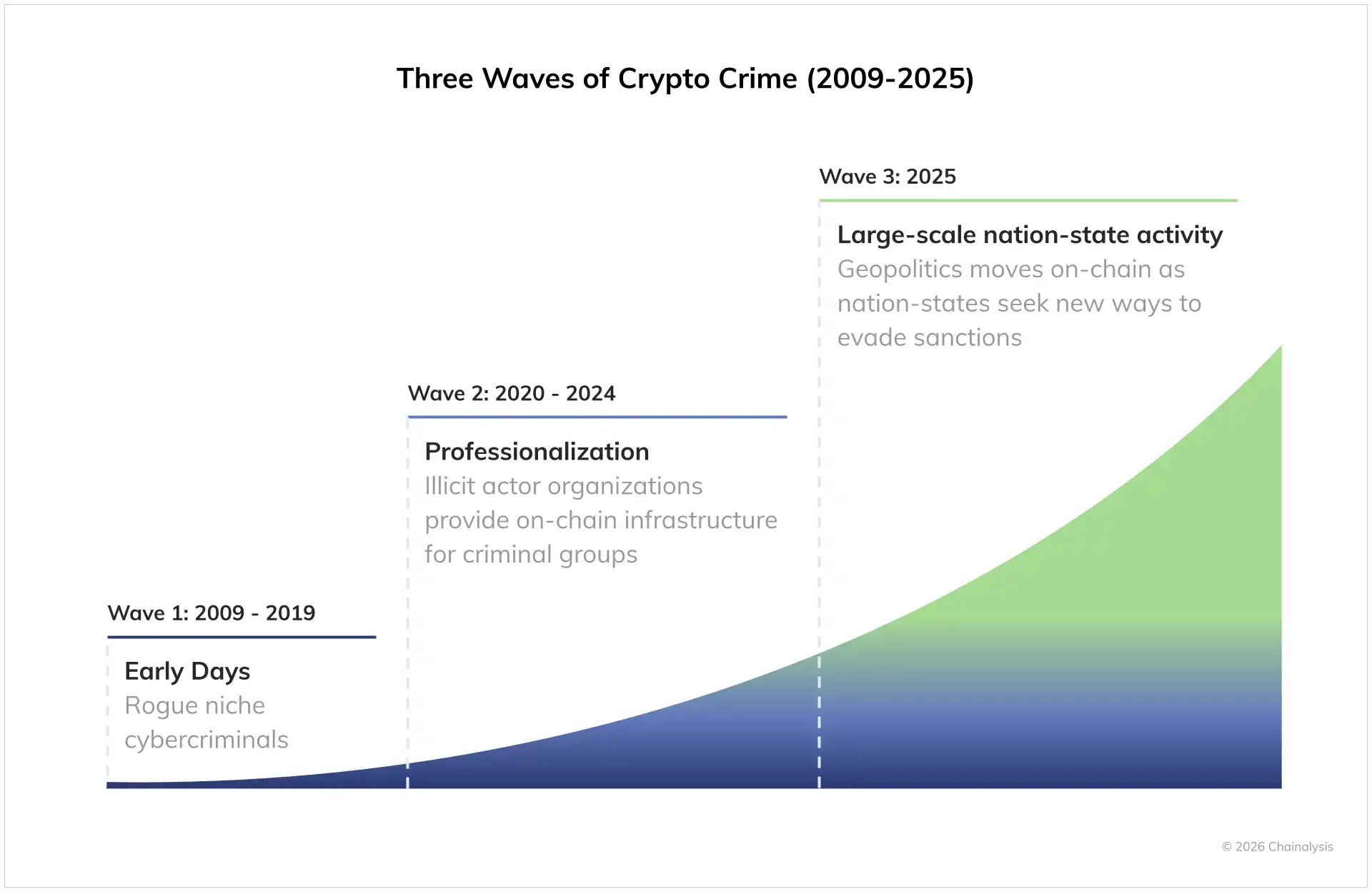
What are the specific on-chain manifestations of these trends and other industry changes? Next, we will analyze them by combining data and macro trends.
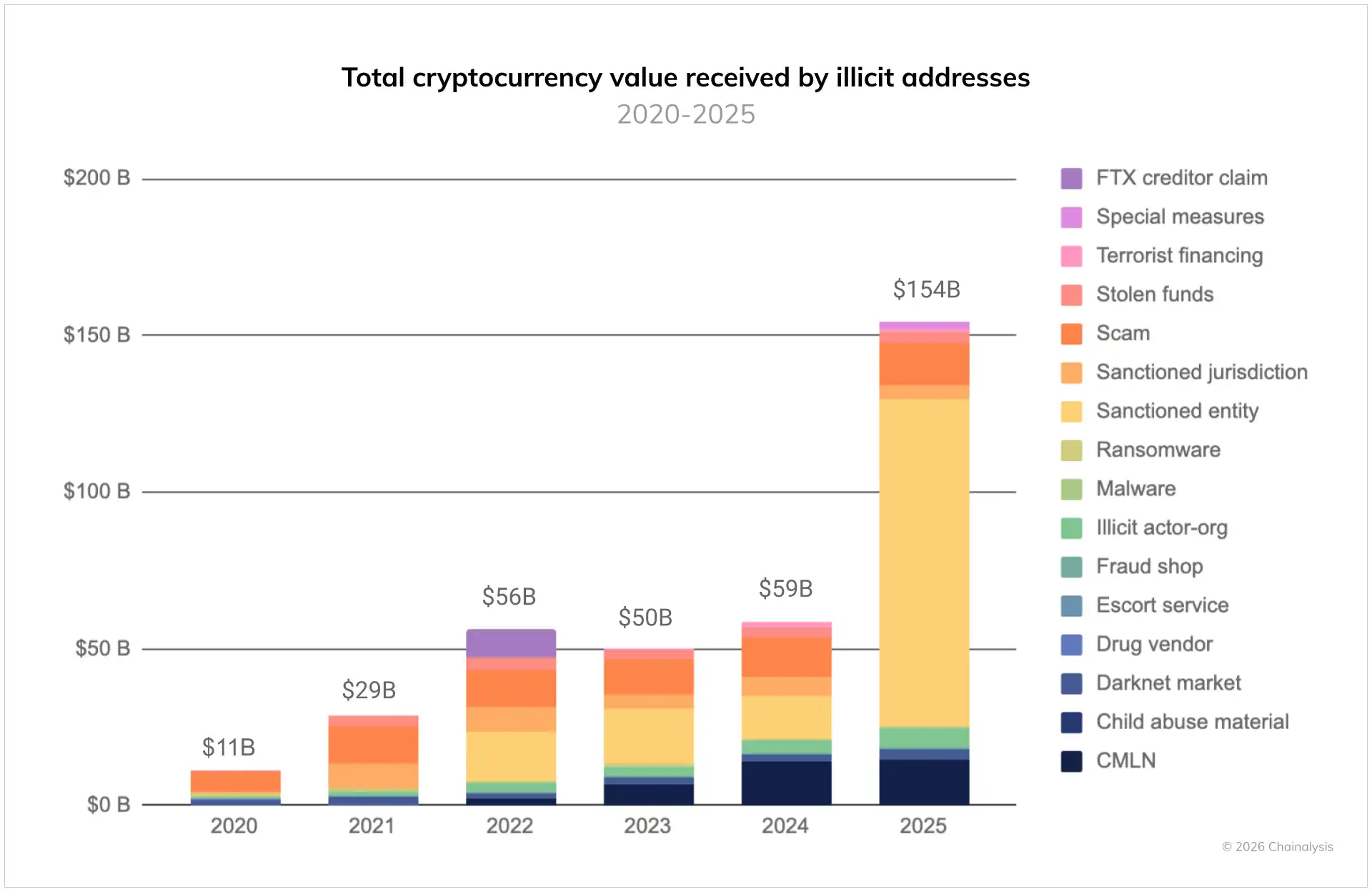
According to our monitoring data, the scale of funds flowing into illegal cryptocurrency addresses in 2025 reached at least $154 billion, a sharp increase of 162% year-on-year. This growth was primarily driven by a surge in fund inflows to sanctioned entities, which soared by 694% year-on-year. However, even excluding the growth from sanctioned entities, 2025 was still a record year for cryptocurrency crime, as the scale of the vast majority of illegal activities increased.

Nevertheless, the scale of these illegal transactions still pales in comparison to the overall cryptocurrency economy, as the main participants in the cryptocurrency market remain legitimate transactions. According to our estimates, although the proportion of illegal transactions in the total traceable cryptocurrency transaction volume in 2025 increased slightly compared to 2024, it remained below 1%.

As shown in the figure below, we also observed a continuous shift in the types of assets involved in cryptocurrency crimes.
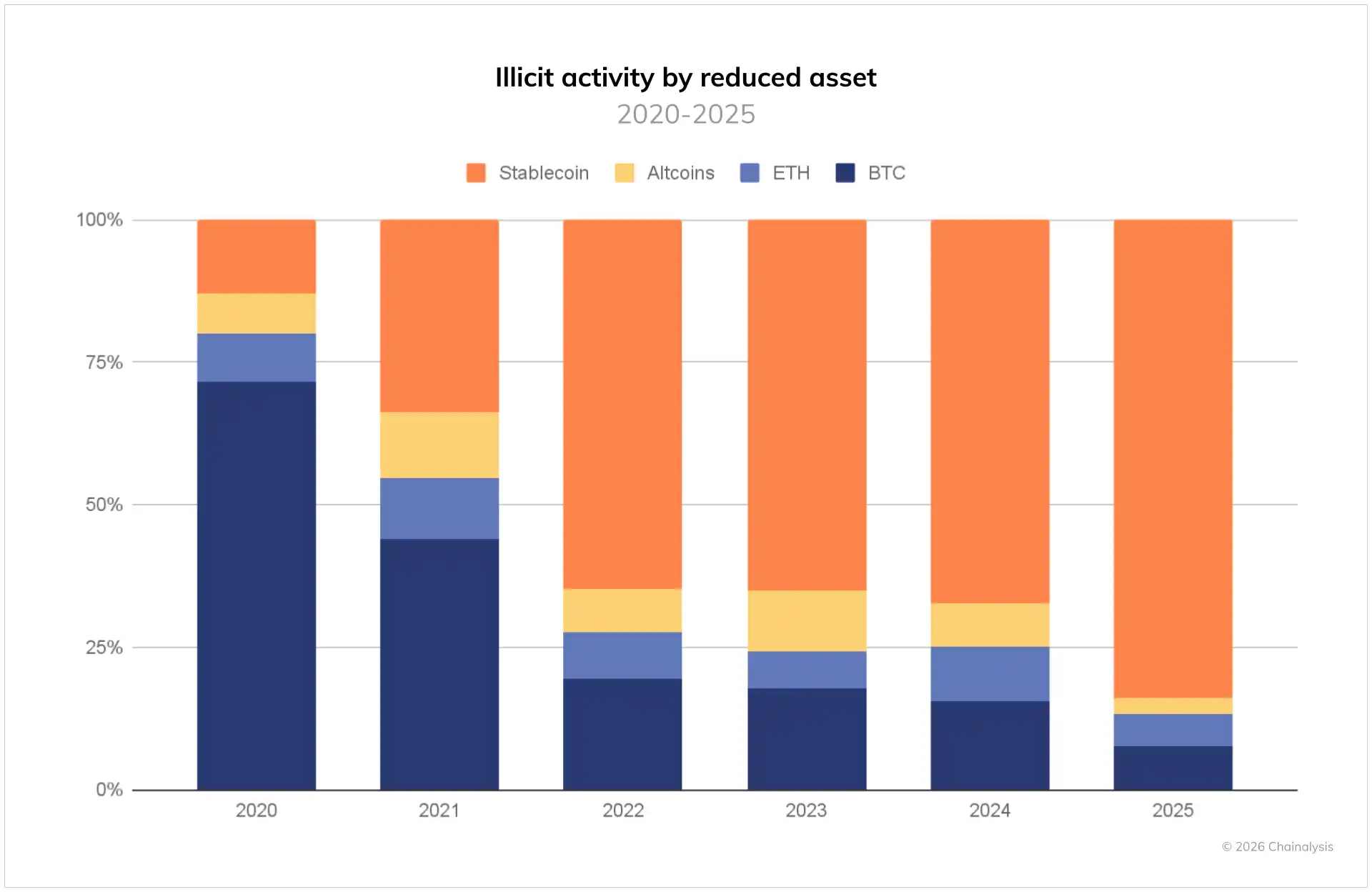
Over the past few years, stablecoins have gradually become the dominant asset in illegal transactions, currently accounting for 84% of the total illegal transaction volume. This trend aligns with the overall development characteristics of the cryptocurrency ecosystem: with advantages such as convenient cross-border transfers, low volatility, and wide application scenarios, stablecoins continue to expand their share in the overall cryptocurrency transactions.

The following sections will delve into the core trends that defined the cryptocurrency crime landscape in 2025, which remain worthy of attention in the future.

National-Level Threats Drive Transaction Scale: North Korea Sets New Record in Theft, Russia's A7A5 Token Facilitates Large-Scale Sanction Evasion

In 2025, stolen funds remained a major threat to the cryptocurrency ecosystem, with hacking groups linked to North Korea alone stealing $2 billion. This figure was primarily driven by several highly destructive large-scale hacking incidents, the most notable of which was the attack on the Bybit exchange in February. The incident involved nearly $1.5 billion, making it the largest digital asset theft in the history of cryptocurrency. Although North Korean hackers have long been a major force threatening the cryptocurrency ecosystem, the past year set new records both in terms of the amount stolen and the sophistication of intrusion and money laundering methods.

Particularly noteworthy is that the scale of on-chain activities by governments reached unprecedented levels in 2025. Russia introduced relevant legislation in 2024 to promote the use of cryptocurrencies to evade sanctions, and this measure was officially implemented in February 2025. The country launched the ruble-backed token A7A5, which achieved a transaction volume of over $93.3 billion in less than a year since its launch.

Meanwhile, over the past few years, Iran's proxy networks have conducted money laundering, illegal oil transactions, and bulk commodity procurement for weapons through confirmed wallet addresses that have been placed on the sanctions list, with a cumulative transaction volume exceeding $2 billion. Despite multiple military strikes, Iran-supported terrorist groups such as Hezbollah, Hamas, and the Houthis continue to use cryptocurrencies on an unprecedented scale.

In 2025, Chinese money laundering networks emerged as a dominant force in the illegal on-chain ecosystem. These organizations operate with high precision, greatly driving the diversification and professionalization of cryptocurrency crimes, offering specialized criminal services including "money laundering services." Building on early illegal operation models such as "Huiyin Guarantee," these networks have established full-service criminal enterprises, covering areas such as fraud, scams, laundering proceeds from North Korean hacking thefts, sanction evasion, and terrorism financing.

Full-Stack Illegal Infrastructure Providers Fuel Malicious Network Activities

While governments are increasing their use of cryptocurrencies, traditional cybercrime activities remain rampant: ransomware operators, child sexual abuse and cybercrime platforms, malware distributors, scammers, and illegal trading markets still rely on extensive support networks to maintain operations. Illegal actors and governments are increasingly dependent on full-stack on-chain infrastructure providers, including domain registrars, secure and reliable hosting services, and other technical infrastructure that can be used to carry out malicious network activities.

These infrastructure providers have evolved into comprehensive infrastructure platforms capable of resisting platform takedowns, abuse complaints, and sanction enforcement. As the scale of these services continues to expand, they may become key drivers in expanding the scope of malicious network activities for economic crime and state-supported forces.

The Increasing Correlation Between Cryptocurrency and Violent Crime

In the perception of many, cryptocurrency crime is still confined to the virtual world. The masterminds are merely anonymous figures hiding behind keyboards, posing no real-world threat. However, in reality, the connection between on-chain activities and violent crime is deepening. Human trafficking groups are increasingly using cryptocurrencies for transactions; at the same time, disturbingly, the number of violent coercion attacks has risen significantly, with criminals using violent means to force victims to transfer crypto assets, and such assaults often occur during peak cryptocurrency price periods.

Looking ahead, collaboration between law enforcement agencies, regulatory bodies, and cryptocurrency companies will be key to addressing these complex, ever-changing, and interconnected threats. Although the proportion of illegal transactions in legitimate cryptocurrency transaction volume remains limited, maintaining the integrity and security of the cryptocurrency ecosystem has never been more important.


Preguntas relacionadas

QWhat was the total value of illicit cryptocurrency transactions in 2025, and what was the primary driver of this growth?

AThe total value of illicit cryptocurrency transactions in 2025 reached at least $154 billion, representing a 162% year-over-year increase. This growth was primarily driven by a massive 694% surge in transaction volume from sanctioned entities.

QWhich asset has become the dominant currency for illicit transactions and what percentage of the total illicit volume does it represent?

AStablecoins have become the dominant asset for illicit transactions, currently accounting for 84% of the total illicit transaction volume.

QWhat significant role did nation-states play in the 2025 crypto crime landscape according to the article?

ANation-states significantly escalated their involvement in 2025. Russia launched the ruble-backed A7A5 token, which processed over $93.3 billion in volume to circumvent sanctions. North Korean hacking groups stole a record $2 billion, and Chinese money laundering networks emerged as dominant, sophisticated players in the illicit ecosystem.

QWhat new concerning trend connects cryptocurrency to real-world physical violence?

AA concerning trend is the rise in violent coercion attacks, where criminals use physical violence to force victims to transfer their cryptocurrency assets. These attacks often occur during periods of peak cryptocurrency prices.

QDespite the growth in illicit activity, how does its scale compare to the overall cryptocurrency economy?

ADespite the significant growth, illicit transactions still represent less than 1% of the total traceable cryptocurrency transaction volume, meaning the vast majority of cryptocurrency market activity remains legitimate.

Lecturas Relacionadas

Gensyn AI: Don't Let AI Repeat the Mistakes of the Internet

In recent months, the rapid growth of the AI industry has attracted significant talent from the crypto sector. A persistent question among researchers intersecting both fields is whether blockchain can become a foundational part of AI infrastructure. While many previous AI and Crypto projects focused on application layers (like AI Agents, on-chain reasoning, data markets, and compute rentals), few achieved viable commercial models. Gensyn differentiates itself by targeting the most critical and expensive layer of AI: model training. Gensyn aims to organize globally distributed GPU resources into an open AI training network. Developers can submit training tasks, nodes provide computational power, and the network verifies results while distributing incentives. The core issue addressed is not decentralization for its own sake, but the increasing centralization of compute power among tech giants. In the era of large models, access to GPUs (like the H100) has become a decisive bottleneck, dictating the pace of AI development. Major AI companies are heavily dependent on large cloud providers for compute resources. Gensyn's approach is significant for several reasons: 1) It operates at the core infrastructure layer (model training), the most resource-intensive and technically demanding part of the AI value chain. 2) It proposes a more open, collaborative model for compute, potentially increasing resource utilization by dynamically pooling idle GPUs, similar to early cloud computing logic. 3) Its technical moat lies in solving complex challenges like verifying training results, ensuring node honesty, and maintaining reliability in a distributed environment—making it more of a deep-tech infrastructure company. 4) It targets a validated, high-growth market with genuine demand, rather than pursuing blockchain integration without purpose. Ultimately, the boundaries between Crypto and AI are blurring. AI requires global resource coordination, incentive mechanisms, and collaborative systems—areas where crypto-native solutions excel. Gensyn represents a step toward making advanced training capabilities more accessible and collaborative, moving beyond a niche controlled by a few giants. If successful, it could evolve into a fundamental piece of AI infrastructure, where the most enduring value in the AI era is often created.

marsbitHace 14 hora(s)

Gensyn AI: Don't Let AI Repeat the Mistakes of the Internet

marsbitHace 14 hora(s)

Why is China's AI Developing So Fast? The Answer Lies Inside the Labs

A US researcher's visit to China's top AI labs reveals distinct cultural and organizational factors driving China's rapid AI development. While talent, data, and compute are similar to the West, Chinese labs excel through a pragmatic, execution-focused culture: less emphasis on individual stardom and conceptual debate, and more on teamwork, engineering optimization, and mastering the full tech stack. A key advantage is the integration of young students and researchers who approach model-building with fresh perspectives and low ego, prioritizing collective progress over personal credit. This contrasts with the US culture of self-promotion and "star scientist" narratives. Chinese labs also exhibit a strong "build, don't buy" mentality, preferring to develop core capabilities—like data pipelines and environments—in-house rather than relying on external services. The ecosystem feels more collaborative than tribal, with mutual respect among labs. While government support exists, its scale is unclear, and technical decisions appear driven by labs, not state mandates. Chinese companies across sectors, from platforms to consumer tech, are building their own foundational models to control their tech destiny, reflecting a broader cultural drive for technological sovereignty. Demand for AI is emerging, with spending patterns potentially mirroring cloud infrastructure more than traditional SaaS. Despite challenges like a less mature data industry and GPU shortages, Chinese labs are propelled by vast talent, rapid iteration, and deep integration with the open-source community. The competition is evolving beyond a pure model race into a contest of organizational execution, developer ecosystems, and industrial pragmatism.

marsbitHace 15 hora(s)

Why is China's AI Developing So Fast? The Answer Lies Inside the Labs

marsbitHace 15 hora(s)

3 Years, 5 Times: The Rebirth of a Century-Old Glass Factory

Corning, a 175-year-old glass company, is experiencing a dramatic revival as a key player in AI infrastructure, driven by surging demand for high-performance optical fiber in data centers. AI data centers require vastly more fiber than traditional ones—5 to 10 times as much per rack—to handle high-speed data transmission between GPUs. This structural demand shift, coupled with supply constraints from the lengthy expansion cycle for fiber preforms, has created a significant supply-demand gap. Nvidia has invested in Corning, along with Lumentum and Coherent, in a $4.5 billion total commitment to secure the optical supply chain for AI. Corning's competitive edge lies in its expertise in producing ultra-low-loss, high-density, and bend-resistant specialty fiber, which is critical for 800G+ and future 1.6T data rates. Its deep involvement in co-packaged optics (CPO) with partners like Nvidia further solidifies its position. While not the largest fiber manufacturer globally, Corning's revenue from enterprise/data center clients now exceeds 40% of its optical communications sales, and it has secured multi-year supply agreements with major hyperscalers including Meta and Nvidia. Financially, Corning's optical communications revenue has surged, doubling from $1.3 billion in 2023 to over $3 billion in 2025. Its stock price has risen nearly 6-fold since late 2023. Key future catalysts include the rollout of Nvidia's CPO products and the scale of undisclosed customer agreements. However, risks include high current valuations and potential disruption from next-generation technologies like hollow-core fiber. The company's long-term bet on light over electricity, maintained even through the telecom bubble crash, is now being validated by the AI boom.

marsbitHace 16 hora(s)

3 Years, 5 Times: The Rebirth of a Century-Old Glass Factory

marsbitHace 16 hora(s)

Trading

Spot
Futuros
活动图片




