Morgan Stanley Files For Ethereum ETF Amid Major Crypto Push

bitcoinistPublicado a 2026-01-08Actualizado a 2026-01-08

Resumen

Morgan Stanley has filed an S-1 form with the SEC for a spot Ethereum ETF, named the Morgan Stanley Ethereum Trust. The proposed fund aims to track the price of ETH and generate returns, including through staking a portion of the trust's assets. This filing follows the bank's recent submissions for spot Bitcoin and Solana ETFs, which also include staking plans for the Solana fund. This move is part of the firm's broader expansion into crypto, which includes offering crypto ETFs to its wealth management clients and enabling cryptocurrency access through its E-Trade platform. The push aligns with a wider regulatory shift in the U.S. towards embracing digital assets.

Wall Street behemoth Morgan Stanley is expanding its recent push into crypto Exchange-Traded Funds (ETFs) and has filed a registration statement for an Ethereum (ETH) Trust with the US Securities and Exchange Commission (SEC).

Morgan Stanley Files For Ethereum Trust

On Tuesday, banking giant Morgan Stanley submitted an S-1 form with the US SEC for its Morgan Stanley Ethereum Trust, which seeks to generate returns for investors by tracking the price of ETH and to “reflect rewards from staking a portion of the Trust’s ether.”

The SEC Filing shows that the bank “plans to engage one or more Staking Services Providers to conduct such Staking Activities,” using a staking model that “aims to maximize the portion of the Trust’s ether available for staking while controlling for liquidity and redemption risks.
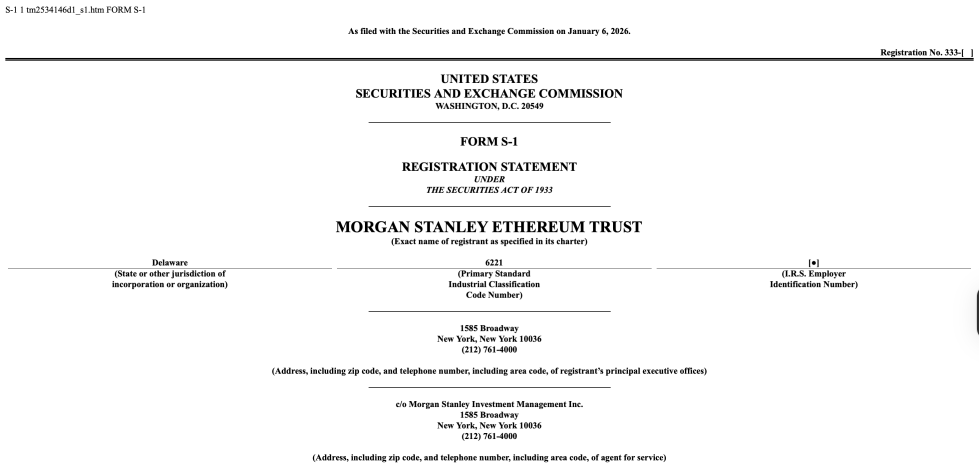
Morgan Stanley files S-1 form for Ethereum ETF. Source: sec.gov

Nonetheless, the document doesn’t address key details, such as the exchange on which the fund will be listed, the Trust’s custodian, or the ticker. Morgan Stanley’s Ethereum ETF filing follows recent efforts to launch other investment products based on some of the largest cryptocurrencies by market capitalization.

As reported by Bitcoinst, the Wall Street giant announced that it had submitted preliminary filings for spot Bitcoin (BTC) and Solana (SOL) Trusts on Tuesday, seeking to hold and generate returns by tracking these two cryptocurrencies.

In a January 6 statement, the bank detailed that “Morgan Stanley Bitcoin Trust and Morgan Stanley Solana Trust are pending regulatory approval and would be passive investment vehicles that seek to track the performance of the price of the relevant cryptocurrency.”

Similar to its submitted Ethereum ETF, the Solana fund will include an allocation for staking, and plans to engage one or more third-party staking service providers to conduct these activities.

A Broader Crypto Push

Notably, Morgan Stanley’s crypto ETF move is part of a broader shift toward a more welcoming approach that expands the presence of traditional institutions in the digital assets industry.

This pivot follows US regulatory efforts led by the Trump administration to turn the country into the “crypto capital of the world.” Amid this major push, the SEC has published new generic listing standards for crypto-based ETFs, which have seen a successful run since their initial launch nearly two years ago.

In 2024, Morgan Stanley, which had built one of the most significant Bitcoin ETF holdings in the US, allowed its managers to offer the products as an investment option for its wealthy customers. This enabled access to individuals with a minimum of $1.5 million in assets and an aggressive risk tolerance.

In October 2025, it expanded its access to crypto fund investments for all clients, including those with retirement accounts, moving away from its previous customer restrictions. The shift allowed its financial advisors to present crypto funds to any client.

It also announced last year that it would enable trading of the largest cryptocurrencies, Bitcoin, Ethereum, and Solana, through its E-Trade subsidiary.
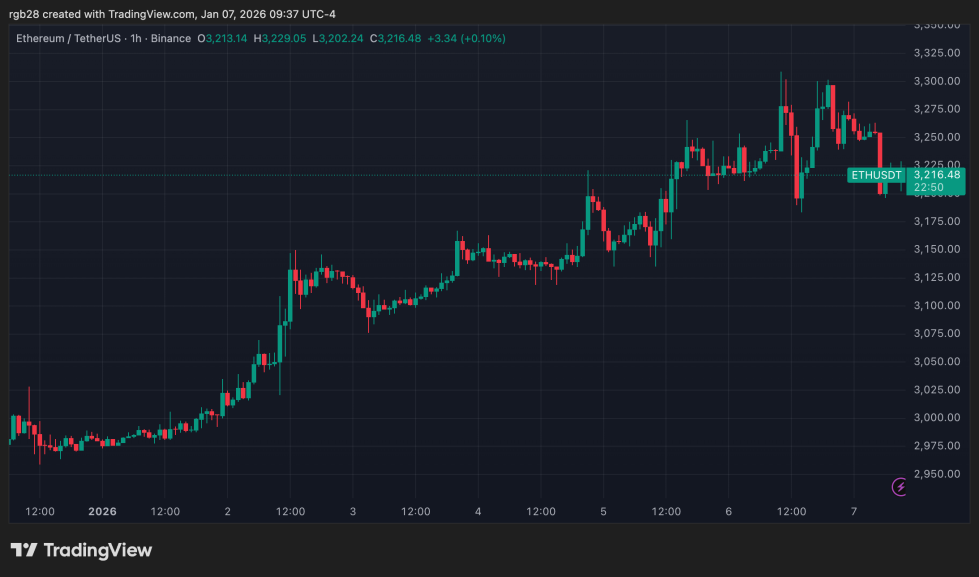
Ethereum trades at $3,216 in the one-week chart. Source: ETHUSDT on TradingView


Preguntas relacionadas

QWhat type of financial product has Morgan Stanley filed for with the SEC, and which cryptocurrency does it track?

AMorgan Stanley has filed an S-1 form for a Morgan Stanley Ethereum Trust, an Exchange-Traded Fund (ETF) that seeks to generate returns by tracking the price of Ethereum (ETH).

QBeyond price tracking, what additional feature does the proposed Morgan Stanley Ethereum Trust include to generate returns?

AThe Trust also aims to reflect rewards from staking a portion of its ether holdings, and it plans to engage one or more Staking Services Providers to conduct these staking activities.

QBesides an Ethereum ETF, what other two cryptocurrency-based investment products did Morgan Stanley file for on the same day?

AOn the same day, Morgan Stanley also submitted preliminary filings for a spot Bitcoin (BTC) Trust and a Solana (SOL) Trust.

QHow has Morgan Stanley's policy on offering crypto investments to its clients evolved since 2024?

AIn 2024, it allowed managers to offer Bitcoin ETFs only to wealthy customers with at least $1.5M in assets. By October 2025, it expanded access to crypto funds for all clients, including those with retirement accounts, and allowed financial advisors to present them to any client.

QThrough which subsidiary did Morgan Stanley announce it would enable direct trading of Bitcoin, Ethereum, and Solana?

AMorgan Stanley announced it would enable trading of these major cryptocurrencies through its E-Trade subsidiary.

Lecturas Relacionadas

South Korean Exchanges 'Battle' Regulators, Challenging the Boundaries of Enforcement and Legislation

South Korea's cryptocurrency industry is engaged in a rare, direct confrontation with regulators. The Financial Intelligence Unit (FIU), the primary anti-money laundering (AML) watchdog, has recently imposed heavy penalties on major exchanges like Upbit and Bithumb for alleged violations involving unregistered overseas VASPs and AML procedures. However, exchanges are now actively challenging these actions in court and through industry associations. In a significant shift, the Seoul Administrative Court ruled in favor of Upbit's operator, Dunamu, overturning part of an FIU-ordered business suspension. The court found the FIU's penalty criteria and justification insufficiently clear. Similarly, the court suspended the enforcement of a six-month business suspension against Bithumb pending a final ruling, citing potential irreversible harm to the exchange. Beyond legal battles, the industry is contesting proposed legislative amendments. The Digital Asset eXchange Alliance (DAXA) strongly opposes a draft rule that would mandate Suspicious Transaction Reports (STRs) for all crypto transfers over 10 million KRW (~$6,800). DAXA argues this "poison pill" clause violates legal principles and would overwhelm the STR system, increasing reports from 63,000 to an estimated 5.45 million annually for major exchanges, thereby crippling effective AML monitoring. This conflict highlights a structural tension in South Korea's crypto governance: comprehensive digital asset laws are still developing, while regulators rely heavily on AML enforcement. The industry's move from passive compliance to active legal and legislative challenges signifies a new phase, pressing for clearer rules and more proportionate enforcement. While short-term disputes may intensify, this clash could ultimately lead to a more mature and sustainable regulatory framework for South Korea's vibrant crypto market.

marsbitHace 44 min(s)

South Korean Exchanges 'Battle' Regulators, Challenging the Boundaries of Enforcement and Legislation

marsbitHace 44 min(s)

After 50x Storage Surge, Justin Sun Always Looks to the Next Decade

Sun Yuchen, known for his controversial stunts like a $30 million lunch with Warren Buffett (canceled due to a kidney stone) and eating a $6.2 million duct-taped banana, is often overshadowed by a significant fact: his decade-long track record of spotting major investment trends. In 2016, he famously advised young people to invest in Bitcoin, Nvidia, Tesla, and Tencent instead of buying property. A hypothetical $20,000 investment in Nvidia and Tesla from that list would now be worth over 50 million RMB. His latest major call was on November 6, 2025, predicting a "50x storage opportunity" tied to the AI boom, which materialized with Sandisk's stock surging nearly 50-fold by 2026. Looking ahead, Sun now focuses on the next frontier: Physical AI. He identifies four key areas: 1. **Embodied AI/Robotics**: He sees this reaching its "iPhone moment," with companies like UBTech and Galaxy General leading in commercialization. 2. **Drones**: Viewed as the first commercially viable form of Physical AI, revolutionizing sectors from warfare (e.g., AeroVironment's Switchblade) to logistics. 3. **Spatial Computing**: Beyond VR, it's about AI understanding physical space, a foundational technology for robotics and autonomous systems, exemplified by Apple's Vision Pro. 4. **Space Exploration**: After a 2025 suborbital flight with Blue Origin, Sun advocates for space as the ultimate frontier, discussing blockchain's potential role in space asset management and data transactions. His investment philosophy involves betting on entire, inevitable trends rather than single companies. For robotics, he sees Tesla (the body/manufacturer) and Nvidia (the brain/AI platform) as complementary plays. In defense drones, he highlights companies making tanks obsolete (AeroVironment) and those augmenting fighter jets (Kratos). For space, he participated in Blue Origin's flight and anticipates SpaceX's potential IPO to redefine the sector's valuation. Sun Yuchen's vision frames the next two decades not as a revolution in information flow (like the internet), but in the fundamental operation of the physical world through AI-powered robots, autonomous systems, and spatial intelligence, ultimately extending human and AI activity into space. While many still focus on conventional assets, he continues to look toward the next technological horizon.

marsbitHace 1 hora(s)

After 50x Storage Surge, Justin Sun Always Looks to the Next Decade

marsbitHace 1 hora(s)

The Billionaires Behind the Most Expensive Midterm Election in History

"The Most Expensive Midterm Elections and Their Billionaire Backers" This analysis details the unprecedented scale of spending in the 2026 midterm elections, highlighting the key billionaire donors shaping the political landscape. Jeff Yass, founder of Susquehanna International Group, has contributed over $81 million, ranking third among individual donors behind George Soros ($102.6M) and Elon Musk ($84.8M). Yass is a major donor to Trump's MAGA Inc. and supports school choice and various candidates. Overall, federal committees have raised over $4.7 billion this cycle, with political ad spending projected to reach $10.8 billion. Republican-aligned groups are significantly out-raising their Democratic counterparts. "Dark money" from undisclosed sources continues to grow. The core stakes involve control of Congress and policy direction for Trump's final term. Donors are also motivated by specific issues: Sergey Brin and Chris Larsen are funding opposition to a proposed California wealth tax and supporting crypto-friendly policies. Other top donors include OpenAI's Greg Brockman and his wife Anna ($50M total to MAGA Inc. and an AI-focused PAC), Richard Uihlein ($45.3M to conservative causes), venture capitalists Marc Andreessen and Ben Horowitz (each over $44M to crypto/AI PACs and MAGA Inc.), Miriam Adelson ($42.6M to GOP leadership PACs), Paul Singer ($33.9M), and Diane Hendricks ($25.8M to MAGA Inc.). The article notes that the peak fundraising period is still ahead, with major primaries approaching.

marsbitHace 1 hora(s)

The Billionaires Behind the Most Expensive Midterm Election in History

marsbitHace 1 hora(s)

The Largest IPO in History Is Approaching, Surpassing SpaceX, 28 Years of AI Self-Iteration, Countdown to Intelligence Explosion

"Anthropic Nears Trillion-Dollar IPO, Fueled by Explosive Growth and 2028 'Intelligence Explosion' Warning Anthropic is considering a deal valuing the AI company near $1 trillion, potentially leading to one of the largest IPOs ever and surpassing SpaceX. Its revenue has skyrocketed, with Annual Recurring Revenue (ARR) reaching $45 billion in May 2026—a 500% increase in just five months. This vertical growth curve is attributed to its key products, Claude Code and Cowork, dominating AI coding and enterprise collaboration. Beyond commercial success, co-founder Jack Clark issued a pivotal warning in an interview: there is a greater than 50% chance that by the end of 2028, AI systems will achieve recursive self-improvement—the ability to autonomously build a 'better version' of themselves, initiating an 'intelligence explosion.' This prophecy underpins the company's astronomical valuation, as the market prices in the potential for transformative and disruptive AI. Further signaling its ambition, Anthropic formed a $1.5 billion joint venture with Goldman Sachs and Blackstone, aiming to disrupt traditional consulting firms like McKinsey by deploying Claude AI for complex strategic work. This move tests AI's capacity to replace high-level cognitive labor, a precursor to its predicted autonomous evolution. The narrative presents a dual future: unprecedented economic opportunity alongside significant risks like economic restructuring and security threats. Anthropic's meteoric rise and Clark's 2028 prediction frame the coming years as a countdown to a potential technological singularity."

marsbitHace 1 hora(s)

The Largest IPO in History Is Approaching, Surpassing SpaceX, 28 Years of AI Self-Iteration, Countdown to Intelligence Explosion

marsbitHace 1 hora(s)

Trading

Spot
Futuros

Artículos destacados

Cómo comprar PUSH

¡Bienvenido a HTX.com! Hemos hecho que comprar Push Protocol (PUSH) sea simple y conveniente. Sigue nuestra guía paso a paso para iniciar tu viaje de criptos.Paso 1: crea tu cuenta HTXUtiliza tu correo electrónico o número de teléfono para registrarte y obtener una cuenta gratuita en HTX. Experimenta un proceso de registro sin complicaciones y desbloquea todas las funciones.Obtener mi cuentaPaso 2: ve a Comprar cripto y elige tu método de pagoTarjeta de crédito/débito: usa tu Visa o Mastercard para comprar Push Protocol (PUSH) al instante.Saldo: utiliza fondos del saldo de tu cuenta HTX para tradear sin problemas.Terceros: hemos agregado métodos de pago populares como Google Pay y Apple Pay para mejorar la comodidad.P2P: tradear directamente con otros usuarios en HTX.Over-the-Counter (OTC): ofrecemos servicios personalizados y tipos de cambio competitivos para los traders.Paso 3: guarda tu Push Protocol (PUSH)Después de comprar tu Push Protocol (PUSH), guárdalo en tu cuenta HTX. Alternativamente, puedes enviarlo a otro lugar mediante transferencia blockchain o utilizarlo para tradear otras criptomonedas.Paso 4: tradear Push Protocol (PUSH)Tradear fácilmente con Push Protocol (PUSH) en HTX's mercado spot. Simplemente accede a tu cuenta, selecciona tu par de trading, ejecuta tus trades y monitorea en tiempo real. Ofrecemos una experiencia fácil de usar tanto para principiantes como para traders experimentados.

198 Vistas totalesPublicado en 2024.12.13Actualizado en 2025.03.21

Cómo comprar PUSH

Discusiones

Bienvenido a la comunidad de HTX. Aquí puedes mantenerte informado sobre los últimos desarrollos de la plataforma y acceder a análisis profesionales del mercado. A continuación se presentan las opiniones de los usuarios sobre el precio de PUSH (PUSH).

活动图片












