Morgan Stanley Confirms Bitcoin Push: Trading, Yield, Custody

bitcoinistPublicado a 2026-02-26Actualizado a 2026-02-26

Resumen

Morgan Stanley is expanding its Bitcoin and crypto services beyond basic access, as confirmed by Amy Oldenburg, Head of Digital Asset Strategy. The roadmap includes enabling spot trading for E*TRADE clients via a partnership, with plans to develop an in-house custody and exchange solution within a year. This move aims to position Morgan Stanley as the first major bank to offer such integrated services, emphasizing control, trust, and liability management. The bank is also exploring yield and lending products backed by Bitcoin, responding to client demand and the growth of off-platform crypto assets. Oldenburg highlighted the institutionalization of crypto and cited the bank's previous classification of Bitcoin as "digital gold," recommending a 2%–4% portfolio allocation.

Morgan Stanley is preparing to expand its Bitcoin and crypto offering beyond simple access, with plans that span spot trading on E*TRADE, a longer-term move toward native custody and an internal exchange stack, and early-stage exploration of yield and lending services backed by Bitcoin.

The roadmap was outlined onstage at Strategy World 2026 in Las Vegas by Amy Oldenburg, Morgan Stanley’s head of digital asset strategy, during a discussion with Strategy President and CEO Phong Le at the Bitcoin for Corporations conference.

From ‘Renting’ Bitcoin Rails To Building Them

Oldenburg framed Morgan Stanley’s near-term step as enabling E*TRADE clients to “buy and sell crypto, spot crypto,” via a partnership, before potentially moving to “a native custody and exchange solution” over the next year. She suggested that would put Morgan Stanley in position to be “the first major bank” to offer that combination in-house.

Oldenburg asked why the custody-and-exchange layer matters strategically. The answer, she said, comes down to control, trust, and liability. “It’s a natural. We really need to build this out internally. We can’t just primarily rent the technology to do this,” she said. “People expect Morgan Stanley, they trust our brand, to be no-fail. And when you sit in that position, you have a significant responsibility to your clients to make sure that you’re delivering that in any level of technology.”

For Morgan Stanley, custody is not just another feature in the product checklist, it changes the bank’s role and responsibility. “It’s a totally different environment to know that you are custodying your assets,” Oldenburg continued. “You have legal custody with Morgan Stanley, and Morgan Stanley is overseeing those assets for you. There’s always those that are going to want to self-custody. That’s a natural part of this space, especially in the Bitcoin space.”

Oldenburg also positioned the push as a response to client behavior: crypto wealth exists, but not necessarily where Morgan Stanley can serve it. With “$8 trillion in assets on platform,” Le pressed the commercial logic that “people have crypto assets off platform.” Oldenburg agreed and characterized the pool as material, saying it is “a considerable number” of “current clients.”

Oldenburg linked her thinking on adoption back to her prior career running Morgan Stanley’s emerging markets investing business, arguing she has watched Bitcoin and crypto usage develop up close for years. “This has been a very, very long journey for me, being on the ground with many of these companies and investors and users of cryptocurrencies early on,” she said, adding that the goal now is to provide services as crypto “continues to mainstream and institutionalize.”

Oldenburg confirmed that yield and lending against Bitcoin are not theoretical topics inside the firm. Asked directly whether Morgan Stanley might offer “yield and lending services against that Bitcoin,” she replied: “Absolutely. That’s part of the discussion and the exploration. It’s a natural part of the roadmap to continue to explore.”

She added that the bank is still early in designing those products, while noting renewed activity in onchain credit markets. “I think we’re in a very early journey on that, just in terms of the number of products that are out in the market,” she said. “I think we’ve seen, even this year, a little bit surprised at how much momentum there is around DeFi lending.”

In October last year, Morgan Stanley classified Bitcoin as “digital gold,” citing its fixed supply, decentralized architecture, and perceived role as a hedge against macroeconomic instability. The firm also recommended a 2%–4% allocation to digital assets.

At press time, Bitcoin traded at $68,138.
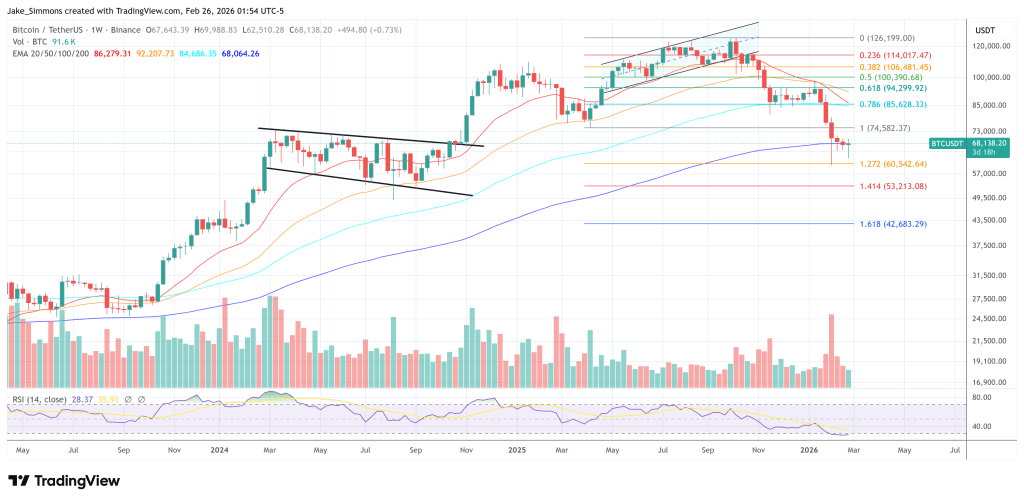
Bitcoin must remain above the 200-week EMA, 1-week chart | Source: BTCUSDT on TradingView.com

Preguntas relacionadas

QWhat are the key areas of Bitcoin and crypto services that Morgan Stanley is planning to expand into?

AMorgan Stanley is planning to expand into spot trading via E*TRADE, develop a native custody and exchange solution, and explore yield and lending services backed by Bitcoin.

QAccording to Amy Oldenburg, why is building a native custody and exchange solution strategically important for Morgan Stanley?

ABuilding a native custody and exchange solution is strategically important due to control, trust, and liability. It ensures the bank can deliver no-fail technology that aligns with client expectations and the Morgan Stanley brand.

QWhat client behavior did Amy Oldenburg cite as a key reason for Morgan Stanley's expanded crypto offerings?

AShe cited that clients hold significant crypto wealth 'off platform,' which represents a material pool of assets from current clients that Morgan Stanley currently cannot serve.

QBeyond trading and custody, what other Bitcoin-based financial products is Morgan Stanley exploring?

AMorgan Stanley is in the early stages of exploring yield and lending services that are backed by Bitcoin.

QHow did Morgan Stanley classify Bitcoin in a report from October of the previous year, and what allocation did they recommend?

AIn October of the previous year, Morgan Stanley classified Bitcoin as 'digital gold' and recommended a 2%–4% allocation to digital assets.

Lecturas Relacionadas

Anthropic Starts Poaching Scientists? $27K Weekly Onsite Stipend to Fix Claude's Expert-Level Errors

Anthropic has launched a new STEM Fellow program, offering $3,800 per week for a three-month, in-person residency in San Francisco. The role targets experts from science, technology, engineering, and mathematics (STEM) fields—machine learning experience is helpful but not required. Instead, Anthropic values scientific judgment and a willingness to learn quickly. Fellows will work with Claude models and internal tools under the guidance of an Anthropic researcher. Example projects include a materials scientist identifying errors in Claude’s reasoning or a climate scientist integrating atmospheric modeling software with Claude. The goal is to have experts "tell Claude where it's wrong" and improve its scientific capabilities. This initiative is part of Anthropic’s broader strategy to strengthen its scientific ecosystem, following earlier programs like the AI Safety Fellows and AI for Science programs. The company acknowledges that current AI models, while powerful, still produce high-confidence errors and lack end-to-end research autonomy. The program aims to embed domain expertise directly into model development, turning scientists into "high-level reviewers" for AI. Anthropic CEO Dario Amodei has previously emphasized AI’s potential to accelerate scientific breakthroughs, particularly in biology and healthcare. The company believes that the next phase of AI competition will depend not on scaling parameters, but on integrating human expertise to refine model accuracy and reliability.

marsbitHace 32 min(s)

Anthropic Starts Poaching Scientists? $27K Weekly Onsite Stipend to Fix Claude's Expert-Level Errors

marsbitHace 32 min(s)

On the Eve of X Money's Launch, Musk Dismantles the Referee First

"X Money Launches After Dismantling Regulator: Musk's 9-Day Power Play" In February 2025, a team from the "Department of Government Efficiency" (DOGE), led by Elon Musk, entered the Consumer Financial Protection Bureau (CFPB) headquarters. Shortly after, the CFPB was effectively dismantled—its funding frozen, activities suspended, and nearly 90% of staff laid off. This move came just nine days after X announced a partnership with Visa and as X Money prepared to launch. The article contrasts this with the decade-long regulatory battles faced by companies like Coinbase and PayPal. Coinbase spent over $75 million in political contributions and endured a major SEC lawsuit to operate legally. PayPal complied with strict state and federal rules for its stablecoin PYUSD, including 100% reserve requirements and monthly audits. However, Musk’s approach was different. After the CFPB introduced a rule placing large digital payment apps under federal oversight, Musk tweeted "Delete CFPB." Within months, the rule was revoked by Congress. Meanwhile, DOGE operatives gained "god-tier" access to CFPB databases, potentially obtaining sensitive competitive information from rivals like Apple, Google, and PayPal. The article also highlights a "suspicious exemption clause" in the GENIUS Act, which allows private companies like X to issue stablecoins with fewer restrictions. Senator Elizabeth Warren questioned whether Musk, who was a senior presidential advisor during the Act’s drafting, influenced this clause. X Money offers a 6% APY on deposits, despite FDIC warnings that stablecoin users are not insured. As X Money launches to 600 million monthly users, the article questions the fairness of a system where Musk can bypass regulations that others spent years and millions to comply with. The dismantling of the CFPB and the alleged regulatory advantages raise concerns about the future of equitable rule-making in the U.S. financial system.

marsbitHace 40 min(s)

On the Eve of X Money's Launch, Musk Dismantles the Referee First

marsbitHace 40 min(s)

Trading

Spot
Futuros

Artículos destacados

Cómo comprar PUSH

¡Bienvenido a HTX.com! Hemos hecho que comprar Push Protocol (PUSH) sea simple y conveniente. Sigue nuestra guía paso a paso para iniciar tu viaje de criptos.Paso 1: crea tu cuenta HTXUtiliza tu correo electrónico o número de teléfono para registrarte y obtener una cuenta gratuita en HTX. Experimenta un proceso de registro sin complicaciones y desbloquea todas las funciones.Obtener mi cuentaPaso 2: ve a Comprar cripto y elige tu método de pagoTarjeta de crédito/débito: usa tu Visa o Mastercard para comprar Push Protocol (PUSH) al instante.Saldo: utiliza fondos del saldo de tu cuenta HTX para tradear sin problemas.Terceros: hemos agregado métodos de pago populares como Google Pay y Apple Pay para mejorar la comodidad.P2P: tradear directamente con otros usuarios en HTX.Over-the-Counter (OTC): ofrecemos servicios personalizados y tipos de cambio competitivos para los traders.Paso 3: guarda tu Push Protocol (PUSH)Después de comprar tu Push Protocol (PUSH), guárdalo en tu cuenta HTX. Alternativamente, puedes enviarlo a otro lugar mediante transferencia blockchain o utilizarlo para tradear otras criptomonedas.Paso 4: tradear Push Protocol (PUSH)Tradear fácilmente con Push Protocol (PUSH) en HTX's mercado spot. Simplemente accede a tu cuenta, selecciona tu par de trading, ejecuta tus trades y monitorea en tiempo real. Ofrecemos una experiencia fácil de usar tanto para principiantes como para traders experimentados.

192 Vistas totalesPublicado en 2024.12.13Actualizado en 2025.03.21

Cómo comprar PUSH

Discusiones

Bienvenido a la comunidad de HTX. Aquí puedes mantenerte informado sobre los últimos desarrollos de la plataforma y acceder a análisis profesionales del mercado. A continuación se presentan las opiniones de los usuarios sobre el precio de PUSH (PUSH).

活动图片













